
Enclosure Heat Exchangers · Technical Explainer
Cabinet Water Heat Exchangers: Match Flow Demand to Pressure Drop
Quick Answer
Match a cabinet water heat exchanger's required flow to the differential pressure available across its actual branch. Obtain the exact unit's flow-versus-pressure-drop evidence and account for the other components within that boundary. Pump nameplate flow, a single pressure reading, and a maximum permitted pressure do not establish the flow delivered to the exchanger.
For factory utility engineers and equipment thermal designers, the useful purchasing deliverable is a hydraulic evidence budget linked to a flow acceptance record. Both should identify the same equipment, fluid conditions and operating scenario. A cooling proposal remains incomplete if it requires a water flow that the proposed branch has not been shown to supply.
This guide covers the hydraulic interface between an enclosure air-to-water exchanger and the plant water circuit. It does not provide pump calculations, piping instructions, valve settings or a pressure-test procedure. Actual assessment and validation require the responsible qualified team, the selected equipment documents and approved project methods.
Define the Required Flow and Its Operating Context
Start with the water flow associated with the proposed cooling requirement, not with whichever flow value is easiest to find. Ask the exchanger supplier to identify the relevant unit configuration and the conditions behind that requirement. The thermal requirement and hydraulic assessment need to refer to the same proposed operating case.
The fluid and its specified conditions belong in that record. A supplier's pressure-drop curve has an applicable scope; it should not be assumed to represent every coolant or operating condition. Request clarification where the quotation provides a curve without identifying the equipment or conditions to which it applies.
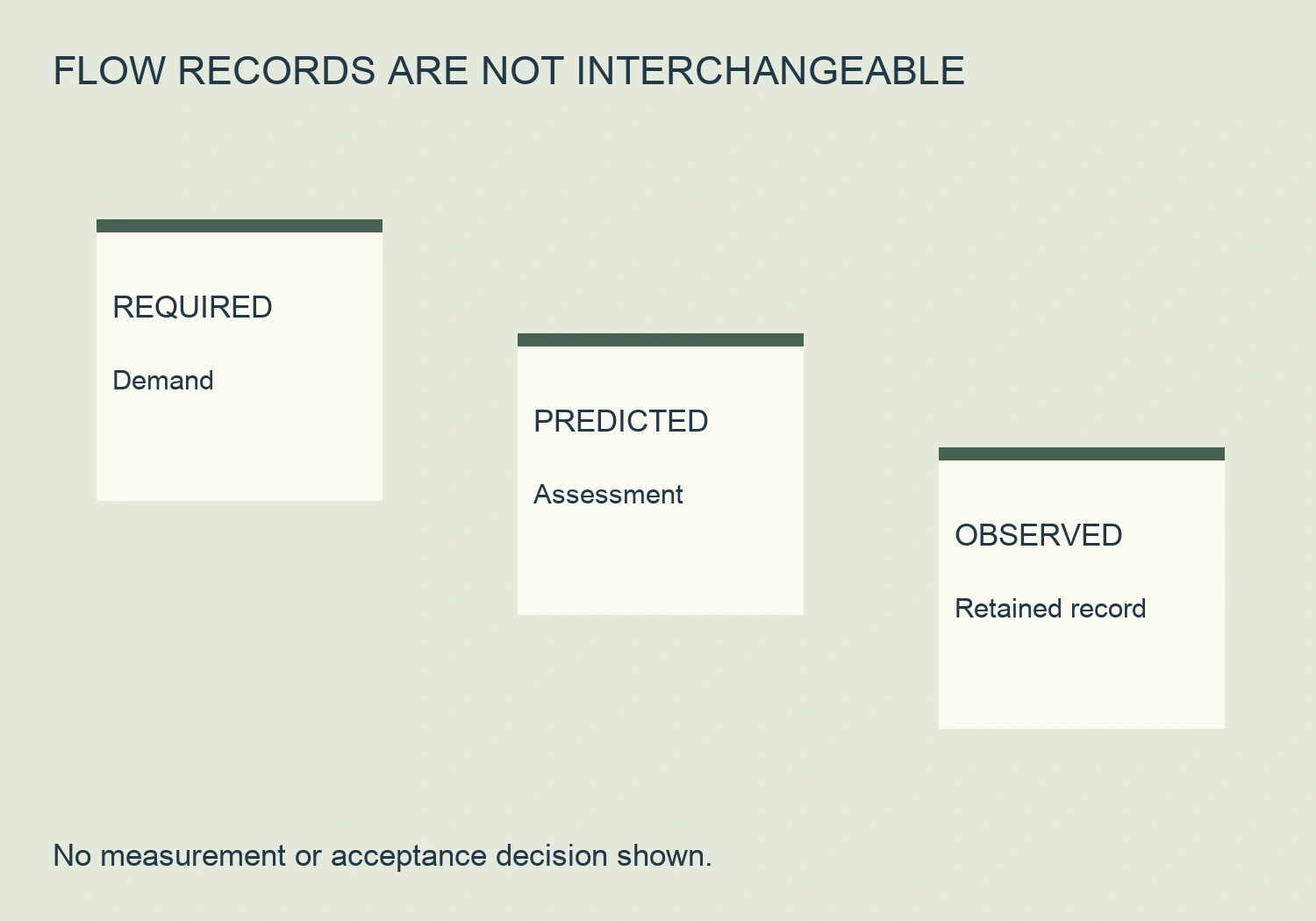
Avoid treating the requested flow as a result already achieved. “Required,” “predicted,” and “observed” describe different evidence stages. A thermal selection can establish a demand for the designer to assess without proving that the connected water system will deliver it. Keeping those stages separate makes the remaining work visible.
This hydraulic question is also different from whether the inlet water and cabinet conditions allow the required cooling performance. That thermal review remains necessary, but it cannot close a missing branch-flow assessment. Conversely, evidence that water can reach the unit does not alone qualify the cooling outcome.
Locate the Supply and Return Boundary
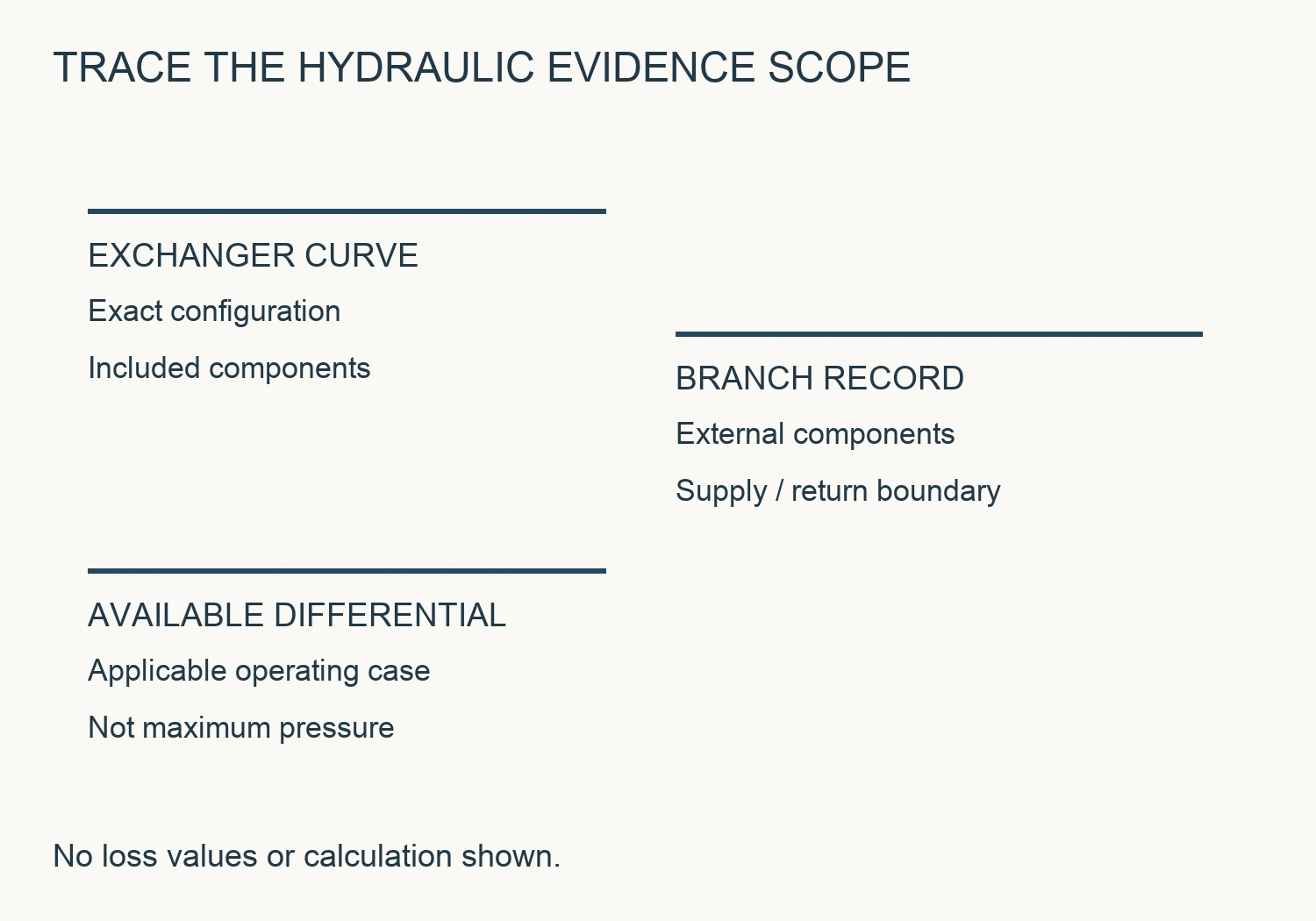
Available differential pressure needs an identified supply point and return point. Those points define the branch being reviewed and the components within it. Without that boundary, two supplier documents can use the same phrase while referring to different parts of the plant circuit.
A pressure at one point is not the pressure difference across the complete proposed branch. Likewise, a maximum permitted pressure identifies an equipment limit, not the differential available to overcome flow resistance. Record these quantities under different names so that a convenient pressure value is not mistaken for the missing hydraulic evidence.
Describe the relevant operating state of the shared system. Other branches, control behavior or supply conditions may affect the case the designer needs to assess. This is a request for actual project information, not an assumption about which pump or control arrangement the factory uses.
The boundary description should be documentary rather than an improvised piping sketch. Ask the responsible team to identify which plant drawing, connection schedule or approved design record governs the review. If the boundary changes during procurement, identify which pressure and loss evidence must be reconsidered.
Obtain the Exact Exchanger Resistance Evidence
Request the flow-versus-pressure-drop information for the exact offered exchanger. It should identify the unit and show what the curve covers. A family name or nominal cooling description is not enough to establish the hydraulic resistance of the ordered configuration.
Rittal's air/water heat exchanger instructions include model-specific graphs relating water resistance to volumetric flow. These graphs illustrate the kind of evidence a designer should request. They are not performance curves for the RITOKS RK 2300 family, and their values must not be transferred to another unit. (Rittal, n.d.)
Clarify whether the supplied curve represents the exchanger alone or a larger unit arrangement. An integrated valve or other internal component may already be within the stated curve boundary. The reviewer should know that scope before adding separate allowances for the same component.
If the supplier cannot establish what a curve includes, preserve that question in the budget. An apparently conservative extra allowance can still produce a misleading record when the same loss is counted twice. The goal is a traceable assessment of the actual path, not a collection of unrelated resistance figures.
Build a Hydraulic Evidence Budget
For cabinet air water heat exchanger flow pressure drop sizing, the budget should connect the required branch flow with applicable resistance evidence and the available differential at the defined boundary. The following original table is a documentation template. It contains no calculated pressure allowance or approved equipment selection.
| Budget item | الأدلة المطلوب تقديمها | Scope question before inclusion |
|---|---|---|
| Required exchanger flow | Supplier's flow requirement for the selected operating case | Does it match the thermal selection being reviewed? |
| Exchanger resistance | Exact configuration's flow-versus-pressure-drop curve | Which internal components and fluid conditions does it cover? |
| Connection piping and fittings | Applicable branch design and loss assessment | Are these components inside the agreed supply/return boundary? |
| Valve and strainer | Selected component evidence and relevant configuration | Are their losses separate or already included in the unit curve? |
| Shared system conditions | Responsible designer's applicable operating case | What other demands or control conditions are represented? |
| Available differential | Evidence between the identified supply and return points | Is it available for this branch under that same operating case? |
Assign a source and revision to each input. A pressure-drop entry without a component identity or applicable condition cannot be confidently reconciled with a later equipment change. If the selected valve or branch layout changes, identify the affected evidence instead of leaving the original budget undisturbed.
The table does not prescribe a calculation method or authorize adding every figure that appears in a supplier folder. The qualified designer determines the applicable hydraulic assessment. The buyer's contribution is to obtain compatible documents, establish their boundaries and expose gaps that prevent that assessment.
Keep equipment limits alongside, but separate from, the budget. A permissible pressure rating remains relevant to equipment suitability, yet it is not a substitute for the branch's operating differential. A document that answers the former question should not be marked as having answered the latter.
Do Not Substitute Pump Nameplate Flow for Branch Flow
A plant pump's flow description does not establish what reaches one enclosure exchanger. The branch is part of an actual hydraulic system with its own resistance and operating conditions. Request the evidence for that path rather than allocating a pump label to the cabinet by assumption.
Grundfos explains a pump duty point through the relationship between the pump characteristic and the system characteristic: their intersection represents the operating point. The actual system conditions affect that relationship. This is a conceptual reason to review the installed system, not a universal curve shape or a branch-flow calculation supplied by this article. (Grundfos, n.d.)
For a shared circuit, ask how the proposed branch is represented in the relevant assessment. A whole-system duty point and an individual branch's delivered flow are different record items. The documentation should establish their relationship for the project rather than assuming that the entire pump flow passes through the exchanger.
Pump control and equipment configuration also need applicable evidence. Do not infer fixed operating behavior from the presence of a pump curve, or propose a speed or valve adjustment to close a documentation gap. Where the operating case remains unknown, record that limitation and identify the team responsible for resolving it.
Distinguish Predicted Flow from Accepted Evidence
The purchasing handover should say whether a flow value is a requirement, a design prediction or a retained observation. These labels prevent an assessment from being presented as a measurement and prevent an observation from being treated as broader approval than its recorded conditions support.
Define acceptance evidence with the responsible team before closing the hydraulic interface. The record should identify the selected unit, branch boundary, relevant system state, applicable method and agreed criteria. This article supplies no test method, numerical threshold or instruction to operate pumps and valves.
| Acceptance-record field | Information to retain | Misinterpretation to avoid |
|---|---|---|
| Equipment and branch identity | Exact exchanger configuration and drawing reference | Assigning evidence from a similar or previous branch |
| Required case | Flow demand and associated thermal selection conditions | Treating an unspecified flow as sufficient for every cooling case |
| Design prediction | Applicable assessment, assumptions and revision | Describing predicted flow as an observed result |
| Retained observation | Approved record, relevant conditions and method reference | Generalizing an observation beyond its documented scope |
| Acceptance decision | Agreed criteria, reviewer and decision limitations | Treating a supplier curve or pump label as project approval |
| Open items and changes | Missing inputs, affected evidence and decision owner | Carrying an earlier conclusion into an altered configuration |
This original register organizes evidence; it does not claim that observations have been collected. The project may have its own controlled format. What matters is that the different evidence stages and their conditions remain identifiable in the handover.
If a later observation differs from the design prediction, retain both with their contexts. The responsible team can determine whether the difference concerns the operating case, documentation or actual configuration. Do not erase the prediction or alter a requirement merely to make the record appear consistent.
A Conditional Purchasing Example
Consider an illustrative enclosure-cooling proposal with a stated water-flow requirement and a referenced plant pump. No site measurement or engineering calculation is implied. The pump information alone leaves unanswered whether the cabinet branch can deliver the required flow.
Suppose the supplier then provides an exchanger resistance curve, but its component scope is unclear. The buyer has obtained useful evidence without completing the budget. The next document question is whether the curve includes the unit's valve, and which external branch components remain outside it. Counting a separate valve entry before resolving that boundary could duplicate part of the evidence.
If the branch design becomes available while the shared-system operating case remains unspecified, another gap still prevents completion. The reviewer needs an applicable available differential between the identified supply and return points. A maximum pressure rating or a single pressure description does not close that gap.
الـ RK 2300 air-to-water enclosure heat exchanger family is a relevant starting point for such a supplier discussion. Request the exact offered configuration, hydraulic curve scope and applicable documentation. Its family listing is not evidence that a particular factory branch delivers the required flow or that the finished cooling arrangement has been accepted.
Prepare a Clear Supplier and Utilities Handover
Connect the exchanger supplier's requirements with the utility designer's branch evidence. The supplier should identify the offered equipment and applicable hydraulic documents; the responsible project team should identify the plant-side operating case and acceptance scope. Neither party should infer missing information from a product title.
When requesting clarification, name the decision that remains open. “Please send pressure data” is less useful than asking for the exact unit's pressure-drop curve, its included components and applicable fluid conditions. Likewise, plant-side evidence should identify the review boundary rather than supplying an unrelated pressure value.
Retain the resolved correspondence with the governing revisions. If the unit configuration, component selection or branch design changes, indicate which part of the hydraulic record needs review. A completed folder is not necessarily a coherent handover; the documents must describe the same proposed arrangement.
الأسئلة الشائعة
Does a pump's rated flow establish the exchanger branch flow?
No. Obtain the applicable system and branch assessment. A pump description does not establish how much flow reaches one branch under the proposed operating conditions.
Is maximum permissible pressure the same as available differential pressure?
No. The equipment limit and the pressure difference available across the defined branch answer different questions. Keep both documented without substituting one for the other.
Should a valve loss always be added to the exchanger curve?
Not automatically. Confirm whether the supplied curve already includes that valve or another internal component. The assessment must cover the actual path without counting an included component twice.
Does meeting the flow requirement prove adequate cooling?
Not alone. Hydraulic delivery and thermal suitability are separate requirements that must correspond to the same operating case. Evidence for one does not replace the other.
Conclusion
Match the exchanger's required flow to the actual branch, its resistance evidence and the available differential at identified supply and return boundaries. Keep static or permissible pressure separate, reconcile component scope before building the budget, and do not substitute pump nameplate flow for delivered branch flow. A useful handover connects the hydraulic evidence budget to an acceptance record that distinguishes requirements, predictions, observations and decisions. That gives suppliers and factory engineers a clear basis for resolving the interface without inventing operating values or treating a family listing as installation approval.
المراجع
- Rittal. (n.d.). Air/water heat exchanger assembly instructions. Official assembly documentation.
- Grundfos. (n.d.). Duty point. Official pump and system characteristic explanation.