
Enclosure Heaters for Control Cabinets · Technical Explainer
PTC Cabinet Heater Startup Current: Check the Control Contact

Quick Answer
Check a PTC cabinet heater's documented cold-start current and duration against the exact control contact's applicable load conditions. Keep startup capability separate from continuous operation and normal switching ratings. Nominal heater output divided by supply voltage does not establish the cold-start profile or prove that a thermostat contact can switch the proposed heater.
For enclosure-heating designers and component buyers, the practical deliverable is a heater-to-contact evidence register. It should identify the offered heater, the controlling device, the electrical load actually being switched and the conditions behind both sets of documents. Missing startup information should remain an open engineering question rather than an assumed compatibility result.
This guide focuses on the control contact's burden during startup. It does not compare heating-element principles, prescribe a heater size, or give wiring and testing instructions. The responsible engineer must assess the exact proposed circuit and equipment using applicable documents and approved project procedures.
Identify the Actual Heater and Switched Load
Begin with the exact offered heater configuration and supply requirement. A family name may describe several options without establishing the startup behavior of the selected unit. Record the order reference and the document revision that supports it before comparing the heater with a control component.
الـ JRQ PTC enclosure heater family provides a natural-convection sourcing route. Its public description does not supply the model-specific cold-start current profile needed to approve a control-contact pairing. Request that evidence for the offered configuration rather than deriving an assumed startup current from a nominal output label.
For a fan-assisted heater, establish the scope of the electrical load being controlled. Ask which heater and fan loads are represented by the supplier's figures and how they relate to the proposed control function. Do not assume that a quoted heater value includes the fan, or that a product description establishes the actual circuit arrangement.
الـ RTX-FHT fan-assisted PTC enclosure heater family is relevant to that documentation discussion. The exact heater and fan current information and applicable control arrangement require confirmation. Features of another supplier's fan heater do not establish the RTX-FHT's wiring, protective functions or startup performance.
Separate Cold-Start Demand from Normal Operation
A startup profile answers a different question from a normal operating-current statement. Obtain the relevant current and time information under the stated initial and supply conditions. The engineer needs to know what demand is being compared, not merely that a data sheet contains a current entry.
STEGO's CSK 060 information illustrates the distinction by listing inrush separately from heating capacity for its configurations. That is a useful documentary example of why a heater's output label does not contain every control-selection input. Its published values belong to those STEGO products, not to the JRQ family. (STEGO, n.d.-a)
STEGO's CS 130 information also provides configuration-specific supply and inrush information for a fan-assisted PTC heater. Use that example to request suitably scoped documents, not to assign its startup demand or protective features to the RTX-FHT. (STEGO, n.d.-b)
Keep a claimed peak attached to its duration and conditions. A current number without the relevant time basis may leave the contact comparison unresolved. Likewise, information for one initial condition should not be assumed to cover the project's required startup condition unless its stated scope supports that use.
The required starting environment belongs in the inquiry. Ask which initial or ambient condition the supplied evidence represents and which condition the project requires. This article supplies no universal PTC multiplier, assumed cold-weather increase or substitute current calculation. Where the manufacturer has not provided the needed profile, record that limitation explicitly.
Read the Control Contact's Rating Conditions
Identify the exact controlling device and the intended contact function. A heating-control requirement should not be assigned to a cooling-control variant merely because both devices share a family listing. The selected contact documentation must also describe the electrical conditions under which its capability is stated.
For the KTO 011/KTS 011 enclosure thermostat family, confirm the intended heating or cooling contact variant and request its actual load-specific switching documents. The public family description does not establish cold-start switching compatibility with either heater family discussed here.
STEGO's KTO 111 documentation provides a different-model example: it separates an inrush capability and duration from ohmic AC, inductive and DC switching conditions. Those distinctions show why a single contact-current label is insufficient. KTO 111 is not KTO 011, and its published ratings must not be used to qualify the RITOKS KTO 011/KTS 011 offering. (STEGO, n.d.-c)
The comparison needs the applicable supply and load category as well as the current and time information. An AC entry does not establish a DC capability, and a load condition described by the manufacturer should not be relabelled to suit the purchasing sheet. If the intended heater load is not covered clearly, ask the relevant supplier or responsible engineer for clarification.
Build a Heater-to-Contact Evidence Register
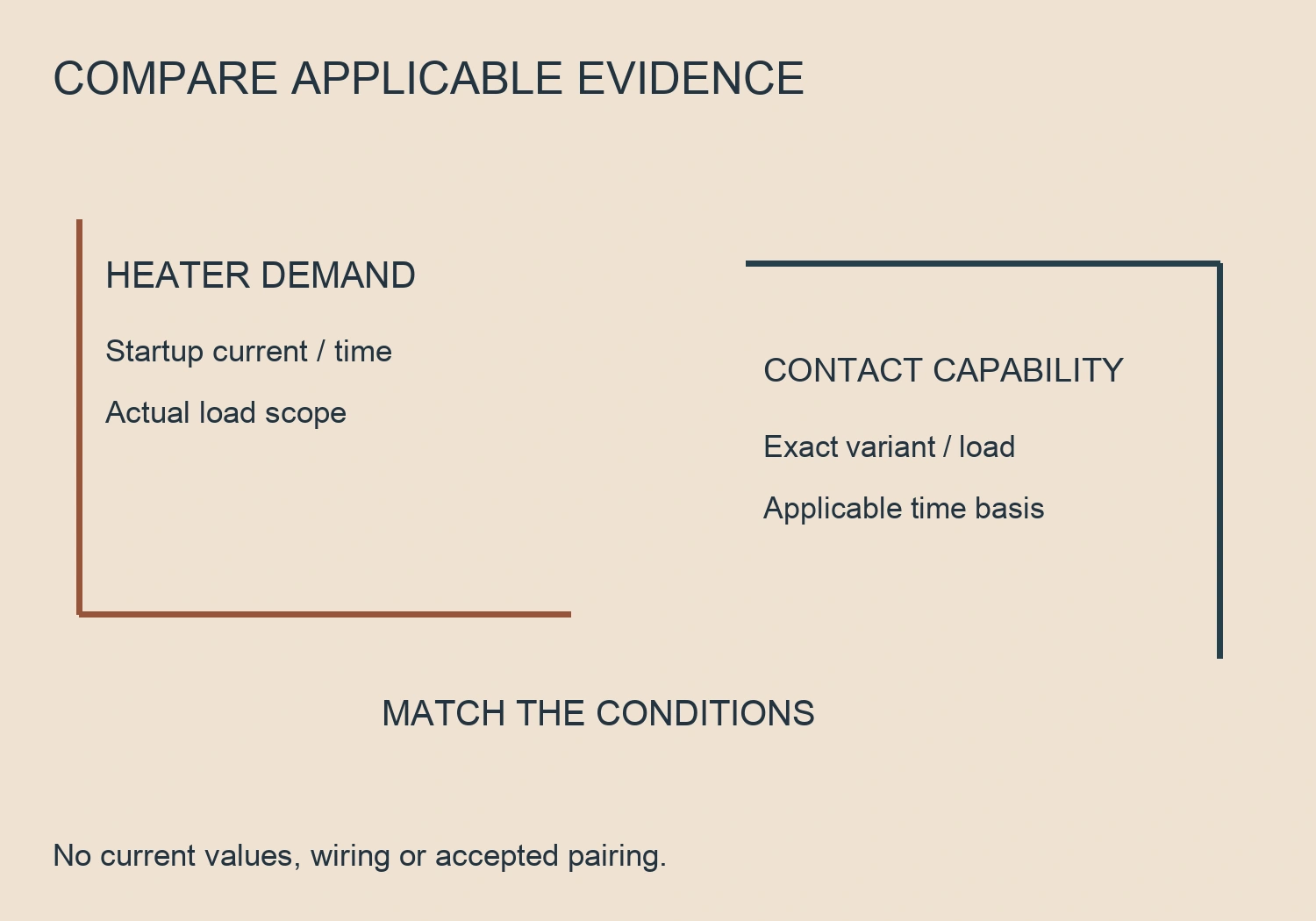
For PTC cabinet heater cold start inrush thermostat contact review, the useful pairing record connects both components to the same intended conditions. The following original table is a documentation framework, not a compatible-products list or an approved electrical design. Populate it for the actual offered configuration.
| دليل | Heater information to retain | Control-contact question |
|---|---|---|
| الهوية الدقيقة | Order reference, supply and applicable document revision | Does the contact evidence cover the selected control variant? |
| Startup condition | Relevant initial conditions and supply assumptions | Are the capability conditions applicable to this startup case? |
| Current and time | Documented cold-start demand and its time basis | Is an applicable making or inrush capability documented for that demand? |
| Normal operation | Applicable operating-load evidence | What continuous and switching conditions apply separately? |
| Load scope | Heater and, where relevant, fan loads represented | Does the contact assessment include the actual controlled load? |
| Decision boundary | Unknown inputs and changed configurations | Who determines compatibility and what remains unresolved? |
Retain the source document behind each entry. A supplier email with an unexplained current figure is less useful than evidence identifying the device, conditions and meaning of the figure. The purchasing team should make those missing details visible rather than assigning them from another model's table.
Do not collapse startup and normal operation into a single “current acceptable” conclusion. The engineer may need different evidence for making the load, carrying it and switching under the applicable conditions. The register helps keep those questions connected without pretending that one nominal rating answers all of them.
If a supplier proposes a substitute heater or thermostat, identify which comparison inputs change. A similar housing, nominal output or familiar family name does not preserve the previous evidence automatically. Record the new device reference and obtain the applicable documents before carrying forward the earlier assessment.
Keep Protection and Contact Suitability Separate
The upstream protective arrangement belongs in the circuit review, but its presence is not proof that the control contact is suitable for the heater's startup demand. Obtain the applicable protection information for the responsible engineer without using it to fill a missing contact-rating field.
Conversely, an applicable contact document does not approve the whole heating circuit. The heater, supply, control function, conductors, protection and enclosure arrangement may have separate relevant requirements. This article addresses the startup evidence at one interface; it does not provide a completed circuit qualification.
Ask the engineer to identify the scope of the retained decision. If the review confirms only that a particular contact document is applicable to an identified load condition, preserve that boundary. Do not expand it into a claim that all installation or protection questions have been settled.
Where the proposed interface is unsupported, the record should identify the unresolved requirement and its owner. This guide does not select an additional switching device, alter a protective setting or suggest an operating workaround. Those decisions require the actual design evidence and responsible engineering authority.
Record Acceptance Without Inventing a Test Result
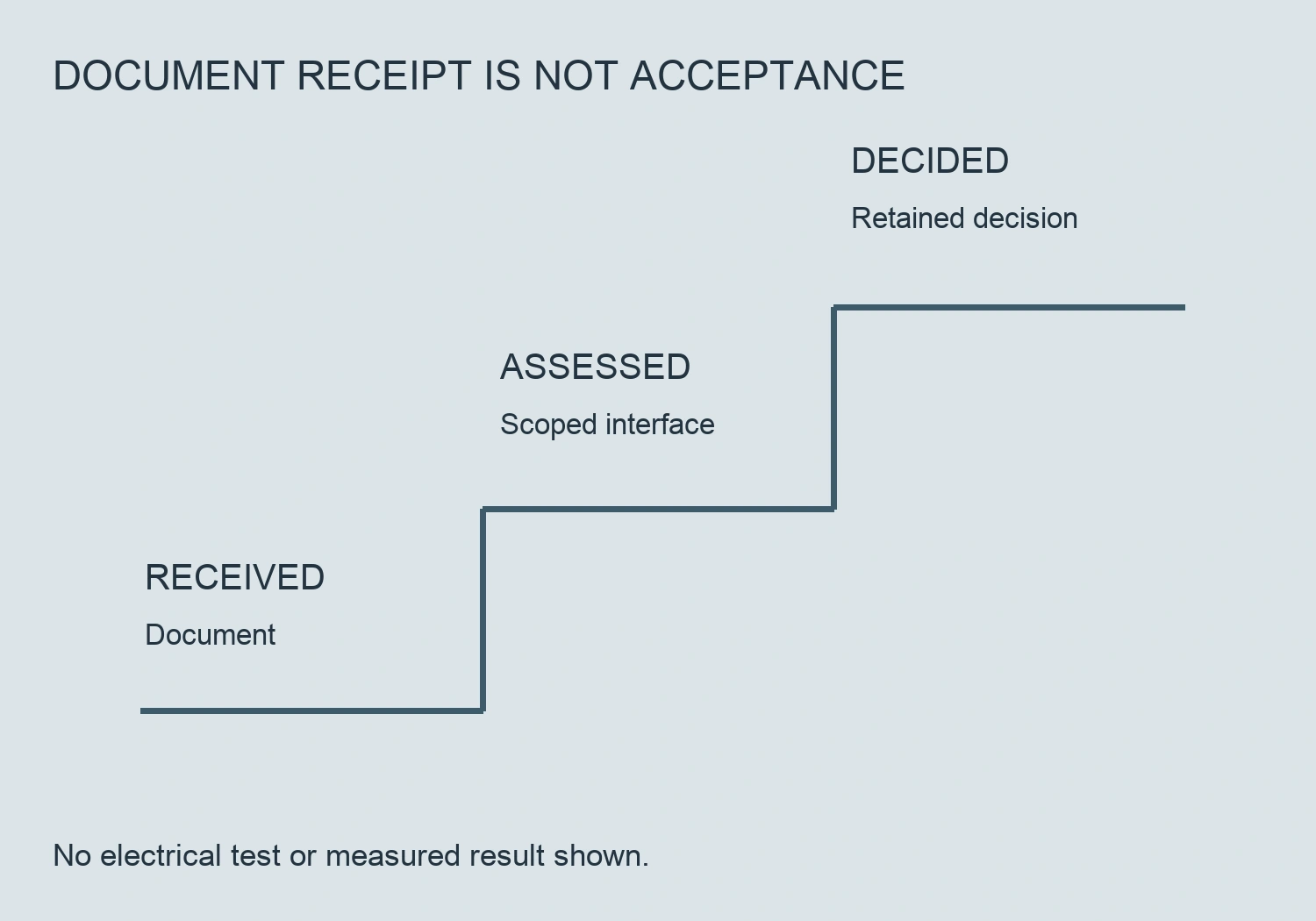
A purchasing package should distinguish requested evidence from received evidence and from an engineering decision. A current-time comparison can be documented without pretending that a startup observation has occurred. If the project requires validation, its method and criteria belong to the authorized team, not to an assumed procedure in a blog.
| Review stage | Record to retain | Conclusion not justified by that record alone |
|---|---|---|
| Requirement defined | Exact load, startup conditions and intended control function | That any listed thermostat can perform the function |
| Heater evidence received | Applicable startup and normal-operation documents | That the selected contact is suitable |
| Contact evidence received | Exact variant and load-specific capability conditions | That every heater condition is covered |
| Interface assessed | Responsible review, evidence used and limitations | Approval of unrelated circuit or installation questions |
| Validation documented, if required | Approved record and conditions actually represented | Universal startup performance outside that scope |
| Configuration changed | Substitutions and affected documents | Automatic continuation of the previous acceptance |
This second original table is a proposed handover aid. It contains no observed current, test duration or pass threshold. The project can use its own controlled format, provided the distinction between document receipt and acceptance remains clear.
Preserve incomplete answers. If a contact supplier confirms normal switching conditions but provides no applicable startup capability, close only the question actually answered. A document package that shows this gap is more useful than an apparently complete sheet built from unsupported assumptions.
A Conditional Procurement Example
Consider an illustrative proposal combining a PTC heater with an enclosure thermostat. The buyer has the heater's nominal output and a general contact-current entry, but no documented cold-start profile or applicable contact time basis. No measurement or installation is implied by this example.
The appropriate record is that both component identities are under review and startup compatibility remains unresolved. Dividing a nominal output by the supply voltage would not produce the missing peak-and-time evidence. Borrowing a different thermostat model's inrush entry would leave the contact side unresolved as well.
Suppose the heater supplier subsequently provides startup information for an identified configuration while the thermostat documents still describe only another load condition. The inquiry has progressed, but the pairing has not become accepted merely because the new information contains a current number. The responsible reviewer must establish that the contact evidence applies to the proposed demand.
If the final proposal changes to a fan-assisted heater, confirm which electrical loads are now included in the control review. That change may affect the earlier evidence scope. The example gives no wiring arrangement, contactor recommendation or test recipe; it illustrates how a purchasing decision follows compatible documents rather than convenient labels.
Prepare the Supplier Inquiry Around the Missing Decision
A precise inquiry identifies the offered heater and contact, the intended control function, the relevant supply and the startup conditions to be assessed. Ask the suppliers for the applicable current-time and load-rating documents rather than requesting a generic assurance that a thermostat is suitable for a PTC heater.
Where heater and fan scope is unclear, state that question explicitly. Where a rating belongs to a different thermostat model, request the exact selected model's evidence. This avoids a folder of technically real documents that do not describe the components being purchased.
Retain the response with its configuration reference and reviewer. If a required answer remains unavailable, preserve that status and its effect on the release decision. A useful handover tells the designer what has been supported and what still prevents acceptance, without fabricating an electrical rating or an installed result.
الأسئلة الشائعة
Can nominal heater output divided by voltage establish cold-start current?
No. It does not supply the documented startup peak, duration or initial conditions needed for this comparison. Obtain the selected heater's applicable startup information rather than describing a derived figure as measured demand.
Is a thermostat's normal current rating enough for the startup review?
Not by itself. Confirm the exact contact variant and its applicable load, supply and startup capability conditions. Keep normal operation, making the load and switching requirements distinguishable in the evidence record.
Can KTO 111 ratings be used for KTO 011/KTS 011?
No. The cited KTO 111 documentation is an example of rating distinctions for a different model. Request evidence for the exact offered KTO 011/KTS 011 configuration before assessing a pairing.
Does adding a fan leave the original load assessment unchanged?
Do not assume that it does. Establish which heater and fan loads are actually within the proposed control scope, and identify which earlier evidence remains applicable. The circuit arrangement requires its own documentation.
Conclusion
PTC heater startup review requires more than nominal output and a convenient thermostat current label. Identify the actual heater and switched load, obtain the relevant cold-start current-time evidence, and compare it with the exact contact's applicable conditions. Keep normal operation, upstream protection and completed circuit approval separate. A traceable pairing register and acceptance record give buyers a clear route to close missing evidence without borrowing another model's rating or claiming a test that has not occurred.
المراجع
- STEGO. (n.d.-a). CSK 060. Official heater information.
- STEGO. (n.d.-b). CS 130. Official fan-heater information.
- STEGO. (n.d.-c). KTO 111. Official thermostat information.