
Power Distribution Components · Technical Explainer
Switching Power Supply Inrush: Checking the Upstream Device
Quick answer
Check a switching power supply's input inrush against the exact upstream protective device and the actual group of supplies that can energize together. Request the inrush waveform or applicable peak and duration data, their test conditions and any manufacturer coordination guidance. A steady input-current figure or DC output rating is not enough.
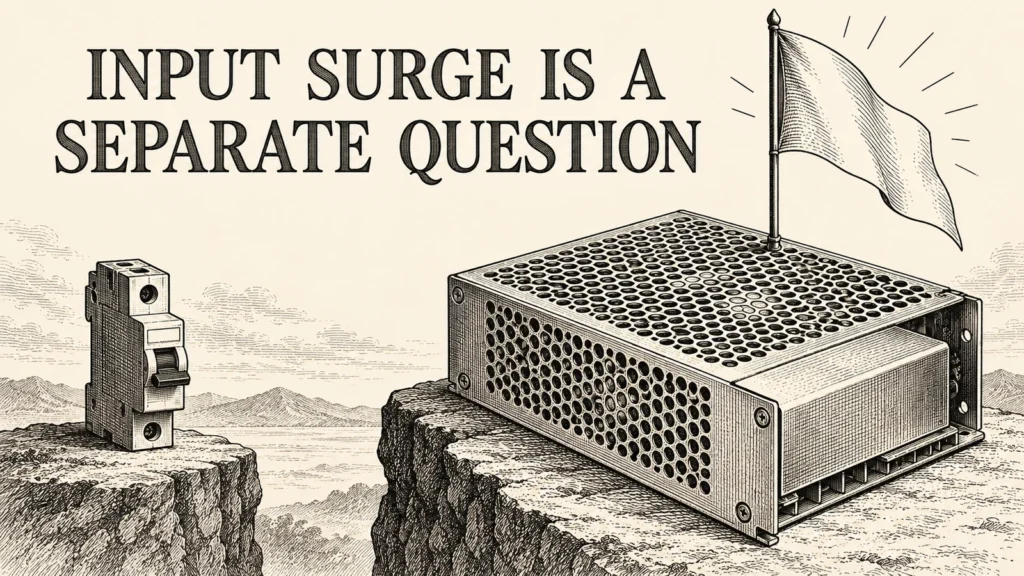
Keep input inrush separate from output overload. A supply can have a short input charging event while operating normally on its output, and output protection data do not establish whether the upstream breaker will tolerate that event. There is no universal breaker multiplier for all switching power supplies.
Before changing an upstream device, review the complete circuit protection requirements as well as unwanted tripping. The appropriate decision should preserve the required conductor and equipment protection, not merely make the initial energization succeed.
Identify which current is being discussed
The current at a power supply's AC input and the current delivered to its DC loads describe different parts of the system. The input also has a transient during energization. A review that mixes these values can produce an inappropriate selection argument.
| Current or characteristic | Relevant documentation | What it does not establish |
|---|---|---|
| Steady input current | Exact supply input data at relevant conditions | Initial charging transient |
| Input inrush | Waveform or peak, duration and conditions | Output-overload behavior |
| DC output current | Load and supply output specification | Permitted upstream breaker arrangement |
| Output protection | Exact overload/short-circuit behavior | Tolerance of the AC input circuit to inrush |
| Upstream trip characteristic | Exact device curve and manufacturer guidance | Complete circuit suitability by itself |
Start the record with the power supply order code and intended input arrangement. Do not copy input data from a different output-power variant or another member of the supplier's range. The inrush-limiting architecture and its documented behavior can differ.
Also identify the actual upstream device. A general description such as “MCB” omits the rating, characteristic and model information needed for a coordination review. Keep the device identity attached to its applicable documentation.

Read the input charging event in its own terms
PULS's official input-inrush FAQ explains that energizing a supply charges its input capacitors and produces an input-current surge. It identifies several limiting methods and notes that inrush associated with an NTC-based limiter can cause protective-device operation. These are general manufacturer explanations, not a statement about RTX-DPS's internal construction or its exact inrush. PULS, What is an input inrush current?.
For the selected supply, ask what is measured, under which input voltage and startup condition, and how the event is represented. A peak without duration or a waveform without its conditions may not answer the protective-device question.
Cold energization and re-energization after a brief interruption should be distinguished when the manufacturer documents them. Whether the output itself rides through that interruption is a separate hold-up time question. Do not assume that every limiting arrangement responds identically in those cases. If the necessary data are missing, record the gap rather than assign a universal hot-restart multiplier.
The power supply's output load state may be part of its startup documentation. Retain any relevant qualification instead of selecting an isolated number from a general specification table. This helps the designer compare like conditions rather than combine unrelated test cases.
Count the supplies that may energize together
List every supply on the upstream circuit and identify which can receive input at the same event. The connected population is not always the same as the group that starts simultaneously. A circuit may have separate switching arrangements or a documented sequence.
Do not take the number of installed supplies and multiply one catalogue peak as if that alone predicts the circuit waveform. The applicable coordination guidance, timing and supply conditions must support the method used. Where the manufacturer supplies an allowed unit count or specific arrangement, check that the actual installation matches it.
Record loss-and-restoration events as well as the normal startup command. A control sequence that staggers initial operation may not cover what happens after an upstream supply disturbance. The approved design needs to identify which event its coordination claim addresses.
An event history can help clarify the symptom. Preserve which protective device operated, when it operated relative to input restoration, which supplies were connected and what else shared the circuit. “The power supply trips the breaker” is an initial report, not proof of the cause.
Use exact protective-device evidence
The upstream review needs the exact protective-device characteristic and any applicable manufacturer instructions. A letter designation alone should not be treated as a complete performance or coordination guarantee. Confirm the installed model and the relevant circuit conditions.
PULS's official QT40.241/QT40.242 installation manual includes model-specific upstream protective-device guidance. That demonstrates why the supply instruction can contain information beyond a generic inrush number. It is not permission to use that guidance for RTX-DPS or for another supply group. PULS, QT40.241/QT40.242 installation manual.
Separate the nuisance-tripping review from the rest of protection selection. The circuit still needs suitable protection for its conductors, installation and connected equipment. Changing the breaker rating or characteristic is not a single-variable adjustment that can be approved merely because startup becomes possible.
Where coordination data depend on a particular device family, retain that identity. A similarly labelled alternative may require its own evaluation. Avoid generalizing a manufacturer's recommendation into a blanket rule that one curve or rating always solves power-supply inrush.
What the RTX-DPS public data leave open
الـ RITOKS RTX-DPS 24V DIN-rail power supply page identifies its published reference and basic input/output data. It directs selection to the control-circuit load, startup demand and installation temperature.
The public page does not identify an exact input-inrush waveform, limiter architecture, hot-restart condition or approved upstream breaker combination. Do not infer those details from its rated output power or input-voltage range.
For an enquiry, provide the exact reference, input supply, number of units sharing the circuit, switching sequence and proposed upstream protection. Request the model-specific inrush data and any applicable coordination documentation. If a short interruption and restart are relevant to the machine, include that condition in the question.
A supplier response should make clear whether it addresses one unit, a group or only a particular tested arrangement. Keep any limitations in the design record. A commercial quotation is not a substitute for evidence that the complete protective arrangement suits the application.
Review symptoms before proposing a larger breaker
Preserve the event record before altering the circuit. Identify whether operation occurs at initial energization, after a supply disturbance or during sustained loading. Review the actual device indication and any available measurement evidence through the qualified investigation process.
Those distinctions help prevent a wrong diagnosis. A repeated event at input restoration may prompt an inrush review, while a different timing pattern may require other investigation. This guide does not diagnose the event solely from its timing or rule out a fault from a successful later start.
Do not use repeated resets as a test method. Any measurement or controlled verification must follow an approved qualified procedure with the necessary equipment state and criteria. The goal is to obtain evidence for the actual circuit, not to expose equipment to undocumented trial-and-error operation.
If a protective-device change is proposed, record the original basis, new selection rationale and affected protection requirements. Where a supply sequence is proposed instead, verify that it covers the relevant restoration events and does not introduce an unsupported dependency. Keep the corrective scope tied to the demonstrated finding.
Use a conditional group-start review example
Consider a fictional control cabinet with several supplies connected to one upstream device. The production report says the device sometimes operates after AC returns. The available design file lists each supply's DC output current but contains no input-inrush conditions or group-start review.
The first conclusion should be that the startup coordination evidence is incomplete. Recover the exact supply and protection data, identify which units energize together and preserve the actual event history. Output-current labels cannot fill the missing input-transient information.
If manufacturer guidance supports the installed combination under the relevant condition, the investigation should examine whether the actual arrangement conforms to that basis. If it does not, a qualified designer can evaluate an appropriate correction while preserving required circuit protection. If essential data remain missing, the combination remains unverified.
This is a document-review example, not a RITOKS field experience or a recommendation for a particular breaker. It supplies no RTX-DPS inrush value and no universal unit count.
Build a coordination evidence sheet
| العنصر قيد المراجعة | Record to retain | تمت الإجابة على السؤال |
|---|---|---|
| Supply identity | Exact references and input arrangement | Which inrush data apply? |
| Energized population | Units and other loads on the circuit | What can energize together? |
| Startup condition | Initial, restoration or documented repeat-start case | Does the evidence cover the event? |
| Inrush evidence | Waveform or qualified peak/duration data | Is the transient sufficiently described? |
| Upstream identity | Exact protective device and applicable data | What response is being compared? |
| Manufacturer guidance | Tested or recommended arrangement and limits | Is a documented combination available? |
| Protection review | Relevant conductor/equipment requirements | Does a proposed change preserve protection? |
| Disposition | Approved basis or specific open item | What can be claimed about the circuit? |
Keep the sheet with the approved circuit drawing and bill of materials. Adding another supply or changing a model can change the evaluated population. A previous startup approval should not silently expand to every later addition.
The record also helps purchasing. It identifies which technical information must accompany a substitute instead of treating nominal output power as the only equivalence criterion. The replacement's own input and coordination conditions need review.

الأسئلة الشائعة
Can the DC output current size the AC breaker by itself?
No. It concerns a different side of the supply. Review exact input data, inrush and complete circuit-protection requirements.
Does a different breaker curve automatically solve inrush?
No universal choice is given here. Use the exact device characteristic and applicable supply coordination guidance, while preserving conductor and equipment protection.
Should multiple catalogue peaks simply be added?
Not as a complete prediction without a supported method. Identify simultaneous energization, relevant conditions and manufacturer group guidance or qualified evaluation.
Does RTX-DPS have published hot-start inrush data here?
The public family page does not establish it. Request the exact model's data and conditions before approving the relevant startup arrangement.
المراجع
- PULS. (n.d.). What is an input inrush current? Official charging-event and limiter explanation. Retrieved October 3, 2026. https://products.pulspower.com/en/faq/input-inrush
- PULS. (2024, May 7). QT40.241/QT40.242 installation manual. PU-374.015.00-xxF (2024-05-07-AY1), model-specific upstream protective-device guidance. Retrieved October 3, 2026. https://products.pulspower.com/sg/mwdownloads/download/link/id/1671/
- RITOKS. (n.d.). RTX-DPS 24V DIN-rail power supplies. Published selection scope, checked October 3, 2026. https://ritoks.com/products/rtx-dps-24v-din-rail-power-supplies/