
Bridge Rectifier Modules · Technical Explainer
Bridge Rectifier Voltage Ratings and System Margin
A bridge rectifier voltage rating has meaning only when it is compared with the reverse voltage that the actual circuit can place across the device. The value printed in a catalog is a limit under defined conditions, not a general allowance for every supply, transient or wiring arrangement. Buyers need a circuit record and an exact module datasheet before they can decide whether a proposed bridge is suitable.
This guide explains how to collect that evidence for an industrial DC supply. It concentrates on reverse-voltage data and system margin. Current, thermal design, mounting and protection still need their own review. No example here assigns a voltage rating to a RITOKS module or approves a specific circuit.
The Short Answer
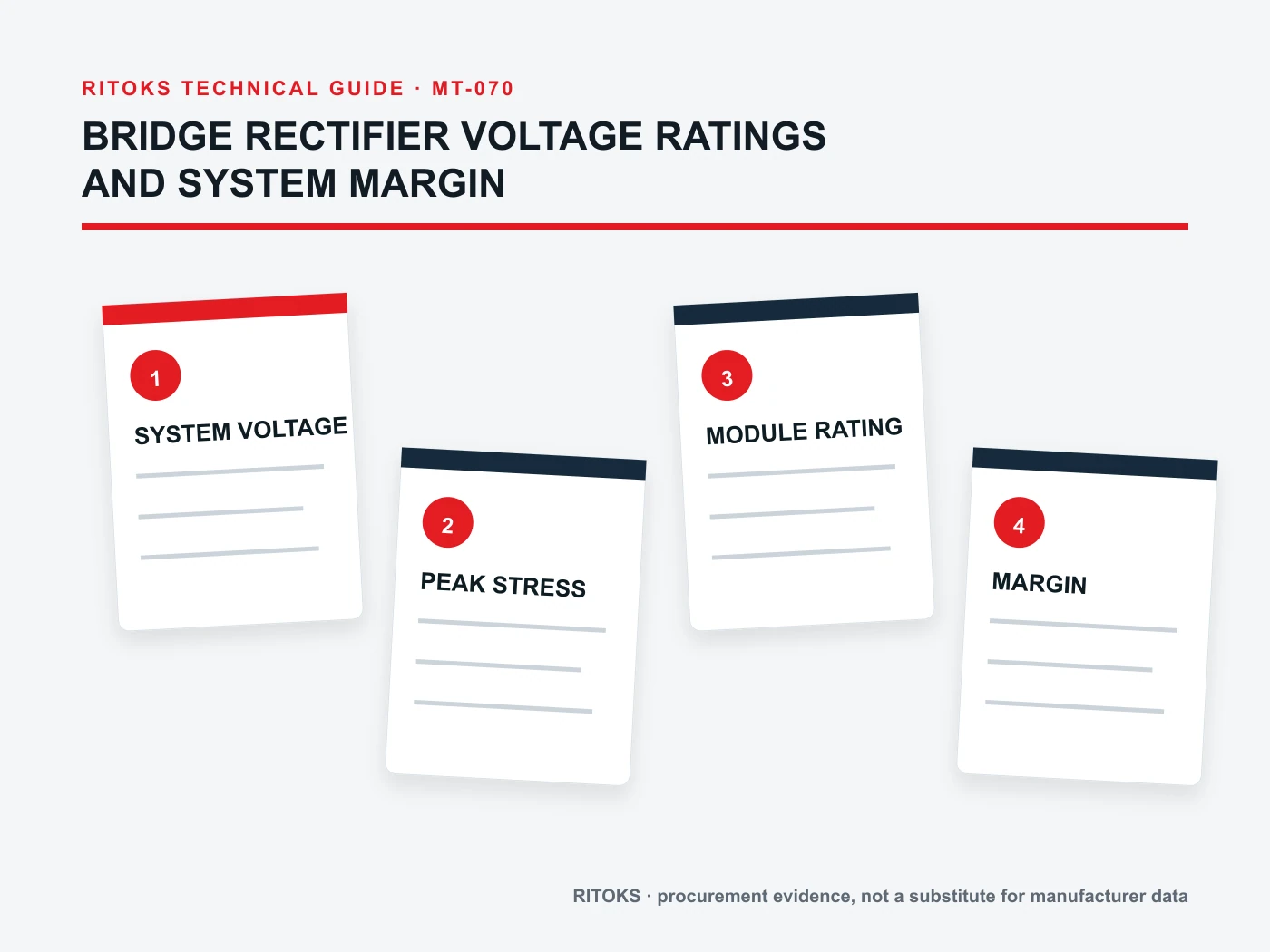
Start with the highest repetitive reverse voltage and credible non-repetitive stresses at the rectifier location. Obtain the exact module's repetitive peak reverse-voltage declaration, its applicable test conditions and any surge or transient limits in the manufacturer document. Compare like quantities, then document the design margin and the protection measures used to maintain it. A nominal AC input or DC output alone cannot complete the comparison.
Define the Circuit Before Reading a Catalog
The source may be a single-phase or three-phase transformer, a mains-fed system, a generator or another AC bus. The bridge may feed a capacitor input, a resistive load, an inverter link or a controlled DC stage. Each arrangement produces a different voltage waveform and different abnormal conditions. Record the source topology, nominal operating range, permitted tolerance, phase arrangement and the location of the rectifier before choosing a module family.
Include the transformer connection, any upstream switching and the way the DC bus is referenced to earth. Ask the design team to identify startup, shutdown, loss-of-phase and fault scenarios that matter at the bridge terminals. A quotation based on an incomplete input description can appear plausible while being evaluated against the wrong maximum stress.
Separate Nominal, Peak and Reverse Voltage
Nominal AC voltage is a convenient system label. It is not the maximum instantaneous voltage across an individual diode. The waveform crest, supply tolerance and circuit state must be considered in the actual topology. A capacitor can retain a bus voltage while the source waveform changes; commutation and switching can add short events that do not appear in a steady-state nameplate value.
When a supplier proposes a bridge, ask which waveform and maximum reverse-voltage calculation supports the selection. The answer should identify the assumptions and the location at which stress is evaluated. Avoid comparing a line-to-line source label directly with a device reverse-voltage rating without the circuit calculation that connects them.
| Pole důkazů | Question for the project team | Document to retain |
|---|---|---|
| střídavý zdroj | What topology, operating range and tolerance reach the bridge? | Approved source and transformer record |
| Bridge connection | Which phase arrangement and terminal scheme apply? | Project schematic and exact module diagram |
| DC-side state | Can stored energy or another source affect reverse stress? | Bus architecture and operating sequence |
| Transient control | Which switching or surge events are credible, and how are they limited? | Protection design and test basis |
| Device limit | Which exact reverse-voltage declaration applies? | Current exact-model datasheet |
Read the Exact Reverse-Voltage Parameter
Datasheets may distinguish repetitive peak reverse voltage from other maximum or test values. Read the symbol, definition and conditions rather than relying on a headline number. Confirm whether the value is declared for the complete module, each internal diode or a specified configuration. The terminal diagram must describe the same order code that appears on the quotation.
Do not transfer a voltage class from a neighboring order code in the same housing. Physical similarity does not establish electrical interchangeability. If a family chart lists several options, circle the quoted row and preserve the revision of the document. Ask the supplier to identify any condition that narrows the rating in the intended application.
Treat Transients as a Separate Design Question
Switching operations, transformer behavior, wiring inductance, upstream disturbances and DC-side events can create voltage excursions. Their existence does not mean a generic safety factor solves the problem. The project engineer should identify relevant events, estimate or measure their effect at the bridge, and specify protection where required. The chosen protection must be part of the review record rather than an assumed accessory.
Ask whether the manufacturer provides application guidance for snubbers, surge suppression or other measures for the exact device and topology. A protective component from one circuit example is not automatically suitable for another. Document the conditions that keep the proposed bridge within its declared limits during both ordinary operation and credible disturbances.
What System Margin Should Mean
Margin is the documented difference between a justified maximum circuit stress and an applicable device limit, interpreted with the manufacturer conditions. It should account for the source range, tolerance, operating states and uncertainty in the stress estimate. It should not be a percentage selected from habit or copied from an unrelated rectifier design.
The review should state who calculated the maximum, which cases were included and what evidence supports the limit. If a proposed module leaves an unacceptably narrow margin, the design team may alter the device class, source, topology or protection plan. Procurement should record the approved choice and its assumptions, not convert the margin discussion into an unsupported catalog claim.
Voltage Rating Does Not Replace Current and Thermal Review
A high reverse-voltage class can still be unsuitable for the waveform, current, cooling or mounting arrangement. Rectifier current depends on the actual conduction waveform and duty, not simply the DC load current printed on a requirement sheet. Capacitor input circuits can produce pulses that need a different evaluation from a smooth current assumption.
Losses, thermal path and interface quality determine operating temperature. Use the exact module's thermal data, the intended heatsink and ambient conditions in a separate calculation. For context, the bridge rectifier modules category shows available product families; it does not substitute for an exact operating-point check.
Check the Internal Connection Diagram
Bridge modules can differ in phase arrangement, terminal sequence and mechanical package. A voltage comparison is invalid if it uses the right rating from the wrong circuit configuration. Request the exact manufacturer terminal diagram and compare it with the approved schematic. Confirm that the quoted assembly exposes the terminals and connection scheme the project expects.
Do not infer terminal identity from a product photograph. Mark any ambiguity for engineering review before an order is approved. The published MDS three-phase bridge family a high-current MDS family are discovery starting points; their individual ratings and diagrams must be confirmed for the quoted variant.
Build an RFQ That Preserves the Voltage Case
Send suppliers the approved source range, phase topology, transformer information, DC bus behavior and the stress cases the design team has evaluated. State the required reverse-voltage class only if it is an approved engineering requirement. Ask the supplier for an exact order code, datasheet revision, connection drawing and any application limits. Separate requested documentation from optional design support.
When several suppliers quote, use the same circuit assumptions for all offers. A module with a larger headline voltage number is not automatically a better fit if its configuration, current capability, thermal interface or availability differs. Record exceptions explicitly, including where a supplier needs more input before confirming suitability.
Compare Exact-Model Evidence
Create a comparison row for each proposed order code. Include the applicable reverse-voltage parameter, test conditions, internal diagram, current data, thermal document and mounting instructions. Put the project stress calculation beside the device data, with document dates. This prevents a family maximum, an unrelated application note and a quoted model from being combined into one unsupported approval.
Ask the supplier to resolve any value that is unclear or missing. An unavailable datasheet is an open item, not a reason to borrow a value from a visually similar bridge. If a substitution arrives after review, repeat the affected voltage, connection and thermal checks for the new exact item before accepting it.
Common Selection Errors
One error is to multiply a nominal source value by a familiar constant and stop, without checking topology, tolerance or switching events. Another is to treat a transient statement as equivalent to continuous repetitive capability. A third is to assume that a rectified DC bus label describes the highest reverse stress of every internal junction.
Buyers also sometimes compare different datasheet symbols as if they were one rating. Keep the parameter names visible in the comparison. If the project requires a design calculation or surge study, assign it to the responsible engineer. The supplier's catalog can supply device limits but cannot validate an unknown installation by itself.
A Practical Approval Record
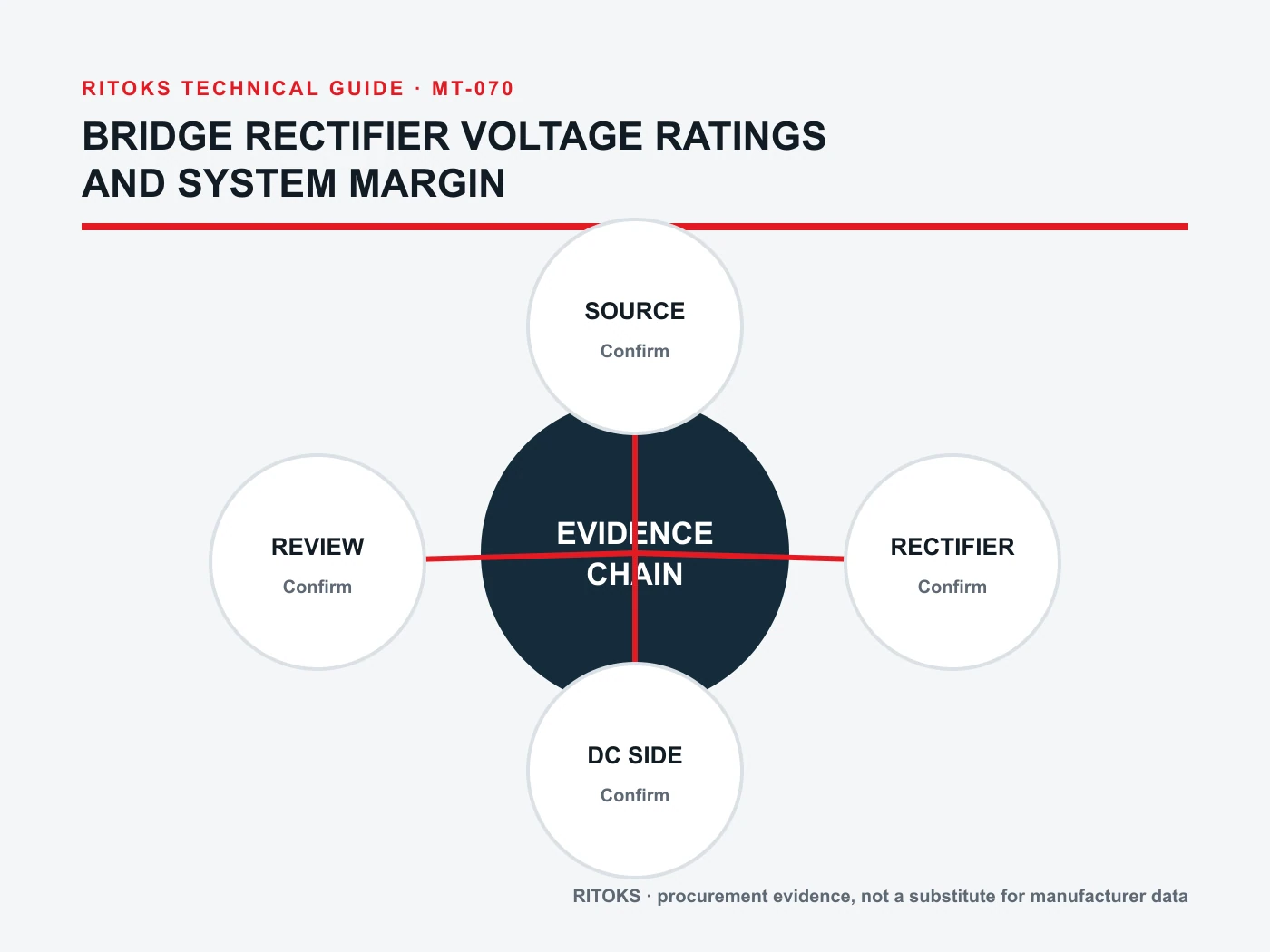
The approval record should name the circuit revision, source range, relevant operating and abnormal cases, calculated maximum reverse stress, protection design, exact rectifier order code and supporting document revisions. Include the owner of each unresolved question. This compact record lets procurement compare offers without stripping away the electrical assumptions on which the decision depends.
When the project changes, revisit only the affected parts of the record, but do not assume the original voltage margin survives a new transformer, capacitor bank, cable layout or control sequence. Retaining the evidence chain makes future maintenance and replacements more reliable than a standalone purchase description.
Questions to Resolve Before Ordering
- What maximum repetitive reverse voltage does the actual topology place across each bridge device?
- Which transient events are credible at the rectifier, and how are they controlled?
- Does the quoted exact order code carry the relevant voltage declaration under the intended conditions?
- Is the connection diagram the one used in the project schematic?
- Have current waveform, cooling and mounting been reviewed separately?
- Who owns any open calculation or documentation item?
Use these questions as a procurement checklist, not a substitute for the design review. If the circuit team and supplier cannot trace the same stress case to the same module document, keep the item open. For an exact quotation, send the circuit context and requested evidence through the Stránka s dotazy k RITOKS.