
Hall Effect Current Sensors for Isolated Measurement · Technical Explainer
Measuring Converter Current Ripple with a Hall Sensor
Quick answer
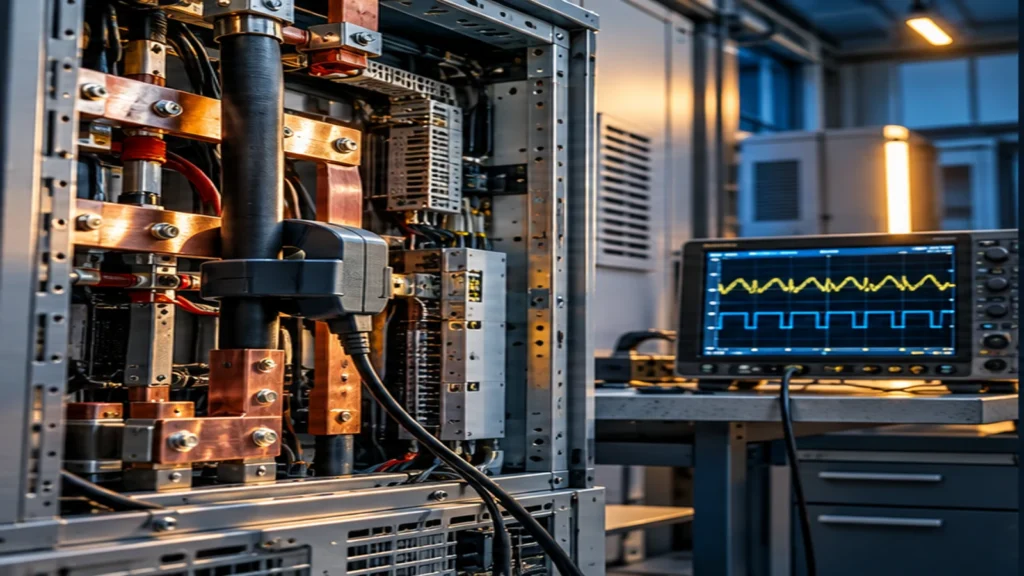
A Hall sensor can be part of converter ripple measurement, but nominal current and DC accuracy do not prove waveform fidelity. Keep sensor response, ADC acquisition and final record update as separate fields. Define whether the buyer needs average current, ripple amplitude, a frequency component or a transient envelope before selecting a chain. For this ripple question, the buyer should identify the target component, analogue response, acquisition path and record definition before accepting a bandwidth statement. A nominal current figure cannot replace a chain-level explanation of what is preserved or intentionally averaged.
Define ripple
Ripple may mean peak-to-peak variation, RMS content in a band, a selected switching component or a difference between averaged readings. Those are different measurements. A control trend may intentionally remove switching variation, while a test report may need to preserve it. State the metric and window before judging a sensor. For this ripple question, the buyer should identify the target component, analogue response, acquisition path and record definition before accepting a bandwidth statement. A nominal current figure cannot replace a chain-level explanation of what is preserved or intentionally averaged.
Nominal accuracy is not bandwidth
An open-loop Hall page can establish output, supply or accuracy conditions around a nominal current. It does not establish frequency response, phase, noise, overload recovery or transient behavior. Request exact model, output reference, temperature, load and response conditions together. For this ripple question, the buyer should identify the target component, analogue response, acquisition path and record definition before accepting a bandwidth statement. A nominal current figure cannot replace a chain-level explanation of what is preserved or intentionally averaged.
Use manufacturer evidence narrowly
Allegro explains why bandwidth matters for fast current variation in a specified PCB sensing discussion. That reasoning is useful, but its package, resistance, isolation and performance do not transfer to HS2V H02. It is not approval of a converter setup or a substitute for the selected datasheet. For this ripple question, the buyer should identify the target component, analogue response, acquisition path and record definition before accepting a bandwidth statement. A nominal current figure cannot replace a chain-level explanation of what is preserved or intentionally averaged.
Separate the three rates
Create columns for sensor response, ADC rate and final record update. A 20 kHz component and a 10 kS/s record are not the same kind of number. A slow historian does not prove the ADC was slow; a fast ADC cannot recover content removed by a sensor or analogue filter. For this ripple question, the buyer should identify the target component, analogue response, acquisition path and record definition before accepting a bandwidth statement. A nominal current figure cannot replace a chain-level explanation of what is preserved or intentionally averaged.

Filtering and aliasing
Filtering can be correct for average-current control and wrong for ripple reporting. Downsampling also needs an anti-alias decision. An Analog Devices motor-control example distinguishes averaged feedback from switching content; its numeric settings belong to that design, not to HS2V or a universal rule. Record filter, window and decimation conditions. For this ripple question, the buyer should identify the target component, analogue response, acquisition path and record definition before accepting a bandwidth statement. A nominal current figure cannot replace a chain-level explanation of what is preserved or intentionally averaged.
Hypothetical arithmetic
For illustration only, a 20 kHz component with a 10 kS/s final record has a simple Nyquist frequency of 5 kHz, so the component lies above that limit. This does not recommend a rate, prove suppression or establish HS2V performance. It only shows why final record rate alone cannot prove ripple capture. For this ripple question, the buyer should identify the target component, analogue response, acquisition path and record definition before accepting a bandwidth statement. A nominal current figure cannot replace a chain-level explanation of what is preserved or intentionally averaged.
Ripple-chain register
Record current path, sensor and revision, reference output, envelope, response conditions, converter state, target metric, conditioning, overload, ADC, anti-aliasing, decimation, time window, clock, noise, offset, raw retention and reference method. Unknown fields remain supplier requests. For this ripple question, the buyer should identify the target component, analogue response, acquisition path and record definition before accepting a bandwidth statement. A nominal current figure cannot replace a chain-level explanation of what is preserved or intentionally averaged.
Average versus waveform
A stable display and a waveform capture can both be correct for different tasks. State whether the value serves a slow alarm, control feedback, stress analysis or report. Do not call a filtered update raw data. For this ripple question, the buyer should identify the target component, analogue response, acquisition path and record definition before accepting a bandwidth statement. A nominal current figure cannot replace a chain-level explanation of what is preserved or intentionally averaged.
RITOKS product context
RITOKS lists HS2V H02 open-loop Hall current sensors in Electrical Measurement & Monitoring. Use the link to identify the family and request frequency-response evidence; it does not establish ripple accuracy, noise, delay or ADC compatibility. For this ripple question, the buyer should identify the target component, analogue response, acquisition path and record definition before accepting a bandwidth statement. A nominal current figure cannot replace a chain-level explanation of what is preserved or intentionally averaged.
FAQ: Is nominal range enough?
No. Range answers current magnitude, not frequency content or acquisition fidelity. For this ripple question, the buyer should identify the target component, analogue response, acquisition path and record definition before accepting a bandwidth statement. A nominal current figure cannot replace a chain-level explanation of what is preserved or intentionally averaged.
FAQ: Is a faster ADC automatically better?
No. Sensor, analogue filter, anti-aliasing and record definition still govern the result. For this ripple question, the buyer should identify the target component, analogue response, acquisition path and record definition before accepting a bandwidth statement. A nominal current figure cannot replace a chain-level explanation of what is preserved or intentionally averaged.
FAQ: Can a slow historian store ripple?
It can store a summary unless the system documents raw or band-limited retention. For this ripple question, the buyer should identify the target component, analogue response, acquisition path and record definition before accepting a bandwidth statement. A nominal current figure cannot replace a chain-level explanation of what is preserved or intentionally averaged.
FAQ: What should the supplier confirm?
Request exact response, conditions, overload, interface, acquisition, filters and record format; keep examples hypothetical. For this ripple question, the buyer should identify the target component, analogue response, acquisition path and record definition before accepting a bandwidth statement. A nominal current figure cannot replace a chain-level explanation of what is preserved or intentionally averaged.
Review the complete signal path
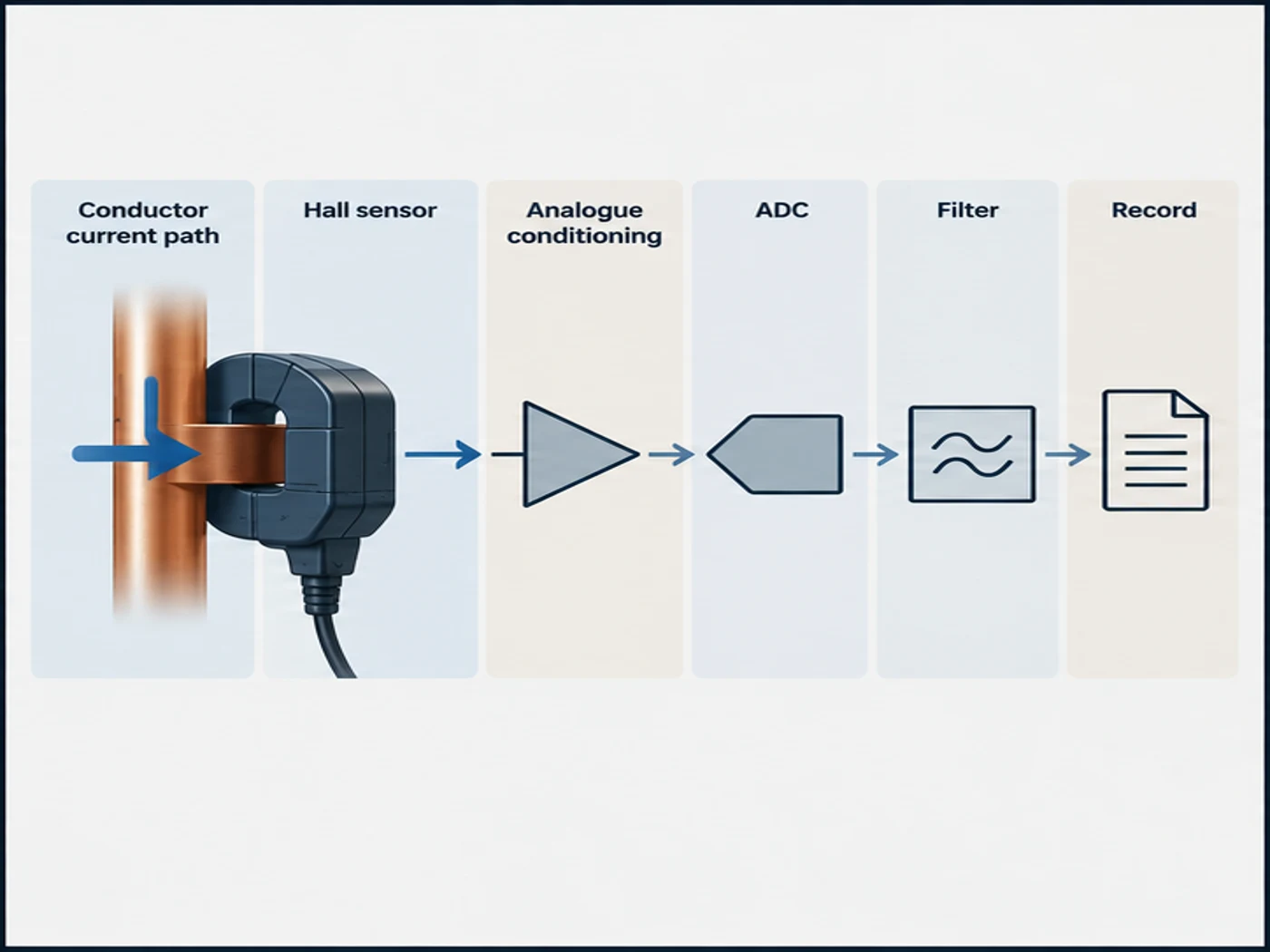
The signal path begins at the current conductor and ends at the value a person or system interprets. Between those points are the Hall element, output interface, analogue conditioning, ADC, digital filter and record destination. A ripple claim is only as strong as the narrowest documented part of that chain. If one stage is unknown, state that the chain is not yet verified rather than borrowing a curve from a related sensor.
Choose the record that matches the task
A commissioning trend, a control feedback value and a laboratory ripple report may use the same sensor but different records. Name the record before choosing the filter or decimation. If the project needs both a smooth control value and a diagnostic waveform, document two paths or state which information is intentionally discarded. This makes the procurement conversation concrete without prescribing an unverified circuit.
Practical buyer takeaway
Ask for the selected model, response conditions, overload behavior and acquisition definition in one request. Then ask how the output is filtered, timestamped and retained. A useful answer may be qualitative when a curve is unavailable, but it must identify the evidence boundary. Do not let a precise-looking sample rate create a false sense of ripple accuracy.
Decide what “good data” means
Good ripple data is not necessarily the fastest or largest dataset. It is data whose frequency content, amplitude meaning, time window and uncertainty match the engineering question. A slow, well-defined average can be excellent for an energy trend and useless for a switching-loss investigation. Write the intended use beside the record format so a later reader does not mistake one for the other.
Record what was intentionally removed
If a filter, decimation or averaging stage removes switching variation, document that choice and its purpose. The absence of a component from a historian is then understandable rather than being mistaken for a quiet converter. This record also helps a future test engineer decide whether a separate raw capture is needed. Also identify whether the recorded value is instantaneous, averaged, RMS, peak-to-peak or a band-limited result. Without that label, two valid records can appear to disagree even though they answer different questions. Preserve units, window and filter state beside the number.
Make the test request reproducible
Name the probe location, converter operating state, reference instrument and capture window in the test request. If a supplier offers a response curve, keep its test conditions with the curve and do not treat it as a guarantee for every installation. A repeatable request lets engineering compare a filtered trend with a diagnostic capture without claiming that either record is the raw current waveform.
Separate commissioning evidence from a product claim
During commissioning, record the converter state at the moment of capture: input condition, load condition, switching mode if documented, and whether the trace is a start-up, steady-state or transition record. Identify the instrument channel and probe placement so a later reviewer can understand what was actually measured. These details support a project record; they do not turn one captured trace into a guaranteed sensor specification. If the trace is used to compare two sensor options, keep the fixture, scaling, filter and time base unchanged, or clearly mark what changed. A supplier may be able to provide a typical response curve, but the buyer still needs to ask whether it applies to the selected output interface and installation. This distinction prevents a visually clean waveform from being mistaken for proof of accuracy across temperature, current range or frequency. It also gives procurement a practical list of evidence to request before selecting a Hall sensor for ripple work.
Source notes
Sources are listed in dossier.md. Product-specific statements are limited to verified evidence; hypothetical arithmetic is labelled.