
AC Power Protection · Technical Explainer
RCCB Backup Protection: Checking Overload and Short-Circuit Duties

Quick answer
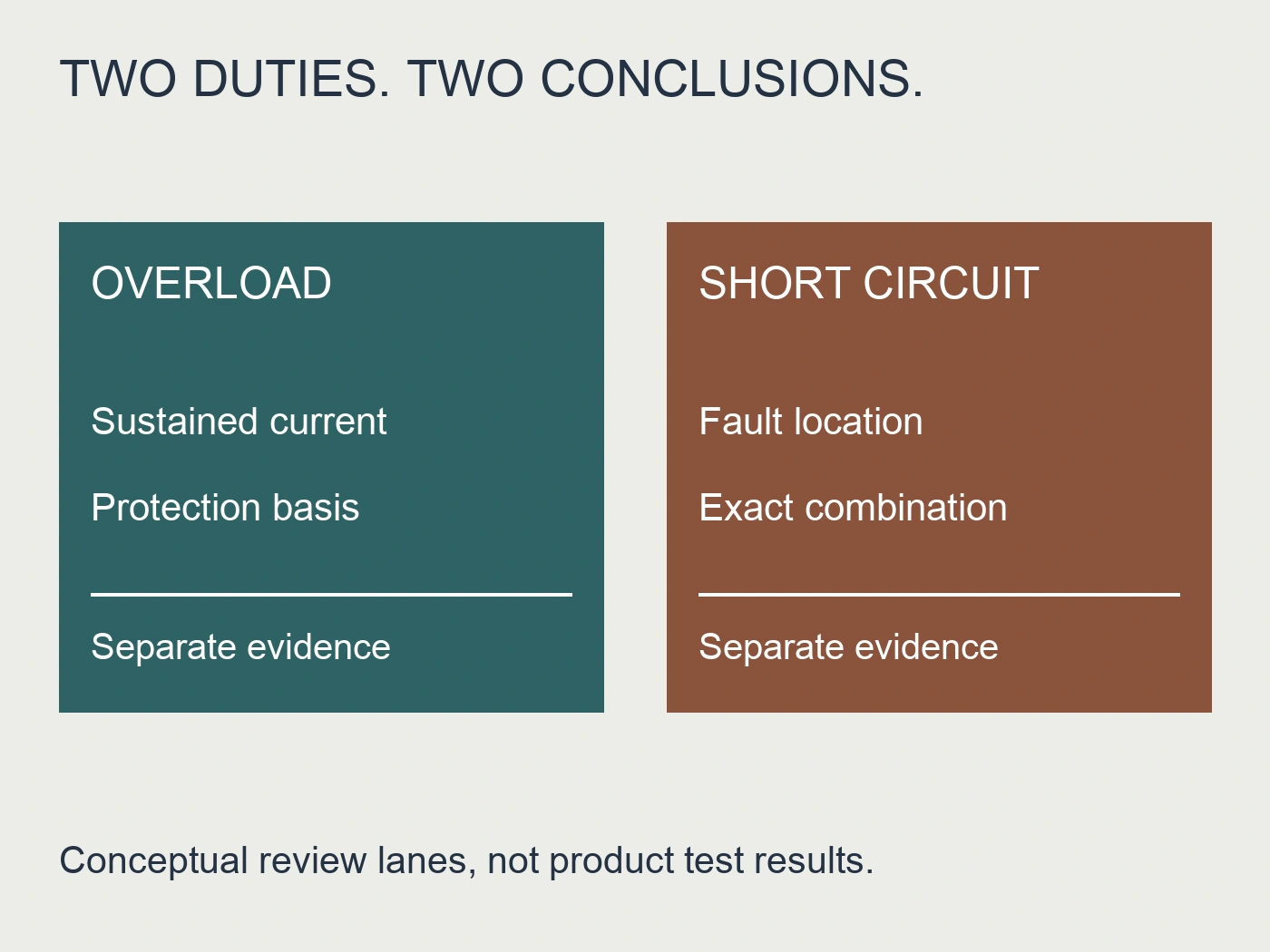
Review RCCB overload protection and short-circuit backup as separate duties. The RCCB's rated current does not make it an overcurrent circuit breaker, and a conditional short-circuit value depends on the specified protective combination. Require the exact RCCB, protective device and applicable coordination evidence before approving the board or purchasing a substitute.
A quotation for an RCCB and an upstream breaker can appear complete while leaving both duties unresolved. The devices have current markings, fit the proposed enclosure and belong to familiar families. None of those observations identifies whether the RCCB is protected against excessive sustained current or whether the exact combination covers the prospective fault current.
The method below gives designers and purchasing teams a shared evidence record. It is not a universal wiring diagram or permission to change protection in an operating board. The qualified designer must approve the final arrangement, installation conditions and applicable requirements.
Identify which current each field describes
Schneider Electric's RCCB guidance selects rated current according to the maximum sustained load carried by the device. Its short-circuit discussion separately requires an upstream short-circuit protective device and manufacturer coordination. The rated-current check and the short-circuit-combination check therefore need different evidence, even when one external device contributes to both duties. Schneider Electric, RCCB characteristics.
Start the comparison sheet with three distinct descriptions: the RCCB's continuous-current duty, its residual-current function and its documented short-circuit characteristics. Keep symbols and units beside their full meaning. A residual-current setting does not answer a load-current question, and an amperage printed beside the product name does not prove a breaking function.
RCCB, RCBO and MCB are not interchangeable descriptions. The present task concerns an RCCB without integral overcurrent protection and the external protection assigned to it. If a proposed replacement changes the device architecture, return that change to the designer rather than treating it as a different brand of the same item.
| Field in the review | What it identifies | Evidence it does not replace |
|---|---|---|
| RCCB rated current | Declared sustained current duty under specified conditions | Overload protection for the actual circuit |
| Residual-current characteristic | The selected residual-current protection function | Protection against ordinary overload current |
| RCCB conditional short-circuit declaration | Withstand with a specified protective combination | The RCCB's independent overcurrent breaking capacity |
| External device characteristics | The selected fuse or circuit breaker's declared duties | Acceptance of that exact device with the RCCB |
| Prospective fault current | Fault-current assessment at the relevant location | A manufacturer's coordination table for the pair |
The table is a terminology and evidence aid. It deliberately avoids example ratings: choosing a convenient number before obtaining the actual model and board data can hide the very question the review is meant to resolve.
Establish the overload-protection basis
ABB's guidance for its F200 RCCBs states that the installation's maximum possible operating current must not exceed the RCCB rated current. It discusses documented external protective arrangements and downstream circuit arrangements as ways to address that duty. Its examples concern named ABB products; they are not universal ratings or approved combinations for another manufacturer's RCCB. ABB, overload and backup protection.
Ask the designer how sustained current through each relevant pole is limited in the proposed board. An upstream overcurrent device may form part of that basis, but the answer should identify the actual device and conditions. If the review relies on downstream circuit protection, request the accepted load and circuit assessment rather than a claim that the outlets will rarely operate together.
A group of individually protected outgoing circuits does not automatically document the common RCCB's sustained-current duty. Record which circuits pass through it and the approved basis for the load assessment. Leave any diversity or utilization assumptions visible, with their source and approval, instead of quietly reducing the sum in a purchasing spreadsheet.
Installation conditions also belong in the record. Obtain the manufacturer's applicable current-duty information and the assembly's assessed conditions. Do not take a value from a familiar open-air installation and assume it covers a different enclosed arrangement. The procurement team need not calculate every thermal detail, but it should know which approved document closes the question.
Distinguish the overload conclusion from a maximum backup-device statement. A catalogue may name an external device for a conditional short-circuit result without establishing the complete sustained-current protection of the intended circuit. The reviewer should state which duty the cited entry supports, not simply mark "backup protection: yes."
Read conditional short-circuit values with their conditions
Schneider Electric defines conditional short-circuit current in terms of a device without integral short-circuit protection, protected by a suitable series protective device under specified test conditions. For an RCCB purchase, the practical implication is to retain the protective-device identity and conditions with the declared result. A number separated from that context is an incomplete specification. Schneider Electric, conditional short-circuit definition.
Use the RCCB manufacturer's exact coordination entry. Record the model or series scope, pole configuration, voltage and external fuse or breaker information covered by it. If a table uses several terms for making, breaking or conditional withstand duties, preserve those distinctions instead of replacing all of them with the word "capacity."
Schneider's RCCB selection guidance specifically points to manufacturer tables associating RCCBs with circuit breakers or fuses. Schneider Electric, RCCB characteristics. A separate MCB sheet can establish the MCB's own declared characteristics; it does not, by itself, establish the RCCB combination's conditional value.
The same boundary applies to a gG fuse. Its utilization category is relevant information, but a buyer still needs the rating, product scope and conditions required by the RCCB's coordination evidence. Do not replace a named or restricted combination with any item carrying the same broad category label.
If the supplier cannot identify an applicable entry, ask for written model-specific evidence. Keep the proposal pending rather than assigning another brand's table to the quoted device. A shared mounting rail or comparable rated current is not a tested-combination statement.
Compare the combination with the actual fault location
The short-circuit review needs prospective fault-current information at the relevant installation point and an applicable protective-combination declaration. ABB distinguishes RCCB short-circuit duties, and Schneider calls for coordination with the external short-circuit protective device. Neither source allows the purchasing team to establish site fault level from the device's front-panel marking. ABB, overload and backup protection; Schneider Electric, RCCB characteristics.
Ask for the approved fault-current assessment and the location it represents. A figure for the incoming supply may not be the figure used for every downstream position. The responsible professional should identify the basis relevant to the proposed assembly and any alternative supply mode included in its design.
Match that assessment to the conditions of the coordination evidence. Do not compare numbers from different voltages or configurations simply because both are expressed in amperes. Where a declaration has limits or restrictions, place them beside the result so they remain visible during procurement and assembly.
Also identify which part of the circuit the proposed external device protects. A downstream breaker cannot be assumed to cover every possible fault location associated with the RCCB and its incoming connections. Ask the designer to mark the accepted protection scope on the circuit drawing; do not invent a field wiring solution to fill an unexplained gap.
If the board arrangement changes, the earlier assessment may need review. Relocating a device or substituting an upstream protective item is a configuration change, even when the catalogue current remains the same. Keep the approved drawing and coordination reference together so those changes are noticed before assembly sign-off.
Keep backup and selectivity conclusions separate
Backup coordination and selectivity answer different purchasing questions. The former review asks whether the specified protective arrangement supports the relevant short-circuit duty. A selectivity request asks about the intended operation of devices relative to one another. ABB presents coordination and selectivity resources separately; a backup entry alone should not become an unsupported promise about which circuits remain energized. ABB, overload and backup protection.
State any continuity requirement explicitly in the RFQ. If the project expects only a particular outgoing circuit to disconnect for a defined event, ask for the relevant coordination evidence and scope. Do not add "fully selective" to an offer merely because an upstream device has a higher current marking.
Residual-current coordination is also a separate subject from an overcurrent backup pair. Preserve the designer's selected residual-current architecture and avoid substituting a sensitivity or device type to solve an unrelated short-circuit documentation problem. A procurement correction should close the demonstrated gap, not redesign the installation by accident.
For maintenance, keep an approved-substitution list or an exact replacement specification with the assembly record. If a fuse or breaker must be replaced, the team should know which characteristics and manufacturer conditions the accepted combination relies on. Similar appearance is not adequate evidence for retaining the earlier declaration.
Use a two-duty approval record
Consider a hypothetical quotation review for board DB-A. The RCCB sheet states a 63 A rated current, while the designer's load assessment gives 58 A maximum sustained current under its stated installation conditions. The comparison 58 A below 63 A answers the normal-load question in this example. It does not identify what prevents excessive sustained current during an overload. The first review entry is therefore “normal load within stated rating; overload protective arrangement still required,” rather than “overcurrent protection approved.” These assumed figures are teaching inputs, not RTX-RCA63 ratings or a board design.
Now suppose the file also contains an assumed 10 kA conditional declaration and an assumed 6 kA prospective fault assessment for the relevant position. The figures appear compatible because 6 kA is below 10 kA, but the quoted upstream breaker has a different reference from the protective device named by that declaration. The second entry must say “fault-current comparison provisionally favourable; exact combination not established.” Buying a breaker with its own 10 kA marking would not close the missing association.
The filled decision record has two open fields with different owners. The designer must identify the accepted overload arrangement; the supplier must provide applicable conditional evidence for the exact quoted devices, voltage and configuration. If the supplier subsequently supplies a matching pair entry, the short-circuit field can be reviewed without implying that overload protection was also resolved. Conversely, an accepted upstream overload arrangement does not turn an unrelated conditional table into the right table.
This separation changes the procurement decision. A quote supported only by current-duty information can remain a component candidate while the assembly approval stays open. A quote with both documented duties can proceed to the remaining installation and project checks. The buyer need not reject a device simply because evidence is absent from its public page, but should avoid closing an approval field on a different device's information. The open issue is specific documentation, not necessarily an unsuitable component.
A useful RCCB approval record has separate overload and short-circuit conclusions, with references that identify the accepted devices. Complete one duty without concealing the other. A quotation remains unresolved when it lacks either the sustained-current basis or the evidence connecting the RCCB to the proposed short-circuit protective arrangement.
| Recenzovaný produkt | Document or decision to record | Reason to keep approval open |
|---|---|---|
| RCCB identity | Exact variant, poles and technical-sheet revision | A family name substitutes for the ordered device |
| Sustained-current duty | Approved load basis and installation conditions | Normal duty has not been established |
| Overload protection | Accepted protective arrangement and its scope | A short-circuit backup limit is the only evidence |
| External short-circuit device | Exact breaker or fuse characteristics | Rating or device type differs from the table |
| Conditional combination | Applicable manufacturer entry and restrictions | Another manufacturer's combination is assumed |
| Fault-current assessment | Relevant location and approved design basis | The number belongs to a different circuit point |
| Final configuration | Controlled drawing and substitution conditions | Assembly changes are outside the accepted record |
For RITOKS sourcing, the RTX-RCA63 Type A RCCB is the residual-current device candidate in this review. Request its exact current-duty and external-protection documentation. Do not assign a conditional short-circuit combination merely because a compatible-looking protective device is available in the same catalogue.
Tento multipole AC miniature circuit breaker family a RTX-NHG NH gG fuse links are distinct overcurrent-protection sourcing candidates. Their family association with the RCCB does not establish a verified pair. Obtain the model-specific combination evidence and designer approval before presenting any of them as the accepted backup arrangement.
Close both duties before ordering
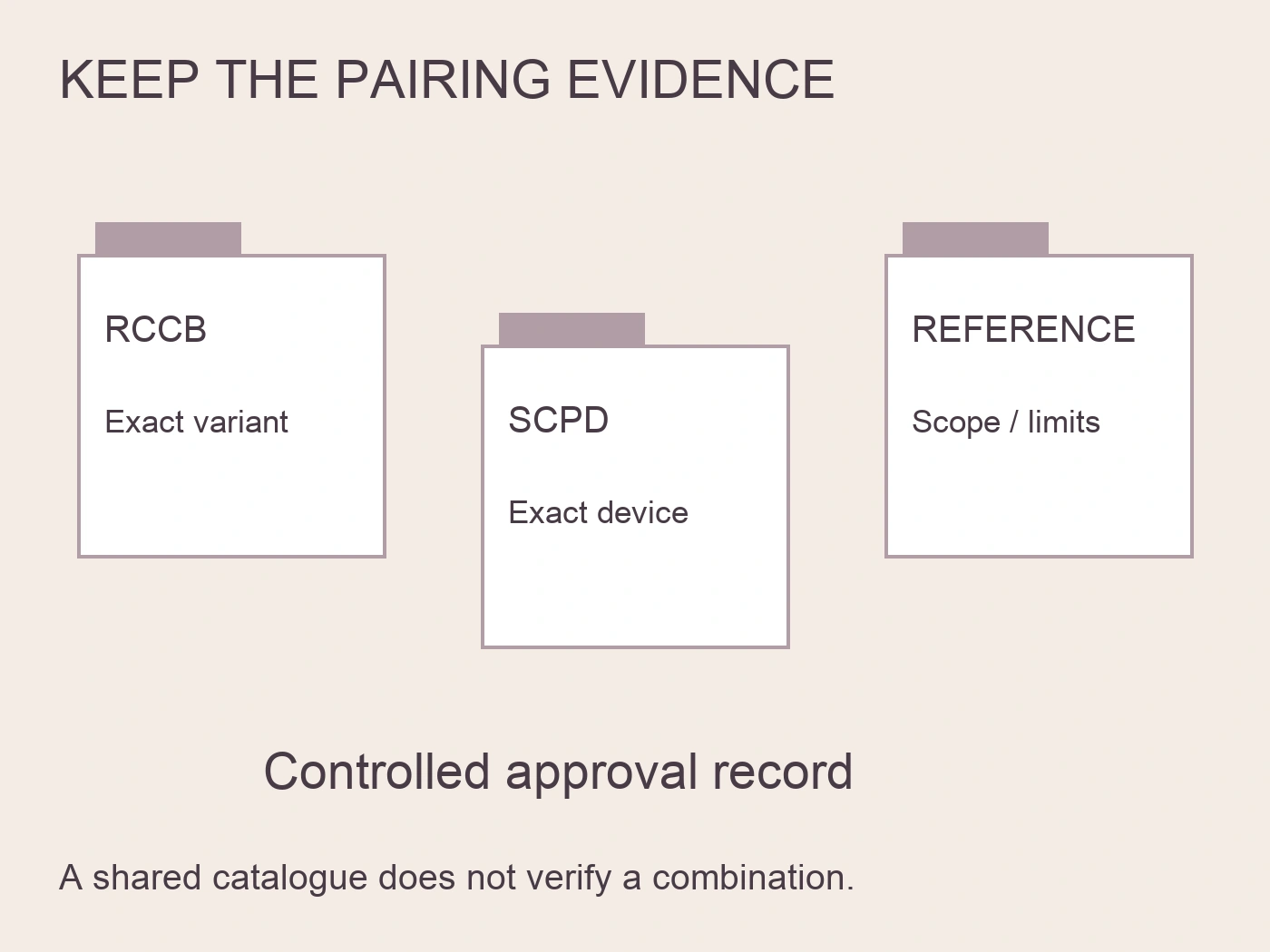
Keep separate, traceable conclusions for RCCB overload protection and short-circuit backup. Order the accepted device identities against the controlled board drawing, relevant fault assessment and manufacturer coordination evidence. If a supplier proposes a substitute, return the changed combination to review rather than carrying forward the old approval automatically.
Literatura
- ABB. (n.d.). Vorsicherung, Überlastschutz und Back-Up Schutz. Official German-language guidance. Retrieved October 2, 2026. Examples concern ABB product families and are not RITOKS combinations.
- Schneider Electric. (n.d.). Sensitivity of RCDs to disturbances. Electrical Installation Guide, section on RCCB characteristics and electrodynamic withstand. Retrieved October 2, 2026.
- Schneider Electric. (2015). What is definition of conditional Short Circuit Current. General conditional-current definition; not an RCCB product rating or combination declaration. Last modified April 21, 2025; retrieved October 2, 2026.