
Industrial Power Switching · Comparison
Emergency Stop vs Normal Stop: Define the Machine Function First

Quick answer
A normal-stop command and an emergency-stop function should be specified by their intended machine response, not by the shape of the button. Routine stopping serves the documented operating task. Emergency stopping addresses an assessed emergency condition within a defined machine scope and safety architecture.
Neither label alone establishes removal of every energy source, permission to enter a danger zone or suitability for maintenance. Resetting an emergency-stop operator is also different from intentionally restarting the machine. Releasing the operator should not be treated as the restart command.
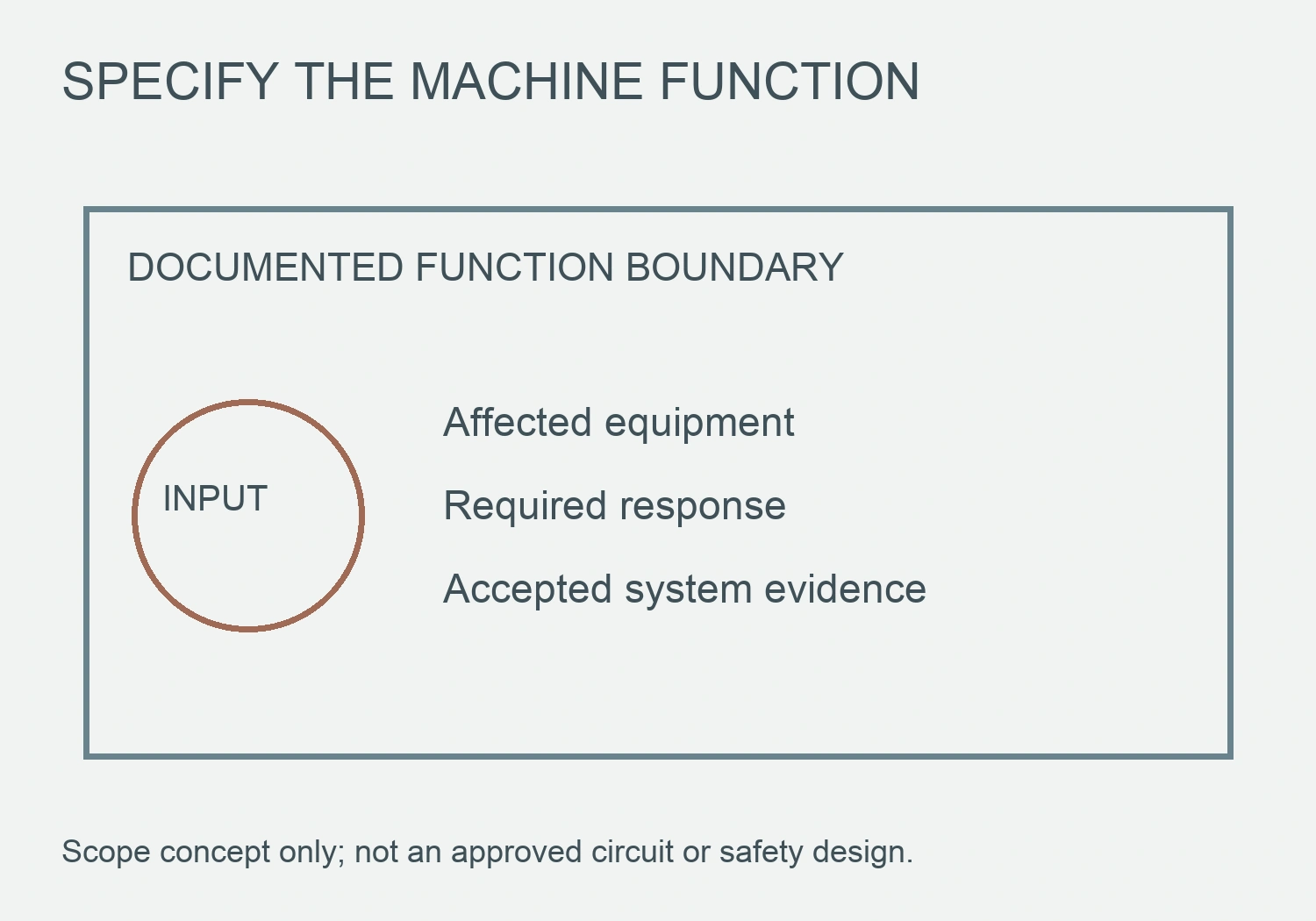
Before buying the device, document the hazard, affected equipment, required stopping behaviour, reset/restart conditions and evidence responsibilities. A mushroom head, NC contact or catalogue family cannot prove the complete function's safety performance.
Write the machine requirement before selecting a button
An operator is an input component. The machine function includes what receives that input, how the command is interpreted and how the relevant equipment reaches its required state. A photograph of the station does not reveal that whole chain.
Start with the machine's task and operating modes. Describe what a routine stop is intended to accomplish and what an emergency response must address. Avoid specifications that say only provide stop and emergency stop without defining their consequences.
HSE's PUWER overview discusses identified starting/stopping controls, guarding, emergency-stop devices and isolation as distinct parts of managing work-equipment risk. This is UK guidance, not an identical worldwide legal obligation or certification of an operator. HSE, PUWER overview.
Use the project's applicable requirements and risk assessment to complete the function description. This article does not assign a stopping category, stopping time, PL or SIL to a machine from its button choice.
Define routine stopping without assuming its safety role
For a normal stop, identify the operating purpose. It might be requested during production or another documented mode. State which part of the machine receives the request and what the approved system should do.
Do not assume that all normal-stop functions are unrelated to safety, or that a routine stop always removes power immediately. The actual design and assessed task determine what behaviour is required.
Procurement needs the relevant interface and contact evidence, but the operator order is not the whole specification. The control designer must connect the requested action to the approved machine response.
Where routine stopping is described in an operator manual, preserve its meaning when the station is changed. A new legend, device type or control interpretation may affect what the user expects, even if the panel layout looks familiar.
Define the emergency scope precisely
Record the hazard addressed and the affected equipment. On an integrated line, do not assume that a station stops every machine, or only the nearest unit. The documented scope must identify the actual boundary.
The required state should describe the relevant hazard response rather than simply the absence of a running indication. Stopping movement and establishing permission for access are separate claims requiring their own evidence.
Pilz describes emergency stop as a complementary protective measure and places reset arrangements within the machine assessment. Its explanation is not a basis for replacing guarding or claiming that a purchased operator provides the entire risk-reduction system. Pilz, emergency-stop acknowledgment.
Keep the responsible designer's requirements attached to the device selection. Without them, a supplier can confirm a component format but cannot reasonably certify the machine function that has not been defined.
Build a function-and-evidence register
Use this original register to structure the enquiry and identify missing responsibilities. It is a planning document, not an approved circuit, safety assessment or record of performed tests.
| Function record | What the buyer needs documented | Evidence responsibility |
|---|---|---|
| Routine stop purpose | Intended operating task and relevant mode | Machine designer/user requirement |
| Emergency condition | Hazard and intended risk-reduction response | Responsible risk assessment |
| Affected equipment | Machine or line boundary and linked functions | Approved functional description |
| Required stopped state | Defined behaviour and limitations | Control/safety design evidence |
| Operator and contacts | Exact device, release action and contact diagram | Selected component documentation |
| Control and final elements | Documented architecture for the intended function | Qualified system designer |
| Reset and restart | Separate actions, permissions and responsibilities | Approved machine requirements |
| Maintenance boundary | Separate intervention/isolation arrangements | Machine maintenance procedure |
| Verification record | Actual evaluated design and accepted revision | Responsible validation personnel |
Name the owner of each unresolved entry. A procurement package should not replace an unknown field with a reassuring phrase such as safety type or industrial grade.
For integrated equipment, ensure that machine and line suppliers agree on the scope. Two documents can use the same stop name while describing different affected equipment or restart permissions.
Separate operator reset from machine restart
An operated emergency-stop device and the machine's readiness to restart are different states. Record the required deliberate release action for the exact device, then document the separate machine restart conditions.
Pilz explains that intentional reset of the operated device permits a subsequent restart rather than causing one. Its FAQ considers visibility of the affected area and possible additional acknowledgment within the risk assessment. The full cited standards and legislation have not been independently reproduced here.
Do not use release, acknowledgment and start as interchangeable terms in purchasing documents. Ask the designer to identify what each means in the actual system. An ambiguous phrase such as reset to run can conceal a requirement that needs clarification.
This guide provides no reset sequence for an actual machine. Operators must follow the approved machine procedures; the procurement register establishes which documented behaviour the selected component must support.
Do not equate emergency stopping with isolation
A stop command is not proof that electrical or other hazardous energy has been isolated. A display showing stopped also does not establish that intervention is safe.
HSE's maintenance guidance treats competent planning, stopped machinery, isolation and stored-energy risks as matters requiring separate attention. These qualitative distinctions are useful to the specification; the UK page is not a universal task-specific isolation procedure. HSE, maintenance of work equipment.
For the actual machine, obtain the maintenance and intervention requirements from the responsible personnel and equipment documentation. Do not infer them from an emergency-stop contact diagram.
Likewise, avoid promising that every emergency-stop function removes all energy or implements the same stopping category. Those are design claims that need applicable evidence. This article supplies no category selection, lockout recipe or permission to enter a machine.

Specify the exact operator within the product family
Den RITOKS RTX-PB22 pushbutton and emergency-stop operator family provides a route for selected 22 mm operator enquiries. A family listing is not a completed machine-safety approval.
Read the mechanical families separately. The published A/B scope includes emergency-stop formats; the C table covers buttons and illuminated variants. Do not grant every format on the page to every family.
Request the exact order code, release mechanism, contact arrangement and relevant device evidence for the specified task. Where a design requires direct/positive-opening characteristics or particular conformity documentation, request the actual selected-device evidence rather than assuming it exists.
A matching nominal mounting diameter does not prove that replacement heads, contact blocks or other makers' parts are compatible. Confirm the selected assembly documentation and intended panel interface through the responsible designer.
Keep component ratings distinct from function validation
Component documentation can establish facts about an ordered operator. It does not alone establish the safety performance of the installed chain from input to final machine response.
Do not convert insulation voltage or conventional thermal-current fields into a universal contact switching duty. Obtain the applicable selected-contact ratings for the intended circuit. Lamp supply information is a separate field, not evidence of contact duty.
Similarly, supplier life figures cannot become an installed safety lifetime or a guaranteed maintenance interval without the required assessment. A device legend or catalogue description does not provide PL, SIL, stopping-time or integrated-circuit validation evidence.
Keep component approval and system validation as different acceptance records. This lets the buyer identify whether a missing item belongs to the device supplier or the machine designer without asking either party to certify an undefined scope.
Compare claims against the evidence supplied
Use this original claim-review table when evaluating quotations or proposed substitutions. It identifies the next document request rather than supplying an unsupported pass/fail threshold.
| Proposed claim | What it does not establish | Bevismateriale, der skal anmodes om |
|---|---|---|
| Emergency-stop operator offered | Complete machine function validated | Exact device evidence plus approved system assessment |
| Button has an NC contact | Required safety architecture or opening characteristics | Selected contact/device documentation |
| Mushroom head and retained position | Appropriate release and restart behaviour | Exact mechanism and machine functional requirements |
| Machine shows stopped | Safe access or maintenance isolation | Approved access/intervention procedure |
| Operator has been released | Hazard removed or restart intentionally commanded | Separate assessed reset and restart conditions |
| One station controls the line | Actual scope of all affected equipment | Agreed machine/line boundary document |
| Catalogue lists ratings and life | Installed duty or safety lifetime accepted | Applicable rating scope and assessment evidence |
| Existing operator fits the opening | Replacement retains the approved function | Assembly compatibility and change review |
Record the unresolved scope directly in the quotation review. Avoid accepting a broad compliance statement when it does not identify the exact component, machine function and supporting documents.
Preserve the design boundary during changes
Keep the machine identifier, operator tag, selected model and approved function revision together. Document changes to contacts, reset action, affected equipment or control interpretation before a replacement is treated as equivalent.
For a line extension, review whether the old emergency scope still matches the new equipment boundary. An unchanged station does not prove that additional machinery is covered by the existing assessment.
Verification must be performed by the responsible qualified personnel under approved procedures. This guide contains no live machine test, forced-input instruction, bypass or invented validation result.
The useful procurement outcome is a traceable match between the specified function, selected operator and accepted system evidence. Buying a recognised format is one step in that process, not proof that routine stopping, emergency response, restart and maintenance isolation are interchangeable.
Ofte stillede spørgsmål
Is emergency stop simply a faster normal-stop button?
No. Specify its assessed purpose, affected equipment and required response. Do not infer a universal stopping speed or category from its name.
Does an emergency-stop device isolate every energy source?
Not automatically. Stopping and maintenance isolation are different claims. Obtain the actual machine's approved intervention and energy-control requirements.
Can resetting the emergency-stop operator restart the machine?
Reset should permit the separately intended restart, not act as the restart command. Exact reset and restart arrangements require the machine's assessed design and procedures.
Does a red mushroom operator prove a machine safety level?
No. Exact device evidence and the complete function's design and validation are needed. Shape, contact designation and catalogue family are insufficient.
Referencer
- Pilz. (n.d.). Emergency-stop acknowledgment on a machine. Manufacturer reset/restart and assessment explanation; not a full normative-standard read. Accessed October 2, 2026.
- Health and Safety Executive. (n.d.). PUWER overview. UK work-equipment guidance distinguishing controls and protective measures; updated November 2024. Accessed October 2, 2026.
- Health and Safety Executive. (n.d.). Maintenance of work equipment. UK maintenance planning, isolation and stored-energy context; updated November 2024. Accessed October 2, 2026.