
Industrial Power Switching · Technical Explainer
Illuminated Pushbuttons: Should the Lamp Show a Command or a Status?

Quick answer
An illuminated pushbutton can indicate a documented command or a documented feedback state. The design must say which signal drives the lamp and what the operator may conclude from it. Pressing a button, accepting a command, energising a coil, receiving an auxiliary-contact signal and completing a process are different events.
A command lamp should not be labelled as proof that the equipment has completed the requested action. A contactor-status signal does not alone prove motor rotation, flow or safe access. Lamp off is also not evidence of isolation.
For procurement, define the indication's source, on/off/unknown meanings and accepted machine boundary before selecting the lamp variant or an auxiliary accessory. This guide provides a requirements register, not a wiring circuit or safety validation.
Give each illuminated operator a defined meaning
A station can look clear while its signals remain ambiguous. A button labelled RUN with a lamp does not tell the buyer whether the light means run requested, command accepted, contactor state received or actual process running.
Write the intended meaning as a sentence. Identify the equipment boundary and the underlying source. Then ask whether that evidence really supports the words an operator will read.
Keep the physical button action separate from the indication. Momentary or maintained operation describes the selected operator mechanism; it does not define the lamp's source. An illuminated head can be ordered without settling the machine-state interpretation.
The specification should be understandable to the machine designer, device supplier and eventual operator. If they assign different meanings to the same light, the component list is not ready for approval.

Separate command evidence from feedback evidence
A command describes what the system has been asked to do. Feedback describes a state reported by a particular source. Neither should be silently promoted into a broader claim.
For example, a retained command can remain present without establishing that the process has reached the requested condition. A feedback point can describe a component state without representing every downstream mechanical or process condition.
Schneider's TeSys Giga auxiliary-module section describes contactor-status indication and remote visual signalling for its exact modules, while separately documenting their contact properties. This supports treating source meaning and device properties as distinct questions, not attributing those properties to all accessories. Schneider Electric, TeSys Giga auxiliary modules.
Use labels that remain within the evidence boundary. If the project needs actual process confirmation, ask the responsible designer which suitable feedback establishes it. Do not manufacture that confirmation by renaming a command variable.
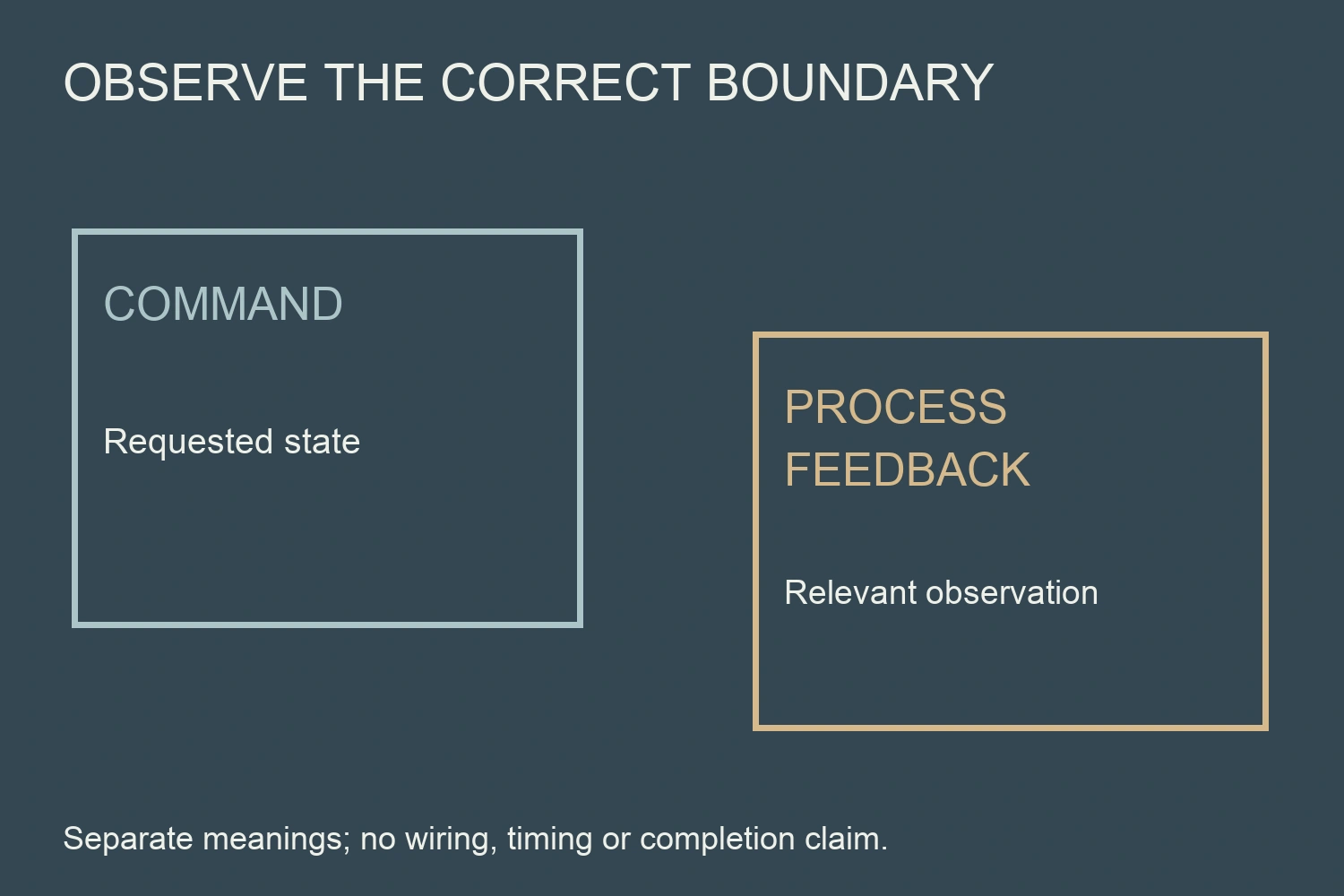
Build the lamp-meaning register
The following original register helps buyers review the proposed station. It is not a catalogue of guaranteed machine behaviour. The exact source and interpretation must be completed from the approved design.
| Proposed indication | Source that must be identified | Unsupported inference to avoid |
|---|---|---|
| Operator action received | Exact documented input/action | Machine accepted or completed the task |
| Command accepted | Approved control state | Coil, contactor or process actually responded |
| Coil/control energised | Exact control-side signal | Every power pole is closed or motor is rotating |
| Auxiliary state received | Selected contact and its documented function | Process complete or all main contacts proven |
| Process running | Feedback relevant to the actual process | Safety permission or maintenance isolation |
| Cycle completed | Defined completion evidence and boundary | Every downstream operation completed |
| Safety permission | Assessed function's required evidence | Ordinary indicator provides safety approval |
| State unknown | Defined loss/unavailable-data treatment | Missing feedback is equivalent to confirmed stopped |
Associate each completed row with an operator tag and document revision. If an indication uses several conditions, preserve their documented meaning rather than treating the combined lamp as proof of an unstated result.
This register can expose a mismatch before installation: the label may promise a process state while the specified source records only a command. The correction belongs in the approved indication requirements, not in an unreviewed purchasing substitution.
Define what auxiliary feedback can actually establish
An auxiliary contact must be identified by exact accessory, compatible base device and contact function. NO/NC designation describes contact behaviour; it is not a universal certificate of all main-pole conditions.
Schneider's mirror-contact FAQ explains a specified relationship between certain NC auxiliary contacts and main power contacts. It also identifies configurations without mirror functionality. Therefore, an NC label alone is not evidence of that property. Its product tables are not copied as a RITOKS compatibility list. Schneider Electric, mirror-contact explanation.
If the proposed lamp meaning relies on a particular feedback relationship, request exact documentation for the selected assembly. Where that documentation is missing, leave the claimed relationship unresolved.
Even a documented contact relationship remains different from direct evidence of motor rotation or process completion. Define the required process observation separately instead of expanding the accessory's stated scope.
Keep mirror and mechanically linked terminology precise
Do not use mirror, guided or mechanically linked as interchangeable marketing words. Their documented relationships need exact device evidence and an appropriate application assessment.
Schneider's safety-contactor FAQ distinguishes a main-contact-to-auxiliary mirror relationship from linked/guided NO/NC terminology and directs users to product literature and the relevant standards. This is a qualitative distinction, not a claim that an entire safety system is approved. Schneider Electric, contact-property distinctions.
For an ordinary indication, identify the actual source without adding unsupported safety attributes. For an indication involved in a safety-related task, the responsible designer must establish the required architecture and evidence.
A lamp driven by a signal does not inherit a safety performance level merely because the signal is described as feedback. This article assigns no mirror property, safety rating or validated machine permission to the RITOKS auxiliary family.
Treat dark, unavailable and confirmed-off states separately
Ask what the operator should understand when the lamp is dark. The approved specification must distinguish confirmed absence of the indicated condition from unavailable indication where needed.
Supply availability, lamp condition and feedback availability are requirements to address, not assumed observations of failures. Do not claim that lamp off proves stopped machinery, removed energy or safe intervention.
Likewise, define indication behaviour during start-up, restoration and relevant faults. A previously displayed state should not silently be treated as current confirmation if the design no longer has the required evidence.
The buyer should request the documented meaning and limitations rather than prescribe a universal flash pattern or delay. Colours, cadence and timing must come from the applicable project requirements and approved design, not from a generic blog recipe.
Specify the lamp separately from the contact function
Den RITOKS RTX-PB22 operator family is a route for exact illuminated-operator enquiries. Confirm the selected mechanical family, action, contact diagram and lamp arrangement separately.
Do not combine all A/B/C options into one device. The C table covers buttons and illuminated variants rather than every selector or emergency-stop format shown elsewhere in the family.
Obtain the exact lamp supply requirements and the selected contact-circuit ratings. Lamp voltage is not contact switching duty, and insulation or conventional thermal-current fields are not universal load approvals.
The device supplier can document the selected component. The control designer must still specify what the lamp source means in the machine. Ordering an illuminated head does not decide that semantic question.
Confirm the auxiliary accessory's exact compatibility
For auxiliary feedback sourcing, the RITOKS RTX-CAX auxiliary-contact and interlock family requires exact contactor-frame compatibility. Front and side options should not be assumed interchangeable.
The published S11 side example and F2/F4 front families require selected-code confirmation. A separately specified mechanical interlock is not a property automatically supplied by an auxiliary-contact block.
Related-product placement does not approve a combination. Request the exact base contactor, accessory code, contact arrangement and mounting documentation for the quotation.
The public page does not establish mirror, force-guided or complete safety-feedback properties. Do not add those claims to the lamp register to fill a gap. Nor does accessory compatibility establish the motor or process feedback that a broader status label may need.
Turn the signal register into a purchasing specification
Use this second original table to keep the indication requirement linked to the ordered hardware and approved documentation. It is a review aid, not an installation or test procedure.
| Specification item | Supplier/designer response needed | Review boundary |
|---|---|---|
| Indication sentence | Exact meaning of illuminated and dark states | Label matches supported evidence |
| Signal provenance | Command, selected feedback or process source | No broader state inferred |
| Unknown state | Defined supply/data/lamp limitations | Unavailable is not confirmed safe |
| Lamp variant | Exact code and supply documentation | Separate from contact switching duty |
| Operator assembly | Family, mechanism and contact diagram | Mechanical action does not define lamp semantics |
| Auxiliary assembly | Base frame, accessory and contact properties | No family-wide compatibility or mirror claim |
| Machine modes | Approved start-up/restoration/fault interpretation | No universal timing or colour convention |
| Revision record | Owner and accepted source/label revision | Replacement preserves the approved meaning |
Require clarification where the quotation describes hardware but omits the intended signal source. Conversely, do not ask a component supplier to validate a machine-state claim without the relevant design information.
The completed document should let another reviewer follow the lamp meaning back to its evidence. It should not require guessing from colour, button legend or a screenshot of controller variables.
Preserve the meaning through machine changes
Keep the operator tag, lamp variant, source identity, approved interpretation and revision together. Review changes to the source or machine boundary even if the visible station remains unchanged.
If a lamp previously indicated a command and is changed to feedback, update the documented meaning and approved operator information. If the signal changes to a different feedback point, check whether the existing label remains accurate.
Qualified personnel should implement and verify the actual arrangement using approved equipment instructions and machine procedures. This guide supplies no live wiring, forced-signal test or safety-access permission.
The practical result is an honest indicator: its meaning matches what the selected source can establish. Clear command indication is useful; unsupported claims of running, completion or safety are not needed to make it useful.
Ofte stillede spørgsmål
Should a start-button lamp always show that the motor is running?
No universal rule applies. Define whether it shows a command or actual feedback, and support the chosen label with evidence relevant to that state.
Does contactor auxiliary feedback prove motor rotation?
Not by itself. Its scope depends on the selected contact function. Actual rotation or process status requires relevant feedback established by the design.
Is every NC auxiliary contact a mirror contact?
No. Obtain exact device and assembly documentation. NO/NC designation alone does not establish the required relationship to main contacts.
Can an unlit button be treated as permission to enter the machine?
No. Lamp off does not prove isolation or safe access. The machine's approved intervention and safety arrangements govern that permission.
Referencer
- Schneider Electric. (2012). TeSys Deca and TeSys K mirror contacts, FA142116. Selected-contact explanation, modified 2025; no pairing table transferred. Accessed October 2, 2026.
- Schneider Electric. (2011). Safety-contactors FAQ, FA136111. Mirror versus linked/guided terminology, modified 2025; full standards not independently read. Accessed October 2, 2026.
- Schneider Electric. (n.d.). TeSys Giga Auxiliary Contact Modules, DOCA0189EN-05. Exact-module indication/property example; Overview section only. Accessed October 2, 2026.