
AC Power Protection · Technical Explainer
RCBO Tripping: Distinguishing Residual Current from Overcurrent
Quick answer
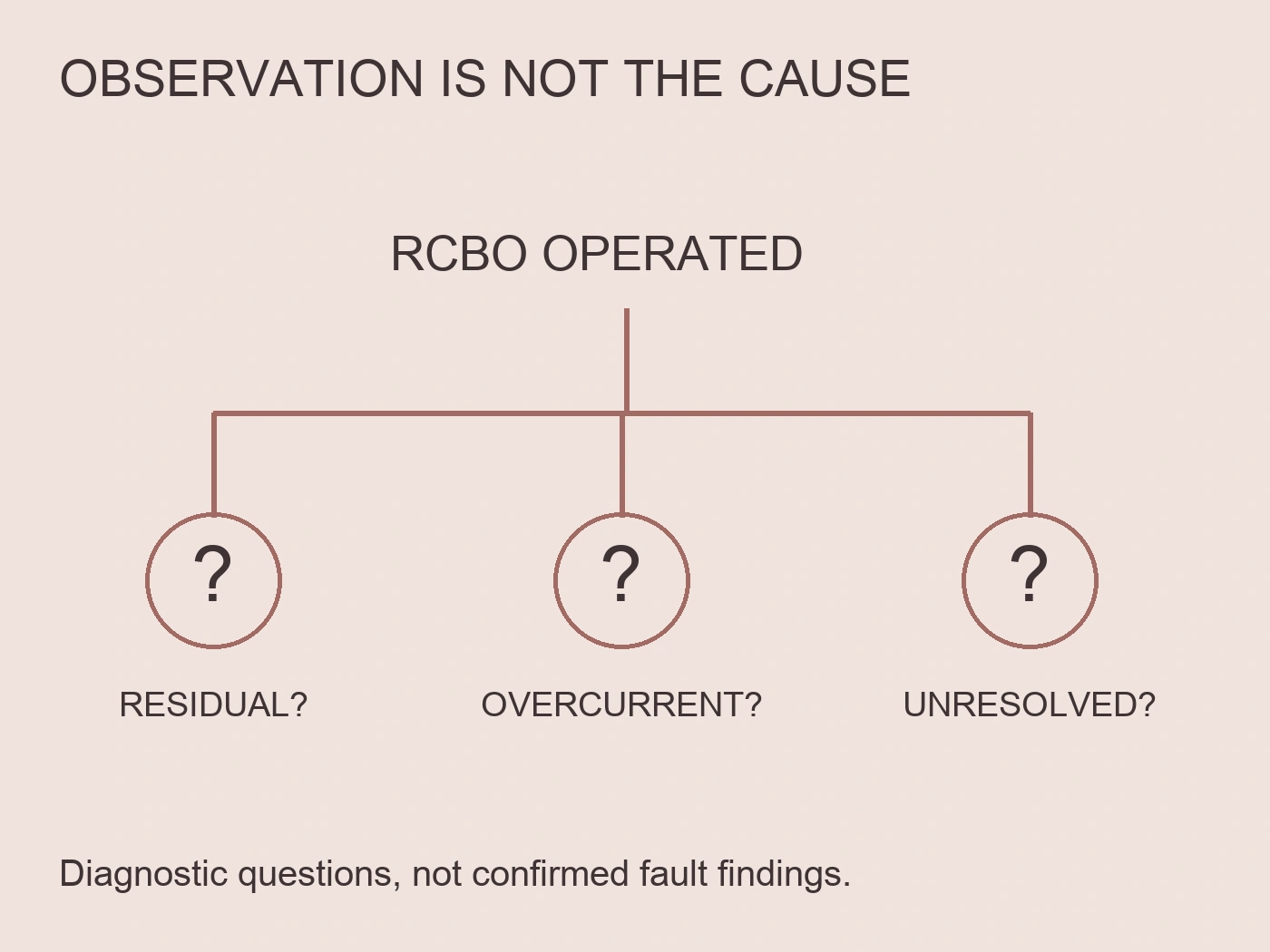
An RCBO combines residual-current and overcurrent protection, so a tripped handle alone may not identify which function operated. Start with any documented cause-of-trip indication for the exact model, the incident circumstances and existing circuit records. Use those observations to direct a competent professional's investigation, not to declare the cause from timing alone.
A trip when equipment starts could involve overcurrent, residual current or another installation condition. A delayed trip is not automatically an overload, and low average load current does not exclude a short-duration event. Preserve the evidence and obtain measurements suited to the suspected mechanism before selecting a replacement or changing a circuit.
This guide provides an evidence-routing checklist for designers and facilities teams. It does not instruct users to probe live terminals, disconnect neutrals, create faults or repeatedly reset a circuit to reproduce a hazardous event.
Understand the three duties behind one handle
Overcurrent protection includes overload and short-circuit duties. Residual-current protection responds to an imbalance in the monitored current paths. These functions address different conditions even when they share one switching mechanism.
ABB's technical explanation of the DS301C illustrates the distinction: its thermal overload mechanism uses a bimetallic element, its short-circuit mechanism uses a magnetic trip coil, and its residual-current function uses differential sensing. That example helps explain the separate duties; it does not establish the internal construction or settings of every RCBO.
For the incident record, keep the rated current In, residual-current rating IΔn and overcurrent characteristic separate. A current reading compared with In says something different from a residual-current observation compared with the device's residual function. The breaking-capacity marking is also not a normal operating trip setting.
One event can produce conditions relevant to more than one duty. For example, an equipment fault may involve both a high current and a current path to earth. The objective is to establish the supported fault mechanism and remedial scope, not force every incident into a single category before evidence is available.
Preserve the incident before evidence is lost
Record the date, affected circuit, equipment operating state and recent changes. Identify the exact protective device that operated and any other devices involved. If the indication can be viewed safely without opening an enclosure, record it before its state changes, following the manufacturer's instructions and site procedures.
Ask whether the event coincided with startup, a process transition, several loads operating together, cleaning, maintenance or equipment relocation. Include observations such as unusual noise, smell, visible damage or loss of a particular function. These details can help determine the urgency and investigation scope, but none is a substitute for inspection.
Do not make “reset successfully” the closing diagnosis. A device that remains closed after an incident does not prove the original fault has disappeared or the circuit is safe. Repeated reclosing should not be used as an informal fault-finding method.
Retain the circuit schedule, equipment references and previous verification records. If the circuit label is uncertain, mark it unresolved. Misidentifying the affected circuit can send a competent investigation toward the wrong equipment and produce an irrelevant replacement order.
Read only the indicator the manufacturer documents
A coloured window may indicate contact position, residual-current operation or another status. Its meaning is model-specific. Do not assume that a red, blue or yellow marking means the same thing across brands or generations.
ABB describes a blue mechanical earth-fault flag on its DS301C in the cited technical article. This is a concrete example of a cause-related feature, not a universal RCBO characteristic. A product without a documented dedicated indication may require other evidence to distinguish the functions.
Check how the indication behaves after manual operation, an integral button test and resetting. Obtain that information from the exact instructions. Do not improvise a fault to learn how the indicator works. A photograph from a different reference may be useful for locating a manual but is not an interpretation guide for the installed item.
If no cause indication is available, state that fact in the report. Absence of such an indication does not show that residual-current protection failed; it simply limits what can be inferred from the front of the device.
Route observations into questions, not verdicts
Use the following original table to decide what evidence the professional investigation needs. The suggested routes are hypotheses, not confirmed diagnoses or instructions to perform electrical tests.
| Observation | Investigation question | Evidence that could support the answer |
|---|---|---|
| Documented residual-trip indication | What return-path imbalance or disturbance caused operation? | Exact indicator instructions and suitable residual-current or circuit assessment |
| Trip during sustained combined operation | Was the overcurrent duty exceeded, or did leakage change with equipment state? | Representative load record, device curve and leakage-related findings |
| Trip immediately when equipment starts | Is startup current relevant, or does the transition create residual current? | Appropriate event records and equipment-specific information |
| Trip after a wiring alteration | Were the circuit relationships and connections preserved? | Updated circuit map, inspection and relevant verification records |
| Trip associated with a particular appliance | Is the appliance, its connection or the shared circuit implicated? | Configuration-specific equipment inspection and circuit evidence |
| No clear indication or repeatable operating pattern | What information is missing? | Structured incident log and a professionally defined investigation scope |
Timing belongs in the record because it helps select evidence. It does not determine the protection function by itself. A report saying “instant trip, therefore short circuit” has skipped the residual-current possibility and the actual device characteristics.
Likewise, one load-current reading below the nameplate rating does not close the overcurrent investigation. Confirm what the measurement covered, which loads were operating and whether the instrument captured the relevant event.
Evaluate the overcurrent route against the actual circuit
For suspected overload, the professional should relate the installed device's characteristic to the circuit's operating profile and the relevant installation conditions. Retain the exact current-time curve rather than substituting a generic curve bearing the same letter.
Ask for the total load seen by the device, not just the largest appliance rating. Nameplate power, a scheduling assumption and an actual current record are different evidence types. A startup event and sustained operation also require different interpretation.
For suspected short-circuit duty, establish the fault evidence and any damage or investigation findings. Do not treat an ordinary measurement after the circuit has been disconnected as proof that no fault existed. Intermittent conditions may not be represented by the later state.
Do not specify a higher-rated or differently characterized RCBO simply because the previous one tripped. Any proposed change must preserve the required protection and fit the conductor, load and assembly design. Avoid converting a diagnostic uncertainty into a purchase of a device that masks the symptom.
This route does not replace the separate short-circuit rating and coordination review. If a change is proposed, the responsible designer must address those requirements as part of the actual installation, not as a conclusion drawn from the incident's duration.
Evaluate the residual-current route without assuming a failed device
Residual-current investigation may concern insulation, equipment filters, cumulative leakage, an incorrect return path or a disturbance. Hager's modular circuit-protection FAQ identifies misplaced or combined neutrals and standing leakage as relevant causes of unwanted tripping. These possibilities should remain distinct from a proven component failure.
Request evidence for the affected circuit and equipment state. A normal load-current measurement is not a residual-current measurement. Similarly, a documented equipment leakage value may describe a different quantity or operating condition from the installed observation.
Where an insulation assessment is needed, the professional chooses the method and addresses connected equipment that could be affected by testing. This guide does not supply a test voltage, connection diagram or acceptance resistance. Equipment inspection and installation testing must follow the appropriate documents.
If a recent alteration changed neutral ownership or circuit grouping, include that relationship in the scope. Do not bridge neutral groups, remove protective-earth conductors or replace the RCBO with an ordinary breaker to determine whether the trip disappears.
Changing residual-current sensitivity or type is not an automatic remedy. A design review may justify a different protection arrangement, but it must first identify the application requirements and the evidence supporting the change.
Commission a professional evidence plan
Facilities managers can prepare access, asset records, operational history and outage coordination. Electrical measurements and intrusive inspections belong to people competent in the specific work. The Health and Safety Executive's electrical FAQ distinguishes competence and emphasizes secure isolation; RCD protection does not replace safe working arrangements.
State the question each proposed measurement or inspection is intended to answer. Record instrument suitability, relevant operating conditions and limitations. If the device was removed or replaced before the investigation, retain its identity and the observations made beforehand.
The following original evidence record keeps the diagnostic and procurement decisions connected without pretending that every case requires the same test sequence.
| Evidence package | Minimum useful content | Decision it supports |
|---|---|---|
| Incident account | Circuit, device, operating state, time pattern and preceding changes | Selects the investigation scope |
| Device documentation | Exact reference, indicator meaning and relevant characteristics | Prevents generic interpretation of the device |
| Load assessment | Method, conditions, relevant current profile and limitations | Evaluates the suspected overcurrent route |
| Residual/circuit assessment | Defined scope, equipment state and relevant professional findings | Evaluates imbalance and installation-related possibilities |
| Remedial proposal | Identified finding, necessary work and unresolved items | Prevents replacement being mistaken for diagnosis |
| Closure record | Changes made, verification evidence and responsible professional | Supports return-to-service and future maintenance decisions |
Where the findings support more than one route, retain both rather than selecting the most convenient explanation. If evidence is insufficient, “cause not established” is a useful outcome when accompanied by the next defined investigation step.
Base the replacement inquiry on the finding
RITOKS lists a PXB2Ln-63 1P+N RCBO for sourcing discussions. Do not infer a dedicated residual-trip flag, a particular internal construction or interchangeability with the installed assembly from that name.
Provide the exact existing reference, circuit requirements and professionally supported replacement scope. Request configuration-specific instructions and characteristics for the proposed item. A sourcing inquiry should explain whether replacement is required because of a confirmed device defect, damage or an approved design change.
If the investigation identifies a wiring or equipment fault instead, correct that fault through the authorized process. Purchasing another RCBO does not establish that the underlying cause has been removed.
A filled incident review with two open evidence routes
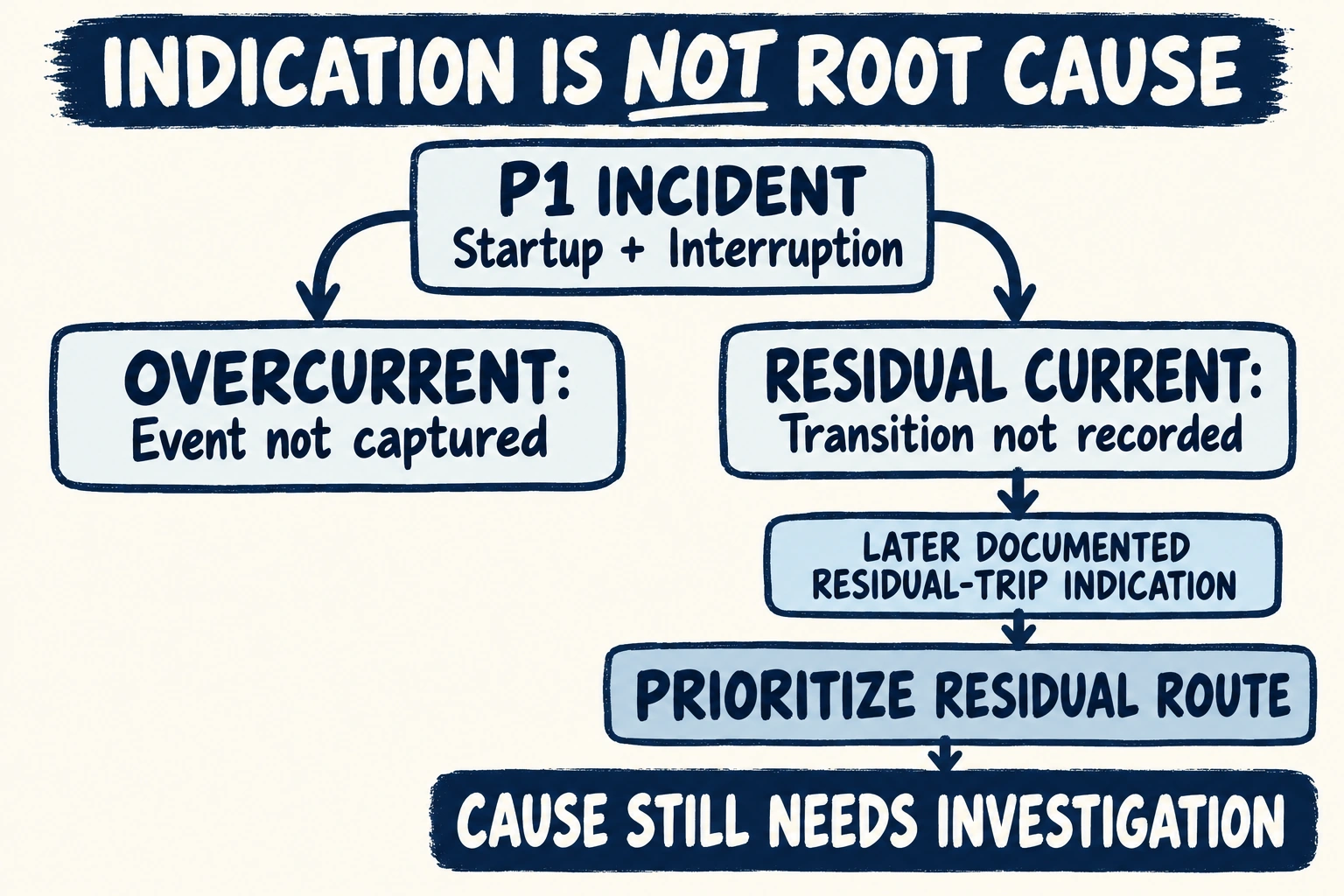
Consider a hypothetical packaging-line record for circuit P1. The controller log shows a startup request immediately before loss of supply. A later steady-state load reading is below the installed RCBO's rated current, but no startup-current record was captured. The model's available instructions provide no dedicated cause-of-trip indicator. No actual RITOKS test or customer event is represented by these assumed facts.
The filled first row is “startup coincided with interruption; cause indicator unavailable; steady reading does not cover event; overcurrent route unresolved.” The second is “residual-current behavior during transition not recorded; equipment configuration and circuit ownership need review; residual route unresolved.” These rows do not say that two faults occurred. They say that the available evidence cannot yet distinguish two plausible mechanisms. Keeping both questions visible is more accurate than labelling the incident a short circuit from its speed or excluding overload from a later reading.
Suppose the investigation later produces a documented, model-specific residual-trip indication recorded before reset. That changes which evidence route is most directly supported: the professional can prioritize the recorded residual event and assess the relevant equipment and current paths. It still does not identify the exact insulation fault, wiring issue or leakage source from the flag alone. The record should retain that distinction between function indicated und cause established.
Alternatively, suppose representative load-event evidence and the selected device characteristic support an overcurrent explanation. The reviewer can then document that basis and the necessary corrective scope. A statement that the device has a larger available current variant is not equivalent evidence. The purchasing request follows the accepted finding: repair affected equipment, correct an identified installation issue, replace a documented damaged device, or review a justified design change. It should not be decided before the mechanism is supported.
For P1, the interim enquiry can ask for the exact installed device's indicator description and applicable characteristic while the site professional owns the event investigation. That is a focused next step, rather than an order for a less sensitive or higher-rated replacement. When the final finding arrives, retain the initial uncertainties beside the new evidence so a future incident can be compared with what was actually established.
Literaturverzeichnis
- ABB. (2024, January 28). Compact impact: ABB's new DS301C compact circuit breaker. Product-specific explanations of overload, short-circuit and residual-current mechanisms, plus its documented earth-fault flag.
- Hager Australia. (n.d.). Modular circuit-protection FAQ. Relevant sections: combined RCBO functions, misplaced neutrals and standing leakage. Retrieved October 2, 2026.
- Health and Safety Executive. (n.d.). Electrical safety: frequently asked questions. Competence, RCD limitations and safe electrical work. Retrieved October 2, 2026.