
AC Contactors for Industrial Motor Control · Technical Explainer
Testing a Reversing Starter Interlock: Write the Acceptance Plan
Define the acceptance boundary
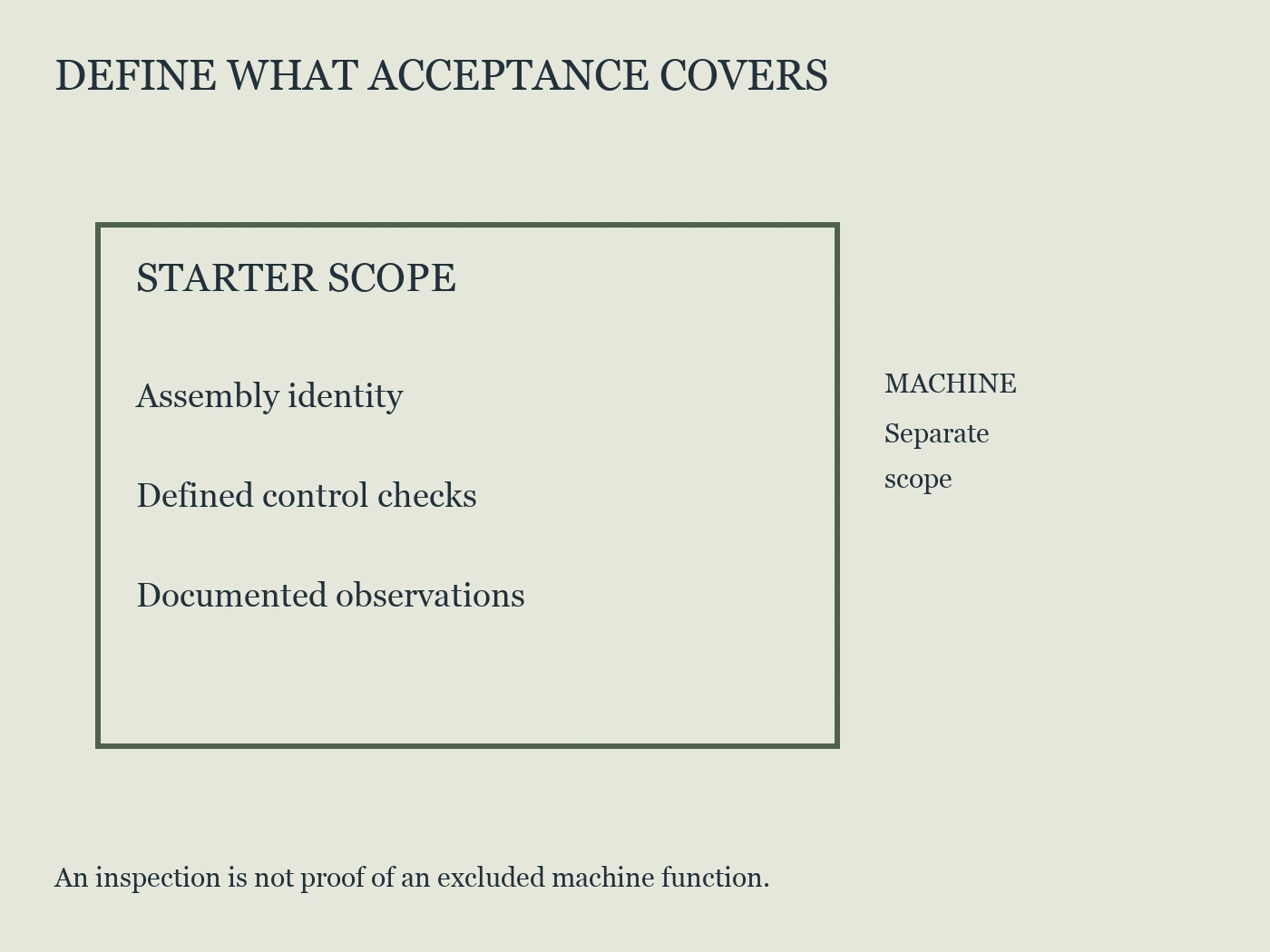
Begin by stating what is being delivered: a mechanical contactor pair, an electrically wired reversing assembly, a complete motor starter, or a machine-control system. Each has a different acceptance boundary. A component inspection cannot prove functions that belong to an excluded controller or to an unconnected machine.
The plan should identify the contactors, interlock accessories, auxiliary contacts, protection devices and control equipment included in scope. Link those identities to the approved drawing and supplier documents. A general brochure for a contactor family is not a substitute for the instructions covering the assembled order codes.
| Acceptance item | Evidence to obtain before testing | Result the record should distinguish |
|---|---|---|
| Mechanical assembly | Compatible frames, interlock part and assembly instructions | Correct installed configuration versus missing compatibility evidence |
| Electrical interlocking | Approved control circuit and contact identities | Expected command exclusion versus an unexplained response |
| Feedback | Signal definition and controller interface | Actual observed indication versus assumed power-contact state |
| Protection response | Device instructions and approved sequence | Defined stop or inhibit behaviour versus an untested function |
| Machine operation | Application requirements and separate test scope | Starter acceptance versus machine-level acceptance |
Schneider Electric's Class 8736 auxiliary-contact FAQ describes electrical-interlocking contacts for specific reversing starters. It is a useful example of a documented function, not evidence that another assembly uses the same auxiliaries. The acceptance plan needs that level of identification for the ordered starter.
Separate checks that answer different questions
A de-energised inspection, an approved control-function test and a machine sequence evaluation should not be combined under one pass box. Ask the manufacturer and responsible engineer which procedures are required and what each demonstrates. Record any excluded test rather than treating an inspection as a complete functional result.
The de-energised part of the plan can require confirmation of component identity, mounting configuration and correspondence with the drawing. How those checks are performed belongs to the approved procedure. Do not use a general article to determine which parts may be operated manually or how a mechanical interlock should be challenged.
The control-function part should define permitted command combinations and expected responses. The machine part, if included, must separately address its operating and motion requirements. An interlocked assembly does not automatically establish that the motor has stopped before a reverse operation or that a safety function has been validated.
| Check category | Typical record question | Boundary that must remain explicit |
|---|---|---|
| Identity and configuration | Do the installed parts match the approved bill of materials? | Matching labels alone does not prove function |
| Approved mechanical check | Was the manufacturer's procedure completed with the stated result? | Do not invent a forcing method or universal acceptance force |
| Command response | Did the defined request produce the specified control response? | A controller indication may not prove every power-contact condition |
| Feedback consistency | Does the indication correspond to its documented meaning? | Feedback interpretation requires the actual contact arrangement |
| Recovery behaviour | What happened after the defined stop or interruption? | Do not assume an automatic restart is permitted |
These categories organise evidence. They are not permission to run every conceivable test on a production machine.
Make command cases specific enough to review
For each command case, list the starting state, requested action, applicable procedure and expected result. The reviewer should be able to tell whether the case concerns a forward request, a reverse request, cancellation, stopping or recovery. A vague instruction to “try both directions” misses the state from which each request is made.
Ask how simultaneous or overlapping requests are handled in the approved design. The manufacturer and test supervisor must determine an appropriate way to verify the specified exclusion behaviour without creating a hazardous power-circuit condition. Do not improvise by energising both coils or bypassing an installed blocking element.
Include the response to a direction request received while the preceding sequence is incomplete if that behaviour is within the supplied controller's scope. A command may be rejected, retained or handled through another approved process. The acceptance record should capture the designed response, not select one on behalf of the machine engineer.
For each case, distinguish command acceptance, contactor feedback and any required machine condition. If the only available observation is a screen label, record that limitation. A test plan becomes more useful when it says precisely what was observed than when it applies a broad “safe” conclusion to a narrow indication.

Set the conditions and criteria before the test
Record the approved test environment, control supply and relevant equipment configuration. Identify the test instruments or observation method where required by the procedure. A pass criterion should come from a documented function or requirement, not from whatever happened during the first attempt.
Where a manufacturer gives a model-specific procedure, attach its revision and relevant section. Where the equipment documentation leaves a question open, obtain clarification before the plan is approved. Do not transfer a procedure for a different interlock or contactor frame merely because the devices look similar.
The plan must also identify who is responsible for isolation, access control and authorising any energised work. Schneider's TeSys Giga installation guide illustrates why the specific control arrangement and qualified application review matter. Its documentation is not an interchangeable testing instruction for UKC1-R.
Do not place destructive, endurance or fault tests in a routine acceptance plan unless the manufacturer and project explicitly require and authorise them. The objective is to verify the contracted functions through suitable evidence, not to discover limits by stressing an unidentified assembly.
Preserve deviations rather than retrying them away
If an expected response is absent, stop that case according to the approved procedure and record the observed state. Keep the command, indication, component identity and drawing revision together. The next engineering question is whether the issue concerns the specified function, installed configuration, wiring, feedback or test method.
Do not repeatedly operate the assembly until the result appears acceptable and then retain only the successful attempt. A deviation can reveal an important mismatch between the quotation, controller program and actual hardware. The responsible team needs the original evidence to decide what correction and retest are required.
Classify an unperformed check as not tested, not as pass. Classify missing manufacturer compatibility evidence as unresolved even when an isolated functional observation appears normal. Acceptance depends on the specified evidence set; a visible response should not erase an outstanding configuration question.
After an authorised correction, identify exactly which cases are repeated and why. Keep the before-and-after record so the final acceptance demonstrates that the deviation was resolved rather than merely omitted from the report.
An original handover example
Consider a hypothetical panel in which the approved drawing identifies an electrical-interlocking auxiliary, but the supplied bill of materials lists only the contactor frames and a mechanical accessory. The panel contractor reports that the pair cannot operate simultaneously and marks the starter accepted.
The quality reviewer should ask what procedure produced that observation and which electrical function was actually verified. The mechanical observation does not resolve the missing auxiliary identity. First reconcile the installed components with the approved control drawing and supplier documentation; then define the applicable electrical response checks.
If the assembly was sold without control wiring, the commercial scope may explain the omission. If wiring was included, it may be a delivery deviation. The acceptance plan exposes that distinction before it becomes a disagreement at commissioning. This example is a purchasing and documentation scenario, not a reported RITOKS fault or a performed test.
Specify the UKC1-R handover evidence
Before sending the plan for approval, create a document index linking each case to its requirement, drawing revision and evidence location. Assign an owner to questions that are still open. This makes a later reviewer able to distinguish a missing file from an excluded function or an actual deviation, without reconstructing the entire project from email attachments.
Also specify the permitted result vocabulary. Completed with documented conformity, deviation recorded, not tested and outside scope should remain distinguishable. A blank result is not acceptance. Where acceptance depends on another party's report, identify that dependency and the document still required rather than copying a general pass statement into every case. These are proposed record controls, not claims that a particular starter or installation has already passed them.
Die veröffentlichten RITOKS UKC1-R reversing contactor assembly describes an interlocked pair and calls for application-specific confirmation of duty, coil requirements and reversing frequency. Request the exact assembly configuration and supporting interlock documents with the quotation.
Ask which mechanical and electrical elements are supplied, whether control wiring is included and which manufacturer acceptance procedures accompany the order. Provide the approved control drawing and state requirements so the supplier can distinguish a hardware deliverable from a complete controller or machine function.
The final handover record should include equipment identity, document revisions, accepted scope, test conditions, case results, deviations and responsible approval. Keep the machine's separate motion and safety requirements visible where they are outside starter acceptance. A concise, traceable plan is more valuable than a broad pass statement that cannot be connected to the ordered parts or the tested function.
Literaturverzeichnis
- Schneider Electric. FAQ FA114642, published December22,2005; modified August15,2026. Electrical-interlocking auxiliary contacts on specified Class8736 starters.
- Schneider Electric. Control Wiring Diagram with Electrical Interlocking, TeSys Giga installation guide, DOCA0189EN-05, n.d.; specific documentation context and qualified application-review limitations. Official guide.