
Enclosure Heat Exchangers · Technical Explainer
Below-Dew-Point Cooling Water: Manage Condensation Inside the Cabinet
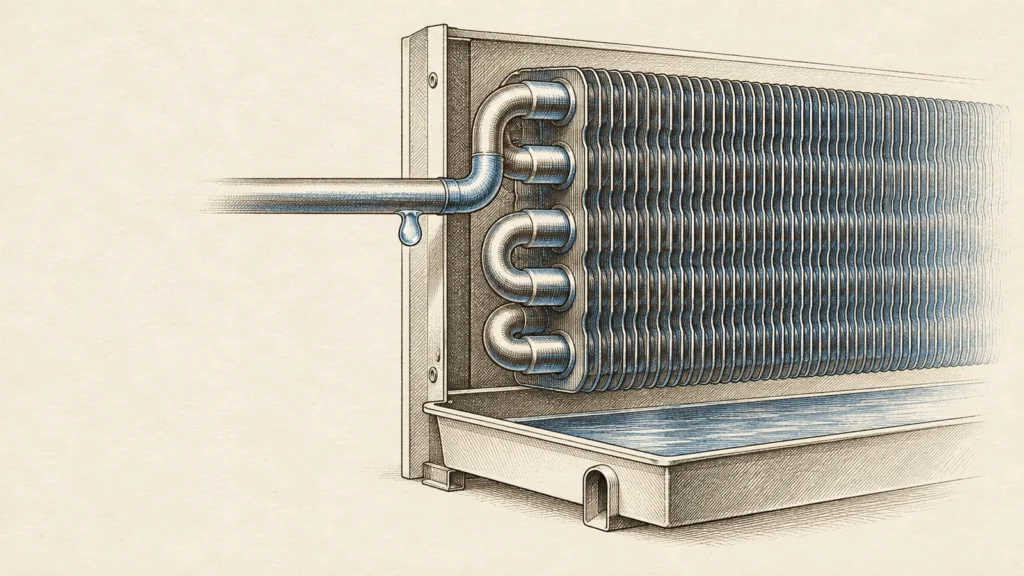
A normal cabinet temperature does not prove every surface is dry
An air-to-water enclosure heat exchanger can remove heat while moisture creates a separate problem. A cabinet temperature reading may look acceptable even though a cold pipe, fitting or heat-exchanger surface is below the dew point of the air around it. The purchasing question is therefore not simply whether the cooling unit can hold a temperature. It is whether the completed water-cooled enclosure manages intended condensate, avoids uncontrolled moisture and has an observable response to abnormal conditions.
Begin with the water circuit and the air conditions as separate inputs. Identify the proposed heat exchanger, cooling-water supply, enclosure sealing arrangement and humidity exposure. The RITOKS air-to-water enclosure heat exchanger family provides a relevant starting point for the cooling unit, but its family name does not establish the condensate arrangement, controller functions or accessories of a specific supplied configuration.
This guide is an RFQ and acceptance framework. It does not set a universal cooling-water temperature, insulation thickness, alarm threshold or drain size. Those choices require the actual unit instructions and the equipment design. Installation, testing and corrective work should be carried out by qualified personnel, with electrical and water-system hazards controlled.
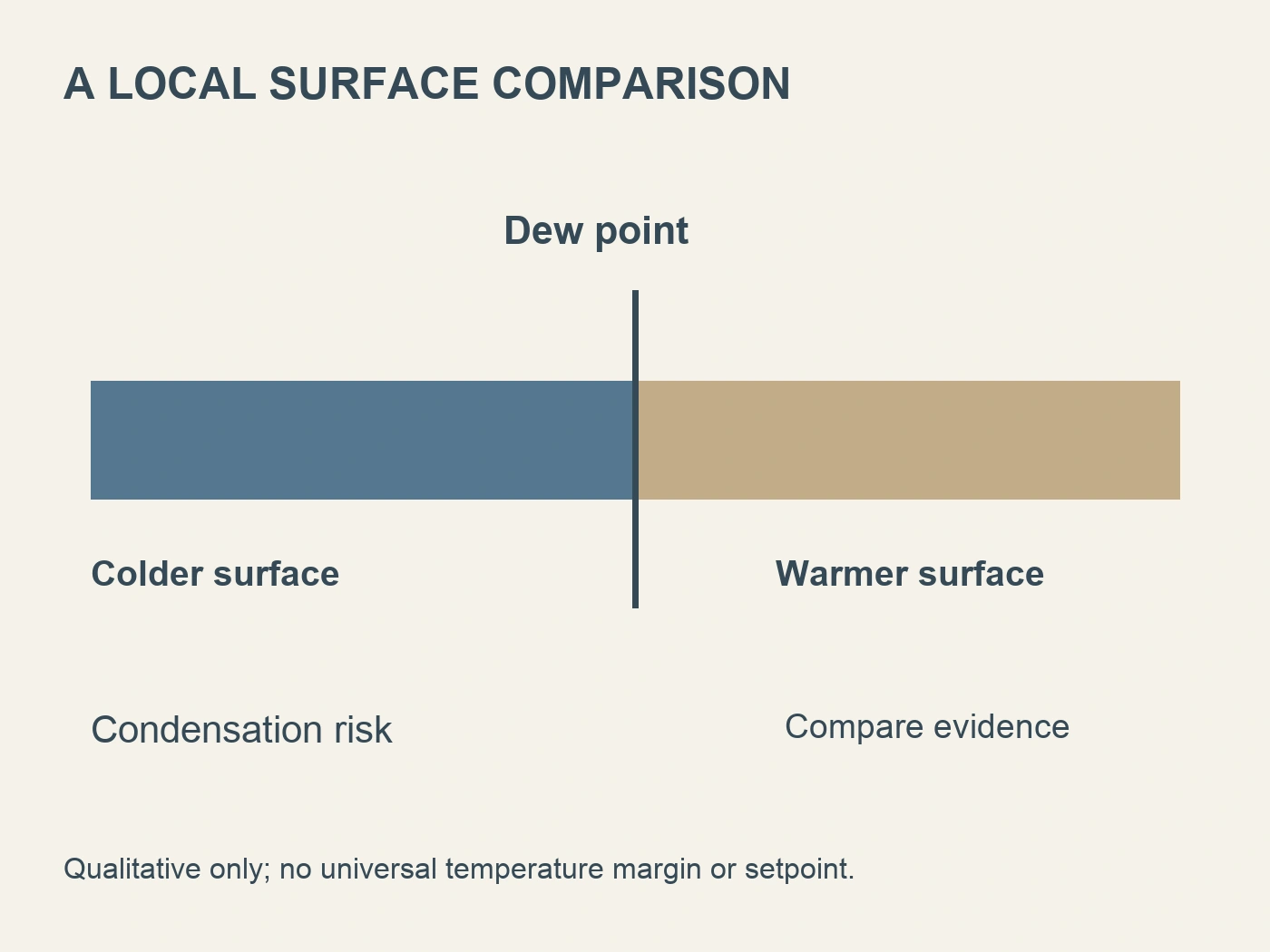
Compare the local surface with the local air dew point
Dew point is the temperature at which an air sample reaches saturation when cooled under the relevant conditions. The Vaisala dew-point explanation uses a cold pipe to illustrate condensation: the pipe surface becomes cold enough for moisture from the surrounding air to form liquid. That is the relevant distinction for a cabinet, rather than treating the main air-temperature display as the coldest point.
The cooling-water inlet temperature is useful evidence, but it is not a measurement of every exposed surface. Conditions differ around connections, supply lines, the coil and the air leaving it. Identify the surfaces exposed to humid air and the locations at which temperature and humidity evidence will be obtained. State whether a value is measured, calculated or inferred from another location.
Relative humidity alone does not define one universal condensation threshold. Record its temperature context and use a suitable dew-point method for the project. Do not infer that a hygrostat switching at a selected relative humidity proves all cold surfaces are above dew point. Nor should a comfortable ambient condition outside the cabinet substitute for evidence inside it after operation or a door-opening event.
Distinguish intended coil condensate from uncontrolled moisture
Some heat-exchanger arrangements are designed to collect and discharge condensate generated at the cooling surface. This does not make condensation at an exposed fitting, cable route or electronic component acceptable. Draw the intended collection boundary and identify which cold parts lie outside it. A tray beneath the coil should not be assumed to catch droplets from every water connection.
Die Rittal air/water heat-exchanger instructions describe condensate collection and discharge for their named equipment, while treating leak detection as a separate function on particular configurations. That supports separating the questions, not attributing the same features to a RITOKS configuration. Ask the supplier for the exact unit's collection path, discharge arrangement and optional monitoring scope.
For exposed cold-water parts, ask the equipment designer which surfaces need a documented protective treatment and how it remains continuous across fittings and service points. Do not specify an arbitrary insulation material or thickness from a generic blog. Obtain a solution appropriate to the temperatures, humidity exposure, access requirements and manufacturer constraints of the actual system.
Give condensate an identifiable, maintainable destination
A discharge connection is only the beginning of a condensate path. Follow the intended route to its destination and identify support, access, obstruction risks and any changes introduced by installation. Confirm the route against the exact unit's instructions rather than applying a hose requirement from a visually similar device.
In the named Rittal manual, the condensate section emphasizes unobstructed drainage and avoiding hose kinks. This is a useful inspection example; its dimensions and installation details should not be copied to an unrelated unit. For the proposed assembly, request the required routing conditions and any restrictions on extension, elevation or discharge arrangement.
Include the final cabinet location in the review. A drain that was convenient on a workshop stand may become inaccessible, pinched or altered when the cabinet is installed. Maintenance should be able to identify its route and inspect the relevant collection points without relying on memory. Where a destination depends on a building service or another machine, make that interface part of the handover.
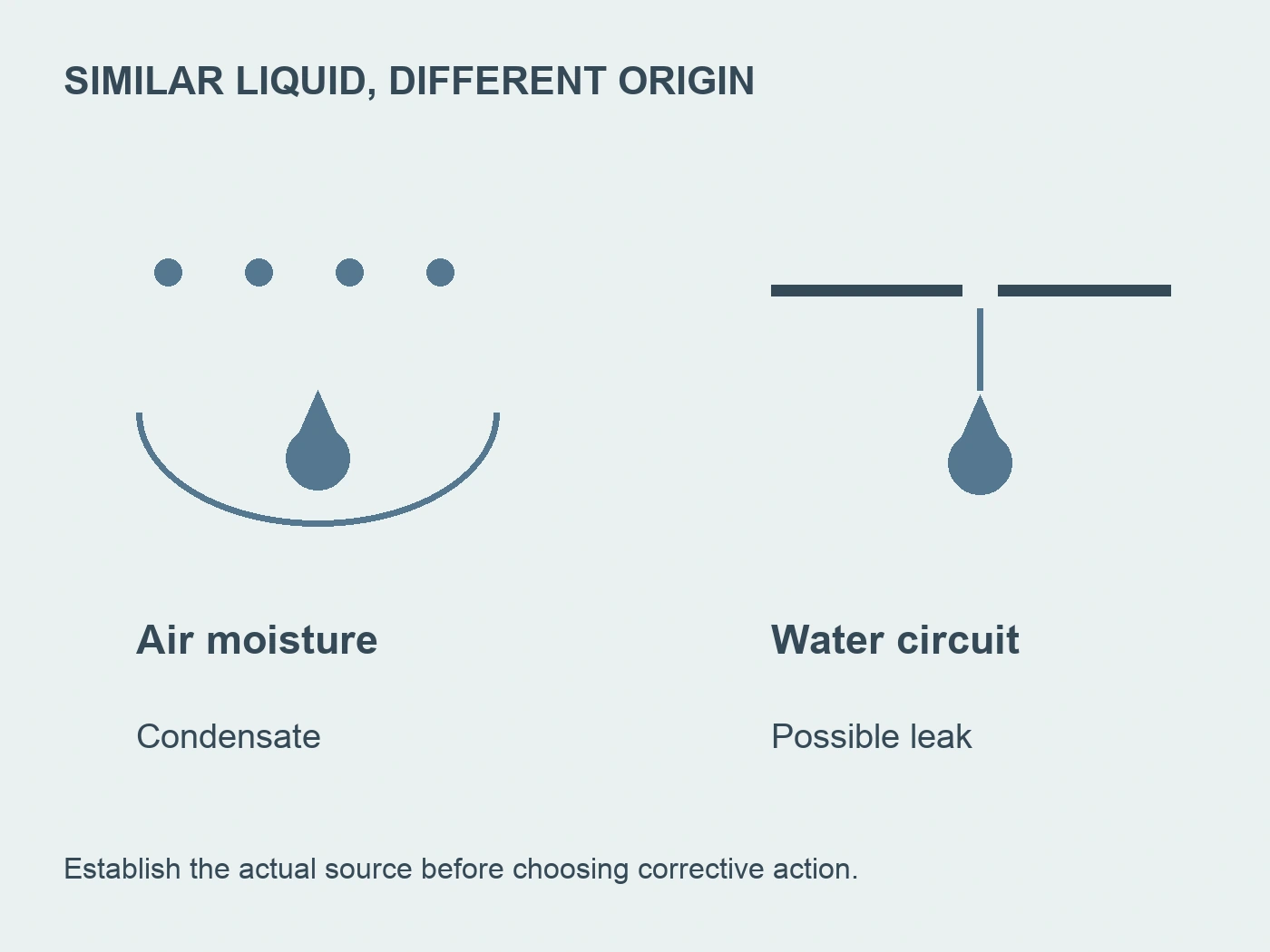
Do not confuse a water-circuit leak with condensation
Water found in a cabinet needs investigation, not an immediate assumption that the drain is blocked. Condensate comes from moisture in air; a water-circuit leak comes from the supplied circuit or its connections. Both may appear near the cooling unit, but their corrective actions and monitoring requirements differ. A location photograph alone may not distinguish them.
The specification should separately identify condensate observation, water-circuit integrity and any sensor intended to detect unwanted liquid. Ask what a sensor monitors, where it is placed, which fault it can indicate and whether it initiates an alarm, a valve action or another documented response. Do not infer automatic water isolation from the phrase leak detection.
| Observation | Question to investigate | Aufzubewahrende Unterlagen |
|---|---|---|
| Moisture at the designed collection point | Is intended condensate leaving by the approved route? | Collection and discharge inspection |
| Droplets on an exposed cold fitting | Is that surface outside the protected collection boundary? | Local surface and air-condition evidence |
| Liquid near a water connection | Is the circuit leaking, condensing or both? | Qualified circuit and moisture investigation |
| An alarm without visible water | What does that sensor actually detect? | Sensor location, logic and event record |
Keep uncertainty explicit until the source is established. Repairing a connection does not demonstrate the condensate route, and clearing a drain does not demonstrate the integrity of the water circuit. Acceptance should include the functions actually supplied, not a generic list of desirable protections.
Review door opening, low load and restart conditions
The cabinet does not operate in only one steady state. Door opening can change the humidity exposure, while low equipment load, stopped airflow or a restart sequence can change the relation between cold surfaces and surrounding air. List relevant operating states before choosing a control response. Do not invent a rule that all water flow must stop whenever any door opens.
Some named heat-exchanger systems provide documented door-related control behavior. The Rittal manual is one such example, but the delay, interface and operating sequence are specific to that system. For the proposed unit, ask what door or supervisory inputs exist, whether they are included and how they interact with water and fan control. If no such function is supplied, the overall equipment design must address the requirement separately.
Review the sequence when cooling water becomes available before the equipment heats the enclosure, and when the enclosure is shut down while water remains available. Record the required operating limits and responsible control function. A policy should be based on manufacturer instructions and the equipment risk assessment, not a copied temperature threshold from another product.
Understand what a humidity controller can and cannot establish
A humidity-control device can be part of moisture management, but its name does not prove dew-point control. The RITOKS enclosure hygrostat family represents a different component role from an air-to-water heat exchanger. Keep the device's measured quantity, switching function and connected equipment explicit instead of presenting it as an automatic cure for condensation.
If a design calculates dew point from temperature and humidity, ask where those values are obtained, how they represent the relevant air and how the calculation is used. If it uses a simple humidity switching contact, describe that function honestly. In either case, a sensor elsewhere in the cabinet does not directly measure the temperature of a cold pipe unless that additional measurement is actually provided.
Define behavior for a missing, invalid or stale reading. Ask which alarm is visible and whether cooling continues, changes or requires operator intervention under the documented arrangement. Avoid assuming that adding a humidity controller creates a safety function or guarantees dry electronics. The acceptance question is whether the completed system meets its defined moisture-management requirement under the agreed conditions.
Build an acceptance record around the completed assembly
Prepare the record before testing. Identify unit and accessory designations, document revisions, water conditions, relevant air observations, cabinet configuration and the operating state being demonstrated. Include the installed drain route and exposed cold-water surfaces. A workshop test with an open cabinet should not silently stand in for the normal closed-cabinet arrangement.
Qualified personnel should select safe, manufacturer-approved methods to observe collection, discharge and any supplied alarms or interlocks. Do not deliberately wet live equipment or block a drain as an improvised fault test. Where a response cannot be safely demonstrated, record the supporting documentation and mark the live demonstration unverified rather than describing it as passed.
Retain observations across the states selected by the equipment designer, including relevant start, stop and access events. Record any discrepancy between expected and observed behavior and assign a corrective action. Do not use a photograph of a dry tray during one short run as proof that condensation can never occur in other humidity or water-supply conditions.
Ask for a moisture-management scope, not just cooling capacity
For an RFQ, describe the enclosure, intended water circuit, humidity exposure and operating sequence. Request the exact cooling unit, condensate arrangement, required accessories, exposed-pipe treatment and monitoring functions. Separate what the unit manufacturer supplies from what the cabinet builder or site installer must provide. This prevents a drain, sensor or supervisory connection from becoming an undocumented assumption between parties.
For the RITOKS air-to-water heat exchanger range, ask for configuration-specific evidence before accepting a moisture-control claim. The useful deliverable is a completed interface record: where condensation is intended, how it is collected, which other cold surfaces are addressed and how abnormal conditions are identified. Cooling capacity and condensation management are related purchasing questions, but one does not answer the other.
Source notes
Primary manufacturer sources were reviewed on 2026-09-30. Vaisala supports the dew-point distinction; Rittal provides named-equipment examples of condensate handling, monitoring and door-related behavior. No Rittal specifications or supplied features are transferred to the RITOKS range. RFQ and acceptance questions are original buyer guidance; exact limits, dimensions, materials and protective functions remain configuration-specific.