
Rack PDUs & Socket Modules · Technical Explainer
Regional PDU Sockets: Verify Plug Fit, Earthing and Voltage Together
Quick Answer
Regional PDU socket compatibility requires more than a plug that fits. Confirm the exact equipment plug and output socket system, supply voltage and frequency, protective-earth requirements, applicable ratings and destination evidence for the assembled PDU. A regional label, universal socket description or component certificate cannot resolve every one of those checks.
For an export cabinet, the downstream connection deserves its own purchasing record. The PDU input may match the site supply while an output socket remains unsuitable for the equipment cord. Equally, a downstream plug can appear to fit while electrical or approval questions remain unresolved. Do not let an input-plug review stand in for the output-interface review.
This guide builds a regional PDU socket, plug, earthing and voltage compatibility matrix for cabinet OEMs and international project buyers. It focuses on equipment-to-PDU outputs, distinguishes modules from complete assemblies, and identifies the evidence required before accepting a configuration.
Identify the Output System Before Choosing a Region
Begin with the actual equipment cord and connector, not the destination country alone. Record the plug or appliance-coupler identity, supplier part reference and drawing. Then ask which exact PDU output is intended to mate with it. Photographs help communicate the proposal but should not replace documented identification.
Regional mains socket systems and IEC appliance couplers are different identification routes. IEC 60884-1:2022 covers household and similar AC plugs and socket-outlets, with compatible combinations forming systems. Its public scope references the inventory of standardized systems in IEC/TR 60083. That does not establish that any socket advertised for a country complies with that country's current requirements. (IEC, 2022)
IEC 60320-1:2021 covers appliance couplers, including relevant inlet and outlet arrangements, with variants both with and without an earth contact. Its public abstract identifies the standards family; it does not provide enough detail to approve an unspecified C13 or C19 part, assign its rating or verify a proposed mating pair. (IEC, 2021)
The useful outcome is an interface description that a supplier can answer precisely. Replace “European outlet” or “US socket” with the proposed component identity, applicable system, equipment connection and evidence request. If identification remains open, mark it open instead of assigning a standard from the shape of the holes.
Keep Fit, Electrical Compatibility and Approval Separate
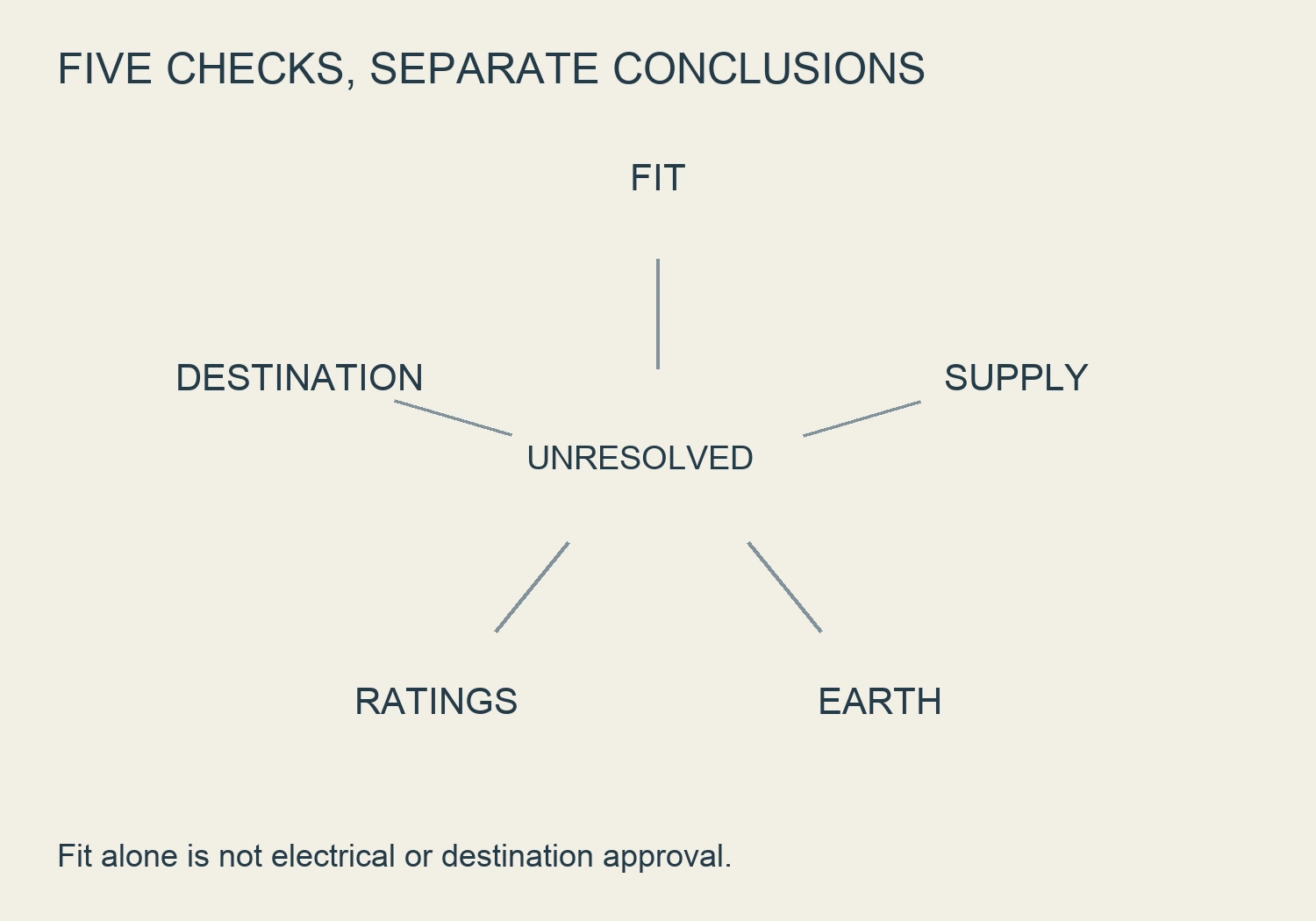
A purchasing matrix should distinguish physical connection, electrical suitability and destination acceptance. Each can require different documents and a different decision owner. A positive result in one column must not silently fill the others. This is particularly important when one cabinet design is offered in several output configurations.
Electrical Safety First explains that a travel adaptor changes the connection interface but does not convert voltage or frequency. Its guidance also highlights earthing and appliance-rating considerations. Those principles help expose an assumption, but the consumer guidance does not approve an adaptor or output arrangement for a fixed industrial rack PDU. (Electrical Safety First, n.d.)
Treat the following table as an evidence map, not a list of automatic approvals.
| Überprüfen | Question for the proposed output connection | Evidence needed |
|---|---|---|
| Physical interface | What exact plug or coupler mates with this output? | Part identities, drawings and documented mating arrangement |
| Supply and equipment | Does the equipment accept the available voltage and frequency? | Equipment input documentation and defined supply conditions |
| Schutzerde | What does the equipment require, and does the selected arrangement provide it? | Applicable equipment and assembly documentation |
| Ratings | Which limits govern the outlet, cord and complete PDU? | Exact-component and assembled-unit ratings and instructions |
| Reiseziel | What evidence is required for this configuration in this project? | Current applicable requirements and configuration-specific supporting records |
Do not write “compatible” without stating which check was completed. For example, an equipment-cord drawing may settle connector identity but say nothing about the PDU's assembly approval. Keeping the columns separate prevents a useful document from being credited with conclusions outside its scope.
Confirm Voltage and Frequency Without Assuming Conversion
Record the intended supply conditions and compare them with the equipment's documented input requirements. Do not infer equipment compatibility from the PDU's listed voltage alone. A PDU entry describes that product's proposed use or rating; it is not evidence that every device connected downstream accepts the supply.
Regional socket selection is not a voltage-conversion function. A mechanical adaptor is not such a function either, as Electrical Safety First's guidance makes clear. If equipment compatibility depends on a separate conversion arrangement, that arrangement needs its own identified equipment and supporting review. It must not be implied by the socket choice. (Electrical Safety First, n.d.)
Include frequency in the equipment check rather than leaving a blank because the plug fits. Obtain the actual equipment input document and retain its model applicability. Where equipment variants differ, the matrix should identify which one is being supplied to the project.
Avoid selecting a destination solely from a familiar voltage figure. Destination requirements and the proposed output system still need confirmation. A voltage entry does not identify a national socket standard, establish protective-earth continuity or prove that a complete unit carries an applicable approval.
Resolve Protective Earth at the Equipment Interface
Earthing should be reviewed against the equipment requirements and the exact proposed connection. Do not assume that a visible earth contact or a three-slot appearance closes the question. Obtain documentation identifying the selected output and the arrangement within the complete assembly, then assign the application decision to the responsible engineer.
Electrical Safety First cautions that some adaptors are unsuitable for appliances requiring an earth connection. The purchasing lesson is to verify the requirement and the actual connection path, not to assume every physically insertable arrangement satisfies it. Its advice is not a substitute for the engineering documentation of a fixed PDU installation. (Electrical Safety First, n.d.)
Likewise, a double-pole switch description does not establish a protective-earth arrangement. Keep switching behavior and earth requirements as separate entries. Do not infer terminal connections, conductor colors or installation procedures from a product title.
The RFQ should ask for the applicable exact-configuration information and identify who will assess it. This article does not prescribe an energized test or a universal acceptance value. Safe verification and acceptance criteria belong to the qualified engineering team working with the actual assembly and applicable requirements.
Distinguish Outlet Modules from Complete PDUs
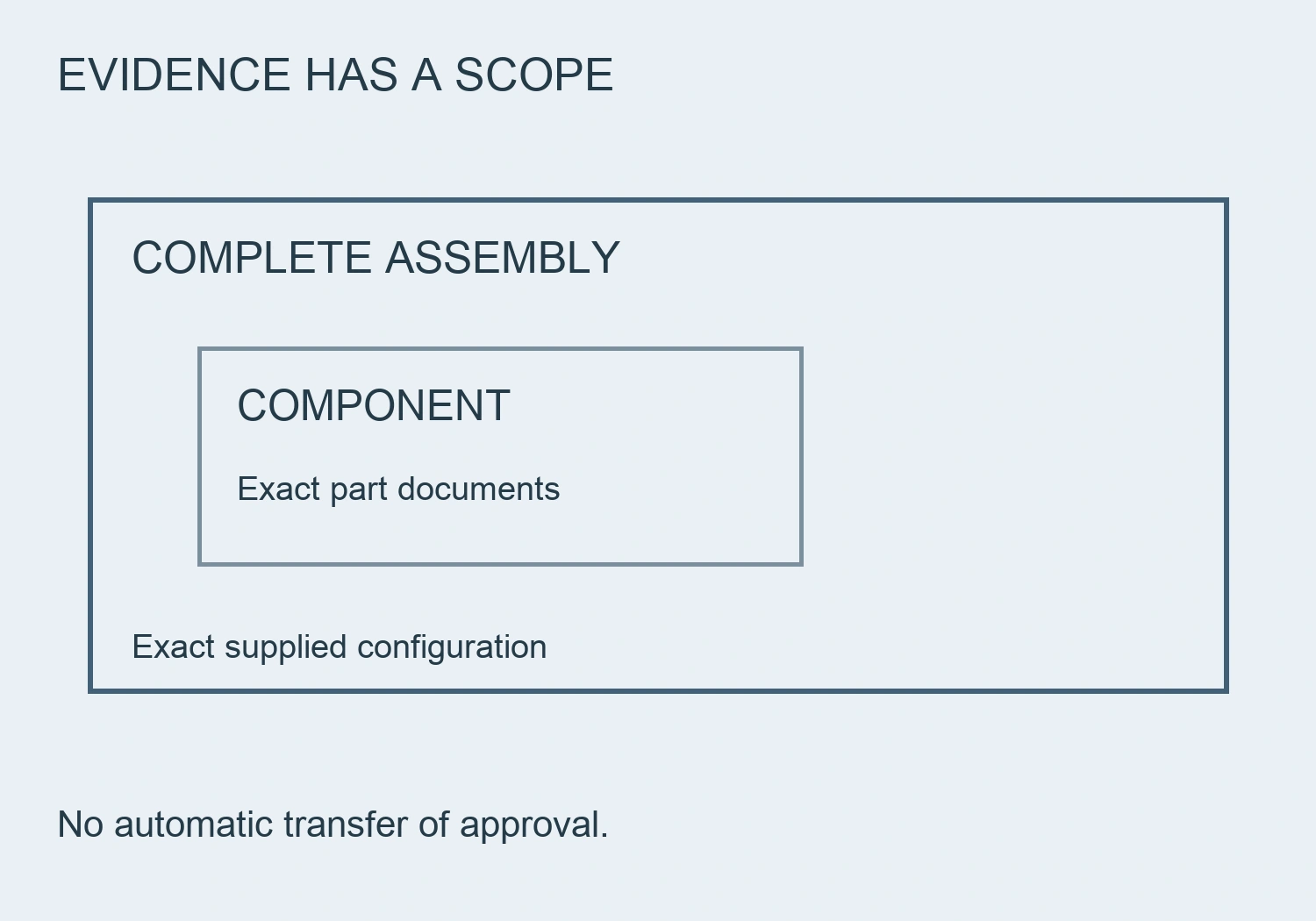
An outlet component and an assembled PDU require different evidence scopes. A module document may identify a component, mounting interface or rating. It does not automatically establish the rating, internal connections or destination acceptance of every assembly made with it. Ask which supplied item each document actually covers.
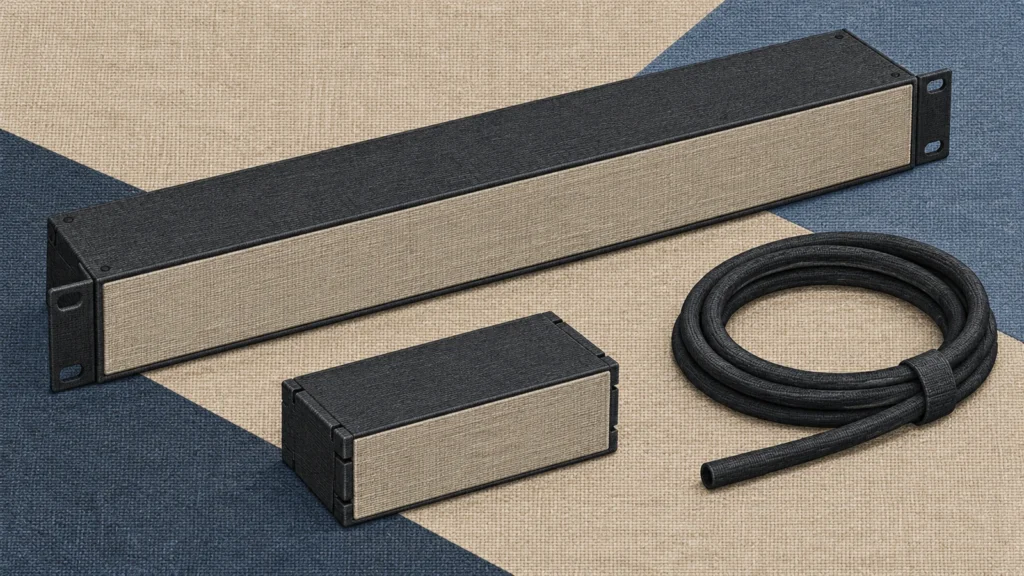
Die modular PDU outlet socket and retention component family is a component-level sourcing route. Its regional, universal and IEC-labelled options need exact-part confirmation. Selected supplier rating entries are not whole-family ratings, and a retention accessory does not demonstrate electrical compatibility or regional approval.
For a module inquiry, request the chosen outlet identity, applicable ratings, cutout and terminal documentation, and any supporting conformity records for that exact part. Identify the proposed assembly separately. If the enclosure OEM will assemble it, the responsibility for reviewing the finished configuration must be explicit rather than hidden behind the module quotation.
For a complete PDU inquiry, request documentation for the supplied unit and selected options. A housing-only option is not equivalent to a finished electrical assembly. Its empty enclosure may match a cabinet mechanically while leaving the electrical configuration entirely to be confirmed.
Check the Scope of Regional Product Listings
Product-family pages help narrow the sourcing discussion, but their labels must not be expanded into undocumented standard or approval claims. Confirm the selected configuration, not just the family name. Ask for records that match the actual item being quoted and delivered.
Die eight-outlet US-style rack PDU provides an assembled-unit sourcing option distinct from the socket components. “US-style” does not establish an exact NEMA configuration, UL or ETL certification, or acceptance for a particular destination. The separate housing-only option also requires its eventual electrical assembly to be identified and assessed.
Die configurable 1U rack PDU family is another assembled-family reference. The available outlet description does not resolve an exact regional socket standard. Its double-pole switch description is not evidence of voltage conversion or a protective-earth guarantee. Cord and installation arrangements also need configuration-specific confirmation.
Keep these boundaries in the comparison sheet. A supplier description can establish which inquiry to send without closing every engineering question. Where evidence is pending, retain that status rather than adding a familiar certification mark or national standard by assumption.
Build an Output Compatibility Matrix for the RFQ
Use one row for each equipment-to-output arrangement, not just one row for each country. A project can contain different equipment cords, and a standard cabinet can have several offered output modules. The matrix should keep those combinations identifiable so a quotation response can be checked against the correct request.
Here is an illustrative blank structure. It records no tested or approved configuration.
| Matrix field | Record to enter | Decision or response owner |
|---|---|---|
| Equipment identity | Exact equipment model and applicable input document | Equipment supplier or system engineer |
| Cord interface | Exact plug or coupler and drawing reference | Equipment supplier |
| Proposed output | Selected module or complete PDU variant | PDU supplier |
| Supply conditions | Project voltage and frequency definition | Project electrical engineer |
| Earth requirement | Equipment requirement and assembly evidence | Responsible engineer |
| Rating scope | Component, cord and complete-unit limits, as applicable | Supplier and engineering reviewer |
| Destination evidence | Current requirements and matching supporting documents | Project compliance owner |
| Conclusion | Accepted, conditional or unresolved, with document revisions | Design-release owner |
For example, a buyer might receive an equipment-cord drawing before the complete PDU documentation. The correct record is “interface identity documented; assembly review pending,” not an invented overall pass. If the selected outlet changes after quotation, review the affected entries against the new configuration.
This is a proposed workflow rather than a mandatory certification process. A team may combine responsibilities, but it should preserve the distinction between supplying evidence and accepting the application. The supplier's sales label should not become the engineering reviewer's conclusion by default.
Allocate Compatibility Work Before Comparing Cost
A lower module price can leave more interface and assembly work with the cabinet OEM. A complete-unit quotation can also leave gaps if its configuration or approval scope is unclear. Compare the scope of supplied evidence alongside the hardware, without inventing a cost saving or assuming one procurement route is always preferable.
Before ordering, resolve who supplies the equipment documentation, who identifies the output system, who assesses earthing and ratings, and who confirms destination requirements. Record any remaining work as an assigned action. This makes the quotation comparison more useful than a simple socket-count and price table.
Use the RFQ to request:
- Exact module or finished-unit identification, including selected options.
- Documented output-to-equipment mating arrangement.
- Applicable ratings and instructions for the actual supplied configuration.
- Earthing information relevant to the equipment and complete assembly.
- Supporting destination records with their product and configuration scope.
- Explicit limitations, pending documents and responsibilities retained by the OEM.
Häufig gestellte Fragen
Does a universal socket mean the PDU is suitable for every country?
No. The description does not establish every mating arrangement, electrical rating, earth requirement or destination approval. Identify the exact component and proposed equipment connection, then review the applicable assembly and project evidence.
Can I select the output socket from voltage alone?
No. Voltage is one input. The connector system, equipment frequency requirements, protective earth, ratings and destination evidence remain separate checks. A matching voltage entry does not identify a regional socket standard.
Are C13 and C19 labels enough to confirm compatibility?
They help frame the inquiry, but the selected part and equipment connector still need identification and applicable documentation. The IEC 60320-1 public abstract does not establish exact mating details or ratings for unspecified components.
Does a module certificate approve the finished rack PDU?
Not automatically. Check what exact item and configuration the document covers. Component evidence and complete-assembly evidence have different scopes, and the application reviewer must identify what is still required for the supplied unit.
Conclusion
Regional PDU output selection is a coordinated interface review. Verify the equipment connection, voltage and frequency, protective-earth requirements, ratings and destination evidence together, while retaining their separate conclusions. Physical insertion alone cannot answer those questions.
Start the RFQ with the exact equipment and proposed output configuration. Keep socket components distinct from complete PDUs, and do not turn regional or universal labels into undocumented approvals. A clear compatibility matrix gives the supplier a precise request and gives the cabinet team a defensible record of what remains to be resolved.
Literaturverzeichnis
- International Electrotechnical Commission. (2022). IEC 60884-1:2022: Plugs and socket-outlets for household and similar purposes, Part 1: General requirements. Public scope and publication information.
- International Electrotechnical Commission. (2021). IEC 60320-1:2021: Appliance couplers for household and similar general purposes, Part 1: General requirements. Public scope and publication information.
- Electrical Safety First. (n.d.). Travel adaptors. Connection, voltage and earthing guidance.