
Power Semiconductor Modules · Selection Guide
Diode Rectifier Module Selection Guide: Current, Voltage, Configuration and Model Verification
Selecting a diode rectifier module starts with a defined electrical and mechanical requirement, not with a family name or a photograph.
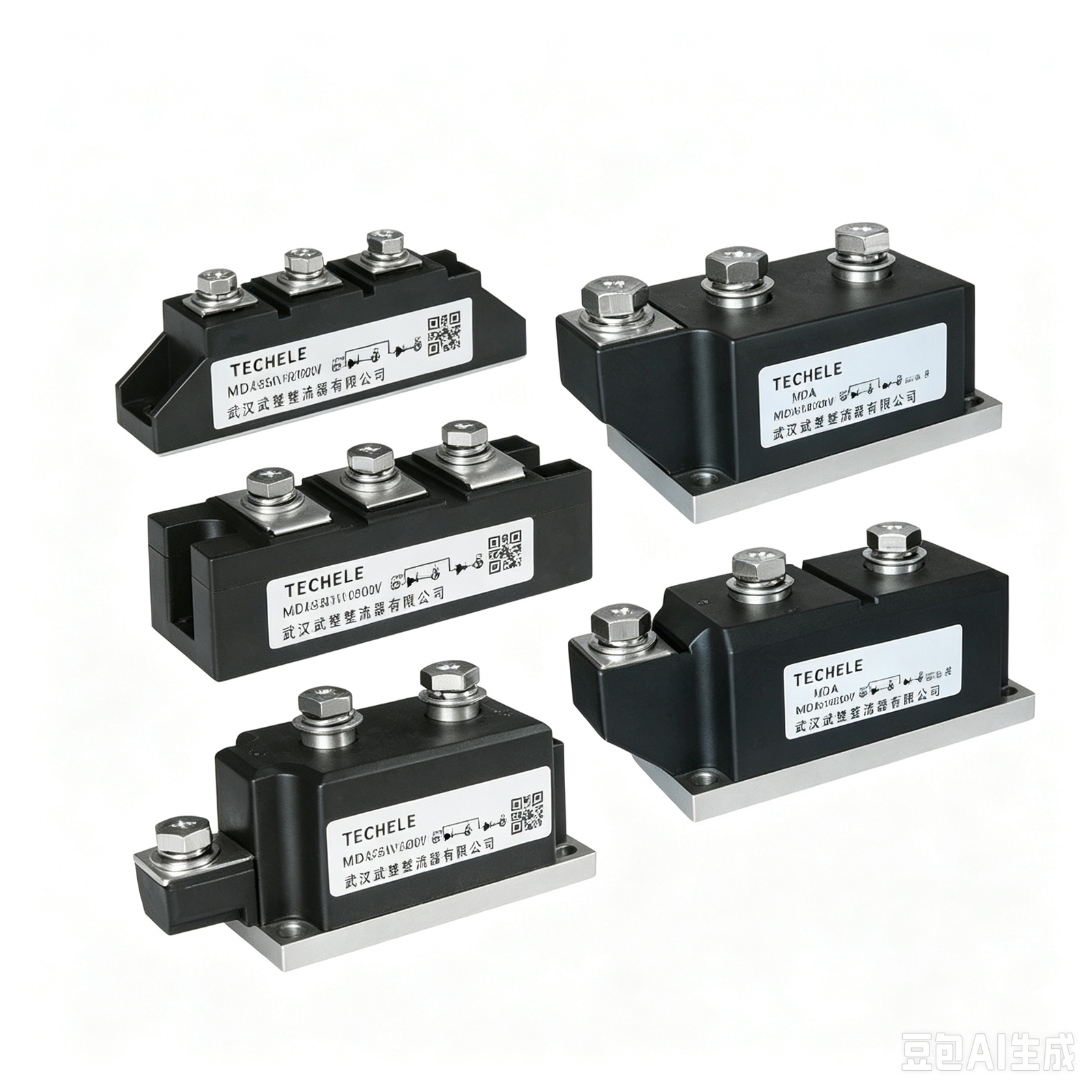
RITOKS currently publishes two diode-module families: the MDA 25A–1000A common-anode dual-diode family and the MD300A 300A nominal anti-reverse family.
Their public pages support initial family screening, but they do not provide every model-specific value needed for engineering approval.
Use this guide to organize an inquiry, compare confirmed published fields and identify the documentation that still needs to be requested before an exact model is selected.
Contents
Diode Module Selection at a Glance
The table separates the information a buyer supplies from the product data that must be confirmed. A current class can narrow the search, but it cannot establish reverse-voltage margin, terminal arrangement, thermal performance or mechanical fit.
| Selection Input | What the Buyer Should Confirm |
|---|---|
| Required current | Use the project requirement to screen a published current class, then verify the exact model |
| Required reverse voltage | Confirm the required reverse-voltage rating and the exact orderable voltage version |
| Module family | Choose a candidate family only after its published scope matches the inquiry |
| Configuration requirement | State the required circuit function without inferring topology from a name or image |
| Terminal/circuit drawing | Request the exact diagram when polarity or terminal assignment matters |
| Package/dimensions | Confirm the exact drawing and mechanical interface |
| Cooling/thermal data | Use model-specific thermal data and the project cooling arrangement |
| Surge/electrical data | Request model-specific ratings and test conditions |
| Documentation | List the datasheet, drawing and evidence required for the project |
| Exact model | Confirm the complete model designation before quotation or ordering |
Official manufacturer references also treat rectifier selection as a multi-parameter process. The ROHM rectifier-diode selection note discusses electrical and thermal characteristics as distinct considerations. Those general principles do not supply specifications for a RITOKS model.
1. Start With Published RITOKS Families
The Power Semiconductor Modules range includes a dedicated Diode Rectifier Modules category. The two current families serve as screening points, not interchangeable solutions.
MDA 25A–1000A Family
The MDA page publishes current classes of 25, 55, 70, 90, 110, 130, 160, 200, 250, 300, 400, 500, 600, 800 and 1000A. Each current row in the current table lists 1600V.
The supplier describes this as a common-anode dual-diode family. That wording supports a family-level configuration statement, but the public page still lacks the exact circuit drawing, terminal map and package drawing required for final verification.
The page also carries a supplier reference of 2500V AC for isolation withstand. It does not publish the associated test standard or full conditions, so the value must remain a supplier reference that requires confirmation for the exact model.
MD300A 300A Nominal Family
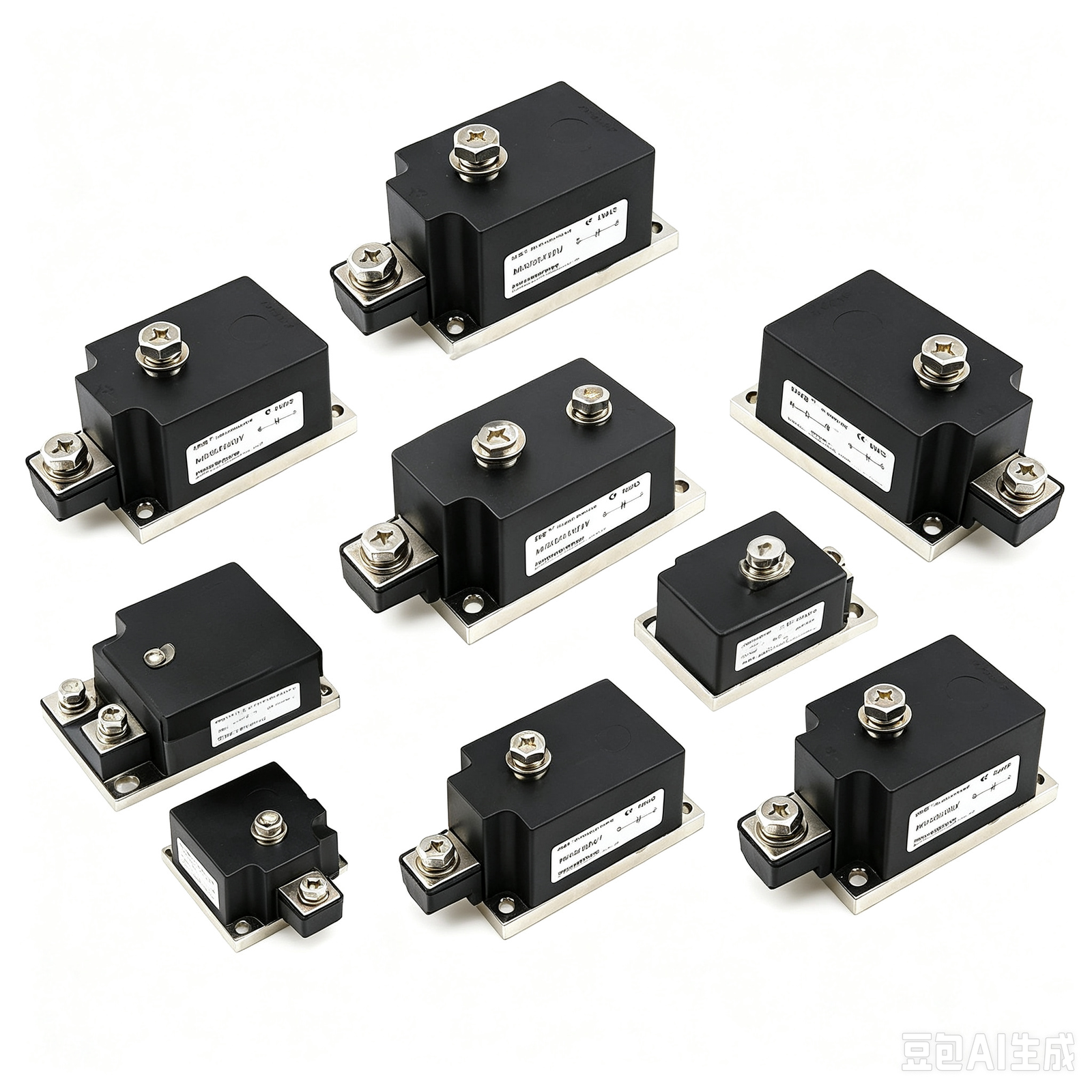
The MD300A anti-reverse diode module is published as a 300A nominal class with orderable voltage SKUs at 600, 800, 1000, 1200, 1400, 1600 and 1800V.
“Anti-reverse” is the supplier’s positioning language. It does not publish the internal circuit, diode count, polarity or terminal behavior. Those details must not be inferred from the product name or image.
2. Use Current Class for Screening, Not Automatic Sizing
Published current classes help a buyer identify candidate families after the project requirement has been defined. They do not create that requirement and they do not prove that a same-number model is suitable.
Do not convert load current directly into a module class, apply an invented multiplier or assume that the next larger published class is automatically correct. Operating waveform, duty, temperature, cooling, surge conditions and other project variables may affect the selection, but the current RITOKS pages do not contain enough model-specific data to calculate those effects.
A safe RFQ records the required current or operating conditions as project inputs, identifies a candidate family and asks RITOKS to confirm the exact model documentation.
3. Confirm the Exact Reverse-Voltage Requirement
Reverse voltage is a separate selection input. It should be defined from the circuit and operating conditions, then compared with the exact model rating under the applicable documentation.
For MDA, the current published table rows list 1600V. Historical references to a 600–1800V range conflict with the current page and must not be used as current Product 361 data.
For MD300A, the page publishes seven voltage-specific SKUs from 600V through 1800V. This does not establish which voltage version a project requires.
The buyer should provide the required reverse voltage and request confirmation of the complete model designation. No voltage margin, transient allowance or series-use rule should be invented from these pages.
4. Configuration Must Be Verified
Configuration terms can narrow the inquiry, but only exact drawings can establish internal connections and terminal assignments.
5. What Common Anode Currently Tells Us
For Product 361, the supplier-stated description supports calling the MDA family a common-anode dual-diode family. It does not provide a complete terminal diagram, polarity map or internal drawing for every model.
Do not use the product image as evidence of terminal function. Request the circuit and terminal drawing for the exact model.
6. What Anti-Reverse Does Not Yet Tell Us
For Product 362, “anti-reverse” is a product-positioning phrase rather than a published topology definition. The current page does not establish whether the internal circuit uses one diode, multiple diodes or a particular terminal arrangement.
The phrase must not be expanded into a wiring rule, protection guarantee or polarity assumption.
7. Confirm Package, Terminals and Mechanical Fit
The current pages do not publish verified package dimensions, mounting-hole spacing, terminal dimensions or a model-specific mechanical drawing. Visual similarity between modules is not evidence of interchangeability.
For a production inquiry, request the exact outline drawing and confirm the available space, mounting interface, terminal arrangement and assembly constraints against the project.
8. Electrical and Thermal Data Must Come From the Exact Datasheet
Forward-voltage data, reverse leakage, surge-current capability, junction-temperature limits, thermal resistance and cooling requirements are not currently published on the reviewed RITOKS pages.
The Vishay official diode-module catalogue illustrates that reverse voltage, forward current, surge current, forward voltage, junction temperature and package are separate device fields. It is useful only as general evidence that diode-module selection is multi-parameter; no Vishay value or rating applies to RITOKS products.
Ask for exact RITOKS model documentation rather than borrowing a value from another brand, a visually similar package or another product family.
9. Published RITOKS Diode Module Family Overview
This table is a publication-status overview, not a performance ranking. “Not published” means that the current public page does not provide the field; it does not mean the product lacks that characteristic.
| Product | Published Current | Published Voltage | Published Configuration Wording | Isolation Reference | Mechanical Drawing | Thermal / Surge Data |
|---|---|---|---|---|---|---|
| 361 MDA | 25–1000A published classes | Current rows list 1600V | Supplier-stated common-anode dual-diode | Supplier reference 2500V AC; exact-model confirmation required | Drawing pending/not published | Not currently published |
| 362 MD300A | 300A nominal class | 600/800/1000/1200/1400/1600/1800V SKUs | Supplier-positioned anti-reverse; internal circuit not published | Not published | Drawing pending/not published | Not currently published |
10. Recommended Verification Workflow
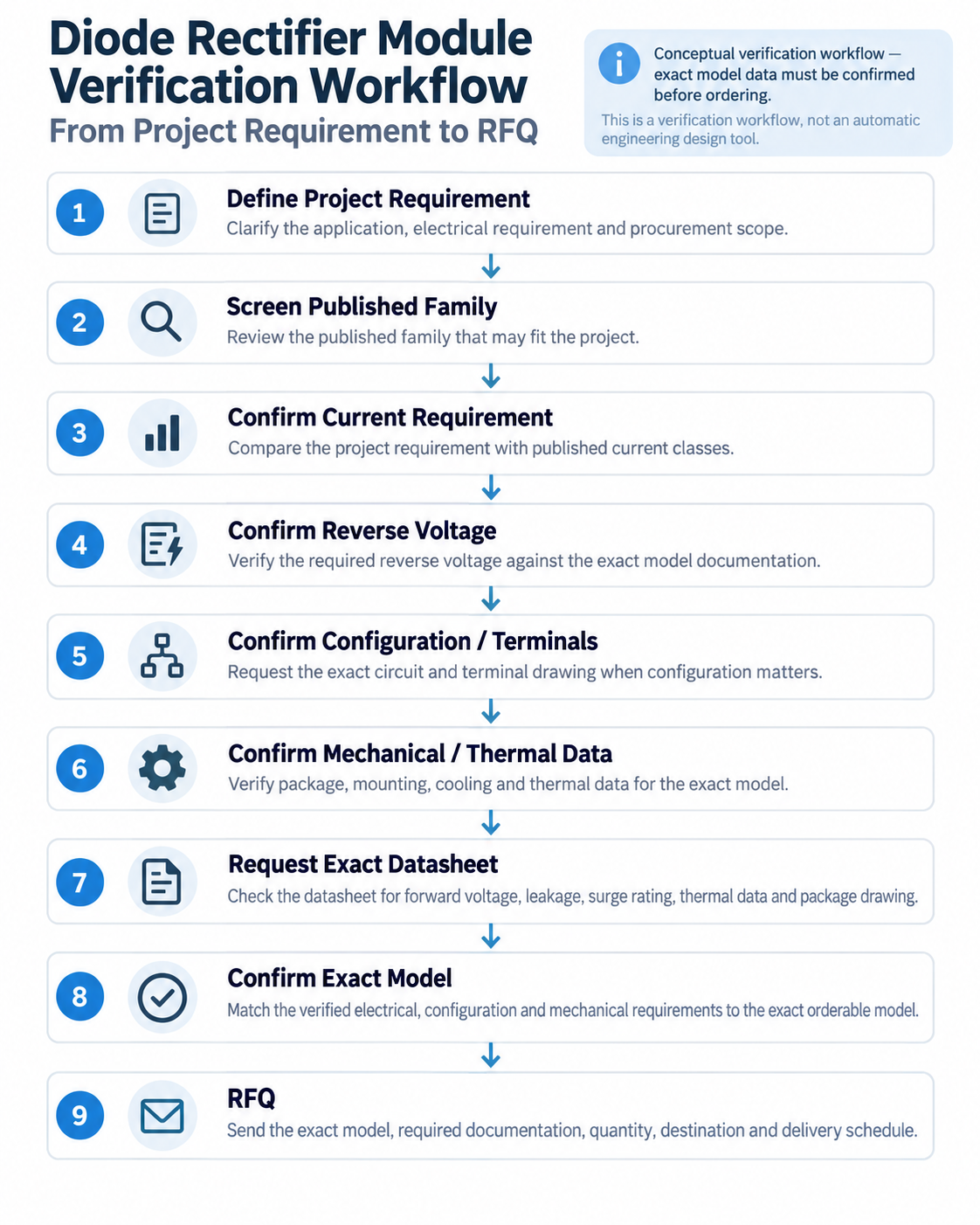
- Define the project requirement. Record the required function, operating conditions and constraints.
- Screen the published family. Compare only confirmed current and voltage information.
- Confirm current and reverse voltage. Keep both as separate project inputs.
- Confirm configuration and terminals. Request the exact circuit and terminal drawing.
- Confirm mechanical and thermal data. Check the model-specific package, mounting and cooling information.
- Request the exact datasheet. Include any required surge, thermal, isolation or compliance evidence.
- Confirm the complete model. Resolve every suffix and voltage version before the RFQ.
11. Information to Include in an Inquiry
A useful diode rectifier module inquiry can include:
- Application or circuit function: [project information]
- Required current or operating-current conditions: [project requirement]
- Required reverse voltage: [project requirement]
- Required configuration: [if known]
- Terminal or polarity drawing required: [yes / no]
- Mechanical envelope and mounting constraints: [project requirement]
- Cooling arrangement and thermal conditions: [project information]
- Required electrical or surge data: [list the fields]
- Required isolation, certification or test evidence: [if applicable]
- Preferred family or exact model: [if known]
- Quantity, destination and required delivery schedule
If a requirement is not yet defined, mark it “to be confirmed” instead of selecting a product value by assumption.
12. What Data Is Still Missing
MDA Family
- Exact circuit and terminal drawings
- Package dimensions and mounting details
- Model-specific thermal data and cooling requirements
- Forward-voltage, leakage and surge ratings
- Full conditions for the supplier-referenced 2500V AC isolation withstand
- Current certification or standards evidence
MD300A Family
- Internal circuit, diode count and polarity
- Terminal drawing and package dimensions
- Thermal, cooling and surge data
- Forward-voltage and leakage data
- Isolation data
- Current certification or standards evidence
These gaps prevent an automatic sizing recommendation or a topology comparison. They should be resolved through exact-model documentation.
Frequently Asked Questions
What diode rectifier module families does RITOKS currently publish?
RITOKS currently publishes the MDA 25A–1000A common-anode dual-diode family and the MD300A 300A nominal anti-reverse family.
Can I select a diode module from current class alone?
No. Current class is a screening input. Reverse voltage, configuration, terminals, package, thermal conditions, surge requirements and exact-model documentation may also need confirmation.
What voltage is currently published for the MDA family?
The current Product 361 table rows list 1600V. Older 600–1800V references conflict with the current page and are not used in this guide.
Does common anode provide a complete terminal map?
No. It is the supplier-stated family configuration for MDA, but the exact circuit and terminal drawing still needs to be requested.
Does anti-reverse define the MD300A internal topology?
No. The current product page uses anti-reverse positioning but does not publish the internal circuit, diode count, polarity or terminal behavior.
Are thermal and surge ratings available on the current product pages?
The reviewed pages do not currently publish the model-specific thermal, cooling and surge data needed for engineering verification.
Can another manufacturer’s datasheet be used for a RITOKS model?
No. External technical references can explain general selection concepts, but ratings, drawings, test results and certification evidence must come from the exact RITOKS model documentation.
Need Help Confirming a Diode Rectifier Module?
Send the project requirements already available, identify the candidate family if known and list every technical document needed for approval.
RITOKS can then confirm the appropriate published family, exact model designation and available documentation without treating the catalogue as an engineering calculation.
Related Resources
Continue exploring Power Semiconductor Modules
SCR Thyristor Module Selection Guide: Current Class, Voltage, Cooling and Model Verification
Selecting an SCR thyristor module requires more than matching a current number to a product name. A practical…
Read guide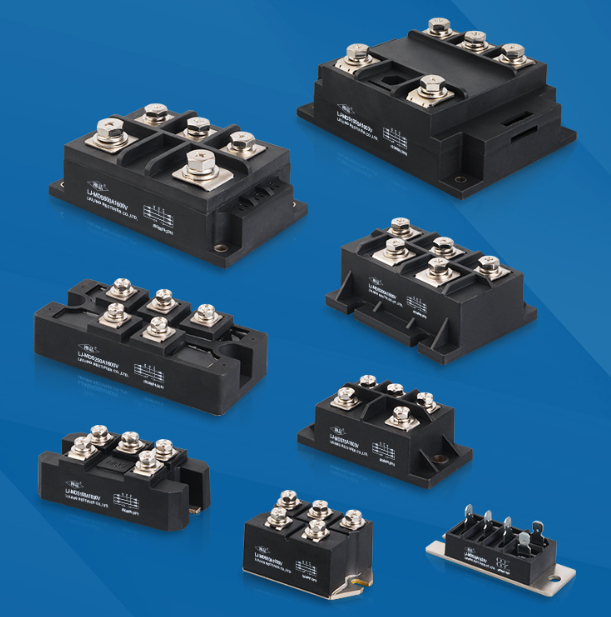
MDS 30A–250A vs 300A–1200A Bridge Rectifier Modules: Model Comparison
RITOKS currently publishes two MDS three-phase bridge rectifier module families covering different current-class ranges: MDS 30A–250A MDS 300A–1200A…
Read guide