
Molded Case Circuit Breakers for Power Distribution · Technical Explainer
ACB and MCCB Selectivity: What the Coordination Study Must Include
Quick answer
An ACB/MCCB selectivity review needs the exact upstream and downstream devices, trip units, settings, system conditions and fault-current study. Check the relevant curves and manufacturer combination evidence within their stated scope. A larger upstream rating or separated curve segments alone does not prove selective operation throughout the required fault range.
The purchasing task is to assemble the evidence for a particular pair in a particular installation. The engineering study then determines which faults and operating cases are selectively cleared. Keep that conclusion separate from the individual breakers' interrupting ratings and from any back-up protection arrangement. They answer different questions.
Eaton's selectivity basic guide explains the relationship between fault current, device characteristics and the selectivity limit. Its discussion of current-limiting combinations also cautions against relying on simple curve or energy comparisons. The guide supports the review method, not approval of an unlisted RITOKS combination.
Define the required boundary and operating cases
State which downstream fault location is being reviewed and which upstream supplies should remain available. Connect that requirement to the single-line diagram and the applicable operating modes. A study result without a defined boundary can be misread as approval of the entire switchboard, even when it covers only one breaker pair.
Identify the upstream ACB and downstream MCCB by their drawing references. Describe the intervening circuit and the loads whose continuity matters to the project. The design owner should specify the required extent of selectivity and the applicable regulations or project criteria. Do not turn a general recommendation into a universal legal requirement.
Include alternate supply arrangements that can change the fault condition. Schneider Electric's coordination guide calls for review under the relevant sources and fault types. The practical buying response is to attach the actual source cases, rather than assuming the normal utility condition represents generator operation or every permitted bus arrangement.
Specify how the final conclusion will be expressed. A limit for one combination and source case is not interchangeable with a statement of total selectivity. Where a result is partial, the study should identify the limit and compare it with the installation case. Where evidence is unavailable, write that limitation explicitly rather than treating a blank table entry as a favourable result.
Build an exact-device evidence register
The device register should identify every characteristic that changes the study input. Record frame and variant, trip-unit identity, rated current, settings and document revision for each breaker. Link the register to the offered bill of materials. A family name alone is too broad when its members have different protection or interruption characteristics.
Use the following original register structure as an information request. It does not specify an accepted breaker pair:
| Input group | Upstream ACB record | Downstream MCCB record |
|---|---|---|
| Device identity | Exact frame, variant, poles and drawing reference | Exact frame, variant, poles and drawing reference |
| Protection identity | Trip-unit reference and enabled functions | Trip-unit reference and available adjustments |
| Configuración | Proposed values and who may approve changes | Fixed values or proposed adjustable settings |
| Curvas | Applicable curve revision and assumptions | Applicable curve revision and assumptions |
| Interruption and withstand | Ratings tied to the actual operating condition | Ratings tied to the actual operating condition |
| Pruebas combinadas | Manufacturer pair/table/software reference | Matching downstream entry and qualifications |
Keep the distinction between fixed and adjustable functions visible. Do not assume every MCCB has an adjustable instantaneous threshold or every ACB has the same enabled protection functions. A coordination study should use the offered hardware, not settings that belong to an optional trip unit absent from the order.
Where a supplier provides software output, ask for the inputs and revision as well as the graph. A screenshot without the device variants, source condition or settings is difficult to verify later. Record any substitutions or manually entered characteristics so the design owner can decide whether the output has an adequate basis.
Separate curve review from combination verification
A time-current plot helps examine protection behavior over its applicable range. It is not a universal substitute for the manufacturer's high-current combination evidence. Read the stated scope of both sources and identify where a conclusion relies on a documented table or supported selection tool rather than visual separation alone.
Eaton explains that interacting current-limiting breakers can require manufacturer tables or tools for energy-selectivity assessment. That is a reason to request exact-pair evidence, not to draw a new curve from guessed let-through data. A purchase package should contain the applicable combination reference alongside the study's interpretation of that reference.
Avoid describing a pair as selective merely because its low-current portions are separated on a plot. Ask which fault range has been assessed and how the upper range is supported. Likewise, an overlapping region should be interpreted with the relevant manufacturer's evidence rather than dismissed solely from the appearance of the curves.
Check the source document's voltage, device variants, trip-unit conditions and setting qualifications. If the offered pair is absent, an entry for a nearby frame is not an approval. Mixed-brand or modified combinations require evidence that actually addresses the proposed arrangement. The study should say where the available documentation stops.
The result should be a readable statement tied to the assessed boundary: what is supported, under which conditions and by which evidence. That is more useful than a graph annotated only with the word "selective."
Keep back-up protection and delayed operation separate
Selectivity aims to limit the affected circuit when a fault is cleared. Back-up protection concerns a documented protective-device combination's interruption capability. The same pair may have evidence for both, but one result does not prove the other. Keep separate references and conclusions in the study record.
Schneider Electric distinguishes cascading from selectivity in its coordination guide. If the offer relies on a back-up arrangement, the design owner should verify the exact manufacturer's conditions and whether the required continuity objective is also supported. Do not substitute an enhanced breaking-capacity entry for a selectivity limit.
Time-delay proposals need a separate withstand review. The circuit-breaker characteristics guide relates selectivity category B to short-time withstand and associated delay. This is not permission to lengthen an ACB delay independently. The designer needs to assess the selected device and the affected installation against the proposed fault-clearing conditions.
Include the safety and protection consequences in that decision. A delay selected to improve coordination can affect other design assessments. The article provides a document-review structure, not a setting schedule or instruction to disable instantaneous protection. Only the responsible engineer should approve the final settings for the actual system.
Record decisions by fault and source case
A study summary should distinguish the fault types, operating modes and evidence limits used to reach its conclusions. A general family comparison loses those details. Keep the summary close to the approved single-line diagram so site personnel can recognize when an altered source arrangement requires another review.
Use this original case matrix to request a clear deliverable:
| Case to identify | Evidence to attach | Conclusion to request |
|---|---|---|
| Normal-source overload case | Applicable curves and approved settings | Supported behavior within the assessed range |
| Normal-source short-circuit case | Fault-current result and exact combination evidence | Required selectivity extent and any limit |
| Relevant earth-fault case | Actual protection functions and study method | Selectivity result for the implemented scheme |
| Alternative-source case | Source assumptions and corresponding fault result | Whether the conclusion differs from normal supply |
| Delay-dependent case | Device and installation withstand review | Whether proposed delay conditions are acceptable |
| Proposed product substitution | Revised device inputs and matching evidence | Whether the previous approval remains applicable |
The matrix should also identify the reviewer and any unresolved items. An unanswered row is not automatically a rejection, but it is a boundary on what can be claimed. Procurement can obtain missing documents while the design owner determines whether the remaining evidence is sufficient.
Once approved, save the selected settings with the as-built device identities. An order change, a replacement trip unit or an altered source can invalidate the previous input set. The record should make those changes discoverable rather than relying on a remembered screenshot from the initial quotation.
A conditional ACB/MCCB procurement review
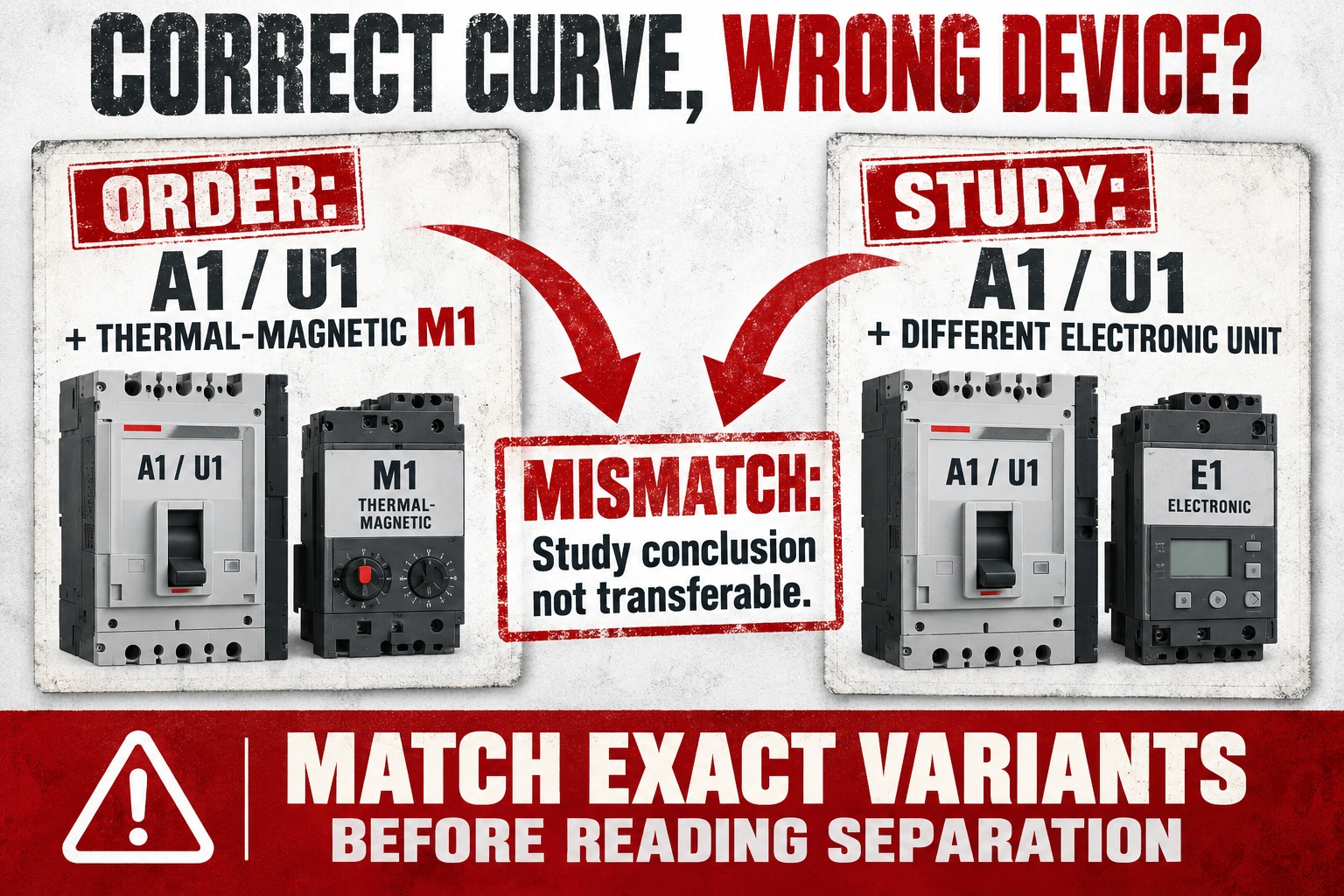
Consider a hypothetical study record naming upstream ACB A1 with trip unit U1 and downstream thermal-magnetic MCCB M1. The supplier's plot instead names a different downstream electronic unit with an adjustable function absent from M1. The filled identity finding is “study input differs from offer; plot conclusion not applicable to ordered variant.” That discrepancy should be resolved before interpreting graphical separation. No setting for A1 or M1 is prescribed here.
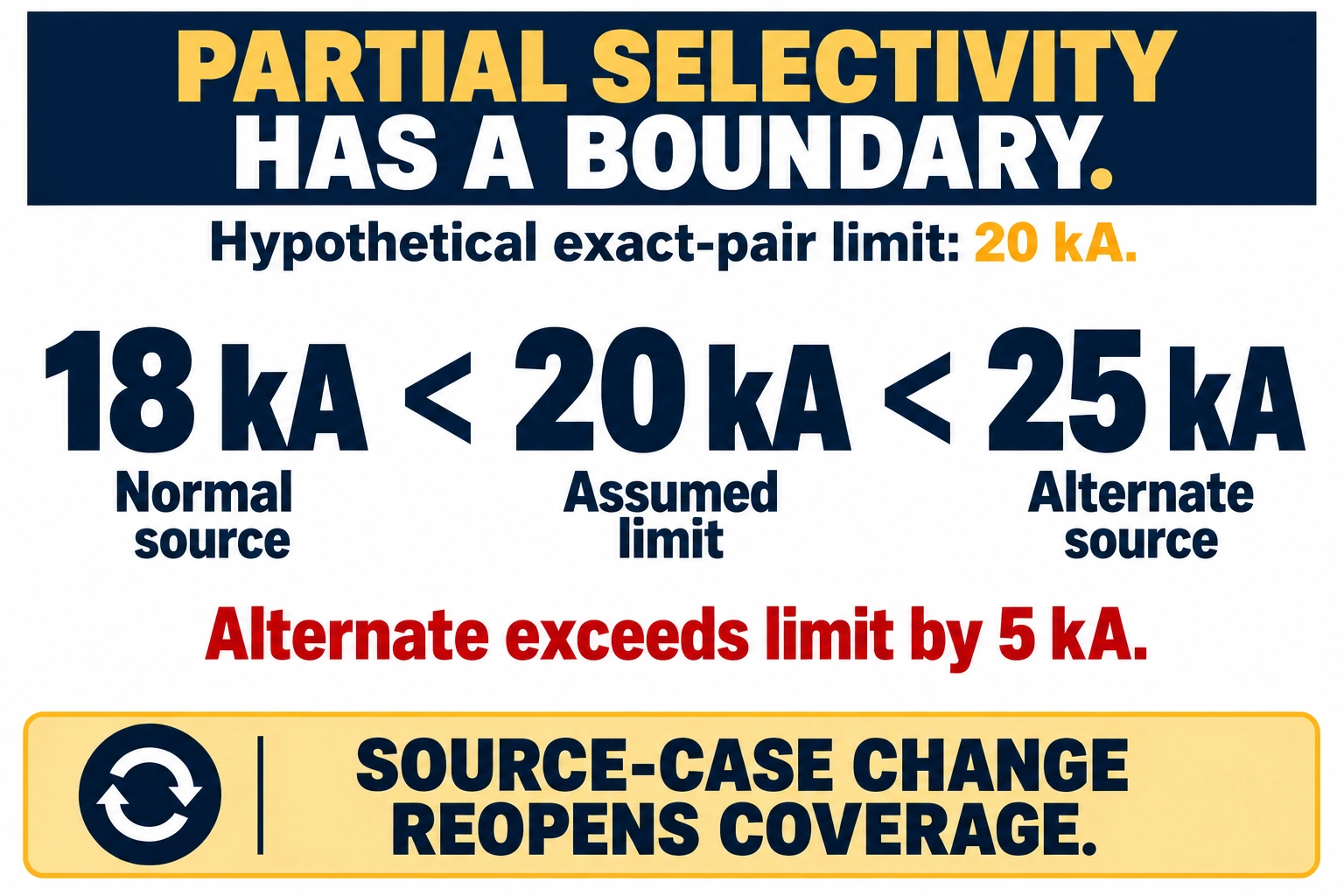
For a separate reading step, assume corrected exact-pair evidence provides a partial selectivity limit of 20 kA at the reviewed voltage and configuration. Assume the fault study gives 18 kA at the defined downstream location in normal mode and 25 kA in another permitted source configuration. These invented values are teaching inputs, not Eaton tables, RITOKS ratings or an installed study. The first source case lies below the assumed limit; the second exceeds it by 5 kA.
The filled case summary is “normal short-circuit scope within stated pair limit; alternative-source extent not covered; other required fault cases remain separate.” Calling the pair “fully selective” would erase the uncovered case. Nor does adequate individual breaking capacity close that continuity question: it addresses an interruption duty rather than proof that only the intended downstream device operates.
The engineer can evaluate another documented pair, supported settings or an accepted change in the required continuity scope. A proposed delay must return to device and installation withstand and the relevant safety assessment. It cannot be chosen by the purchasing team simply to move a curve away from another line. If an alternative pair has evidence for the full required cases, its cost and substitution impact can be compared with the original proposal; an unsupported nearby-frame entry remains a document gap.
Retain the result by drawing reference and source case. A field such as “A1/U1–M1, stated configuration, normal case supported to the supplied limit, alternate case unresolved” is useful even before final acceptance because it identifies exactly what the next document must cover. Save the adopted trip-unit identities and approved settings with the order. Later changes to M1, U1 or the supply arrangement should trigger review of affected entries, while unrelated valid evidence can remain in the file.
Request evidence for the offered RITOKS pair
RITOKS lists WEW1-2000 air circuit breakers y GYCM8 thermal-magnetic MCCBs. Those commercial pages identify relevant product families. They are not themselves an exact-pair selectivity table and should not be cited as proof of coordinated operation between the offered configurations.
Send the single-line diagram, exact device schedule, operating voltage and required coordination objective with the enquiry. Request the relevant trip data, settings information, applicable withstand data and any manufacturer-supported combination evidence. Make the fault-current study available to the responsible reviewer rather than asking purchasing to approve a generic pair.
For other molded-case breaker options, preserve the same review process. A commercial substitute should trigger a check of the affected inputs before it inherits the original study conclusion.
An accepted coordination study explains its inputs, operating cases and evidence limits. Attach that explanation to the approved order so later changes can be reviewed against the same basis.
Referencias
- Eaton. (2023, August). Selectivity basic guide, BR012020EN.
- Schneider Electric. (n.d.). Coordination between circuit-breakers.
- Schneider Electric. (n.d.). Other characteristics of a circuit-breaker.