
Electrical Measurement & Monitoring · Technical Explainer
Battery Shunt Placement: Account for Every Charge and Discharge Path
Quick answer
A battery shunt intended to measure the whole battery must account for every intended charge and discharge path across the measurement boundary. A charger, load or return connection that bypasses that boundary can leave part of the battery exchange unmeasured. Start with a complete system drawing and the exact monitor instructions, not the nearest convenient mounting position.
The practical deliverable is a current-path register: which battery is being monitored, which sources and loads exchange energy with it, and how each relevant operating state crosses the approved measurement point. The register supports design review without prescribing a universal terminal arrangement. Grounding, protection and permitted shunt position need their own qualified review.
This guide addresses measurement coverage for industrial procurement and system teams. It does not provide wiring instructions, live testing procedures or approval for a particular installation. Correct coverage is necessary for meaningful battery-current accounting, but it does not by itself prove accurate state of charge, a safe installation or compatibility between independently sourced components.
Define the battery boundary before counting branches
Begin by naming the monitored battery or bank. “The DC system” can include a main battery, another battery, a DC converter and several charging sources. Those elements do not automatically belong to the same measurement boundary. State whether the requested output concerns the whole battery exchange or one specific device branch.
This distinction changes the evidence needed. A device-branch meter can intentionally observe only that device, while a whole-battery monitor needs the relevant paths into and out of its named battery. A display reading does not tell the reviewer which purpose was selected. Put the purpose on the drawing, the procurement schedule and the commissioning record.
Victron's SmartShunt installation manual provides a specific manufacturer example. It warns that loads or chargers connected on its battery side are excluded from the state-of-charge calculation, and identifies the system-side connection for the relevant sources and loads. Its separate DC-meter section also distinguishes a selected branch from whole-battery monitoring. These are instructions for that product, not a BM500 terminal drawing.
El RITOKS BM500 battery shunt monitoring family describes an external-shunt measurement arrangement and asks buyers to confirm the system voltage and compatible display or controller. Its public family information does not establish every permitted installation topology. Request the exact circuit and connection documentation before representing a proposed arrangement as manufacturer-approved.
Write a one-sentence boundary statement such as “measure exchange with the named main battery in all approved operating modes.” That statement is an objective, not a completed design. The designer still has to identify the valid position and decide how the actual conductors, bonds and equipment interfaces satisfy it.
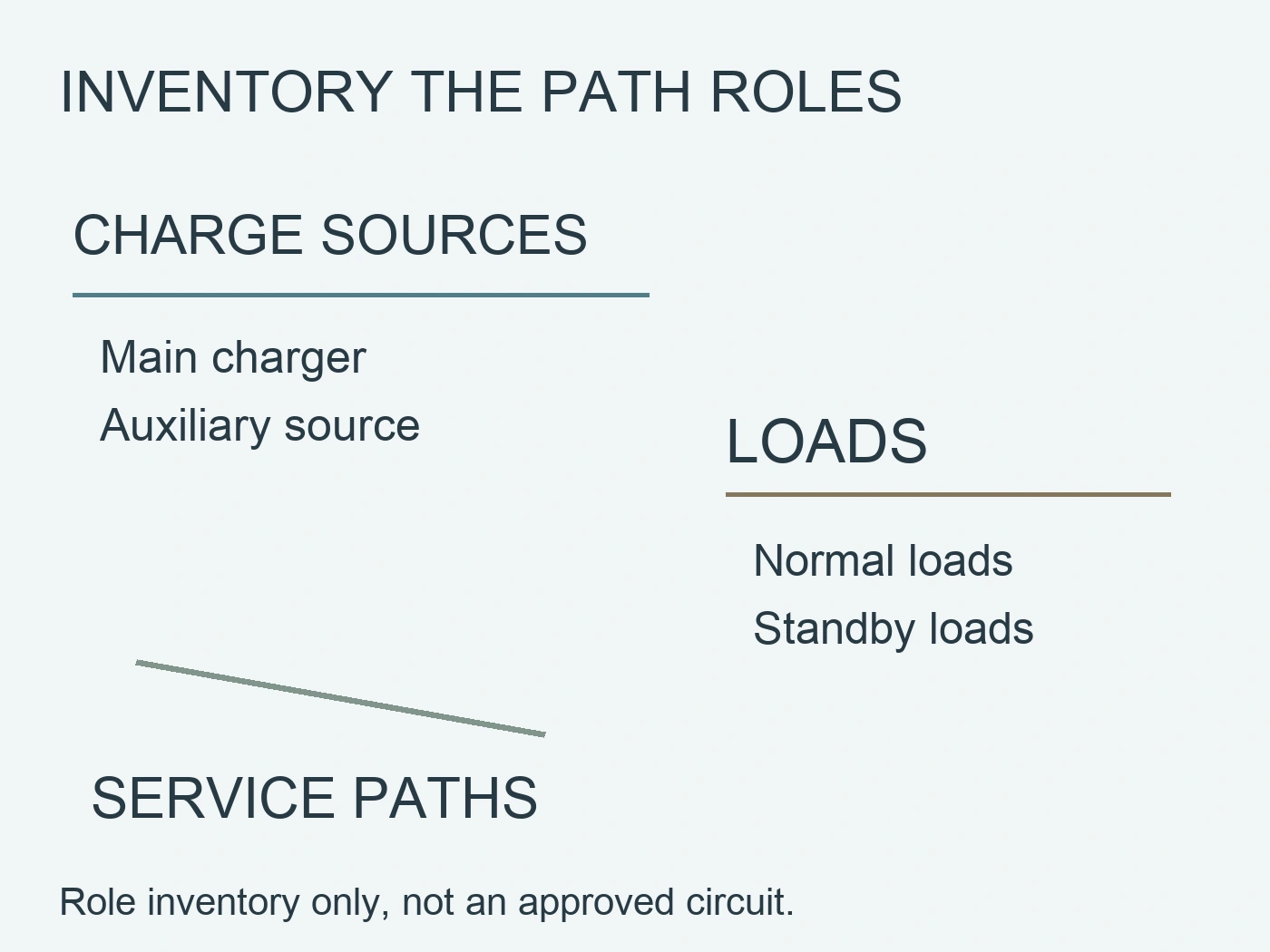
Build a path inventory from the complete drawing
Use the latest approved system drawing, not an isolated shunt sketch. Include the charging and loading equipment that can operate in normal service, maintenance and alternate supply modes. A register based only on the primary inverter can overlook an auxiliary charger or a service connection that becomes active later.
For each item, record its battery relationship and the drawing reference showing the relevant route. The task is not to guess whether a device is a charger or a load from its label. Equipment with more than one operating function should be reviewed for the states that actually exchange current with the monitored battery.
| Register item | Question for the drawing review | Pruebas que deben conservarse |
|---|---|---|
| Main battery or bank | Which battery exchange is the monitor intended to represent? | Named boundary and bank identification |
| Charger or charging source | Does its relevant battery path cross the approved measurement point? | Connection reference and operating-state description |
| Inverter or DC load | Is its discharge path included in the intended boundary? | Device identity and drawing location |
| Auxiliary equipment | Is there a separate supply or return route? | Complete branch reference, not only the main feed |
| Service or temporary connection | Can it become active without appearing on the normal-service sketch? | Approved service arrangement and review owner |
| Alternate or combined mode | Does switching change which battery or path is observed? | State-specific drawing or documented mode table |
An empty evidence cell means the route has not been demonstrated. It does not mean the equipment draws no current or the branch is harmless. Assign the missing drawing or manufacturer clarification to an owner. This makes the review actionable without converting uncertainty into an assumed pass.
Keep component identity separate from route identity. Replacing a charger with a similarly named device may preserve its physical location but change the connection information that governs the review. The register should therefore include the exact equipment reference and drawing revision, not merely a location label such as “rear charger.”
Treat bypass questions as coverage questions
A bypass in this review means a relevant battery exchange that is not observed at the intended measurement point. It is a measurement-boundary description, not permission to alter protection or grounding. The design reviewer must determine what the actual connection does and whether the documented arrangement remains acceptable.
Do not assume that every connection drawn near the battery belongs on one side of a shunt. Protective bonding and functional returns can have different purposes, and the approved topology matters. A procurement article cannot resolve those purposes from a photo. Preserve the complete drawing and ask the responsible designer to identify the relevant current paths.
A good question is “Which approved connection demonstrates that this charging state is included?” A poor question is “Can we move this wire so the number looks right?” The first requests evidence of coverage. The second jumps to an installation change without establishing its safety, purpose or compatibility with the exact monitor instructions.
Also distinguish an intentional partial boundary from an accidental omission. A separate meter observing one converter branch may be doing exactly what it was specified to do. The error occurs when its result is presented as whole-battery current without supporting coverage. Name the measured quantity accurately before investigating the instrument itself.
If documentation identifies a path outside the intended whole-battery boundary, record the finding as unresolved pending design action. Do not correct the drawing, the wiring and the acceptance record independently. They need to describe the same reviewed configuration, and the person approving the change must have the authority to assess the wider electrical design.
Review operating states, not just one static layout
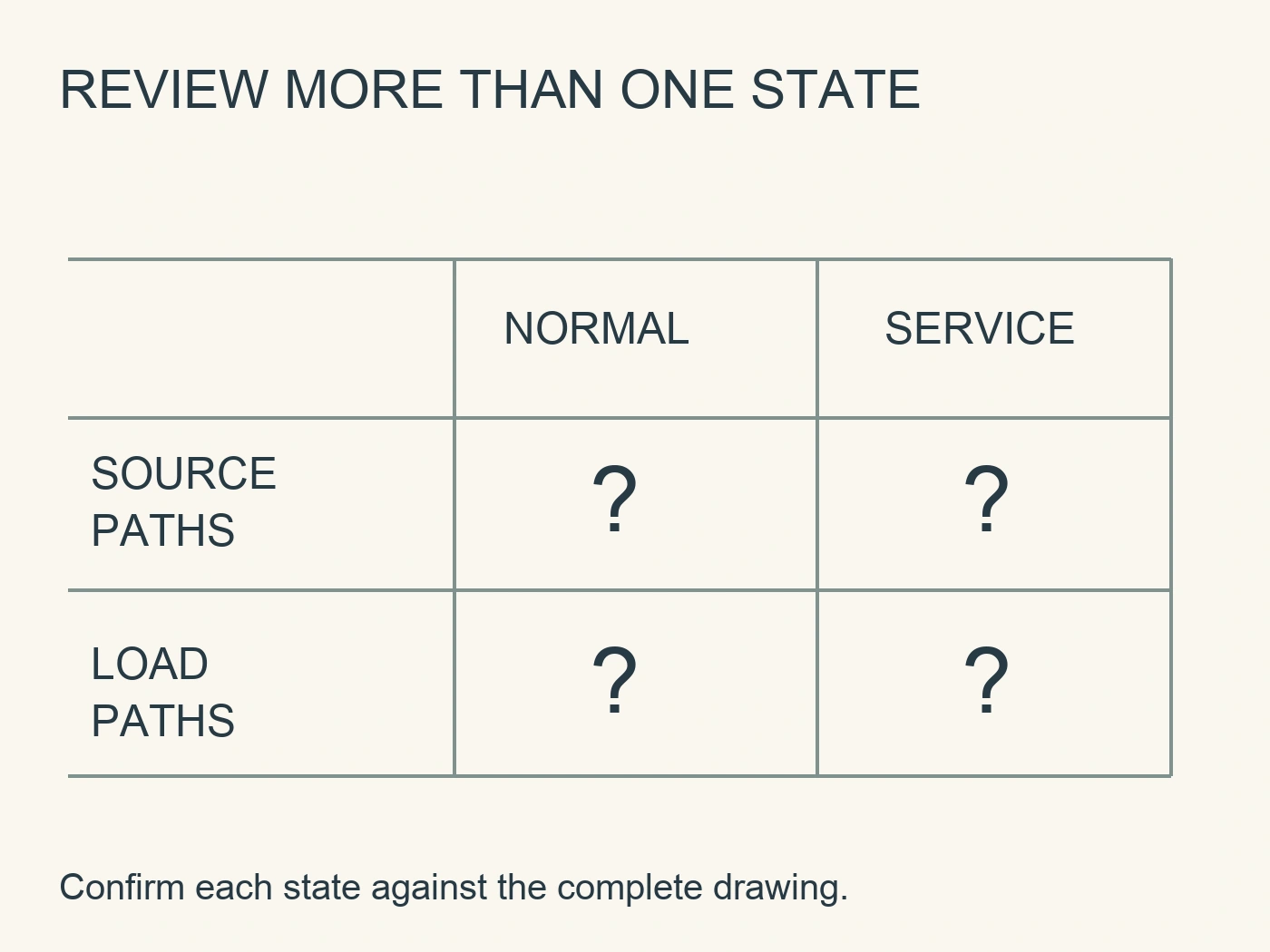
A single drawing view can conceal a connection that matters only in another mode. The review should therefore connect equipment paths to approved operating states. Examples to consider, where actually present, include charger operation, normal loading, maintenance supply and alternate-source operation. Do not invent modes that the system does not have.
Use a state table to identify what needs review rather than to assert a test result. A row should name the state, the relevant equipment and the evidence showing how the battery exchange is represented. If a state is excluded from the monitoring purpose, document that exclusion and its effect on the information users may rely on.
| Operating-state record | Coverage question | Appropriate status before evidence exists |
|---|---|---|
| Charging from the named source | Is the battery exchange included at the selected boundary? | Drawing review required |
| Supplying the named load | Is the discharge route represented by the same boundary? | Drawing review required |
| Simultaneous source and load operation | Does the requested reading represent the defined battery exchange rather than one branch? | Purpose and topology review required |
| Approved service mode | Does the temporary arrangement preserve the monitoring purpose? | Service documentation required |
| Equipment addition or replacement | Has the route inventory been updated? | Change review required |
These statuses are examples of a document workflow, not measured outcomes. Any commissioning observations should follow an approved safe procedure and carry their own dates, configuration and acceptance criteria. A plausible display value cannot replace the route review, and one observed operating state cannot establish coverage of every other state.
Keep coverage, scaling and state of charge separate
Three different questions often become merged: whether all intended paths are measured, whether the sensing and receiving equipment are correctly matched, and whether the resulting battery estimate is properly configured. Each needs its own evidence. Passing one does not close the others.
Coverage concerns the system boundary and connection routes. Matching concerns the exact shunt, monitor, display or controller and their documented interface. Configuration concerns the intended battery information and the settings or calibration required by the exact product. A complete buying record should identify which document and reviewer address each question.
The BM500 family page specifically cautions that state-of-charge output depends on capacity setup and system calibration. Do not promise that an external shunt automatically gives an accurate battery percentage. Likewise, do not treat the family designation as an unconditional continuous-current rating, compatible display list or proof of a particular grounding arrangement.
When a user reports a surprising battery reading, retain the observed state and configuration before concluding that placement is the cause. The path register is one part of the investigation. Component matching, settings and the exact manufacturer's troubleshooting instructions remain separate possible review tasks, not conclusions supplied by this article.
Work through a bounded procurement example
Suppose a quotation includes a battery monitor and external shunt, while the submitted drawing shows a main load and one charger. A later equipment list also names an auxiliary charging source. The reviewer should ask where that source appears in the approved system drawing and whether its operating state is included in the named measurement boundary.
If no connection reference is provided, the correct record is “auxiliary source coverage unresolved.” The reviewer has not demonstrated a bypass, and has not demonstrated complete coverage either. The supplier or designer can close the item by providing the relevant drawing and exact monitor instructions, followed by the appropriate design decision.
Now imagine that a separate branch meter was intended only for the main load. Its partial coverage is not necessarily a defect. The quotation must describe that purpose accurately, and the whole-battery monitoring requirement needs its own solution review. Changing the label on a display does not change what the physical measurement boundary observes.
Finally, when the auxiliary equipment changes, reopen the affected route and operating-state records rather than discarding the whole evidence set. Retain the unchanged information, record the revised documents and identify the reviewer. This example describes procurement traceability, not a wiring plan, a commissioning result or an approved combination of products.
Questions to settle before ordering
Is the shortest battery cable the correct shunt location?
Convenience alone does not establish the permitted position or measurement coverage. The exact monitor instructions and approved system design must govern. Confirm the named battery boundary and relevant paths before assessing practical mounting details with the responsible designer.
Can a second charger be ignored because it is rarely used?
Its operating frequency does not answer the coverage question. Determine whether its battery exchange belongs in the specified monitoring purpose and obtain the relevant route evidence. An intentional exclusion should be documented, not silently treated as complete whole-battery monitoring.
Does complete coverage prove accurate state of charge?
No. Component matching, capacity setup, calibration and the exact product requirements remain separate. Coverage explains which battery exchanges the measurement can represent; it does not establish every setting or the accuracy of the final estimate.
What should the RFQ include?
Provide the named battery boundary, complete current drawing, equipment and operating-state inventory, exact monitor and shunt references, and intended display or controller. Ask for model-specific connection and compatibility documentation. Keep unresolved grounding or protection decisions with the qualified system designer.
Referencias
- Victron Energy. (n.d.). Manual—SmartShunt: Installation, sections 3.4 and 3.7. Manufacturer manual.