
Rack Power Distribution · Technical Explainer
DCDU Branch Protection: Checking DC Fault Duty for Each Output
Quick Answer
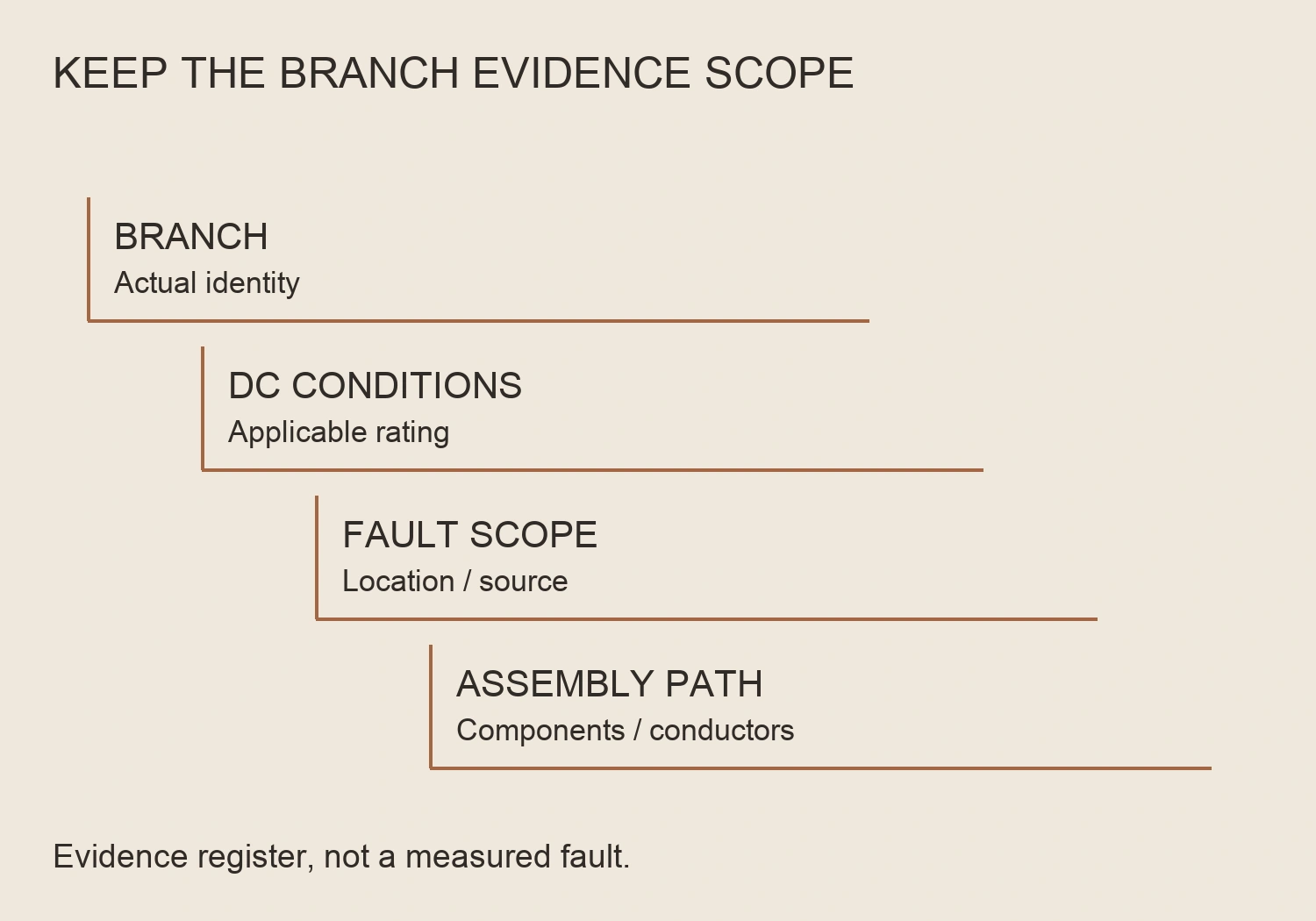
A protected output on a DC distribution unit does not establish suitability for every connected source or load. Identify the actual installed branch protector, its applicable DC conditions, the fault duty at that location, and the conductors and assembly it serves. Assess upstream coordination separately, using evidence for the exact proposed combination rather than a generic breaker label.
For telecom power designers and engineering buyers, the useful deliverable is a branch-by-branch evidence register connected to an assembly review. It should show which configuration is being quoted, what information supports it, and what remains unresolved. An apparently complete list of rated currents cannot replace that record.
This guide addresses DCDU branch protection and DC fault current coordination at the assembled-unit level. It does not provide a fault calculation, wiring arrangement, protection setting or test procedure. Those decisions belong to the qualified designer working with the actual source, distribution system and applicable equipment documents.
Start with the Actual Supplied Branch Configuration
Begin with the equipment being supplied, not an illustration of a similar distribution unit. Ask for an exact configuration reference and a branch schedule that identifies the installed protection devices. The schedule should connect each protected output to its device reference and to the relevant assembly drawing or documentation revision.
A family page can help establish the sourcing route while leaving important configuration questions open. The RITOKS telecom rack DC distribution unit is such a starting point. Its exact branch arrangement, installed protector list, electrical limits and supporting assembly evidence require confirmation for the offered unit. Do not resolve inconsistent branch descriptions by choosing a preferred count from a listing.
Request the identity of the actual protector, not just “DC breaker included.” A reference to a manufacturer family may cover several variants with different conditions. Record the selected device and its documentation alongside the assembly reference. If the supplier proposes a substitute, that change needs its own evidence rather than inheriting the original entry's conclusion.
This is different from reviewing an individual DC MCB in isolation. The assembled DCDU adds actual branch locations, internal distribution paths, terminal arrangements, upstream devices and external conductors. A valid component document is necessary evidence where applicable, but its scope must remain visible within the larger assessment.
Distinguish Operating Load from Fault Duty
Normal load information describes intended operation. Fault-duty information concerns a different condition at a defined location. Keep both records because they answer different selection questions. A branch's planned operating current does not establish the prospective short-circuit conditions that its protection may encounter.
Schneider Electric's DC breaker selection guidance identifies system type, voltage, nominal current, prospective short-circuit current and circuit time-constant conditions as relevant inputs. That list supports an evidence request; it does not supply the missing values for a particular DCDU or establish a universal protector arrangement. (Schneider Electric, 2025)
Ask the responsible designer which source conditions apply to the assessment. A telecom system may have relevant battery, rectifier or other supply arrangements, but their contributions must be established for the actual design. Do not add unrelated published source figures and present the total as a calculated or observed fault at every output.
Location matters to the documentation. Identify the point covered by a supplied fault-duty assessment and the conditions represented by it. An assessment at an upstream interface should not silently become evidence for a different internal or downstream location. Where a designer determines that one assessment covers several locations, retain that stated scope and its basis.
Record the Conditions Behind a DC Rating
A protection-device rating must be read with the conditions under which it applies. Obtain the exact documentation rather than copying a current figure into a comparison sheet. The selected DC voltage, applicable polarity or pole conditions, and relevant circuit characteristics belong with the device identity and the intended location.
An AC rating should not be relabelled as a DC capability. Likewise, documentation for a different variant or arrangement should not be assumed to qualify the installed one. If the supplier's evidence leaves the applicable conditions unclear, mark the entry unresolved and request clarification from the responsible technical source.
The register should distinguish a condition that has been documented from a configuration that has been approved for the project. A supplier can provide a data sheet without determining every aspect of the customer's distribution design. Keep the evidence provider and the application decision owner identifiable so that receipt of a document does not become an accidental acceptance.
Polarity and pole conditions are included here as protection-rating questions. They are not a wiring prescription or a substitute for a separate review of the site's DC architecture. The buyer's task is to obtain the configuration evidence; the qualified designer determines its application to the assembled circuit.
Build a Branch Evidence Matrix
Use one entry for each actual protected output in the offered configuration. The following original template contains no measurements, approved ratings or implied branch count. Its purpose is to connect the physical configuration to the evidence needed for a decision.
| Evidence layer | Record for the actual branch | Question that remains separate |
|---|---|---|
| Configuration identity | Output designation and assembly revision | Is this the branch supplied in the quoted unit? |
| Installed protector | Exact device and variant reference | Does the supporting document apply to this installed item? |
| DC conditions | Applicable voltage and documented rating conditions | Do these conditions match the proposed circuit assessment? |
| Fault-duty scope | Designer's location-specific assessment and assumptions | Does it cover this branch under the relevant source conditions? |
| Conductors and connections | Applicable internal and external path documentation | Have their separate protection and duty questions been assessed? |
| Decision record | Reviewer, conclusion, limitations and open items | What evidence still prevents release of this configuration? |
The working register should retain document revisions and configuration changes. A branch designation is useful only if it can be reconciled with the current assembly information. If an outlet assignment or installed protector changes, identify which conclusions relied on the previous arrangement before accepting the revision.
Avoid a single whole-unit “protection verified” field that conceals unresolved outputs. A shared assessment may legitimately cover several branches, but the record should identify which ones and why. The matrix makes that scope visible without inventing a separate test result for each row.
Review Conductors and Assembly Paths Separately
A branch breaker document does not, by itself, qualify every part of the distribution path. Internal conductors, busbars, terminals, external cables and their installation conditions have their own relevant evidence. Ask which paths the assembly documentation covers and which remain the installer's or system designer's responsibility.
The Electrical Installation Guide describes conductor overcurrent protection in terms of both allowable sustained operation and thermal duty during a fault. This is a general documentation principle, not a supplied DC calculation or proof that the offered DCDU satisfies a particular cable arrangement. (Electrical Installation Guide, n.d.-b)
Keep sustained-load information and fault-related assessment connected but distinct. A documented cable operating limit does not automatically settle its protection under the proposed fault conditions. Conversely, a protective-device interruption claim does not answer all questions about normal loading, connection conditions or the complete assembly.
Ask for the relevant assembly evidence before treating a component capability as a finished-unit capability. The scope should identify the offered configuration and applicable limitations. Where the supplier provides component documents only, make the retained assembly-review work explicit rather than describing the package as complete by default.
Separate Selectivity from Backup Capability
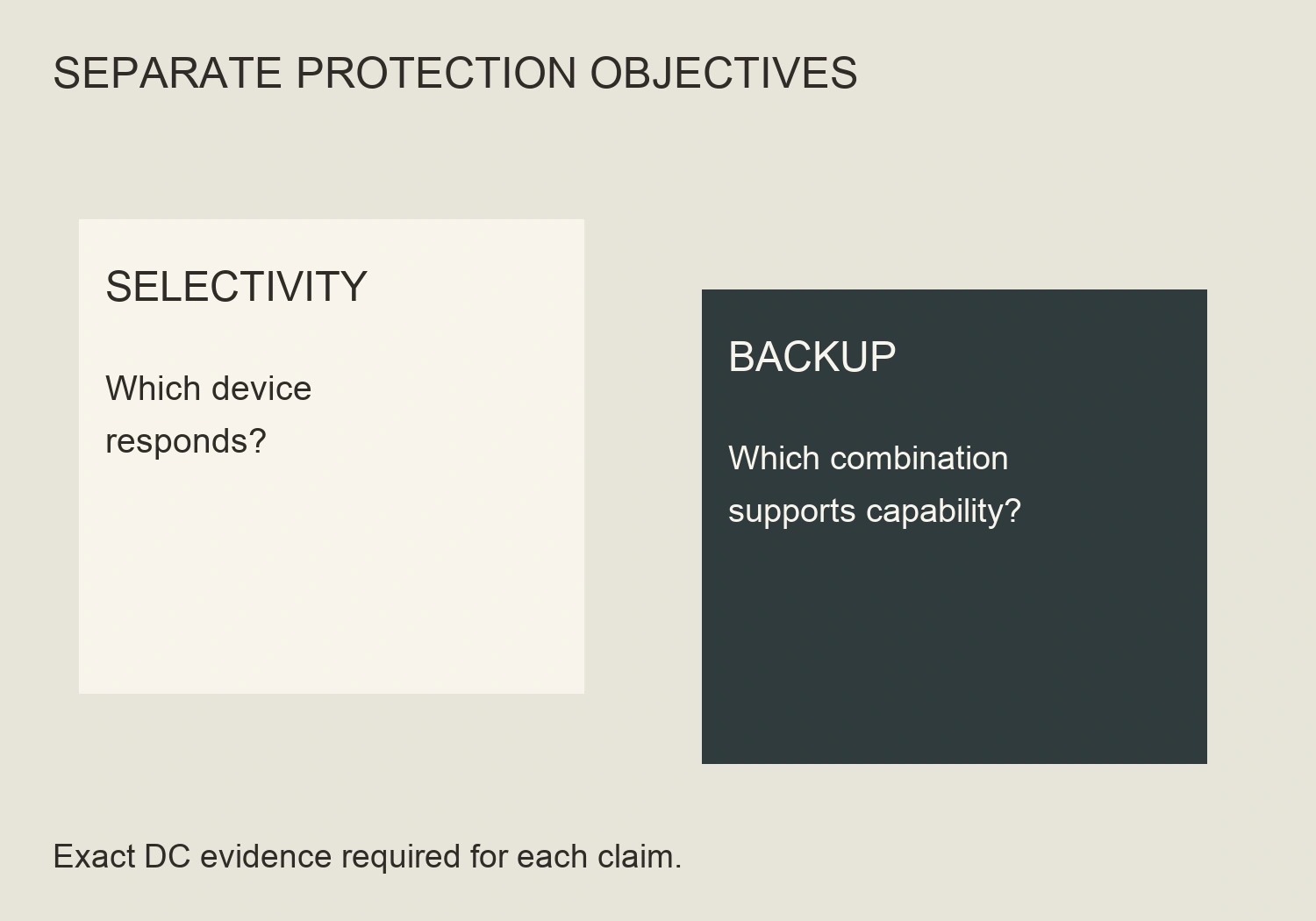
Upstream and downstream protection can be discussed under different objectives. Selectivity concerns which protective device is intended to respond within the assessed conditions. Backup capability concerns whether a documented device combination supports the claimed interruption capability. These objectives should not share an unexplained “coordinated” tick in the purchasing sheet.
The Electrical Installation Guide's breaker-selection discussion includes conductor and upstream/downstream coordination considerations. Its backup discussion describes coordinated device capability rather than merely the presence of an upstream breaker. The guide also contains AC-specific examples; those examples do not establish a DC DCDU combination. (Electrical Installation Guide, n.d.-a)
If selectivity is claimed, request evidence for the exact DC devices, arrangement and assessed scope. If backup protection is claimed, request the applicable combination evidence and conditions separately. Do not assume that a document supporting one objective proves the other, or that a familiar upstream device name closes both questions.
A project may not require the same objective at every interface. The responsible designer should identify what is being sought and the limits of the assessment. The register should reflect that decision rather than imposing a universal coordination preference on every telecom installation.
Connect the Branch Register to Upstream and Cable Evidence
The second original matrix helps route questions beyond the branch component. It is a proposed inquiry structure, not a manufacturer test table or approved engineering sequence. Attach the actual project records where the responsible team supplies them.
| Review interface | Evidence to connect | Scope question for the reviewer |
|---|---|---|
| Source to DCDU input | Source configuration and relevant fault assessment | Which operating and source conditions are represented? |
| Upstream protection to branch protection | Exact devices and objective-specific coordination records | Is the claim selectivity, backup capability or another defined objective? |
| Branch to external conductor | Cable and protection documentation for the proposed path | Who assesses the actual installation conditions and limitations? |
| Installed component to complete unit | Assembly reference and applicable supporting evidence | What has been established for the finished supplied configuration? |
| Proposed revision to release | Changed items, affected records and named approver | Which earlier conclusions remain applicable after the change? |
Keep open questions attached to the correct owner. A supplier may identify the installed branch device while the project designer supplies the source assessment. Neither should be expected to infer the other's missing information from a quotation title. A clear handoff is more useful than a large folder with unconnected documents.
A Conditional Purchasing Example
Consider a proposed DCDU for which the supplier has supplied the branch device references, but the project's source assessment is not yet available. The correct purchasing record is that component identities are documented and application fault-duty review remains open. No branch suitability or complete-unit acceptance follows from receiving those references alone.
Suppose the source information then arrives, while the supplier proposes a different branch protector. The new information improves one part of the assessment but does not approve the substitution. The reviewer needs the replacement device's applicable DC conditions and must identify whether the existing assembly and coordination evidence still covers it.
If a backup claim is later offered, it becomes another defined evidence question, not an automatic reason to mark selectivity complete. The conditional example records no test, calculation, fault event or approved installation. It illustrates how configuration changes and evidence scopes affect a purchasing decision.
Preguntas frecuentes
Does an included DC breaker prove compatibility with any battery system?
No. The actual source conditions, location-specific fault duty, installed device conditions and complete distribution path still require assessment. A component description cannot establish every proposed system's suitability.
Can an upstream breaker name establish backup protection?
Not by itself. Request evidence for the exact applicable DC combination and the claimed capability. Keep that request separate from selectivity and retain the stated conditions and limitations.
Why review cables if the branch device has interruption documentation?
Interruption capability and conductor protection are different evidence scopes. The actual cable, connection and installation conditions require their own applicable review alongside the component and assembly information.
What should happen when a quoted protector changes?
Record the substitution, obtain the new applicable documentation and identify the conclusions affected by it. Do not carry forward approval solely because the replacement has a similar family name or nominal current label.
Conclusion
DCDU branch protection starts with the actual supplied configuration and continues through the source, installed devices, conductors, complete assembly and upstream relationships. Keep normal operation separate from fault duty, and keep selectivity separate from backup capability. The practical RFQ deliverable is a traceable pair of registers that connects every claimed conclusion to its relevant evidence and reviewer. Unresolved fields should remain visible until the qualified team can assess them; they should not disappear behind a breaker description or a whole-unit protection label.
Referencias
- Schneider Electric. (2025). How to select the correct DC breaker? Official technical FAQ.
- Electrical Installation Guide. (n.d.-a). Selection of a circuit-breaker. Breaker-selection and coordination discussion.
- Electrical Installation Guide. (n.d.-b). Overcurrent protection principles. Conductor-protection discussion.