
Smart Rack PDUs for Data Center Power Management · Technical Explainer
PDU Load Alarms: Setting Thresholds from the Protected Circuit

Quick answer
Set PDU current alarms from the documented limits and operating requirements of the circuit being monitored, then confirm that the installed unit can measure and report at the intended level. An input-current reading, a branch measurement and an outlet measurement are not interchangeable. A software alarm is also not the protective device responsible for interrupting an electrical fault.
There is no worldwide alarm percentage that can be applied to every rack PDU. The responsible designer must establish the applicable circuit allowance, duty conditions and project requirements. This guide organizes an alarm-setting record without prescribing a regional wiring rule or assuming that every metered, smart or monitored PDU supports the same notifications.
Identify the monitored circuit before choosing a value
Start with the approved distribution information. Identify the PDU input, relevant line or phase where applicable, protected branch or bank, and connected outlets. Record which measurement belongs to which physical scope. A label such as “load” is insufficient if operations cannot tell whether it refers to one outlet, one bank or the whole unit.
Raritan's rack PDU technical specifications distinguish input and branch monitoring and describe outlet-level functions in their applicable product ranges. That manufacturer example demonstrates why monitoring scope belongs in the selection record; it does not establish those functions for every RITOKS configuration.
Do not invent a branch layout from the number of sockets. Obtain the actual bank assignment and circuit information for the offered model. Likewise, do not assume a multi-phase input's combined display represents the current in each line. The threshold must be associated with the measurement and circuit it is intended to represent.
Establish the applicable limits with the responsible designer
Collect the documented PDU conditions, relevant upstream and internal protection information, connector and circuit requirements, and the project's operating allowance. Keep each limit attached to its source and scope. A front-panel current class alone does not establish the complete installed-circuit allowance.
Where continuous-load conditions or jurisdictional requirements matter, request the project-specific basis from the responsible electrical designer. Do not convert an often-repeated percentage into a universal rule. Different equipment, rating conditions and applications can require different assessments; this article does not determine the legal allowance of a circuit.
Also distinguish a documented electrical limit from an operational planning target. An operations team may want warning before reaching its accepted allowance, but that objective does not change the protective-device rating. Record which figure is the established allowance and which figure is the chosen operating threshold.
Keep warning, critical and protection concepts separate
A warning threshold is an operational event criterion. A critical threshold can identify a more urgent condition in a supported monitoring system. Neither label makes the alarm equivalent to a circuit breaker's protective function or proves that the load remains acceptable until a notification arrives.
An indexed official excerpt from the Raritan PXE user guide, page 102, distinguishes warning and critical thresholds and reminds users to configure event rules. Only that accessible excerpt is used here; the complete historical manual was not obtained. Its terminology and workflow are examples for that platform, not universal RITOKS menu names.
Define what each proposed alarm means and what response is expected. Avoid a record where “critical” simply duplicates the breaker number without documenting the allowance, measurement behavior or operational decision. If an automatic action is proposed, obtain its exact supported behavior and authorization separately rather than assuming every alarm disconnects a load.
Build an input-to-outlet threshold record
An original setting record should have one entry for each monitored scope actually supported by the selected unit. For each entry, identify the circuit or channel, measured quantity and unit, applicable allowance with evidence, proposed warning and critical settings, and the intended response.
For an input entry, keep the whole-unit scope distinct from individual lines where the configuration provides them. For a branch or bank entry, attach its outlet assignment and protection reference. For an outlet entry, identify the connected load and the measurement's scope. Do not create fictional monitored branches merely to complete a symmetrical table.
Include a “not provided” entry where a desired level is absent from the offered configuration. That can reveal a sourcing requirement without implying that the product is defective. A product with aggregate monitoring can still have a valid role, but its aggregate reading should not be presented as individual outlet evidence.

Review event reset and persistence where supported
A threshold's assertion and reset behavior affect how operations interpret notifications. The accessible PXE excerpt identifies deassertion hysteresis as a way to avoid excessive repeated events. Ask whether the selected unit provides an equivalent function and obtain its definition before assigning a setting.
Keep supported persistence or delay behavior separately documented where available. A brief crossing and a sustained condition may be treated differently by a selected system, but a feature label does not specify the duration or guarantee that the implementation matches the project requirement.
Do not silently widen an alarm or suppress events merely because notifications are inconvenient. First identify whether the observation concerns changing load, measurement behavior, event configuration or an unsupported expectation. A revised setting needs its own operational rationale and should remain inside the established circuit assessment.
Distinguish local indication from remote delivery
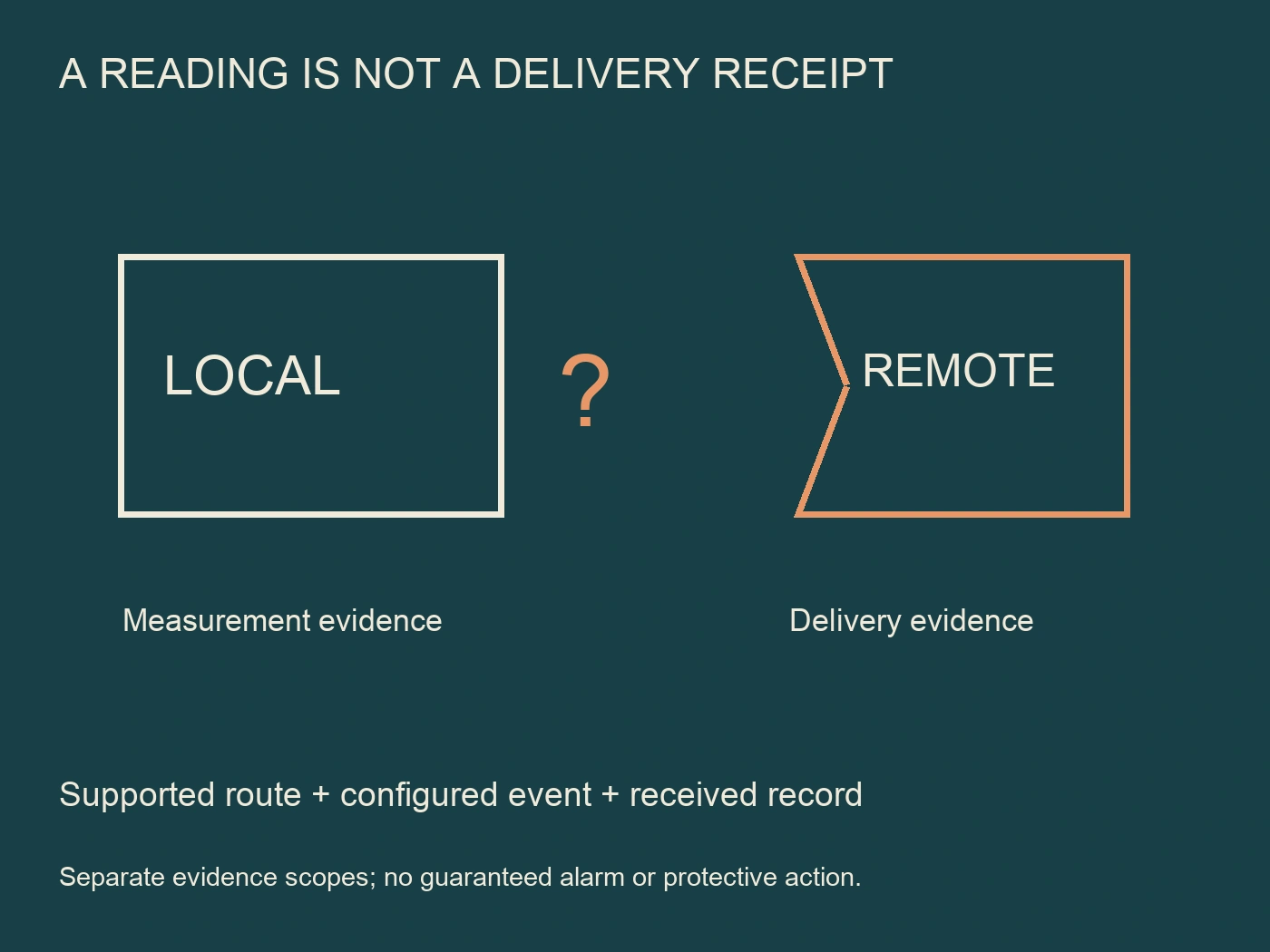
A local display can show a measurement without providing a programmable alert or remote notification. A network interface can expose data without establishing that the intended event route is configured and functioning. Treat measurement, alarm creation and notification delivery as separate capabilities.
Raritan's technical page describes event delivery through channels such as SNMP notifications, email and syslog in its supported range. That is a useful reminder to verify the destination and mechanism. It is not evidence that every product using the word “smart” offers all of those channels.
For the selected PDU, record whether the event appears locally, is logged, is exported to another system, or reaches a responsible recipient. Keep the installed interface and configuration tied to the entry. Do not assume that a displayed alarm automatically generates a ticket or reaches the person expected to respond.
Evaluate two hypothetical configuration gaps
Suppose a rack has a valid aggregate current reading and an operator requests a warning for one particular bank. The proposed configuration has no established bank measurement or bank assignment in its documents. The missing entry is bank-level evidence, not an invitation to divide the aggregate current by the number of banks.
Now suppose a selected unit supports a current event but the notification destination has not been configured or checked. The sensor and threshold can be suitable while the operational route remains incomplete. A saved threshold is not proof that a notification arrives with the correct PDU and circuit identity.
These are hypothetical documentation cases, not actual product failures or measured overloads. They show why scope and delivery must be reviewed separately. Neither case assigns an electrical limit, alarm percentage or time-to-trip claim.
Check the exact RITOKS monitoring architecture
Se local-display metered rack PDU family lists local electrical display functions and selection requirements. That does not by itself establish every desired programmable alarm or network notification. Request the selected configuration's measurement and interface documentation.
Se P-series smart rack PDU distinguishes aggregate monitoring, per-outlet monitoring and switching across its listed variants. Those differences matter: a capability listed for one variant should not be assigned to all others. Identify the offered variant and request its exact alarm scope, event configuration and supported notification route.
For the Monitored PDU 5.0 family with outlet-level metering, outlet-level monitoring is a relevant starting point. It is not proof that the product provides every branch-level alarm, switching function or notification channel. Keep those questions tied to the selected model and interface.
These monitoring architectures should also remain distinct from an ATS source-transfer function. Monitoring data or a smart-management label does not establish automatic source changeover. Select the actual functions required instead of treating rack-power labels as interchangeable specifications.
Verify the alarm path without overloading the circuit
Request a supported, controlled way to check the configured event and delivery path. There is no need to deliberately overload an installed circuit to establish that a notification route works. Any electrical validation must remain under the responsible team's appropriate procedures and approval.
The useful record identifies the configured threshold, channel, local event, remote destination and observed result of an authorized check. Keep event generation and actual circuit protection separate. A successful message-delivery check does not certify the distribution design or the protective device's operation.
Retain unresolved issues, including unsupported measurement levels, missing limit documentation and unconfirmed recipients. Operations should know which events are established and which expectations remain unverified. That is more actionable than a blanket “alarms enabled” statement.
Keep the record current after load changes
When equipment is moved, added or reassigned, check whether the monitored circuit mapping and accepted operating assessment still apply. A previously correct outlet identity can become misleading after a rack change even if the software value has not changed.
Preserve the basis, revision and owner of each setting so a later operator can understand it. Threshold selection should be a traceable decision linked to real circuit conditions and supported monitoring, not an unexplained percentage copied across a fleet.
Does a current alarm replace a breaker?
No. It is a monitoring event with its documented behavior. The circuit's protective function and rating must be assessed separately.
Should every PDU use the same percentage?
No. Establish the applicable circuit and project allowance first, then document operational settings and supported measurement scope.
Source notes
Raritan's current technical page was read directly, including monitoring levels and alert routes. The historical PXE manual contributed only the accessible indexed page-102 excerpt, not a full-document review. Current RITOKS commercial pages were checked; no unlisted configuration capability or regional electrical rule is inferred.