
Solid State Relays for Electronic Switching · Technical Explainer
Planning for a Shorted SSR in an Industrial Heater Safety Circuit
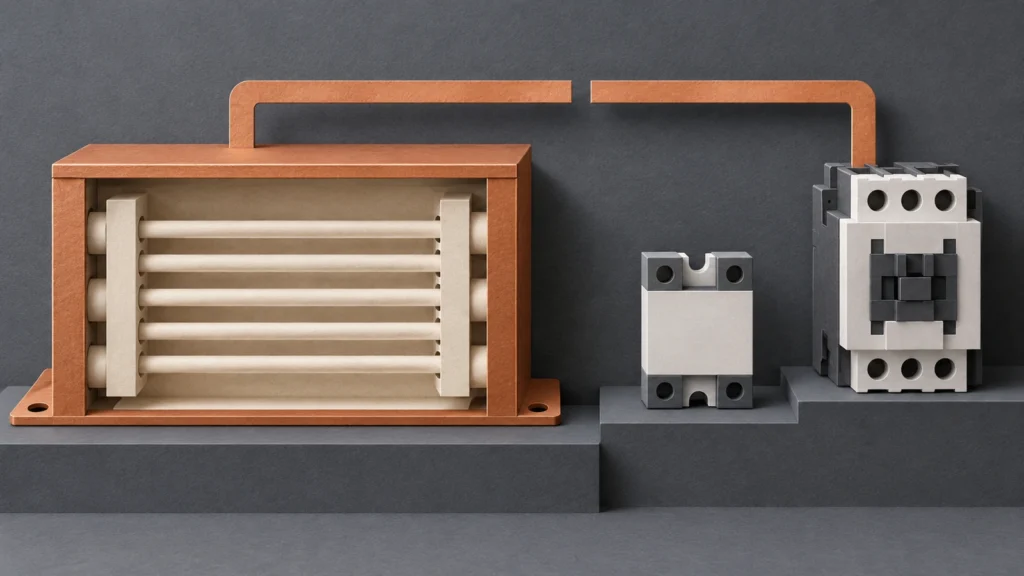
Ask what removes heat when the control switch cannot
An industrial heater review must consider the condition in which the solid-state relay continues conducting after the controller requests off. The buying question is not simply whether the SSR can carry the normal heater current. It is whether the equipment has a documented response to loss of control over that switching element.
Omron describes short-circuit failures as an important SSR failure mode and recommends a separate means of removing load power when the SSR fails. Watlow also distinguishes its shorted-SSR alarm from a high-temperature limit device. These are manufacturer design cautions, not evidence that any particular assembled circuit meets a safety performance requirement. Omron precautions, Watlow SSR specification sheet.
The deliverable for an OEM is a failure-response review: the heater hazard, the failure scenario, the detection method, the separate shutdown path, the required final condition and the acceptance evidence. This article organizes those inputs. It provides no universal wiring scheme, limit setpoint or certification claim. The responsible equipment designer must determine and validate the required architecture.
Define the heater consequence before selecting devices
Document what uncontrolled heating could do in the actual process. Identify the material, equipment and operating conditions that make the consequence relevant. Keep normal temperature regulation separate from the abnormal condition the protection review must address. A process that normally stabilizes at its setpoint still needs a defined response to a control failure where the risk assessment requires it.
Specify the intended safe condition in operational language. Does the equipment need heater power removed, a process stopped, cooling maintained or another sequence? The answer must come from the machine and process review. It cannot be inferred from the presence of an SSR, a temperature alarm or a contactor in a parts list.
Record the responsible design owner and the governing requirements already applicable to the equipment. Do not select a safety integrity level, performance level or regulatory claim from a component title. If the project has established safety requirements, attach the relevant assessment and acceptance criteria. If those requirements are unresolved, the sourcing file should show that gap.
The resulting requirement helps purchasing ask a useful question: which offered components support the defined duty and verified shutdown design? That is more specific than asking for a “safe SSR.” An SSR remains the normal control switch within a broader reviewed system.
Trace normal regulation and abnormal shutdown separately
Map the normal loop from the process sensor through the temperature controller to the SSR and heater. Record the exact hardware and the command used for normal regulation. Then map the abnormal shutdown path independently, showing what detects the relevant condition and what removes power even if the SSR output cannot turn off.
The drawing must reveal any shared dependencies that matter to the required response. A shared sensor, supply, controller function or final switching element may affect the independence claimed for the design. Flag the dependency for the responsible engineer rather than assuming that two software functions are separate protection layers.
RITOKS lists XSSR-P2 AC solid-state relays et SDA3-40 three-phase solid-state contactors as switching families. Their exact offered models need a current, voltage, thermal and application review. Their listing does not establish the independent shutdown function for a heater installation.
For a three-phase heater, preserve the actual load connection and pole arrangement in the engineering drawings. Do not reuse a single-phase sketch and imply that it resolves every energized conductor or failure scenario. The final interruption and isolation requirements depend on the equipment design and applicable rules, which require qualified review.
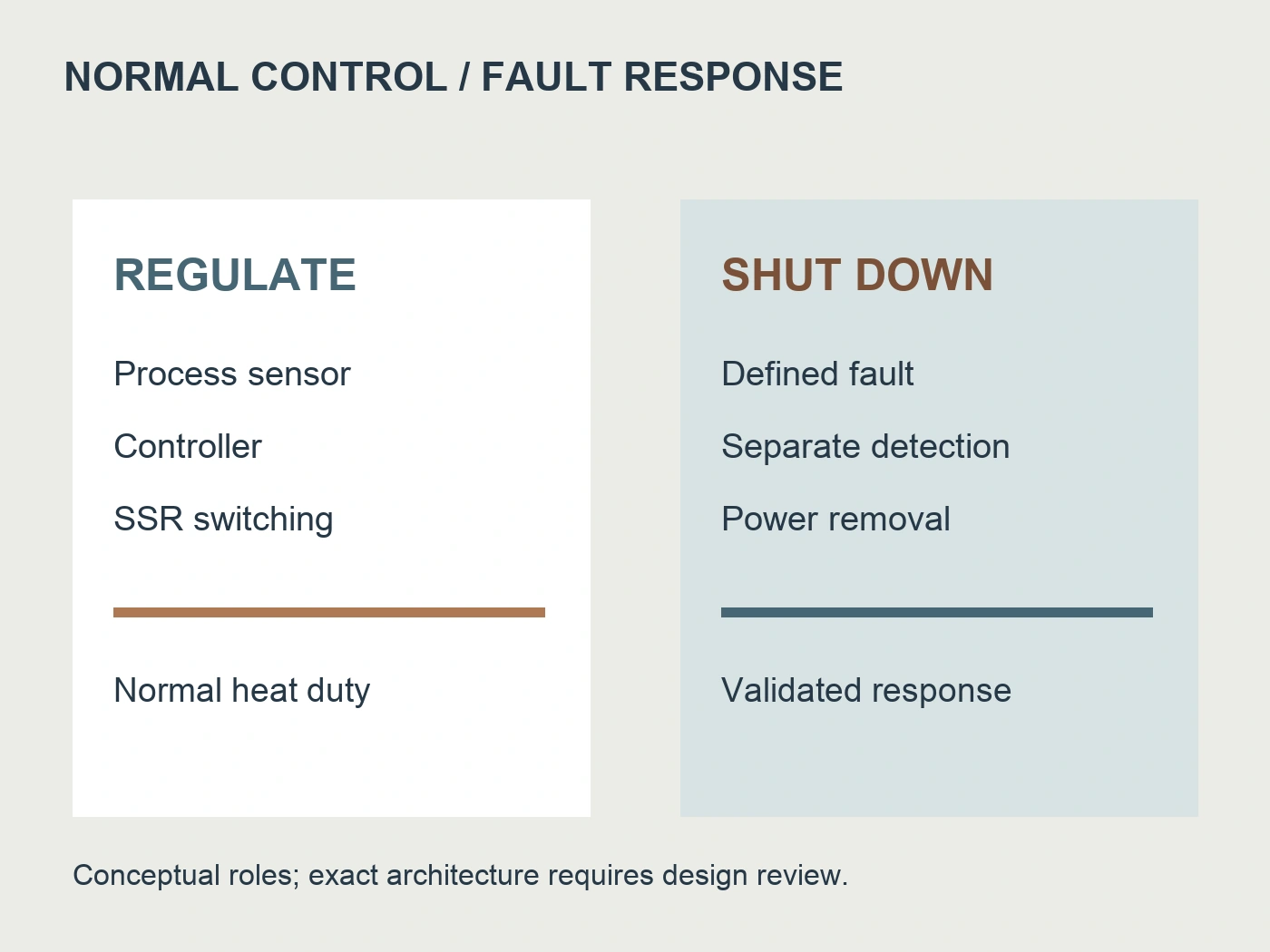
Distinguish a shorted-switch alarm from a temperature limit
A shorted-SSR alarm can compare requested off behavior with observed heater current. Omron’s glossary describes this detection principle for time-proportioning control. That is useful evidence about what the alarm observes, but it is not the same as measuring the process’s abnormal temperature condition. Omron heater short alarm glossary.
Ask what the alarm output actually does. A status bit sent to a display differs from an output that participates in a verified shutdown sequence. Record the receiving device, required logic and final action. If the output only alerts an operator, do not describe it as automatically removing heat.
Likewise, a high-temperature limit function needs its own sensor, settings, response and reset evidence as defined by the equipment design. Watlow explicitly states that its shorted-SSR alarm is not a substitute for an approved high-temperature limit device. Use that distinction to avoid combining two different functions in one vague RFQ line.
The review should say which failures each function can detect and which it cannot establish from its measurement. Avoid calling a diagnostic alarm a complete safety function. A useful acceptance report names the observed condition and demonstrated action without claiming more coverage than the test and design evidence support.
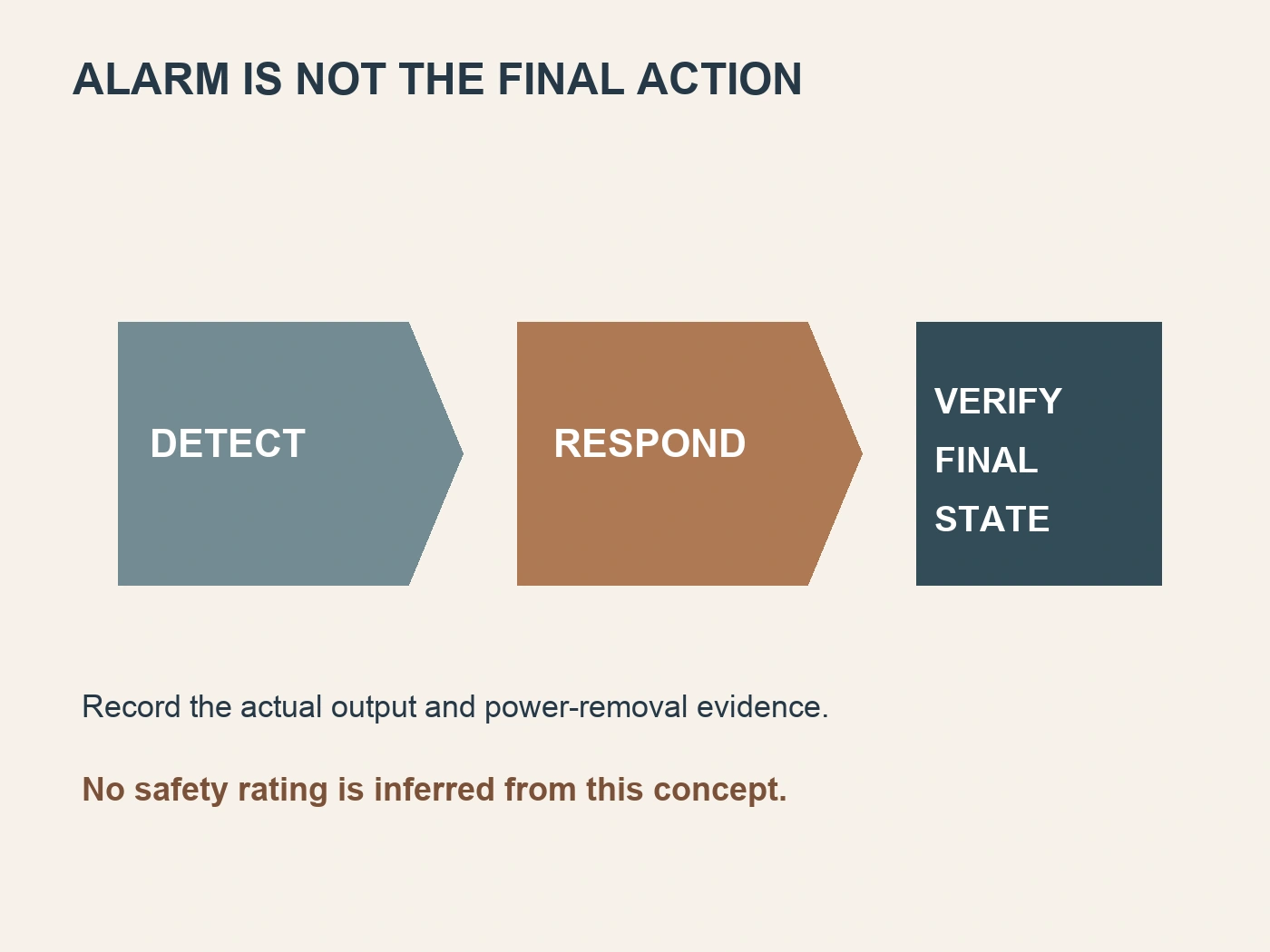
Review the final power-removal path
Identify the exact device and control path intended to interrupt heater power. Request its applicable switching duty, the conditions under which it is expected to operate, and the evidence needed for the equipment’s acceptance criteria. A contactor or breaker name alone does not prove that the entire shutdown sequence works.
Trace the shutdown request through to the final power state. Consider the documented behavior when control power is lost, when the limit detects a fault and when an operator requests reset. The relevant conditions must be selected by the responsible designer, not copied as a generic sequence from another machine.
Do not confuse overcurrent protection with detection of excessive process temperature. Keep each protection purpose in the review file, including its exact component and coordination evidence where required. A fuse chosen for semiconductor protection should not be credited with a different function without supported application evidence.
Also distinguish fault shutdown from servicing isolation. The equipment’s designated isolation and verification procedure remains a separate requirement. An off indication on the process controller does not establish absence of hazardous voltage, whether the SSR is healthy or has failed.
Choose the SSR for its normal duty as well
Failure planning does not remove the need to select and install the SSR correctly for normal operation. Obtain the exact load current and voltage, operating cycle, inrush conditions, ambient conditions and thermal arrangement. Keep the manufacturer’s rating conditions attached to the chosen part.
Review the mounting and heat-removal instructions for the actual enclosure. A headline current rating without its thermal conditions is incomplete. If an offered alternative changes the heatsink, mounting interface or enclosure airflow, record that change and request the corresponding evidence. Do not assume that a physically similar component can use the same assembly details.
Request the applicable surge and short-circuit protection information. The equipment engineer must review coordination using the selected SSR and protective components. Avoid combining unrelated maximum ratings into an unsupported claim that the assembly is protected against every fault.
The normal-duty review and the failure-response review should therefore remain two linked records. One supports component selection; the other supports the equipment’s response when that control component no longer behaves as commanded.
Build a failure-response table with owners
Use a table that records the actual equipment review instead of a generic tick-box declaration:
| Scenario | Evidence to record | Required review owner |
|---|---|---|
| SSR conducts after off request | Detection conditions and independent shutdown action | Controls and equipment safety designer |
| Temperature exceeds the accepted boundary | Limit sensing, response and final power state | Process and safety designer |
| Control power is lost | Component states and resulting heater condition | Electrical designer |
| Reset is requested | Permitted restart conditions and operator behavior | Equipment design owner |
| Final switching path does not respond | Coverage required by the project assessment | Safety design owner |
The rows identify questions, not an approved architecture. Add the exact schematic revision, component documents and test references beside each applicable scenario. Leave unresolved requirements visible until the responsible owner has supplied evidence.
Keep reset behavior explicit. A cleared alarm does not automatically mean the process is ready to resume heating. The equipment design should define what must be verified before restart and whether a manual action is required. Record that behavior in the controller configuration and acceptance report where applicable.
Verify the response with a controlled acceptance plan
Have the responsible engineer define safe, controlled ways to demonstrate the specified fault response. Do not improvise a destructive short of a live switching device. The acceptance method must be appropriate to the equipment, hazards and governing design requirements.
The plan should identify the initial state, simulated or introduced condition, expected detection, required shutdown action and observed final condition. Record timing only where it is specified and measured using suitable instrumentation. An unmeasured response should not be described with an invented reaction-time claim.
Retain the tested hardware, firmware and configuration revisions. If the offered SSR or a limit component changes after the test, review whether the evidence still applies. A component substitution can affect the engineering record even when the normal heater operation appears unchanged.
Do not report a safety rating from a successful demonstration alone. The test contributes to the project’s validation evidence; the overall conclusion requires the design assessment, component data and required checks for that equipment. State those practical limits clearly in the commissioning handoff.
Make the procurement scope match the design
The RFQ should identify whether the supplier is providing the normal switching component, a power-control assembly or additional shutdown components. Attach the approved duty and interface requirements for the supplied scope. Ask for exact part numbers and revision-controlled documentation, not a broad statement that a product is suitable for heaters.
Keep any offered safety or compliance claim tied to the exact item, document and conditions it covers. A component approval does not automatically cover the assembled machine. Where the supplier cannot support a requested claim, record it as unresolved rather than rewriting the article or specification to imply acceptance.
Release the order only against a defined component and evidence boundary. The finished review should show how normal control is achieved, how the specified abnormal condition leads to power removal and what remains subject to equipment validation. That makes the shorted-SSR scenario an explicit design input instead of a hidden assumption in the purchasing process.
Source notes
- Omron, Solid-state Relay Safety Precautions. Retrieved2026-09-30. https://www.ia.omron.com/product/cautions/18/safety_precautions.html
- Watlow, Solid State Relay specification sheet. Retrieved2026-09-30. https://www.watlow.com/-/media/documents/specification-sheets/win-ssr-0818.ashx
- Omron, Heater short alarm glossary. Retrieved2026-09-30. https://www.ia.omron.com/support/glossary/meaning/2856.html