
DIN Rail Energy Meters · Technical Explainer
Remote Meter Disconnection: Define Commands, Feedback and Recovery

Quick answer
An operator presses Disconnect, the communication transaction succeeds, and the dashboard displays a reassuring message. What has actually been established? The application may know that a request was sent or a response received without knowing the physical switching state. An energy meter remote disconnect control sequence needs to distinguish those facts before the function is accepted.
Start with a confirmed disconnect-capable configuration, then define the command, documented response, available state evidence and recovery conditions. Preserve an unresolved state when feedback is unavailable. Remote switching must not be treated as maintenance isolation, and a reconnect command must not be issued merely because communications have returned.
This guide provides a proposed acceptance framework for equipment energy-management projects. It is not a register map, relay operating instruction or permission to disconnect a live installation. The project designer and equipment supplier must determine the supported behavior and the authorized test arrangements. The useful deliverable is a command-and-evidence table, not a dashboard that hides uncertainty behind “success.”
Confirm the ordered function before designing its sequence
Le RITOKS 2P single-phase communication energy meter lists Modbus RTU and DL/T645 configurations, with remote disconnect available only on selected variants. A communication-only variant is not evidence of an included switching function. Retain the exact orderable configuration and supplier confirmation alongside the controller design.
Request the selected variant's command documentation, switching ratings, applicable load limitations and instructions. Its metering current designation does not, by itself, establish the permitted switching duty. Also obtain the feedback definitions and any local conditions affecting operation. Do not infer these from another model using the same protocol.
The public family page does not supply command addresses, switch-position registers, interlocks or detailed recovery rules. Treat those as required evidence, not as fields to fill with plausible values. A design may specify the information it needs without claiming that the selected meter already provides it.
Separate the protocol question from the control-sequence question. Protocol selection establishes how devices communicate. Functional acceptance establishes what a particular command means, how completion is determined and what happens when information is missing. Both matter, but a successful serial connection does not resolve the second task.
Separate transaction outcome from switching-state evidence
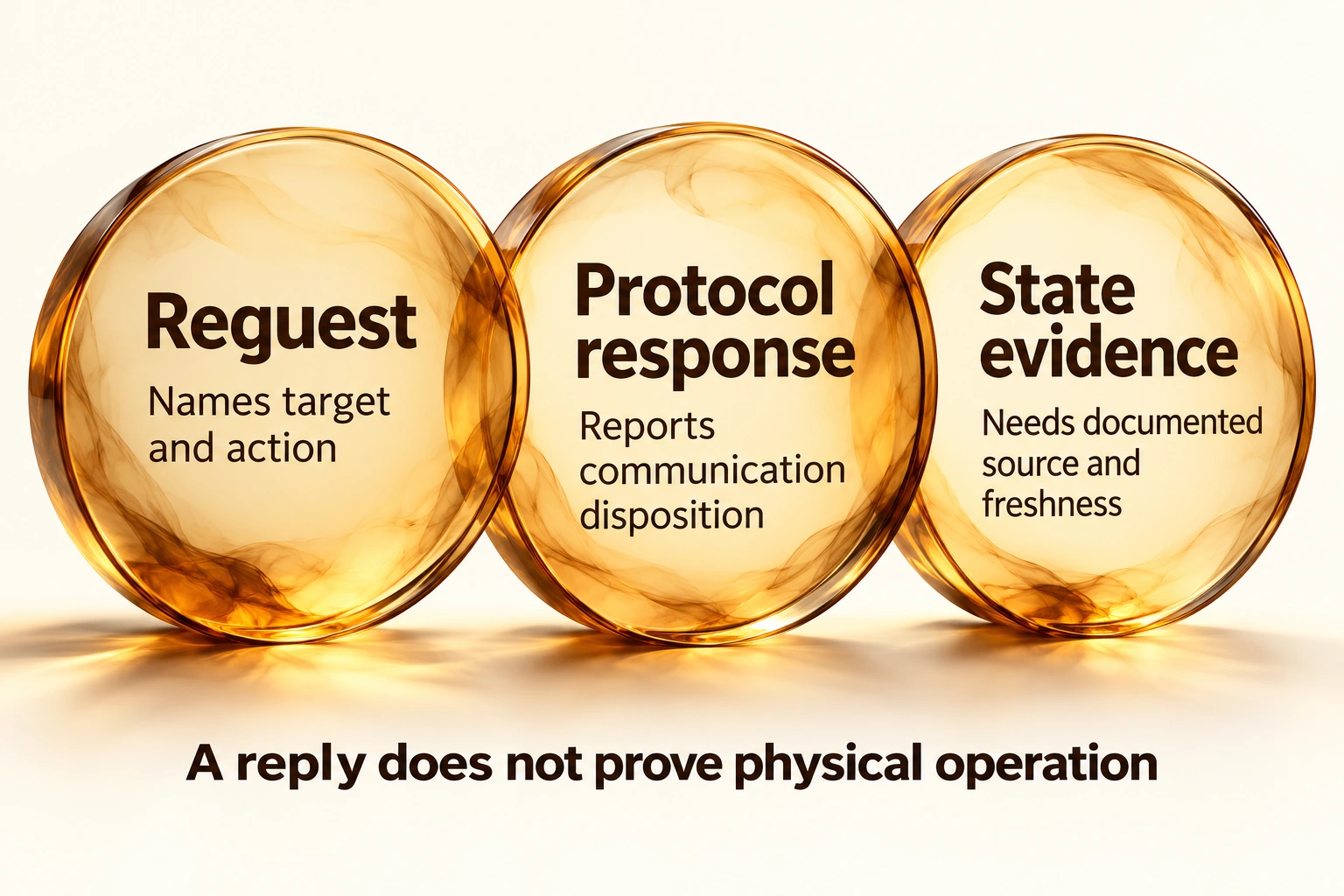
The official Modbus Application Protocol Specification defines request/reply transactions, normal responses and exception responses. It also discusses managing a timeout. This supports separate communication outcomes; it does not define this meter's disconnect register or prove the state of its physical switching element.
In the project record, identify what the normal response actually confirms according to the meter documentation. A returned value might represent a command field rather than independent position feedback. Label it by its documented meaning. Do not rename a software request value “contacts open” unless the manufacturer provides evidence for that interpretation.
Likewise, an exception response and a missing response are different observations. The first supplies a documented protocol-level error; the second leaves the transaction outcome uncertain. Neither should be displayed as proof that the load is connected or disconnected. Preserve the distinction in the event record so that the operator can tell a rejection from an unanswered request.
Where the design requires independently evidenced switching state, identify its source and what it demonstrates. If the meter does not provide the needed evidence, return that gap to the supplier and designer. Do not claim a new feedback capability, invent a status bit or assume that a low power reading proves physical isolation.
Build the sequence around explicit evidence states
The following is an original acceptance-state proposal. Its labels describe the information a supervisory application holds, not a manufacturer-defined meter state machine. The supplier and designer must map each relevant row to documented functions before implementation or testing.
| Supervisory observation | Pièces justificatives requises | Appropriate recorded conclusion |
|---|---|---|
| Disconnect requested | Authorized request and identified destination | Request issued, completion not yet established |
| Normal response received | Meaning of the response in the selected variant's documentation | Transaction outcome recorded within its documented scope |
| Documented disconnected feedback available | Defined feedback source, meaning and freshness | Reported switching state known within that evidence scope |
| Exception returned | Response and documented exception interpretation | Request encountered a reported error |
| Response or feedback missing | Event history and defined communication checks | Outcome or current state unresolved |
| Reconnection proposed | Authorized request and applicable recovery conditions | Reconnection remains a separate decision |
Do not turn these rows into a compulsory sequence that the product has not documented. Some variants may expose different information, or require local participation before reconnection. The table's purpose is to expose that difference before purchase, not to force every meter into a preferred controller design.
For the user interface, use labels that match the evidence. “Request sent,” “response received” and “state unresolved” are distinct messages. The application's desired state and the documented reported state should remain separate so that an operator can recognize disagreement. Avoid a single colored icon that silently merges communication health with switching status.
Handle missing responses without guessing the physical state
Consider a disconnect request followed by a communication interruption. It may be unclear whether the request reached the meter or whether the reply was lost. Do not resolve that ambiguity by assuming success, failure or a specific contact position. Preserve the last established information and mark what is now unknown.
Before selecting a retry behavior, ask the manufacturer how repeated commands are handled for the exact variant. A controller must not rely on an assumed repeat-safe command or a toggle interpretation borrowed from another product. Document the permitted handling in the project sequence and leave it unresolved until the necessary information is supplied.
Distinguish a transaction awaiting completion from an old status display. Record when the information was obtained and the source used. The project should define when it no longer represents an acceptable current observation; this article supplies no universal timeout or polling interval. Those values depend on the documented behavior and application requirements.
During commissioning, the authorized test plan should include the relevant missing-response scenario and its expected display and escalation. That is a requirement for a controlled test, not an instruction to interrupt an operating site's network or load. Keep the test arrangement and findings with the accepted configuration.
Define restoration as a new control decision
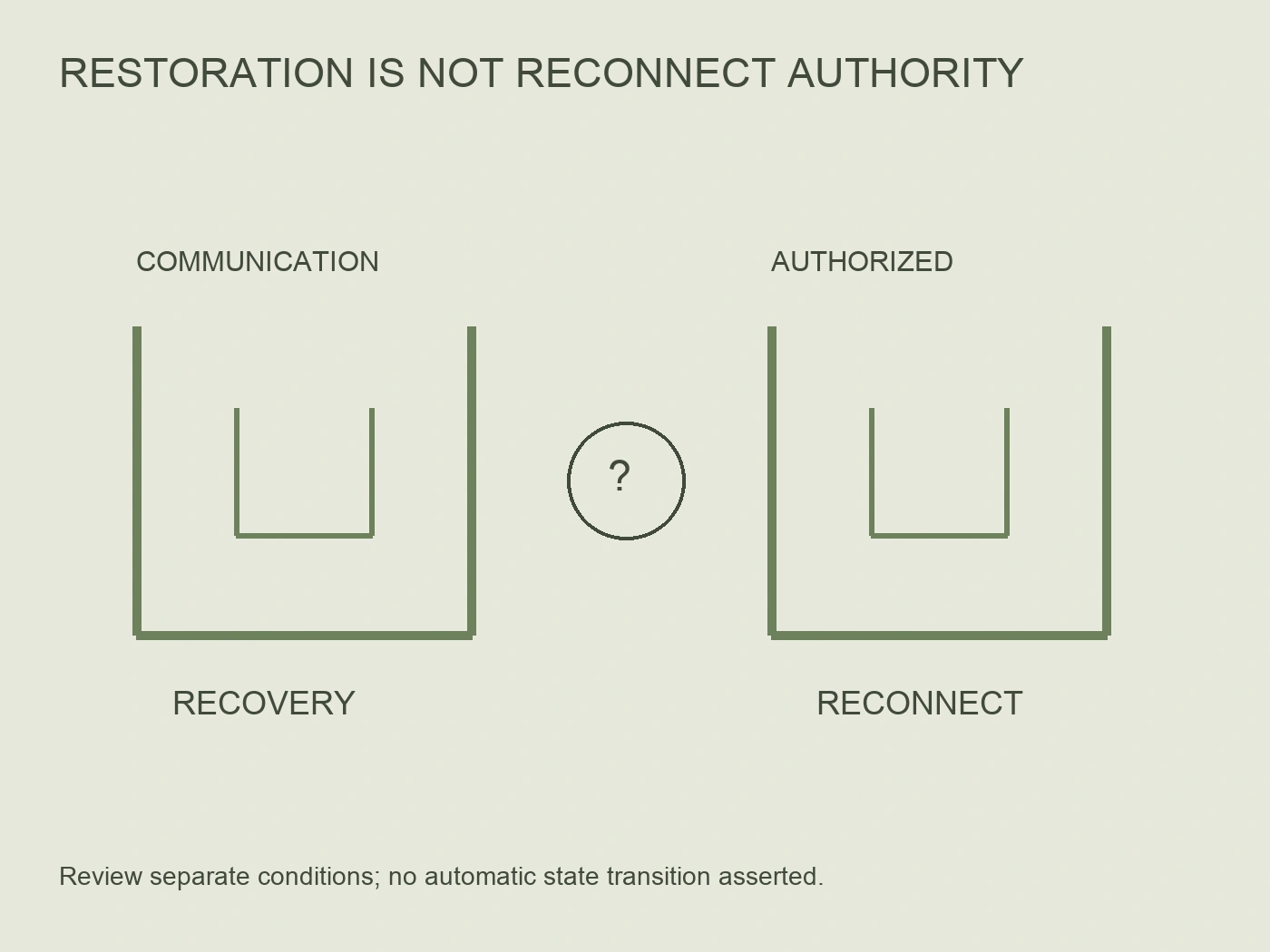
Communication restoration does not necessarily establish the present switching state. Meter power restoration may also have behavior different from communication recovery. Verify separately what the meter retains after a power outage. Request documentation covering the applicable scenarios, including what state is retained, what is reported after restart and whether local action is required. Do not infer relay-state retention from a general “power-off memory” feature.
Make reconnect authorization explicit. The application should not treat an earlier desire for a connected load as permission to reconnect after an unresolved interruption. Ask the responsible project owner to define which conditions and personnel authorize reconnection, and have the supplier confirm how the selected configuration supports that process.
Keep “ready for reconnection” separate from “connected” if such a distinction is actually documented for the selected product. If it is not documented, do not invent that capability. A useful requirement can remain an open supplier question rather than becoming a fictional state in the operating interface.
Remote switching is not a substitute for the site's maintenance-isolation procedure. A control response or status display does not establish that all hazardous sources have been isolated. Work authorization, isolation and verification belong to the applicable equipment and site procedures, not to the communications acceptance record.
Keep a command-and-recovery record at handover
For each selected variant and controller configuration, retain a bounded functional record. The following worksheet makes the missing evidence visible and connects an observed result to the design that was tested. It is not a completed acceptance certificate.
| Record field | Information to retain | Gap to flag |
|---|---|---|
| Product configuration | Exact meter option, documentation and relevant version | Disconnect option not confirmed |
| Command definition | Documented action and permitted use | Address, meaning or switching duty missing |
| Response interpretation | Normal and exception outcomes | Response mistaken for physical feedback |
| State evidence | Source, scope and observation timing | Desired state shown as actual state |
| Failure behavior | Unanswered request and stale-information handling | Unknown state converted to success |
| Recovery conditions | Restart behavior and reconnect authorization | Reconnection assumed on restoration |
| Test finding | Authorized scenario, observed evidence and reviewer | Result detached from tested configuration |
For example, a test records a normal command response, but the supplied documentation contains no position-feedback definition. Record the transaction result and leave switching-state confirmation unresolved. Do not report a failed meter solely because the required evidence is absent, and do not approve the complete control function solely because the transaction worked.
In another case, the functional documentation is complete but the controller has changed its recovery behavior since testing. Preserve the earlier result and identify the changed sequence for review. A new controller release can alter the accepted function even when the meter remains unchanged. That dependency belongs in the handover record.
Compare two filled command records before accepting recovery
Consider fictional record F1 for meter option M1 and controller release C1. Supplier document D1 confirms that M1 includes the disconnect function and identifies the normal command response as acknowledgement of the documented command transaction. It supplies no independent switching-position definition. The test file records the normal response and an operator-interface message saying “disconnected.” These are hypothetical documents and administrative observations, not a performed load-switching test. The transaction field can be recorded within D1's scope; the physical-state claim on the interface has no supporting feedback basis.
The buyer's next request should name that gap. Reconfirming that M1 has a disconnect option does not define position evidence. If the project requires such evidence, the supplier and designer must identify a supported source and its meaning. A revised controller message could truthfully say “response received; switching state unresolved” while that engineering question remains open. Changing the wording would improve the evidence display but would not create the missing feedback capability or approve the entire requested control function.
Now assume fictional record F2 identifies a different documented option M2. Its selected instructions define feedback source S2 and the conditions under which that source reports switching state. The responsible reviewer accepts those definitions for the proposed function, and F2 retains a qualified observation record referencing them. This makes F2 a better-documented candidate for the state-evidence requirement than F1. The preference depends on the required function and applicable documentation, not on an assumed superiority of all variants with more communication fields.
F2 still leaves recovery open: release C2 reconnects automatically after communication returns, but the project owner's accepted requirement A1 calls for a separate authorized reconnect decision. Supported state evidence does not resolve that policy mismatch. A controller revision implementing the accepted authorization requirement could change the decision, subject to its own reviewed record. Conversely, changing the project requirement is a decision for its owner, not a shortcut procurement can take to match an available controller. Neither hypothetical option is approved merely because a response or status field exists.
Retain the conclusions individually: F1 has a documented transaction response but unsupported physical-state wording; F2 has a selected feedback basis but an unresolved recovery mismatch. If later documentation changes only the feedback scope, revisit that field rather than discard unrelated order confirmation. If the controller changes its restart behavior, preserve the earlier evidence as history for that release. This is an evidence comparison, not a command address, retry rule, reconnection instruction or maintenance-isolation procedure.
Ask for the evidence that closes the function
Send the supplier the exact ordered option, proposed control purpose and required feedback and recovery behavior. Request its function documentation and operating limits, rather than asking only whether the meter supports remote disconnect. A yes/no feature confirmation is useful, but insufficient to define an acceptance sequence.
The finished record should show what the system can command, what the response confirms, how switching state is evidenced and what remains unresolved after an interruption. Accept only the documented, reviewed arrangement. That gives operators a truthful control interface and gives future maintainers a clear boundary between remote load control and separate electrical-work procedures.
Références
- Modbus Organization. (n.d.). Modbus Application Protocol Specification V1.1b3, section 4.1. https://www.modbus.org/file/secure/modbusprotocolspecification.pdf
- RITOKS. (n.d.). 2P single-phase RS485 Modbus DIN-rail energy meter. https://ritoks.com/products/2p-single-phase-rs485-modbus-din-rail-energy-meter/