
Enclosure Heaters for Control Cabinets · Comparison
Thermostat vs Hygrostat for Electrical Enclosures
A thermostat and a hygrostat can both switch an enclosure heater, but they respond to different measured conditions. A thermostat acts on temperature. A hygrostat acts on relative humidity. That difference determines which device can answer the cabinet's control question. If the buyer needs to maintain a minimum internal temperature for an instrument, temperature is the direct variable. If the buyer is mainly trying to limit a humidity condition associated with condensation risk, humidity-responsive control may be worth evaluating. Neither label proves that a particular heater and controller are electrically compatible or that the complete enclosure will remain condensation-free.
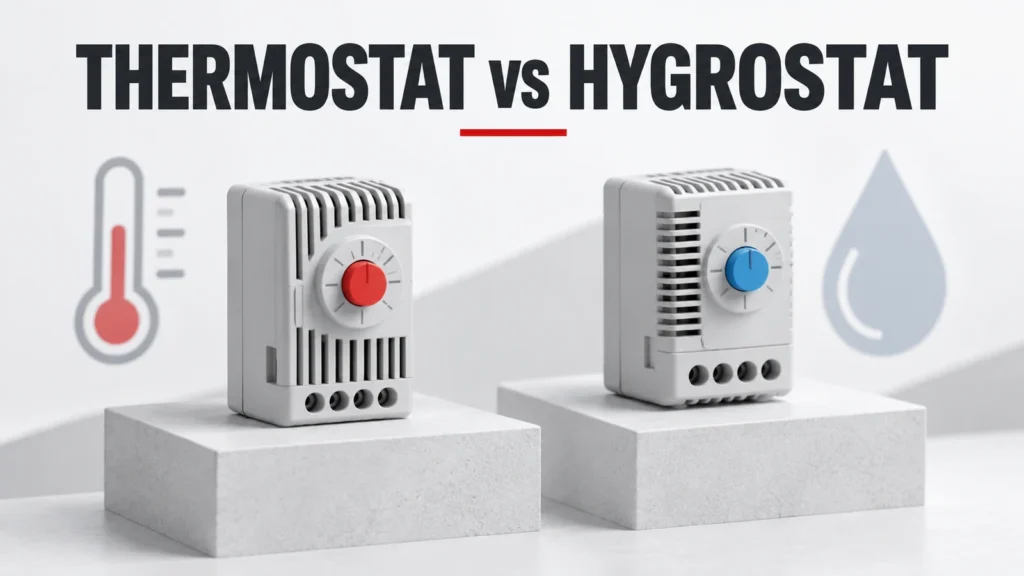
This article is a buying guide to control intent, not a catalog of RITOKS thermostat or hygrostat models. The relevant RITOKS commercial product family is enclosure heaters. Any separate control device, switching setpoint, contact capacity or integrated-controller claim must be established by the exact documents supplied for the proposed configuration.
Decide which condition requires action
Write the intended operating statement before asking for a control component. “Energize the heater when cabinet air falls below the specified minimum” is a temperature-control request. “Energize the heater when cabinet humidity reaches the selected threshold” is a humidity-control request. A vague request such as “anti-condensation controller” does not identify the sensor variable or the protective target. It may hide a disagreement between the panel designer and purchasing team about what the device is supposed to do.
The distinction is reflected in manufacturer guidance. Rittal's enclosure-heater information recommends a thermostat for precise temperature control inside an enclosure and a hygrostat where the purpose is controlling heating against condensation on assemblies. That guidance is an example of functional separation, not an instruction that every cabinet must use one of each. The selected control strategy depends on equipment limits, environmental exposure, moisture behavior and verified component documentation.
A thermostat can command a heater without measuring humidity. It may help keep surfaces warmer, but it cannot tell the designer whether relative humidity has reached a chosen threshold. A hygrostat can command a heater without guaranteeing that a temperature-sensitive device stays above its minimum allowed operating temperature. If both requirements matter, both conditions need to be documented and reviewed as a system rather than assumed to be met by one abbreviation.
What a thermostat actually tells the system
Un enclosure thermostat senses temperature at its own location and changes a contact or output according to its design. The exact control action depends on the model: contact state, setpoint, switching differential, sensing accuracy and any supply requirement. The thermostat does not measure the temperature at every component, and a sensor next to a heater can see conditions unlike those at a cold corner or door surface. Define where the representative temperature should be measured, then check the manufacturer's installation guidance.
The heater-control version of a thermostat commonly calls for heat as sensed temperature falls. That is not enough detail for wiring. Request the exact contact-state diagram and determine whether the switching element can drive the heater directly or should command a relay. Heater power, supply, inrush behavior and the thermostat's resistive or inductive contact ratings must be checked together. A thermostat is a control device; it is not a branch-circuit protective device.
Le RITOKS JRQ heater family provides a published route to actual heater models. The family page should be used to identify candidate parts and request missing exact-model data. It must not be treated as proof that a generic thermostat is included, that a particular setpoint is supported, or that a third-party contact is approved for every JRQ version.
What a hygrostat actually tells the system
A hygrostat responds to relative humidity near its sensor. Relative humidity describes moisture in relation to air temperature, so a threshold is meaningful only in the context of the temperature and surfaces in the enclosure. The device may switch a heater or another load when its selected humidity condition is reached, depending on its contact action and model. It does not remove water from the cabinet, stop liquid ingress or measure every surface's dew-point margin. A leaking cabinet still needs the water path addressed.
STEGO's product catalogue describes an electromechanical hygrostat intended to control enclosure heaters when a critical relative-humidity level is exceeded. That supports the basic control concept, but its threshold, terminals and electrical ratings belong to STEGO's device, not to any RITOKS heater or an unspecified hygrostat. Request the proposed controller's datasheet and state chart before specifying an exact setting or electrical connection.
Sensor location can materially change the response. A hygrostat next to a warm airflow path may indicate a different relative humidity than one near a cold wall. Even a correctly operating sensor cannot substitute for a moisture assessment if the enclosure contains cold metal surfaces, frequent door openings, cable-entry leaks or sharp temperature cycling. Describe when condensation is observed and where it forms. That evidence helps a supplier decide whether humidity-responsive heating is a plausible part of the solution.
Temperature and humidity can point to different actions
Consider an unheated cabinet in a cold but dry setting. The electronics may need a defined minimum operating temperature even when relative humidity is not high. A temperature-responsive heater call is the direct way to express that requirement. Now consider a cabinet whose equipment tolerates the temperature but develops moisture on internal surfaces during morning transitions. A fixed minimum-temperature threshold may not correspond neatly to the humidity event. A humidity-responsive control may give a more relevant signal, subject to the actual sensor and condensation analysis.
These are conceptual cases, not prescribed setpoints. Relative humidity can change when temperature changes even if the amount of water vapor does not. A heater can lower relative humidity in the warmed air while a colder surface remains vulnerable if it is not warmed sufficiently. The cabinet's thermal paths and moisture sources therefore matter more than a slogan such as “hygrostat prevents condensation.” Where both low-temperature performance and moisture are critical, an engineer may evaluate coordinated controls or a combined device. Ask for the full operating sequence, not merely a parts list.
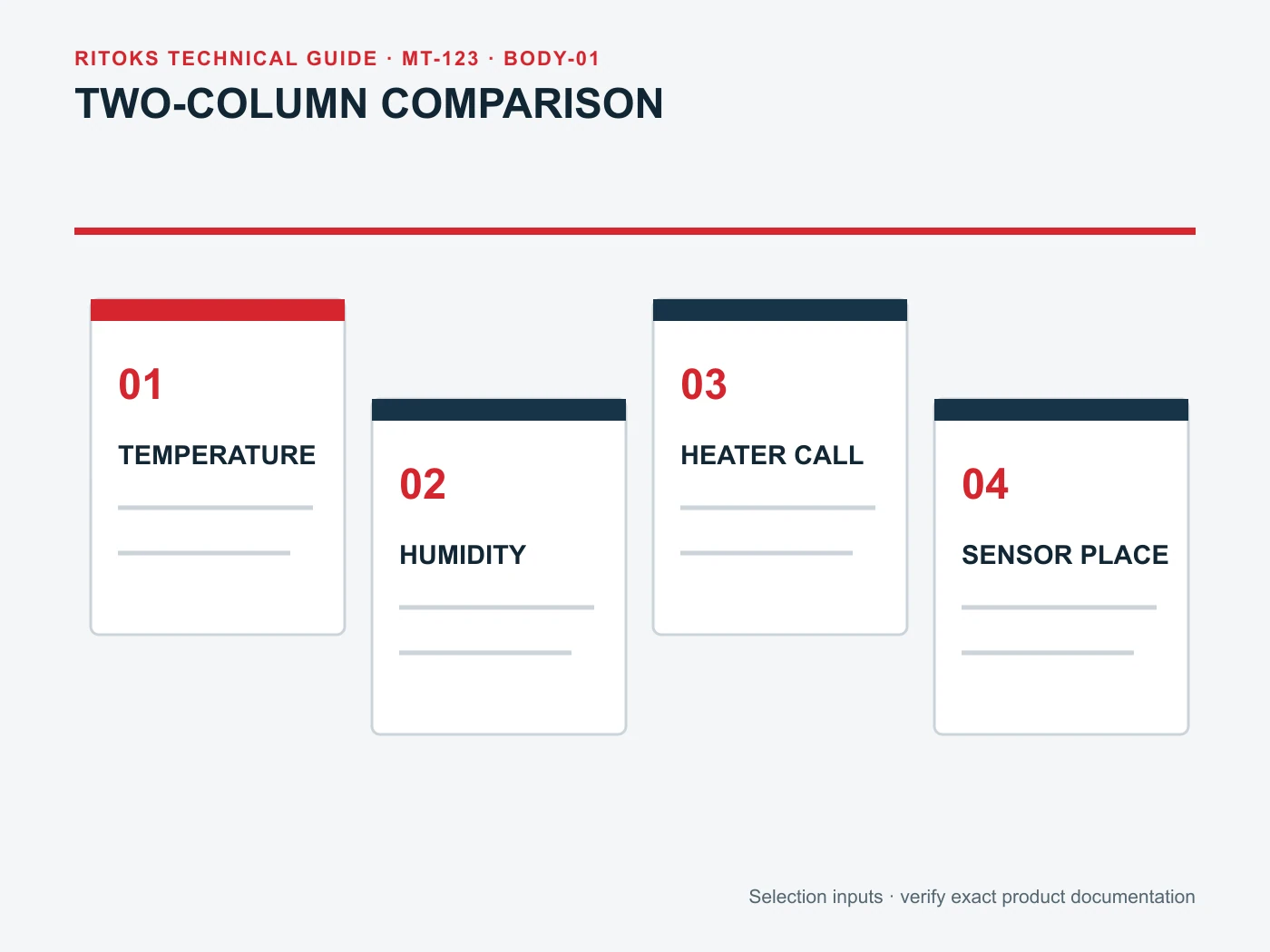
For either device, the selected heater still needs adequate thermal output under the cold-case condition. Control cannot create capacity. The related enclosure-heater sizing problem requires cabinet geometry, exposed surfaces, ambient minimum, target internal condition and verified internal losses. A supplier should not infer heater wattage from a thermostat or hygrostat selection alone.
Compare control choices in a buyer's table
| Champ de décision | Thermostat route | Hygrostat route |
|---|---|---|
| Measured variable | Local temperature | Local relative humidity |
| Direct buyer objective | Maintain a defined temperature condition | Respond to a defined humidity condition |
| Evidence needed | Temperature range, contact action, differential and sensor location | Humidity range, contact action, differential and sensor location |
| Ce que cela ne prouve pas | Dew-point safety at every surface | Minimum component operating temperature |
| Electrical check | Contact versus heater or relay load | Contact versus heater or relay load |
The table separates questions; it does not declare one control universally better. Some products incorporate fixed control; others require a separate device. A manufacturer may offer electronic, electromechanical or combined arrangements. The engineering decision should use the proposed part number's documented behavior and the cabinet's actual duty. Do not assume that two control devices with the same nominal switching value behave identically across temperature, tolerances or mounting orientations.
Verify the heater and controller as a pair
Start with the heater's supply and documented operating behavior. Then obtain the controller's contact rating and the manufacturer's wiring information. A PTC heater's element can be self-regulating in a limited physical sense, yet the cabinet may still need a thermostat or hygrostat to implement the desired system behavior. STEGO's CS 060 manufacturer page distinguishes its heater from a version with an integrated fixed thermostat. That example shows why the buyer must check the configuration rather than assuming every heater includes control.
Ask whether a proposed controller directly switches the load or a separate relay. Confirm AC or DC supply, switching current, inrush considerations and failure response. Locate the sensor so it sees the condition it is meant to control without being biased by immediate heater exhaust. The final wiring diagram belongs to the panel designer and exact product instructions. This article does not assign terminals, cable sizes, protective devices or clearance values.
If a controller is advertised as “anti-condensation,” ask what it measures and when it switches. The phrase can describe a temperature-controlled heater, a humidity-controlled heater or an integrated product. Purchasing by that phrase alone risks an unsuitable control objective. The RFQ should state whether the enclosure must meet a temperature requirement, a humidity response requirement, or both.
What to include in an RFQ
- Describe the enclosure, its location and the cold or humid event that needs to be managed.
- State the equipment's documented minimum temperature requirement, if one applies.
- State whether relative humidity or observed condensation is the control concern, including when and where it appears.
- Provide the heater model or candidate family, supply data and any available electrical load information.
- Ask for the proposed controller's sensing variable, adjustable range, switching differential, contact-state diagram and load rating.
- Identify the intended sensor location and whether the heater or control is integrated or separate.
- Request a complete model-specific control description and installation instructions before approving the panel design.
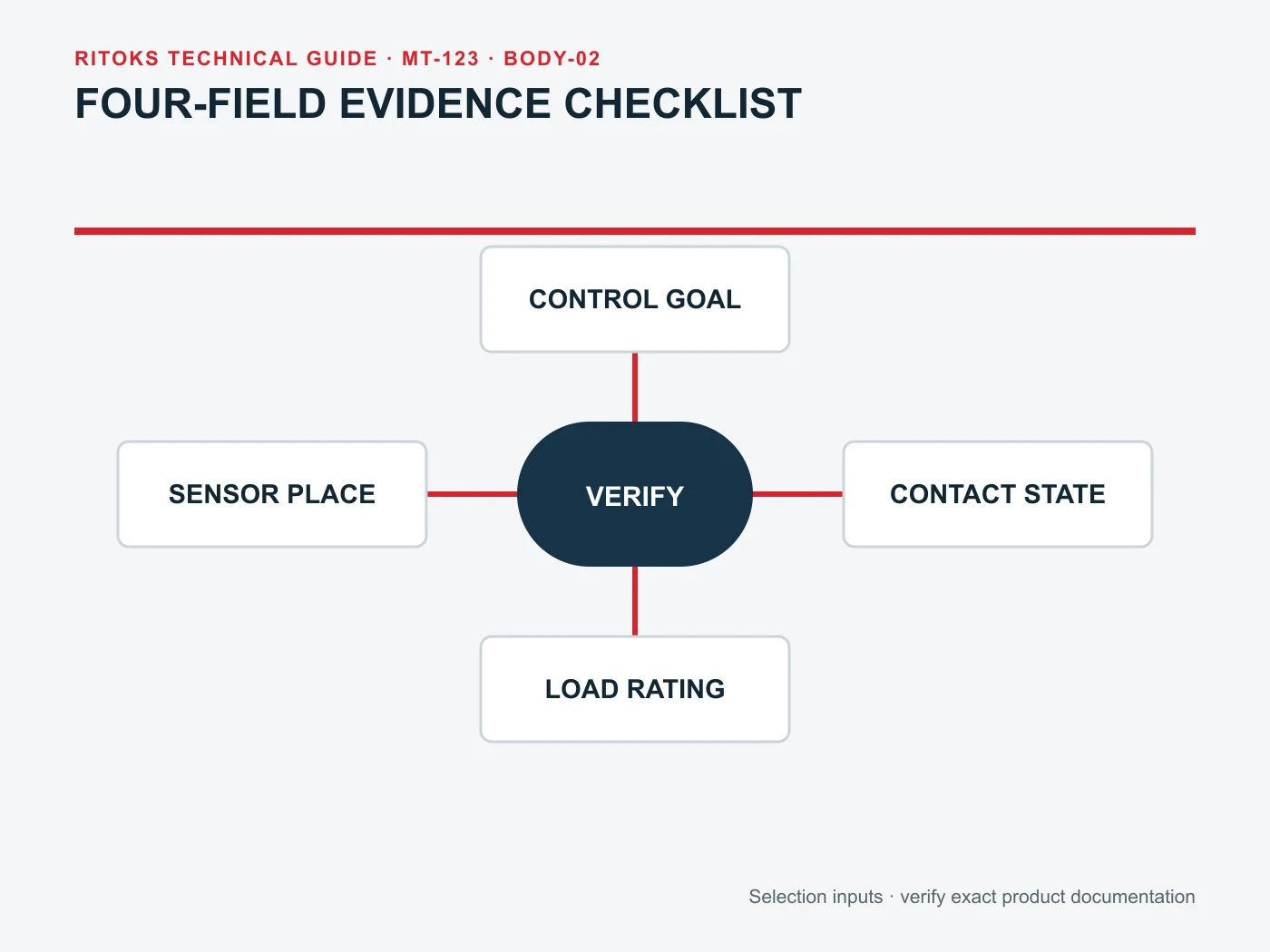
This list helps the supplier recommend an arrangement that answers the actual problem. If the buyer does not yet know whether temperature or humidity is primary, include that uncertainty openly. The supplier can then request the missing operating and environmental evidence rather than pretending a single control label settles it.
Final decision
Choose a thermostat when the cabinet's defined action is based on temperature; evaluate a hygrostat when the defined action is based on relative humidity. For mixed risks, assess the combined temperature, moisture and heat-balance behavior. In every case, check the selected device's exact contact action, rating and sensor placement with the heater and enclosure. The RITOKS enclosure-heater category is the correct commercial starting point for the heater family, while control-device availability and compatibility require explicit confirmation in the RFQ.