
पीवी डीसी आइसोलेटर स्विच · तकनीकी व्याख्या
DC Disconnector Icw Ratings: Coordinating Fault Withstand and Clearing Time
Quick answer
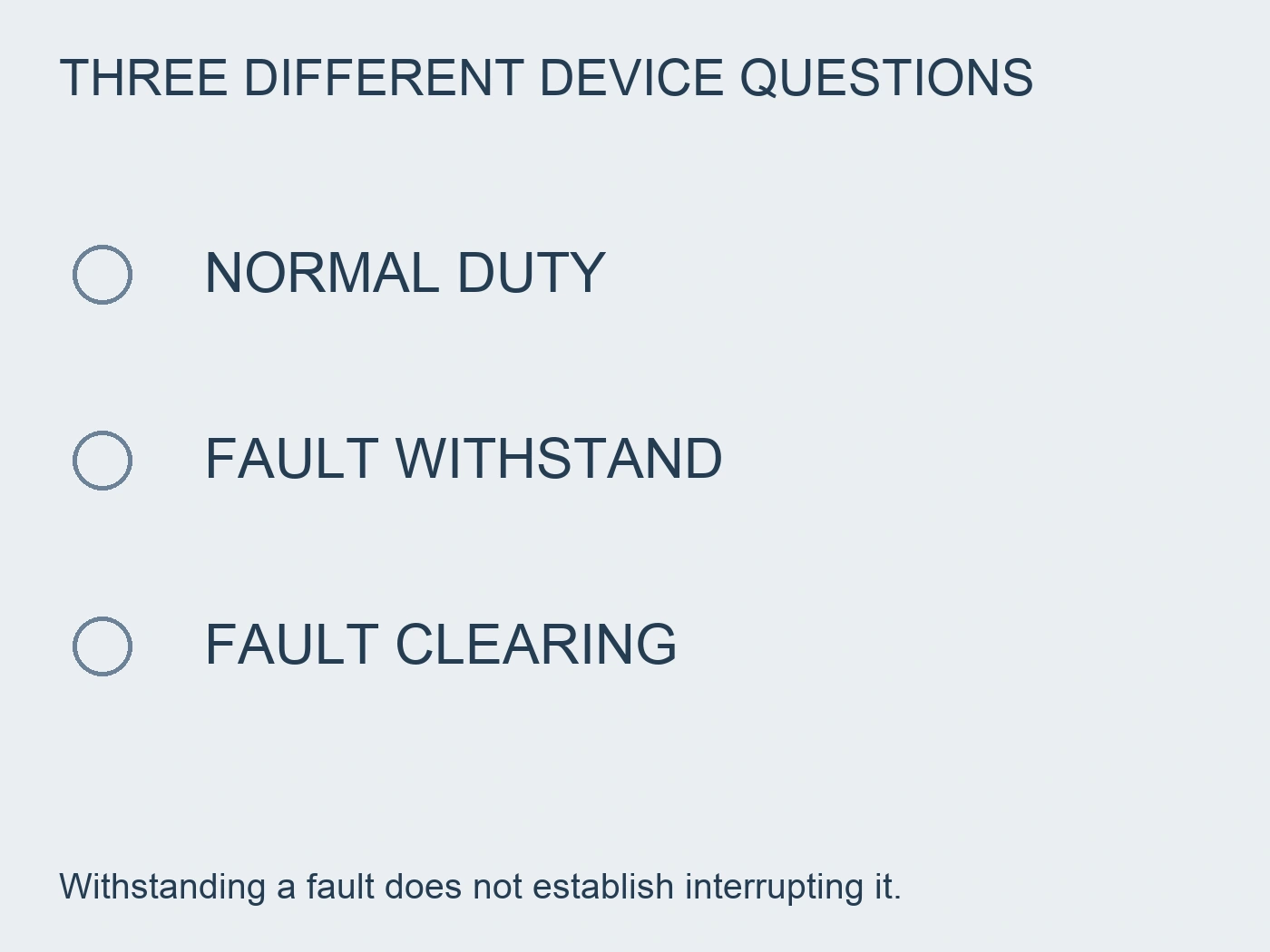
A DC disconnector's short-time withstand rating must be reviewed with its stated duration and conditions, not as a free-standing fault-current number. The protection assessment must also identify how the fault is cleared. Withstanding current, switching the intended load and interrupting a short circuit are different questions; an Icw entry does not answer all three.
This guide helps engineers and buyers assemble the evidence needed for that review. It does not set protection delays, derive a higher current rating for a shorter duration or approve a particular disconnector and protective device combination. Missing exact-model conditions remain unresolved until the responsible manufacturer and project engineer supply the relevant basis.
Separate normal duty, fault withstand and fault clearing
The disconnector review should identify its normal operating duty, its fault-withstand evidence and the means of fault clearing as separate items. A datasheet heading is useful only when its conditions and device function are understood. Carrying a current for a stated time is not a claim that the device interrupts that current.
Schneider Electric's FAQ distinguishes Icw and Icm from short-circuit breaking capability for switch-disconnectors. Its explanation supports the distinction between withstand, making and breaking; it does not establish a DC rating for a RITOKS product. Nor should its broad wording be read as saying that a load-rated switch cannot switch normal loads. Schneider Electric switch-disconnector FAQ.
Before comparing figures, name the device function intended in the project. Is the device being selected for the documented load-switching duty, for isolation or for another explicitly supported function? Then identify the separate protection responsible for fault interruption. Avoid describing every device with a handle as a circuit breaker.
The following table is an original document-review aid. It provides no approved ratings or fault-study result.
| Review question | Evidence to identify | Do not substitute |
|---|---|---|
| Normal operating duty | Exact utilization and operating conditions | A short-time withstand number |
| Isolation function | Applicable exact-device documentation | An unrelated product-family label |
| अल्पकालिक सहनशीलता | Current, duration and stated conditions | Continuous current rating |
| Short-circuit making | Applicable making-capacity evidence | Short-circuit breaking capacity |
| Fault clearing | Protective device and assessed operating conditions | The disconnector's Icw entry |
Keep these rows separate in the purchase schedule. A supplier can answer the normal-duty question while the fault-clearing assessment remains open. That should be visible, rather than hidden behind a general “suitable for DC” statement.
Read the complete Icw entry rather than its largest number
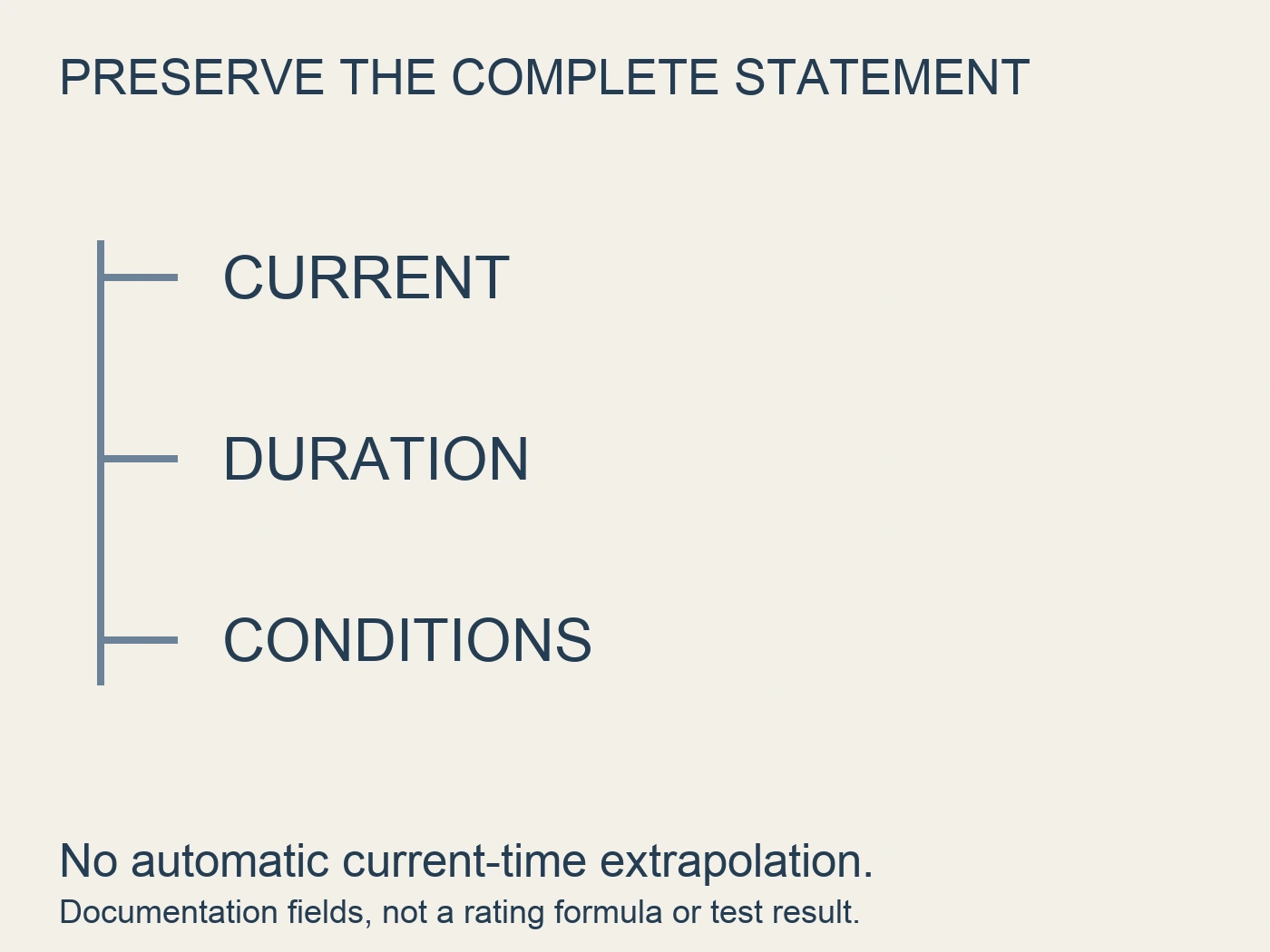
A short-time withstand statement needs an identifiable duration and application context. Record the exact model, document revision, current basis and the configuration to which the entry applies. If the source does not establish the relevant DC conditions, ask for them instead of transferring a nearby AC entry.
ABB's current MS/DC-E page presents short-time withstand performance together with a one-second duration for its named DC range. This is an example of a manufacturer attaching time to the statement. It is not a RITOKS rating, a guarantee for every variant or a basis for substituting that range's figures into another product's specification. ABB MS/DC-E range information.
For the proposed device, request the applicable voltage, pole arrangement and test or assessment conditions. Keep any requirement for associated protection visible. If a catalogue describes several configurations, ask which line applies to the actual order code instead of collecting the most favorable values from different lines.
An isolated entry such as “short-time withstand” is incomplete when its duration is absent. Equally, a time value without an applicable current and conditions does not close the review. Procurement should send a targeted clarification request listing the missing items, rather than replacing the entry with a generic industry example.
The reference current basis needs care. This guide supplies no universal conversion between a reported peak, RMS value or a DC waveform description. Ask the manufacturer and engineer to identify a consistent basis for the comparison. A chart should retain the terms used in the source, not silently rename them to make two values appear comparable.
Define the fault-clearing evidence at the disconnector
The assessment needs the relevant fault conditions at the disconnector and the protective device's complete clearing behavior under those conditions. Identify the circuit location and operating state before asking whether the withstand evidence is adequate. A device rating somewhere else in the system is not automatically the value at the point under review.
Procurement can help by requesting an identifiable study package. It should name the protection device, its exact configuration, the relevant settings and the document used for operating-time information. The electrical designer then determines the fault scenarios and how that information applies. This is a responsibility boundary, not permission for the buyer to calculate settings from a marketing chart.
Ask the designer to state which sources and operating states the assessment includes. Where another source can supply the affected area, clarify how that path is treated. Do not assume that opening the most visibly upstream device necessarily removes every possible contribution. No particular battery, converter or BMS behavior is assumed by this guide.
Keep time definitions explicit. A protection delay, a sensing interval or a contact-opening statement may describe only part of the event being reviewed. Request the manufacturer's applicable clearing-time information and the engineer's interpretation, rather than treating any single time mentioned in a brochure as the duration of fault exposure.
If the required clearing information is unavailable, record that specific gap. A fast-sounding product description should not close the gap, and the absence of a complete study should not be disguised as a successful coordination result.
Compare conditions without inventing a higher rating
The review should ask whether the actual assessment remains within the device's documented conditions. It should not extrapolate a higher allowable current because the intended clearing time appears shorter. Any alternative withstand relationship requires an applicable manufacturer or engineering basis, not a rearranged formula copied into a purchasing spreadsheet.
The following worksheet separates the source statement from the project assessment. Its statuses are suggested documentation language, not pass criteria for a particular installation.
| रिकॉर्ड | What belongs in it | Useful unresolved status |
|---|---|---|
| Disconnector statement | Exact current-duration entry and conditions | Applicable DC conditions missing |
| Project fault assessment | Location, sources and relevant scenarios | Fault case not yet assessed |
| Protection evidence | Exact protective device and clearing basis | Complete clearing information unavailable |
| Coordination decision | Engineer's conclusion and restrictions | Comparison awaiting responsible review |
| Installed configuration | Fitted parts and accepted setting record | Fitted configuration not reconciled |
Current and time are not the only labels worth preserving. Ask whether the review also needs separate peak-current or conditional-combination evidence and where that evidence is documented. This guide does not calculate thermal or dynamic acceptance from Icw alone, or assert that an energy comparison is sufficient for every device.
A higher individual breaking capacity for the protective device does not by itself document the exposure that the disconnector experiences. It answers an individual device question under stated conditions. The coordination decision still needs to identify the assessment of the combined arrangement.
Make the procurement request specific to the selected family
उपयोग करें RITOKS PV DC isolator switch category to identify the proposed switching and isolation family. Request the exact selected model's applicable duty and withstand documents. Category membership is not a declaration that every listed product has identical fault performance or that any associated protective device has been approved.
The request should attach the project circuit reference, intended configuration and the engineer's required information. Ask the supplier to separate the product's own withstand evidence from any claim dependent on a particular fuse or breaker. If a combination document is offered, retain the exact references and conditions it names.
Record whether a proposed pole arrangement or terminal configuration is supported by the exact product documentation. Do not infer a series connection scheme from another manufacturer's range description. This guide gives no wiring or pole-linking instruction.
It can be practical to request quotations before every technical question is closed, provided the status is explicit. Label the option as awaiting assessment rather than approved. This allows purchasing to collect commercial information without turning an incomplete engineering review into a final acceptance.
Keep the accepted basis through later changes
A withstand-coordination decision needs to remain connected to the installed parts and settings. Preserve the source document, study revision and acceptance restrictions with the assembly record. A maintenance or replacement team should be able to identify which assumptions it must keep, not merely find a large fault-current number in an old quotation.
Consider a hypothetical project that later changes its protective device while keeping the disconnector. No failure or successful test is assumed. The original conclusion may have depended on the original protection configuration; the change should therefore be sent back for review instead of being accepted solely because the new device has a similar nameplate rating.
Changes to source arrangements or approved settings should also be screened by the responsible engineer for their effect on the assessment. This article does not prescribe a universal reassessment interval. It recommends a traceable change decision whenever the documented basis is altered.
Close the file with a bounded conclusion: accepted for the identified configuration and conditions, awaiting named information or requiring a different documented arrangement. Specific wording is more useful than an unconditional “fault-proof” label and is easier to preserve in a spare-parts schedule.
Worked document comparison: when a protection change reverses the decision
Consider a hypothetical project with a fictional disconnector record D1 and protection assessment P1. These are invented identifiers and values for a documentary comparison, not ABB, Schneider or RITOKS ratings. D1 states a withstand condition of ten kiloamperes for one second. P1 assigns eight kiloamperes at the disconnector and a total clearing exposure of six tenths of a second for the assessed fault. The example assumes the engineer has identified the same current measure and relevant fault location; without that common basis, the two numbers cannot even be compared meaningfully.
The initial arithmetic is limited. Eight kiloamperes is below ten kiloamperes, and six tenths of a second is shorter than one second. Those observations identify no obvious exceedance in those two fields. They do not establish acceptable peak behavior, voltage conditions, connections, short-circuit making duty or a tested protective combination. The filled review therefore says “current and duration comparison completed; remaining conditions open,” rather than “approved.” The named next owner is the engineer responsible for matching D1's complete conditions to P1, not the purchasing agent selecting the largest current number.
Now replace P1 with fictional protection record P2. Keep the assigned current at eight kiloamperes, but change the documented total clearing exposure to one and two tenths seconds. The time is now two tenths of a second longer than D1's stated duration. Procurement cannot carry forward the earlier comparison merely because the fault current and disconnector model have not changed. The record becomes “published duration not demonstrated adequate for the revised exposure.” An applicable alternative manufacturer basis or a different coordinated selection is needed before that documentary issue can close.
This reversal does not require computing an equivalent current or thermal allowance. A tempting shortcut would reduce the current because it is below the headline value and then assume that extra time is available. This article supplies no authority for that transformation. P2 also should not be reduced to a relay's intentional delay if the protection assessment requires the complete clearing exposure. The project's protection specialist must identify the relevant total and its basis; the buyer should preserve that conclusion rather than constructing a replacement from separate timing fragments.
A third fictional revision, P3, reports a shorter exposure than P1 but assigns twelve kiloamperes. Duration has improved while the assigned current is now above D1's stated value. The outcome again becomes unresolved against that published condition, not automatically acceptable. The two revisions show why “faster protection” and “lower current” are incomplete descriptions of coordination. A change can improve one field while exceeding another, and the selected configuration may introduce conditions that neither field captures.
The practical handover contains D1's exact revision, the selected equipment configuration, the applicable P record and an issue-by-issue conclusion. In the hypothetical register, P1 retains open configuration and combination questions, P2 adds a duration exceedance, and P3 adds a current exceedance. None claims a real installation passed a test. This filled distinction gives procurement a defensible reason to pause a substitution, while allowing unrelated accepted mechanical or commercial details to remain intact. When supporting evidence changes the conclusion, retain the previous basis so a later reviewer can see why the selection changed.
संदर्भ
- Schneider Electric. (2019, August 23; updated 2025, June 26). Do switch-disconnectors have Icw, Icm and Icu values? https://www.se.com/ng/en/faqs/FA381456/
- ABB. (n.d.). SACE Emax 2 MS/DC-E. https://www.abb.com/global/en/areas/electrification/low-voltage/circuit-breakers/air-circuit-breakers/emax2/ms-dc-e