
डीसी मिनिएचर सर्किट ब्रेकर्स (एमसीबी) · तकनीकी व्याख्या
DC MCB Standards and Certifications by Market

Quick answer
Which standard and certificate to ask for depends on where the DC MCB will be installed and which code governs that installation. For IEC-based markets, request the product standard the ratings were declared under (IEC 60947-2 for industrial devices up to 1500 V DC, or IEC 60898-2 for household-type devices up to 440 V DC two-pole), plus a test report or certificate that names the exact order code. For the European Union, the device also falls under the Low Voltage Directive when its DC voltage rating is between 75 and 1500 V, so ask for the manufacturer's EU declaration of conformity. For the United States and similar markets, ask whether the device is a UL 489 or UL 489B listed breaker or a UL 1077 recognized supplementary protector, because those are not interchangeable. In every case, check that the certificate covers the model, voltage and pole wiring you are buying.
Certificates are often the last thing checked and the first thing that stops a shipment. An installer, inspector or utility may reject a DC protection device that has a valid test report for a different voltage, a related series or a different market's standard. The cost of checking before ordering is a few emails; the cost of checking after delivery can be a replacement order.
This guide explains the main product standards for DC MCBs, how they map to common destination markets, and how to read a certificate so that it actually supports your project. It lists what to request. It does not state that any particular supplier, including RITOKS, holds a given certificate; that must be confirmed per model with the documents themselves.
Product standards and installation rules are different documents
Two kinds of document control a DC breaker on a project.
A product standard defines how the breaker is built and tested, and what its ratings mean. Examples are IEC 60947-2, IEC 60898-2, UL 489 and UL 489B. A certificate or test report shows that a specific product was tested against one of these.
An installation rule defines where protection is needed and how it must be rated for the circuit. Examples are IEC 60364-7-712 for PV installations and the national wiring code adopted in each country. These rules may require a device to comply with a particular product standard.
Buyers need both. The installation rule tells the designer which product standard is acceptable; the certificate shows the product meets it. A breaker can have a valid product certificate and still be wrong for the installation, for example if its voltage under the certified wiring is lower than the circuit requires.
The main IEC product standards for DC MCBs
IEC 60947-2: industrial circuit-breakers
The IEC webstore describes IEC 60947-2:2024 (edition 6.0, published 2024-09-18) as applying to circuit-breakers installed and operated by instructed or skilled persons, with main contacts in circuits up to 1000 V AC or 1500 V DC. This sixth edition replaces the 2016 edition and its 2019 amendment. That amendment had added Annex P, covering circuit-breakers for PV applications.
Many DC MCBs rated for PV strings at 500 to 1000 V DC, and many battery-system breakers, declare their ratings under IEC 60947-2. Breaking capacity is expressed as Icu and Ics.
When you receive an IEC 60947-2 report, check which edition was used. A report to the 2016 edition with Amendment 1 is not automatically invalid, but some projects or certification bodies may ask about the current edition. Ask the supplier whether Annex P tests were included if the device is for PV use.
IEC 60898-2: household and similar circuit-breakers for DC
The IEC webstore abstract for IEC 60898-2:2016 limits its scope to single-pole devices up to 220 V DC and two-pole devices up to 440 V DC, with rated current up to 125 A and rated DC short-circuit capacity up to 10 000 A. It is read together with IEC 60898-1:2015, and the 2016 edition introduced the Icn1 test.
IEC 60898-2 suits fixed low-voltage DC installations of the household and similar type within those limits. It does not cover high-voltage PV strings, and vehicle on-board systems fall under other rules. A claim of IEC 60898-2 compliance for a device rated at 1000 V DC two-pole falls outside the published scope and should be questioned. Our डीसी एमसीबी चयन मार्गदर्शिका explains how voltage, poles and breaking capacity fit together once the standard is known.
Installation rule for PV: IEC 60364-7-712
IEC 60364-7-712 covers the electrical installation of PV systems. The IEC webstore lists the 2017 edition as withdrawn on 2025-10-21 and replaced by IEC 60364-7-712:2025. The Schneider Electric Electrical Installation Guide summarises the 2017 edition's string and sub-array protection rules, including rating windows and the condition for when string protection is needed. Designers should confirm which edition their country has adopted, because national adoption can lag the IEC publication date.
The North American picture: UL 489, UL 489B and UL 1077
UL standards split DC breaker-type devices into categories that are not interchangeable.
| UL standard | Device type | Status noted on the UL Standards store (checked 2026-10-23) | Typical role |
|---|---|---|---|
| UL 489 | Molded-case circuit breakers, molded-case switches and enclosures | Edition 14, published 2025-03-07 | Branch-circuit protection |
| UL 489B | Molded-case breakers, switches and enclosures for PV systems | Edition 1, published 2016-03-07, last revised 2025-08-26 | PV circuits up to 1500 V DC |
| UL 489A | Circuit breakers for communications equipment | Edition 1, published 2008-10-15, last revised 2023-06-26 | Telecom DC power |
| UL 1077 | Supplementary protectors for electrical equipment | Edition 7, last revised 2021-11-16 | Protection inside equipment, not branch circuits |
The key distinction for buyers is between a listed breaker and a recognized supplementary protector. A UL 1077 device is intended for protection within equipment where branch-circuit protection is already provided upstream. It cannot be used where the code calls for a branch-circuit breaker. Some DIN-rail DC devices are UL 1077 recognized rather than UL 489 listed, so ask which one applies before quoting the device for a North American branch circuit.
For PV, ask specifically whether the device is evaluated to UL 489B and at what DC voltage. A UL 489 listing at a lower DC voltage does not cover a 1000 V PV string.
The European Union: Low Voltage Directive and harmonised standards
Directive 2014/35/EU, the Low Voltage Directive, applies to electrical equipment designed for use with a voltage rating between 50 and 1000 V AC and between 75 and 1500 V DC, apart from listed exclusions. A DC MCB rated within that DC range is in scope.
Under the directive, the manufacturer places the CE marking and draws up an EU declaration of conformity. Compliance is commonly shown by applying harmonised European standards: EN standards whose references are published in the Official Journal of the European Union under the directive. Many EN breaker standards are based on IEC product standards, but harmonised status must be checked per EN reference and edition. Ask for:
- The EU declaration of conformity naming the product and listing the standards applied.
- The test report behind it, preferably from an independent laboratory, naming the order code.
- Confirmation of which EN edition was applied, and whether that reference is listed as harmonised under 2014/35/EU.
A CE mark on the label is the manufacturer's claim. The declaration and report are the documents that let the buyer check it.
The CB Scheme: one report, several national certificates
The IECEE describes its CB Scheme as an international system for mutual acceptance of test reports and certificates for the safety of electrical and electronic products, operated as a multilateral agreement among participating countries and certification bodies. A CB test certificate and report issued against an IEC standard can be used to support national certification in other participating countries, which may still add national differences or their own marks.
For a buyer, a CB certificate is useful evidence, but check three things: the IEC standard and edition, the national differences covered in the report, and the model list. A CB report for IEC 60947-2 does not by itself grant a national mark in the destination country.
Matching standards to destination markets
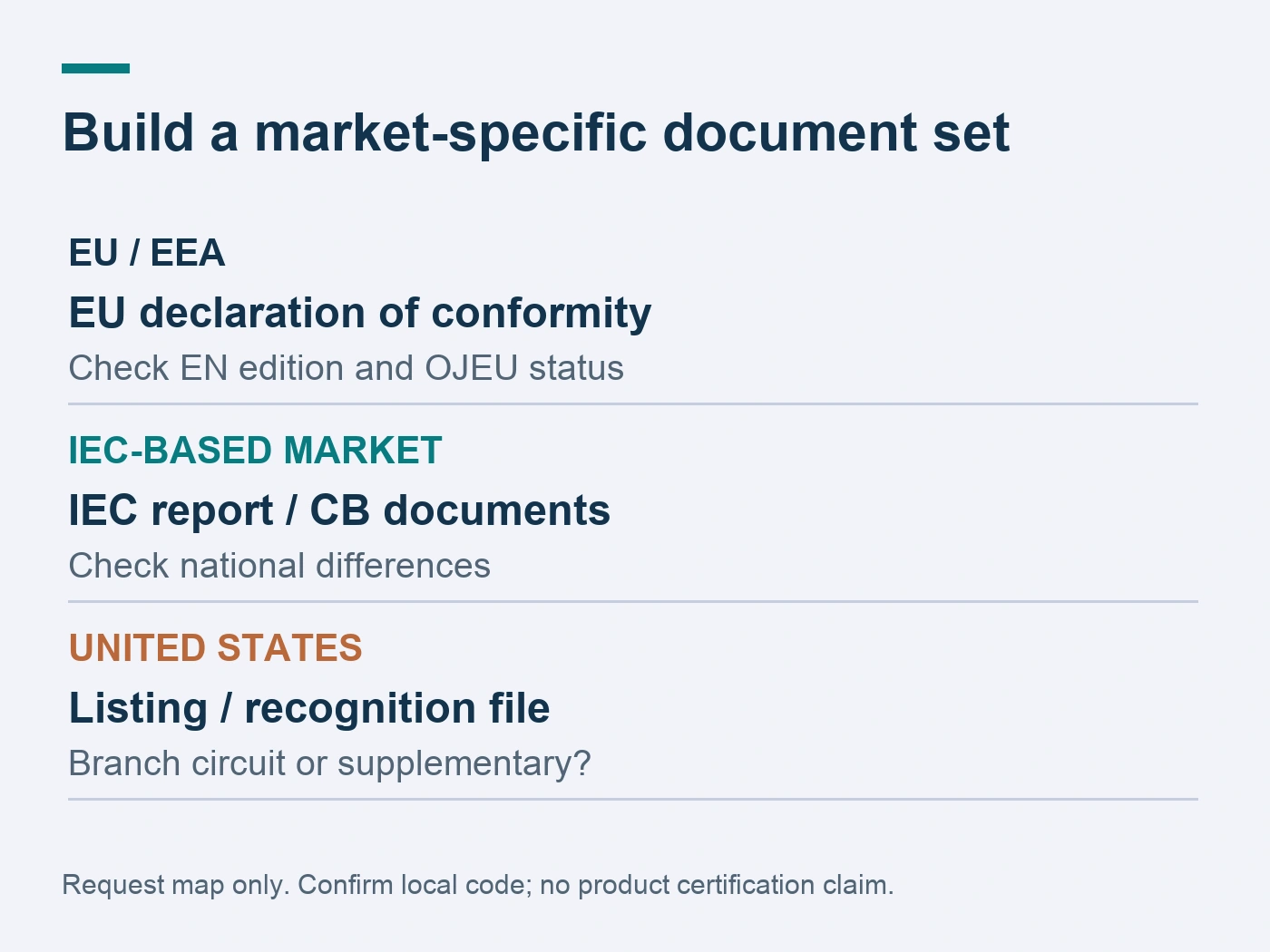
The table below is a starting point for requests. Confirm local requirements with the project designer, the installer or the local authority, because codes and adoption dates change.
| गंतव्य | Product standard to request | Market document to request | टिप्पणियाँ |
|---|---|---|---|
| EU / EEA | EN versions of IEC 60947-2 or IEC 60898-2 (check OJEU harmonised list) | EU declaration of conformity (CE) | LVD scope 75–1500 V DC |
| Other IEC-based markets | IEC 60947-2 or IEC 60898-2 | CB report, plus any national certification | Check national differences |
| United States | UL 489, UL 489B for PV, or UL 1077 for supplementary use | UL listing or recognition file naming the model | Branch-circuit vs supplementary role |
| Projects with a named specification | As written in the specification | As written in the specification | The specification overrides general practice |
For markets not listed, start with the installation code the local inspector applies and work backwards to the product standard it references.
How to read a certificate so it supports your project

A certificate is only as useful as its scope. Before accepting it, check:
- Holder and manufacturer. The certificate should name the manufacturer of the device. If a trading company supplies the breaker, the certificate may name the factory; ask for a document linking the two.
- Model list. The exact order code, or a family designation whose coverage clearly includes it. A series name alone may not cover every current rating or pole count.
- Standard and edition. The same standard you need for the destination market.
- Ratings covered. The DC voltage, breaking capacity, current range and pole arrangement in the report should include the configuration you will use.
- Validity. Issue date, any expiry or surveillance conditions, and whether the issuing body's register can confirm it.
- Test laboratory. Whether the test was done by an independent laboratory or under a manufacturer's self-declaration.
If the certificate's voltage is lower than your circuit's, or the pole wiring differs, the certificate does not support that application, even if the device is the same family.
Questions to ask a DC MCB supplier
Copy these into the request:
- Which product standard and edition are the DC ratings declared under?
- Please send the test report or certificate that names this exact order code.
- Does the certified rating include our DC voltage with the pole wiring shown in your connection diagram?
- For the EU: please send the EU declaration of conformity.
- For North America: is this device UL 489 or UL 489B listed, or UL 1077 recognized? Please send the file number.
- For PV: were PV-specific tests, such as IEC 60947-2 Annex P or UL 489B, included?
- Who is the certificate holder, and how does it relate to the supplier?
Our डीसी एमसीबी आरएफक्यू चेकलिस्ट adds the technical and commercial fields that go with these questions.
Common certification mistakes
Accepting a certificate for an AC breaker. Many MCB certificates cover AC ratings only. A DC application needs DC ratings in the report.
Assuming one standard satisfies all markets. An IEC 60898-2 report may be enough for a 48 V telecom panel in one country and not acceptable for a branch circuit in another.
Treating a supplementary protector as a branch breaker. This gap can lead to failed inspection in North American projects.
Ignoring the voltage in the certificate. A family certified at 500 V DC is not certified at 1000 V DC because a higher-voltage variant exists in the catalogue.
Buyer questions
Is a CE mark enough proof for a DC MCB?
It is the manufacturer's statement of conformity. For a project file, ask for the EU declaration of conformity and the test report behind it, and check that both name the model and DC ratings you are using.
Does a newer edition of IEC 60947-2 make older reports invalid?
Not automatically. Acceptance of an older edition depends on the certification body, the market's transition rules and the project specification. Ask the supplier which edition was tested and ask the project's approving party whether it is accepted.
How do I check RITOKS documents for a DC MCB?
Ask for the order-code datasheet, wiring diagram and the compliance documents available for that model when you request a quotation. For example, the RTS-DC63-500 2P DC MCB page references IEC 60947-2 for that family. The certificate itself, and its model list and DC ratings, should be checked against your market before ordering. Browse all families on the DC miniature circuit breakers page.
Finish with a market-specific document list
Write down the destination market, the installation code that applies, the product standard it references and the document you need: declaration, CB report, national certificate or UL file. Then check each received document against the exact model, voltage and wiring. A request that names these items gets a clear answer from the supplier, and the inspection file is ready before the goods ship.
संदर्भ
- International Electrotechnical Commission. (2024). IEC 60947-2:2024 Low-voltage switchgear and controlgear – Part 2: Circuit-breakers. Retrieved October 23, 2026, from https://webstore.iec.ch/en/publication/66277
- International Electrotechnical Commission. (2016). IEC 60898-2:2016 Circuit-breakers for overcurrent protection for household and similar installations – Part 2: Circuit-breakers for AC and DC operation. Retrieved October 23, 2026, from https://webstore.iec.ch/en/publication/25675
- European Parliament and Council of the European Union. (2014). Directive 2014/35/EU (Low Voltage Directive). EUR-Lex. Retrieved October 23, 2026, from https://eur-lex.europa.eu/legal-content/EN/TXT/?uri=CELEX:32014L0035
- UL Standards & Engagement. (2025). UL 489B: Molded-case circuit breakers, molded-case switches, and circuit-breaker enclosures for use with photovoltaic (PV) systems. Retrieved October 23, 2026, from https://www.shopulstandards.com/ProductDetail.aspx?UniqueKey=30753
- UL Standards & Engagement. (2021). UL 1077: Supplementary protectors for use in electrical equipment. Retrieved October 23, 2026, from https://www.shopulstandards.com/ProductDetail.aspx?UniqueKey=29703
- IECEE. (n.d.). CB scheme. Retrieved October 23, 2026, from https://www.iecee.org/who-we-are/cb-scheme