
DIN Rail Terminal Blocks for Control Panels · Technical Explainer
Can a High-Current Terminal Accept Aluminum Conductors?
Quick answer
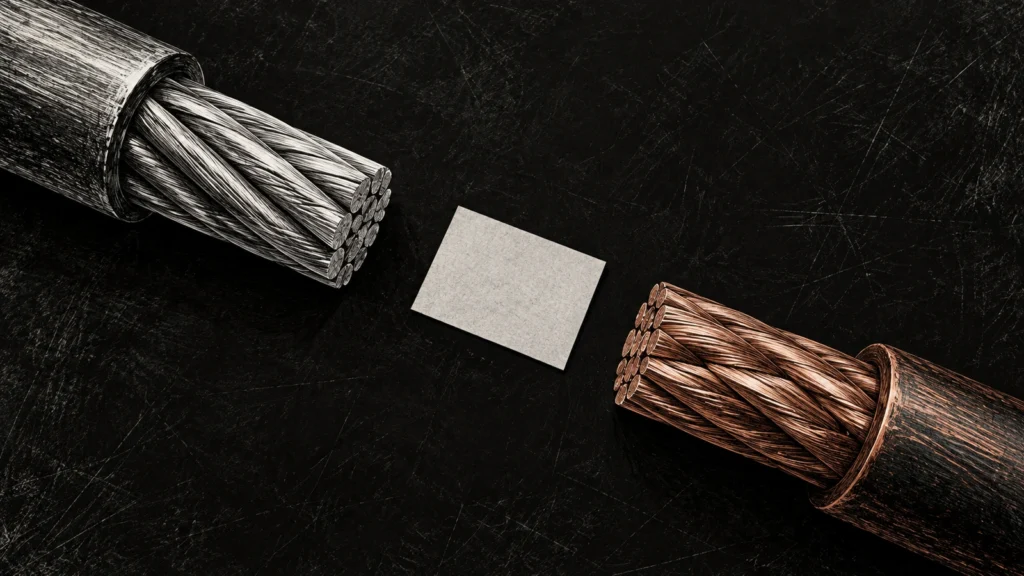
A high-current terminal can accept aluminum conductors when its exact documentation establishes suitability for that conductor material, form and connection process. A large conductor opening, screw clamp or high-current description is not enough. The material declaration, permitted conductor construction, contact design and installation instructions must describe the selected terminal, not a visually similar product.
For procurement, treat missing aluminum compatibility evidence as an unresolved field. It does not prove that the terminal accepts aluminum, but it also does not prove that aluminum is prohibited. Request the necessary documents before approving the connection. Where a copper-to-aluminum transition is proposed instead of direct clamping, review that complete assembly separately rather than assuming an adapter resolves the uncertainty.
Start with the cable specification, not the terminal opening
An inquiry stating only a conductor cross-section leaves important material questions unanswered. Record whether the conductor is copper or aluminum, its specified material or alloy where available, and whether it is solid, stranded, compacted or sector-shaped. Preserve the cable manufacturer's designation instead of translating every large conductor into a generic “wire.”
Then record what will actually enter the terminal. A bare conductor, a ferrule and a cable lug are different termination arrangements. If an intermediate component is specified, its material and exact identity belong in the connection record. Approval for a bare aluminum conductor does not automatically cover an aluminum conductor fitted with any available ferrule.
This is distinct from asking whether the opening accommodates the cable. Dimensional fit answers a mechanical question. Material compatibility answers whether the documented connection system supports that conductor under its stated conditions. Both are needed, and neither substitutes for the other.
Keep the two ends of a feed-through connection visible in the inquiry. An aluminum incoming conductor and copper outgoing conductor are not the same proposal as aluminum on both sides. The supplier should identify which combinations the selected connection permits, including any differences between connection points.
Separate four layers of compatibility evidence
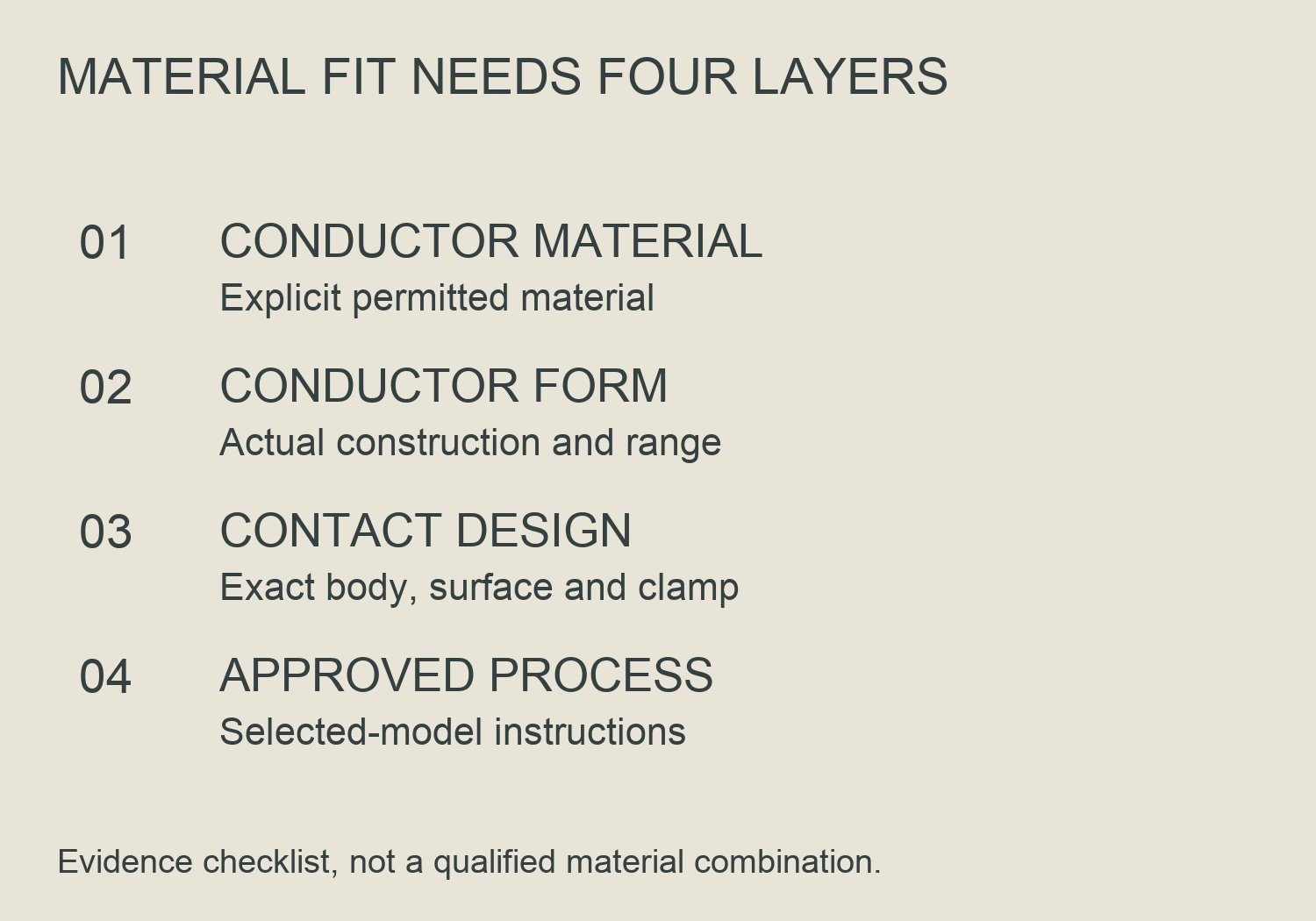
The buyer needs a connection description that remains meaningful when quotations from different manufacturers are compared. Use four layers: conductor material, conductor form, contact construction and approved process. A confident answer in one layer cannot fill an empty field in another.
| Evidence layer | Information to request for the exact selection | What does not settle the question |
|---|---|---|
| Conductor material | Explicit copper, aluminum or Cu/Al suitability; relevant alloy restrictions if specified | “High current,” a large size class or a picture of a screw clamp |
| Conductor form | Permitted solid, stranded, compacted or sector forms and their applicable ranges | A single cross-section printed without construction details |
| Contact construction | Manufacturer's description of the contact body, coating and selected clamping arrangement | Appearance, generic metal descriptions or another manufacturer's coating explanation |
| Connection process | Applicable preparation, compound, tool and tightening instructions tied to the selected product | A workshop's customary method or a paste marketed for aluminum generally |
| विद्युत साक्ष्य | Rating and supporting test or approval scope for the documented connection | A copper rating copied into an aluminum application |
| Assembly conditions | Mounting, environment, accessories and inspection requirements relevant to the proposal | A component certificate treated as approval of the entire enclosure |
These are procurement questions, not a substitute installation instruction. Their purpose is to determine which manufacturer documents must control the later work. Installation and inspection remain tasks for qualified personnel using those documents and the applicable project safety procedures.
What manufacturer examples actually demonstrate
Weidmüller's WPD documentation provides an example of a purpose-described connection. It identifies a specially coated aluminum contact body and describes suitability for copper and aluminum conductors, including round and sector-shaped forms. That is meaningful because the manufacturer connects material suitability to an identified terminal design. It does not establish that every large feed-through terminal uses the same construction. Weidmüller WPD terminals
The useful purchasing lesson is to seek an equally explicit description for the proposed product. Do not copy WPD ratings, approvals or conductor ranges into a different supplier's quotation. Even within a documented family, confirm the selected order code and configuration rather than relying solely on a family overview.
WAGO presents a different manufacturer example. Its material information describes contact plating and contact-pressure design, while its aluminum connection section restricts suitability to named connector technologies and series with specified conditions. This illustrates why a general coating description or the availability of contact paste does not make every connector aluminum-compatible. It is not a preparation recipe for a high-current screw terminal. WAGO material specifications
Both examples support asking for product-specific evidence. Neither authorizes a RITOKS connection, a substitute compound or a workshop-designed transition.
Contact coating is a question, not a shortcut to approval
Buyers sometimes receive “plated contact” as the complete answer to a copper-and-aluminum inquiry. Ask the supplier to connect that statement to the exact product and its permitted conductor materials. A coating description alone does not provide the applicable conductor range, preparation instructions or tested electrical conditions.
The contact body and the coating should also remain separate fields. A manufacturer may describe one material for the body and another for the contact surface. Do not infer either from the visible color. Where the supplier considers a particular construction relevant to aluminum suitability, request its documented scope and the selected connection arrangement.
This keeps the discussion useful without asking the buyer to invent a metallurgical qualification. The purchasing decision is whether adequate manufacturer evidence exists for the intended connection. A photograph, a sample that accepts the cable or a generic explanation of corrosion resistance cannot replace that evidence.
If two offers provide different levels of documentation, record the difference. “Material suitability documented for the requested conductor” and “material suitability pending” are more informative than classifying both as equivalent high-current terminals because their housings look alike.
Direct clamping and a transition assembly are different proposals
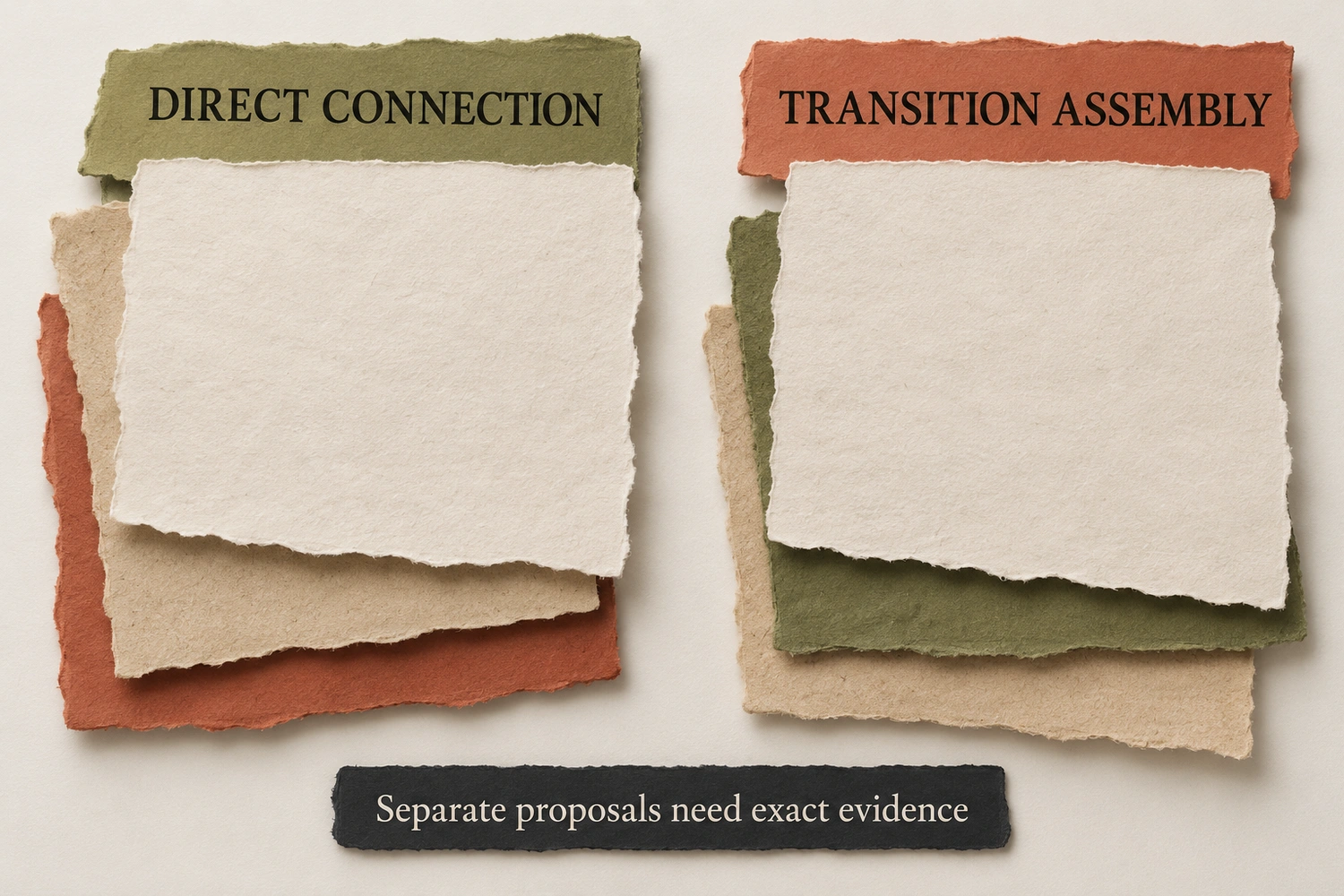
Direct connection means that the proposed conductor is accepted by the terminal's documented connection system. A transition assembly adds an interface or component whose own suitability must be established. These routes should occupy separate rows in a technical quotation, even when they serve the same incoming cable.
Weidmüller's aluminum connection guidance distinguishes direct and indirect connection arrangements. For its WPD aluminum-to-copper application, it directs users to the respective product data sheets for pretreatment and tightening torque. The source supports a model-specific process requirement, not a universal preparation method for other terminals. Weidmüller aluminum connection guidance
A proposed transition therefore needs more than “use a Cu/Al accessory.” Identify the exact accessory, both conductor interfaces, its permitted termination methods and the connection to the selected terminal. Establish which manufacturer instructions apply at each interface and who is responsible for confirming the complete arrangement.
Do not assume that a lug, washer or ferrule converts an undocumented terminal into an approved aluminum connection. Equally, do not reject a properly documented engineered transition simply because it is indirect. Review the actual evidence for the proposed assembly, including its electrical and mechanical conditions.
Keep the current rating attached to its conditions
Conductor cross-section and current capability are related selection inputs, but they are not interchangeable declarations. A terminal size class does not establish an aluminum operating current. Nor does a rating documented for a copper connection automatically apply to aluminum of the same cross-section.
Request the applicable rating with its conductor material, construction and environmental conditions. If the supplier provides a test report, check that its product identity and tested connection match the quotation. If it provides an approval or certificate, confirm the covered model and conditions rather than treating the logo as a complete connection specification.
Avoid applying a universal aluminum current-reduction factor. The reviewed manufacturer information contains product-specific conditions; it does not establish a single ratio for every terminal and enclosure. The project engineer must assess the documented connection within the actual assembly, not an assumed conversion based only on conductor material.
For an enclosure inquiry, record the proposed loading and relevant operating environment without fabricating a thermal result. A supplier's terminal rating is an input to the assembly review. It is not evidence that an untested enclosure, conductor arrangement or mixed-material transition has achieved a particular temperature rise.
Build a material-compatibility register before ordering
The register below is a document request and decision record. It contains no measured results or approved pairings. Give each pending field an owner so that an incomplete answer does not disappear between procurement, engineering and production.
| Register field | Required record | Decision when information is missing |
|---|---|---|
| Terminal identity | Exact order code, variant and document revision | Keep material approval pending |
| Incoming and outgoing conductors | Cable designations, material, form and cross-section for each side | Request separate descriptions; do not merge the two ends |
| Material suitability | Explicit manufacturer statement covering the proposed conductor combination | Do not infer acceptance or rejection |
| Contact construction | Relevant body/coating and clamp documentation | Request clarification rather than identifying material visually |
| Process instructions | Exact applicable instructions, compound requirements and specified tools | Do not insert a generic preparation or tightening method |
| Transition components | Exact identities and documented interface compatibility, if proposed | Review the complete transition independently |
| Electrical support | Applicable rating conditions and supporting report or approval scope | Do not borrow another material's or manufacturer's values |
| Handoff and changes | Engineering disposition, instruction revision and substitution controls | Prevent an unresolved quotation from becoming a production instruction |
At quotation review, distinguish a supplier answer from an engineering disposition. “Supplier document received” means evidence is available; it does not mean every project condition has been assessed. The final record should identify the reviewer and the selected arrangement without implying that procurement conducted a qualification test.
Carry the same identities into the bill of materials and production documentation. If the cable construction, terminal variant or transition accessory changes, reopen the affected compatibility fields. A previously complete record describes the previous arrangement, not an unrestricted permission to substitute parts.
What to request for the RITOKS JUT1-95 candidate
द JUT1-95 high-current feed-through terminal page provides a sourcing starting point for a screw feed-through, DIN-rail terminal in the supplier-listed 95 mm² class. That description does not establish aluminum suitability or a combined Cu/Al connection.
For an aluminum inquiry, send the incoming and outgoing cable details with the exact proposed model. Request an explicit material statement, permitted conductor forms, relevant contact construction, applicable connection instructions and supporting electrical evidence. Ask for the documented transition arrangement separately if direct clamping is not the proposal.
The public information does not settle an aluminum alloy or strand class, coating, compound, torque or aluminum-specific current rating. Record these as pending rather than filling them from WPD, WAGO or a neighboring product. This keeps the inquiry accurate while allowing the supplier to provide the necessary exact-model evidence.
अक्सर पूछे जाने वाले प्रश्न
Does a 95 mm² terminal designation mean aluminum is accepted?
No. A size designation does not establish conductor-material suitability. Confirm the exact terminal's permitted material, conductor form and connection process. For JUT1-95, the public size-class description alone supports neither aluminum approval nor a definitive rejection.
Can contact paste make any screw terminal suitable for aluminum?
No such general conclusion follows from the reviewed sources. A manufacturer's specified compound belongs to its documented connection system and conditions. It cannot substitute for a missing material declaration or authorize an otherwise undocumented terminal arrangement.
Is a copper-to-aluminum transition automatically acceptable?
No. A transition is a separate assembly proposal requiring exact component and interface evidence. Confirm both conductor terminations and the connection to the terminal. An accessory's description does not establish that the complete combination is suitable.
What should procurement do when the supplier has not confirmed the material?
Mark the field pending, identify the required document and assign follow-up responsibility. Do not release the uncertainty as an approved production instruction, and do not describe the product as incompatible without evidence. Compare offers using the completeness of their exact-connection documentation.
संदर्भ
- Weidmüller. Power terminal blocks: WPD. n.d. Technical introduction, conductor-material discussion and family overview. Accessed October 2, 2026.
- Weidmüller. Connection of aluminum wire in terminal blocks. n.d. Direct/indirect connection and product-specific transition guidance. Accessed October 2, 2026.
- WAGO. Material specifications. n.d. Contact materials, plating and aluminum-conductor connection sections. Accessed October 2, 2026.