
Sumber Daya Teknis · Daftar Periksa Permintaan Penawaran (RFQ)
Digital Panel Meter RFQ Checklist
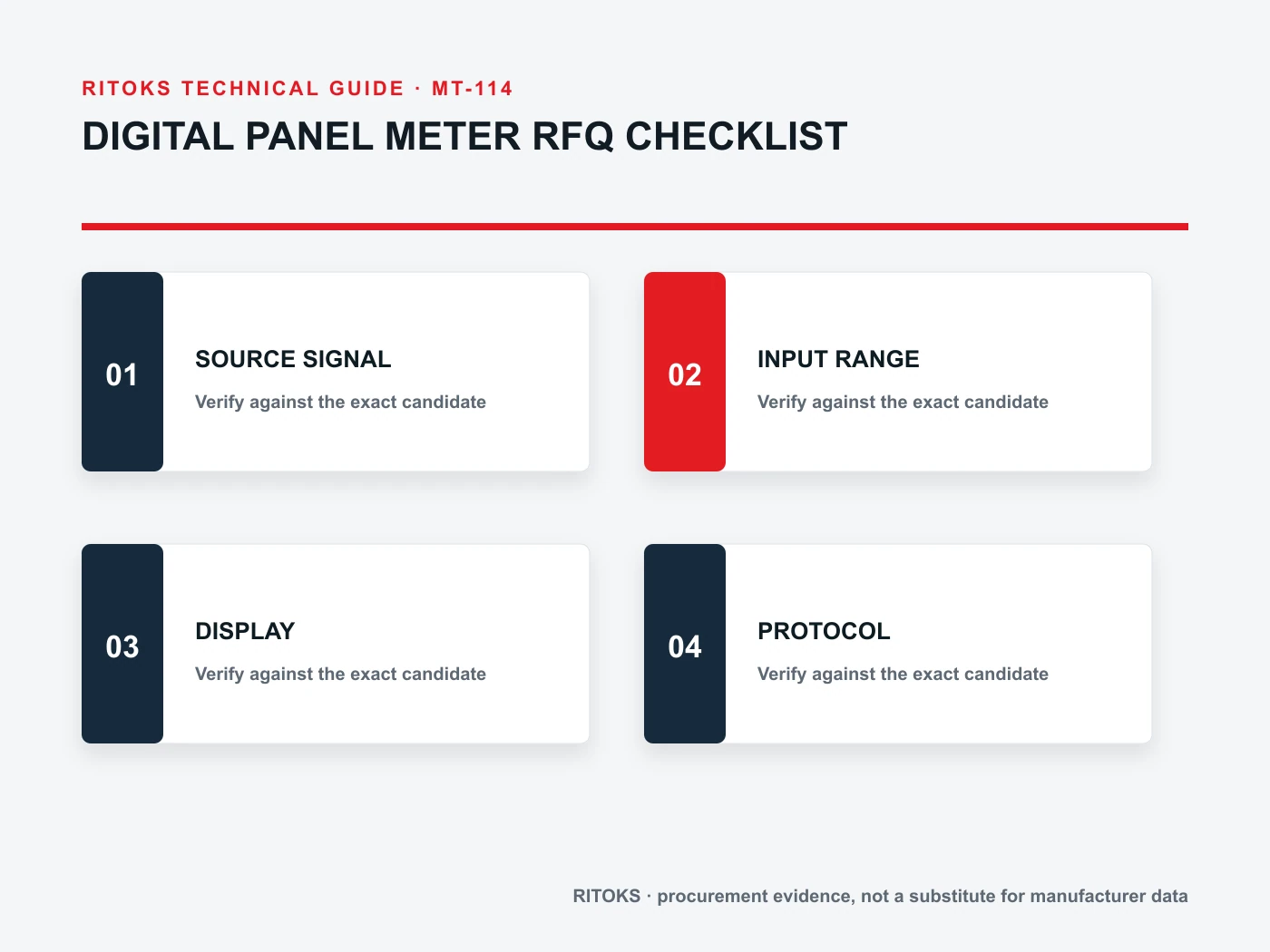
A digital panel meter RFQ needs more than a display size and a measured quantity. The buyer should define the electrical input, measurement function, auxiliary supply, display behavior, panel cutout and any communication interface. A meter with a similar front bezel may need a different transformer, wiring or software configuration.
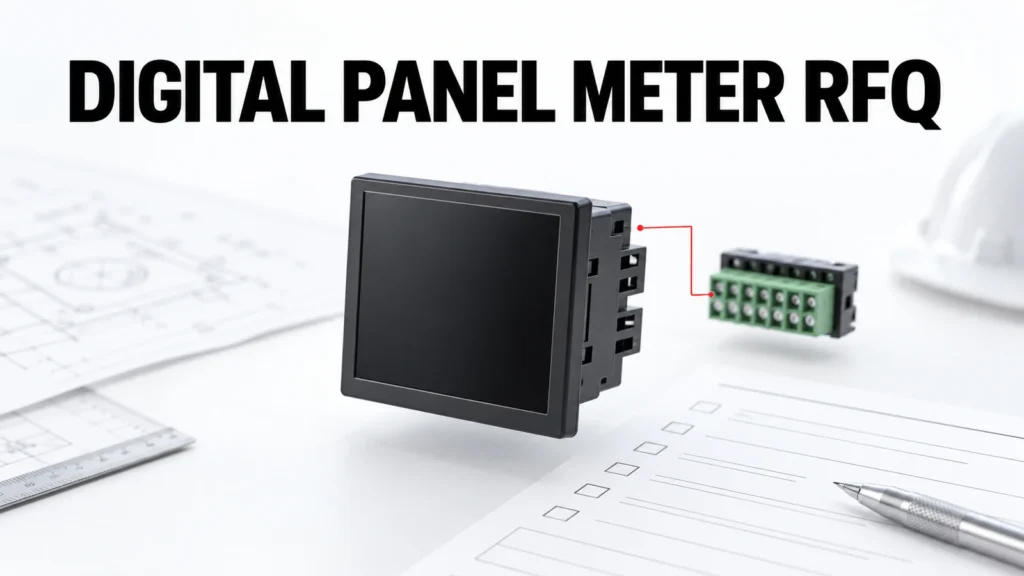
This checklist helps engineers and sourcing teams turn a vague request into a comparable specification. It separates single-function indicators from multifunction power meters and flags model-specific information that a supplier must confirm. It does not assume any RITOKS meter has a particular accuracy class, protocol or certification without exact documentation.
Describe the measured quantity and circuit
State whether the panel needs to display voltage, current, frequency, power, energy, power factor or another quantity. A single-function display is not equivalent to a multifunction network meter. If several values are needed, list each one and say whether simultaneous display, scrolling or remote reading is required.
Provide the electrical system configuration: single-phase or three-phase, wiring arrangement, nominal and maximum voltages, frequency and where the meter connects. If the instrument uses CTs or voltage transformers, identify their ratios and secondary outputs. The meter must accept the actual signal; a transformer ratio entered in setup cannot make an incompatible hardware input suitable.
For DC measurement, explicitly distinguish DC input from AC input. Do not infer DC capability from a digital readout or a generic “voltage meter” label. Request a terminal diagram and exact input range for the proposed order code.
Define input range and measurement quality
List normal and maximum values the meter must handle, along with expected transients and the accuracy requirement. Ask the supplier to state the reference conditions for any accuracy claim: measured range, waveform, frequency, ambient and whether the figure applies to the meter alone or a metering chain with CTs and VTs.
A product that displays many decimal places is not automatically more accurate. Resolution and accuracy are different. If the measurement supports billing, compliance or process control, the project engineer should specify the required performance and verification method. Do not let a visually precise display substitute for a documented error limit.
Include whether the meter should retain energy totals, show peaks, issue alarms or provide status outputs. Those functions change the required model and sometimes the wiring. A simple panel voltage display should not be quoted as though it were a network analyzer, while a multifunction requirement should not be met with several isolated indicators unless the system design calls for them.
Specify CT, VT and wiring details where used
Supply the current transformer primary and secondary ratings, burden plan and polarity marks. If a voltage transformer is used, provide its ratio and wiring. Schneider Electric's meter installation documentation shows that meters can require configuration for power-system type, CT count and transformer ratios. The exact options vary by product, so request the proposed model's manual.
State whether the project uses direct-connected current inputs or a CT-operated arrangement. These are different hardware and safety contexts. A meter input designed for one secondary signal cannot be assumed to accept another. Check phase assignment and polarity; incorrect wiring or ratio setup can produce believable but wrong readings.
Do not open-circuit conventional CT secondaries on an energized primary. Include the project's test block, shorting and commissioning procedure when CTs are part of the installation. The meter RFQ should identify interface requirements without replacing the separate CT selection and safety review.
Describe the display and operator task
Explain who reads the meter and from what distance. State the values that must be visible at a glance, desired units, alarm indication and whether the display will be in a dim or bright environment. These are operational requirements, not merely aesthetic preferences. A small numerical display may be adequate for local checks but awkward for frequent diagnostics.
Request a front-panel drawing or display description. If the meter cycles between values, ask how the operator identifies which quantity is shown. Clarify whether the display can be configured, locked or reset and who will own the setup procedure. A replacement meter should preserve the essential operator workflow, not just fit the hole.
Provide the cutout and mounting envelope
Measure the existing or planned panel cutout, panel thickness, available depth and clearance for terminals and wiring. Share photographs or a dimensioned drawing for retrofit projects. Do not treat a front-bezel dimension as the cutout size. The mounting clamps, gasket and terminal block may need additional space.
State enclosure environment and desired ingress protection at the front panel, including whether the cabinet door is exposed to washdown, dust or outdoor conditions. Ask for exact model installation and sealing instructions. A meter with an attractive bezel cannot maintain an enclosure's protection if the cutout, gasket or installation is wrong.
Identify auxiliary supply voltage and power availability. Some meters draw power from measured circuits, while others require a separate supply. Confirm which applies to the exact model, along with permitted operating range and wiring protection. An otherwise compatible meter may be unusable if its supply is missing.
State communication and integration requirements
If the meter reports to a PLC, energy-management platform or building system, specify physical interface, protocol, address management, data items and update expectations. “RS-485 required” identifies a physical layer, not a complete integration specification. Ask for the register map, protocol version and wiring instructions for the exact model.
List any pulse output, alarm relay or digital input separately. Identify whether a function must be available locally, remotely or both. A meter may have optional communication modules or variant-specific outputs; the order code should include every required feature.
Clarify data ownership and commissioning. Who programs CT ratio, communication address, time setting and alarm thresholds? Who verifies readings against a reference? A well-specified meter can still give misleading system data if configuration is copied from another panel without checking the new circuit.
Use a structured supplier response
| Bagian Permintaan Penawaran (RFQ) | Perlengkapan proyek | Pemasok mengonfirmasi |
|---|---|---|
| Fungsi | Quantities and display task | Exact model functions |
| Masukan listrik | System and direct/CT/VT path | Input ranges and wiring diagram |
| Akurasi | Required range and purpose | Class/error data and conditions |
| Physical fit | Cutout, depth and environment | Dimension and mounting drawing |
| Integrasi | Protocol, data and I/O needs | Interface and register documents |
| Pasokan | Available auxiliary power | Supply variant and consumption |
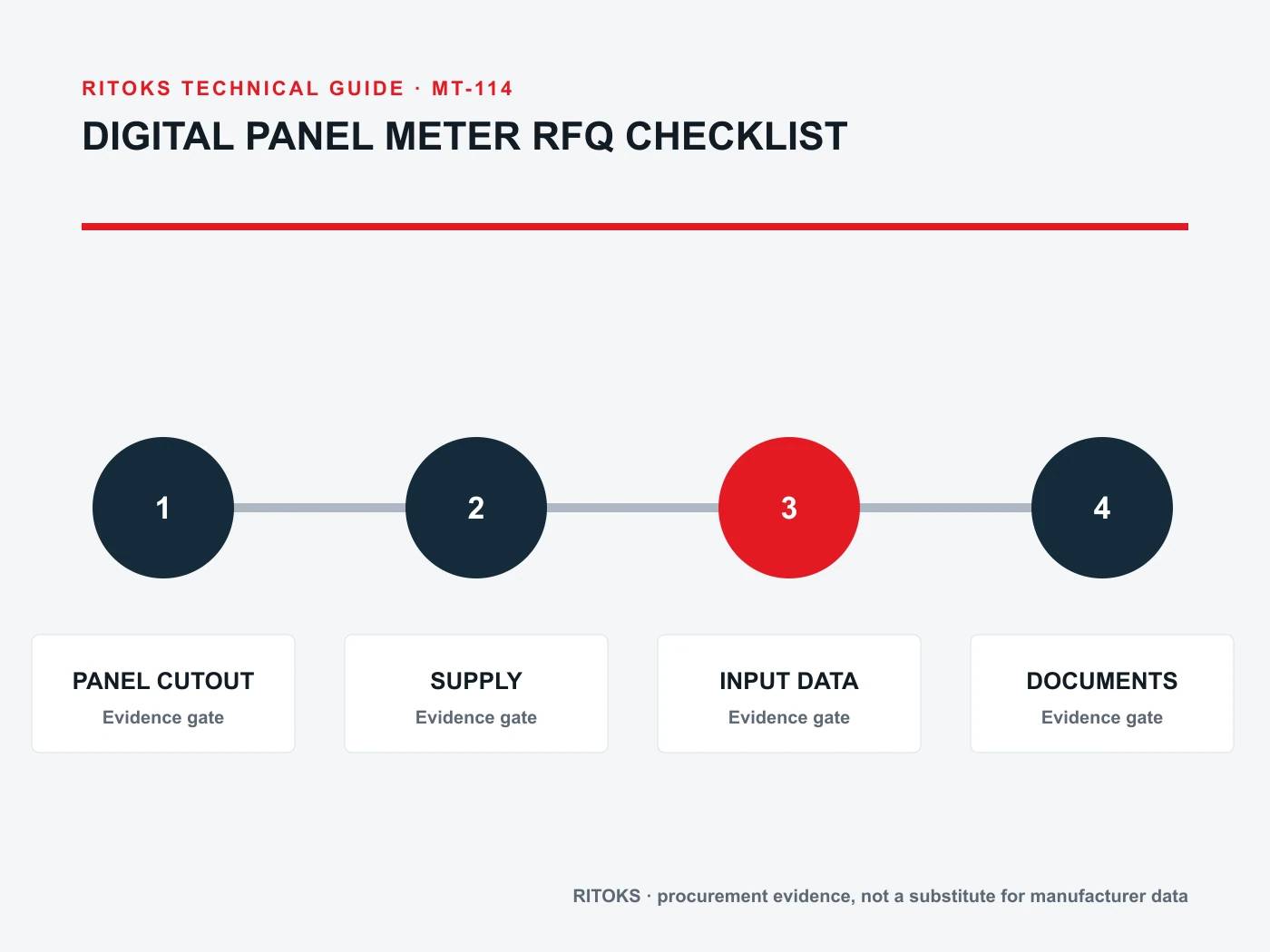
Request exact order code, datasheet, installation manual, terminal diagram, dimensions and communication manual where applicable. If a function is optional, ask whether the quote includes it. Record deviations from the original panel specification rather than relying on a verbal “equivalent” statement.
Compare RITOKS meter families with the task in mind
Yang digital panel meter category covers different use cases. The D85 voltage/current family, multifunction power meter family dan AD16-22 voltage display family should be treated as distinct starting points, not presumed equivalents.
Send the completed input and installation schedule through Kontak RITOKS. Ask for the proposed variant and its supporting documents. The buyer can then separate a simple indication requirement from a power-monitoring requirement before price comparison.
Define acceptance tests and configuration records
Decide how the meter will be accepted after installation. Check that the displayed quantity, phase assignment, CT or VT ratio and units match the source circuit. Where communications are specified, verify the actual values received by the supervisory system, not merely that the port responds. A good acceptance record includes the meter order code, firmware or configuration version when relevant, wiring drawing and settings export or photographs.
For a retrofit, compare the old and new meter behavior at normal operation and at a safe test condition approved by the site. Different scaling, update rates or alarm logic can affect operators even when both units display the same nominal quantity. If the replacement changes a register map or pulse constant, coordinate with the PLC or energy-management team before cutover.
Ask who will retain the commissioning password or setup procedure. Configuration access should support maintenance without leaving critical ratios easy to change accidentally. This is an operational requirement worth putting in the RFQ, especially for repeated OEM panels. Record how the meter is restored after a device replacement or power interruption.
Pertanyaan Umum seputar RFQ
Does an RS-485 port guarantee PLC integration?
No. Confirm protocol, register map, supported data, addressing and wiring for the exact model and the receiving system.
Can a meter accept any CT ratio?
No. Confirm hardware input type, supported configuration range and the actual CT secondary. A programmable ratio does not make unlike signals interchangeable.
Is a matching front bezel enough for retrofit?
No. Check cutout, panel thickness, rear depth, terminals, power supply and the operator functions that the old meter provided.
Intinya
A strong digital panel meter RFQ specifies the measurement, electrical input, accuracy purpose, display task, cutout, auxiliary power and integration needs. Require an exact-model response so that visually similar meters are not treated as technical substitutes.