
Relai Kelebihan Beban Termal untuk Perlindungan Motor · Penjelasan Teknis
Overload Relay Test Buttons: What the Test Does and Does Not Verify

Quick answer
An overload relay test button or selector can exercise a documented test function, but a successful operation does not automatically verify the relay's thermal response, current-setting accuracy or suitability for the motor. First identify the exact relay and read what its manufacturer says the control operates.
Separate a mechanical trip check, an auxiliary-contact check, an installed control-circuit check and a protection-characteristic verification. Each requires different evidence. A report saying only “test passed” leaves that boundary unclear.
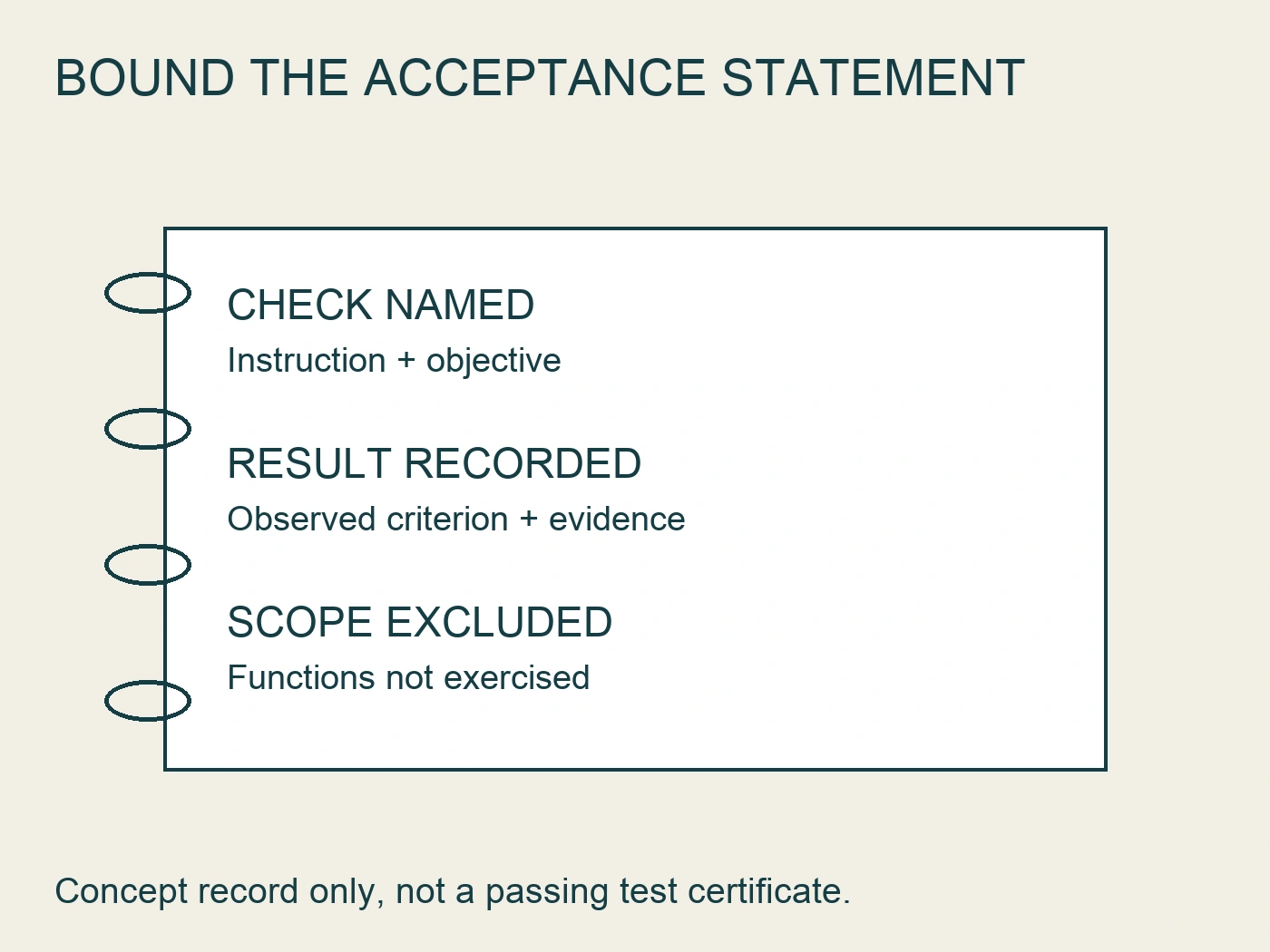
For a local acceptance record, name the approved check, the expected indication or contact state, the observed result and the functions not tested. Use qualified personnel and the manufacturer's and site's procedures. This guide explains test scope; it does not prescribe energized testing or deliberate motor overloading.
Define the question before using the test control
The word “test” can describe several objectives. A procurement team may need evidence that a relay meets its specified protection characteristic. A commissioning team may need to verify the installed trip path. A maintenance team may be checking an accessible mechanical function under an approved procedure. These are not interchangeable tasks.
| Intended check | Evidence that could support the result | What should not be inferred |
|---|---|---|
| Mechanical test function | Exact instruction and observed operation | Thermal calibration is correct |
| Local indication | Expected and observed indicator states | Every control-system signal is correct |
| Auxiliary-contact operation | Approved contact-state check and terminal identification | The motor current path was tested |
| Installed control response | Approved circuit check and documented assembly response | The relay's time-current characteristic was verified |
| Protection characteristic | Applicable manufacturer or qualified test evidence | A button operation substitutes for that evidence |
This table is a scope distinction, not a test procedure. The authorized plan must define the safe equipment state, necessary isolation and appropriate method. Do not infer permission to operate a panel simply because its relay has a front-accessible test control.
A useful first question is: what result would change the decision? If the concern is an unknown current-adjustment band, pressing a test control cannot establish the correct band. If the concern is the control-circuit wiring, a catalogue's protection curve alone cannot establish the installed circuit response. Choose the check that addresses the actual uncertainty.
Read the exact manufacturer's description
Schneider Electric's official LRD test-trip FAQ describes a test control that trips the device, produces a visible flag and places the overload contacts in their tripped state. That is a specific description for the identified LRD product line. It does not state that this action verifies the thermal characteristic under motor current. Schneider Electric, Test trip TeSys D LRD overload relay.
The distinction follows from the scope described by the manufacturer: observing a simulated or mechanically initiated trip is not the same evidence as establishing protection response to a defined electrical condition. Do not extend a test result beyond the function actually exercised.
Also avoid transferring physical operating details between products. The location, form and purpose of a test button or selector can differ. Instructions for an LRD control should not be used as operating instructions for a ZS3RU relay simply because the devices belong to the same broad commercial family.
Yang RITOKS ZS3RU thermal overload relay page establishes the family's overload and phase-loss protection, temperature compensation and trip indication. The exact setting band and mounting compatibility require confirmation. Its public description does not provide a model-specific test-button procedure or establish which protection functions a test operation validates.
Request that missing instruction before defining a ZS3RU test plan. Ask for the full orderable reference, the control descriptions, terminal identification and applicable acceptance guidance. An unverified detail should remain an open document request, not become an assumed product feature in the report.
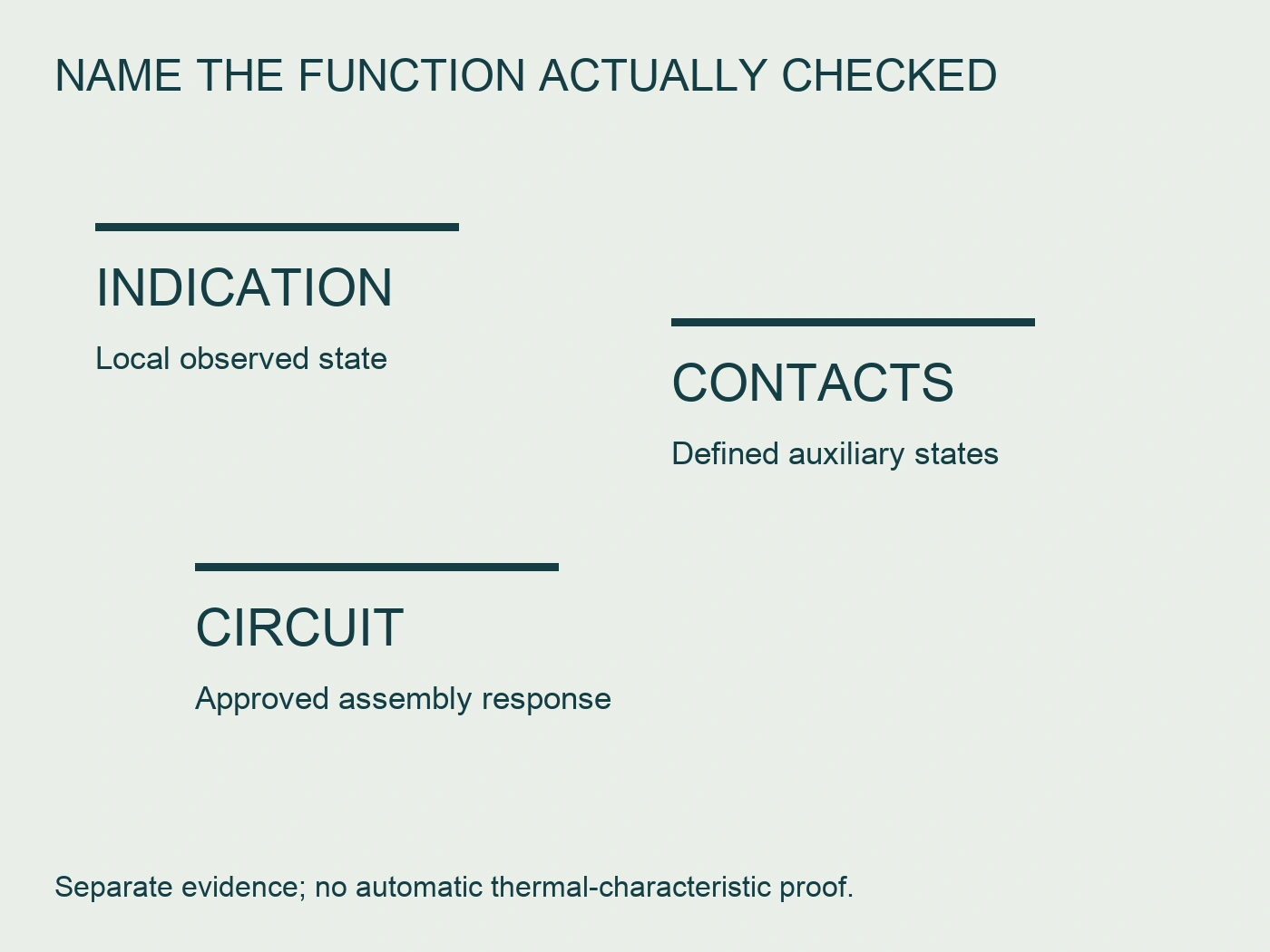
Keep indication, contacts and circuit response separate
A visible indication is useful evidence, but it describes only the indication observed. If a PLC alarm or panel lamp is part of the acceptance requirement, its actual response must be included in the approved check. Conversely, an alarm appearing on a screen does not identify which relay function or contact caused it without the circuit record.
Auxiliary-contact information needs exact terminal identification and the relevant state definitions. “Open” and “closed” should refer to the documented normal and tripped conditions of the selected relay, not an assumed numbering convention. Record which state was expected and what method was used to verify it under the authorized procedure.
For an installed motor starter, the trip path also includes wiring and other components. A relay can perform its local test function while a wiring error prevents the intended assembly response. That possibility explains why the commissioning objective should be stated at the assembly level when appropriate, rather than claim that a relay button checks everything.
Reset is another separate event. A return of the relay indication or auxiliary contacts does not by itself prove that the motor cannot restart. The assembly's command logic determines the effect of reset, and the approved procedure must address that behavior. Do not describe a test-and-reset action as motion-free without reviewing the actual circuit.
Why thermal response requires different evidence
A thermal overload characteristic concerns the device's response under specified conditions. The evidence must identify the exact model, setting, applicable characteristic and test or verification basis. A mechanical control operation does not supply those conditions merely by generating a trip indication.
Schneider Electric's July 2021 instruction for specified TeSys Protect Deca thermal overload relays describes operating the test, reset and stop controls as a mechanical-operation maintenance check. Its English page is identified as 1672603EN-06 and concerns specified models for explosive-atmosphere applications; it is not a certification statement for ZS3RU or a universal procedure. The narrow lesson is that manufacturer documentation can explicitly name the function being checked. Schneider Electric, TeSys Protect Deca thermal overload relay instruction, 1672603EN-06.
For procurement, ask for model-specific documentation and applicable test evidence instead of requesting a photograph of a pushed button as proof of calibration. For commissioning, follow the equipment manufacturer's acceptance plan. For maintenance, define whether the task is a functional check or an investigation of suspected protection behavior.
Do not improvise a protection test by overloading the motor, changing the relay setting until it trips or defeating another protective function. Those actions are not justified by a generic article. Any electrical protection verification requires an approved qualified method suited to the actual equipment and site.
Write an acceptance statement with a clear boundary
Compare two hypothetical report entries. The first says, “Overload relay tested, protection good.” The second says, “The manufacturer's documented mechanical test function operated; the expected local indication was observed. The approved control-circuit check is recorded separately. Thermal characteristic verification was outside this check's scope.”
The second statement is more useful because it identifies the evidence without claiming a wider result. If the inspection also included auxiliary-contact operation, add the applicable instruction and recorded states. If it did not, leave that portion unverified rather than infer it from the flag.
Suppose a project requires both the mechanical function and the installed stop response. The reviewer should find two linked records or one record with separate criteria. A passing local indication alongside an unexpected assembly response is a deviation to resolve, not an overall pass to hide behind the word “test.”
This is a fictional reporting example. It does not describe a RITOKS installation or supply expected ZS3RU contact states. The exact instructions and approved circuit must provide those details before acceptance.
Build a useful test-scope record
Use the following structure to prepare the record before the approved work begins. It keeps the result tied to an objective and makes omissions visible.
| Record item | What to enter | Review question |
|---|---|---|
| Equipment identity | Relay order code, starter and motor tags | Does the instruction match the installed relay? |
| Test objective | Mechanical function, contact state or circuit response | Is the proposed check relevant to the concern? |
| Procedure reference | Manufacturer instruction and authorized site plan | Is the method approved for this equipment? |
| Equipment state | State required by the approved procedure | Were its prerequisites recorded? |
| Expected result | Specific documented indication or response | Is the acceptance criterion observable? |
| Actual result | Observation, time and evidence reference | Does it meet that criterion? |
| Excluded functions | Characteristics or circuits not exercised | Is the conclusion limited to the evidence? |
| Deviation and disposition | Unexpected result and responsible reviewer | Is an unresolved issue being called a pass? |
Retain the result with the equipment documentation rather than only in an operator chat. If a relay or control circuit later changes, the record should make clear which version was checked. A previous passing check cannot automatically cover a replacement with a different reference or a revised wiring arrangement.
For a supplier enquiry, specify the exact relay and the acceptance evidence you need. A request for “test button function” may otherwise receive only a general feature description. If thermal-response evidence is required, name that requirement separately and ask which documentation applies to the selected configuration.
Avoid three common overclaims
The first overclaim is that a button proves the current setting is correct. Setting selection depends on the motor and exact relay requirements; a button check does not establish that relationship. Preserve the setting rationale in a separate selection or commissioning record.
The second is that a successful local trip proves the complete starter is correctly wired. Only the functions actually observed under the approved assembly check can support that conclusion. Keep feedback, stopping behavior and reset behavior within their documented scope.
The third is that a test control verifies every protection function listed on the product page. Overload and phase-loss protection may be family features, but that does not explain what the test control exercises. The manufacturer's exact description must establish that boundary.
These distinctions also help avoid unnecessary replacement. An unexpected panel response may concern wiring or logic rather than the relay's mechanical function. Record the demonstrated finding first and let the authorized investigation determine the corrective scope.
Pertanyaan yang Sering Diajukan
Does the test button verify thermal calibration?
Do not assume it does. Read the exact manufacturer's description. A documented mechanical or simulated trip operation is different evidence from verification of a thermal protection characteristic.
Can LRD test instructions be used for ZS3RU?
No direct transfer is established here. Obtain the exact ZS3RU instruction and control description. The LRD source is cited only to illustrate a clearly defined manufacturer-specific test function.
Does the trip flag prove the contactor stopped correctly?
The flag proves only the recorded local indication. If the installed circuit response is part of acceptance, it needs its own approved criterion and observed result.
What should a report say if only the local function was checked?
Name that local function, the instruction and the observed result. State that unexercised circuit and protection characteristics were outside the check, rather than reporting a general protection pass.
Daftar Pustaka
- Schneider Electric. (2021). Test trip TeSys D LRD overload relay. Updated September 28, 2021; retrieved October 3, 2026. https://www.se.com/ca/en/faqs/FA326783/
- Schneider Electric. (2021, July). TeSys Protect Deca thermal overload relay instruction. English page identifier 1672603EN-06; delivery filename 1672603-07.pdf. Retrieved October 3, 2026. https://download.se.com/files?p_Doc_Ref=1672603&p_File_Name=1672603-07.pdf&p_enDocType=User+guide
- RITOKS. (n.d.). Relai kelebihan beban termal ZS3RU. Live published product-family scope, checked October 3, 2026. https://ritoks.com/products/zs3ru-thermal-overload-relays-0-11a-100a/