
Enclosure Air Conditioners for Control Cabinets · Technical Explainer
Enclosure Air Conditioner Condensate: Include Door-Open Events

Quick answer
An enclosure air conditioner can remove heat without keeping every internal surface dry forever. A door-open event introduces outside air and moisture, while damaged gaskets, cable entries, internal circulation and cold surfaces can create local condensation. Condensate diagnosis therefore needs the operating timeline and the cabinet boundary, not only a cooling-capacity calculation.
Log ambient temperature and humidity, cabinet temperature, door-open intervals, unit operating state and drain condition together. Then inspect seals and drain paths against the selected unit instruction. A water drop may be from a humid-air intrusion event rather than a manufacturing defect, but that conclusion requires evidence from the whole enclosure.
Water appears where temperature and moisture meet
Condensation occurs when moist air reaches a surface below its dew point. In an enclosure air conditioner, the cold-side circuit can create surfaces below the internal dew point, while outside air can enter through a door or an imperfect seal. The two paths require different fixes even when the observation is the same puddle.
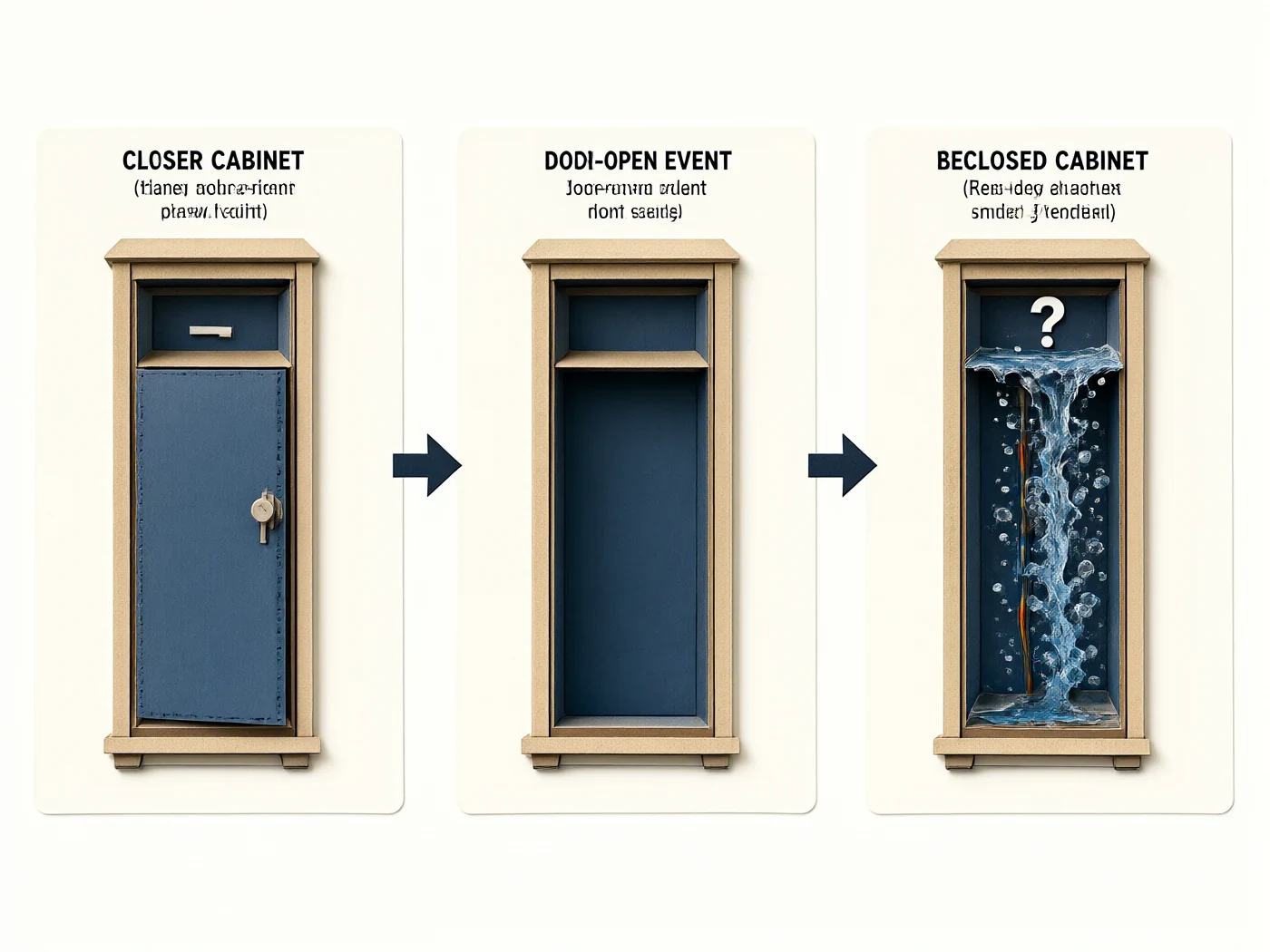
The cabinet boundary matters. A small opening during maintenance can exchange a large amount of moisture-rich air. A cable gland left loose, a damaged filter path or a door gasket that no longer compresses can exchange moisture continuously. The cooling unit may then condense water that entered from somewhere else.
This article does not claim that an enclosure air conditioner must always produce condensate. It asks the service investigator to establish the moisture source, the cold-surface path and the timing of the event. The unit manual and cabinet design remain the authority for intended operation.
A visible drop also needs a location. Record whether water collects at the evaporator, on a cabinet wall, around a gland, inside a duct or under the enclosure. Two locations can imply two mechanisms and deserve separate observations.
Build a door-open event log
For each maintenance or inspection event, record start and end time, work performed, door opening size, ambient humidity and whether external fans or nearby heat sources were active. Note whether the air conditioner continued running and whether internal components remained cold. The event log gives the timeline needed to compare water appearance with intrusion.
After closure, record cabinet temperature and any return-to-setpoint interval. A long interval can keep a cooled surface below the dew point while the internal air remains humid. The exact thresholds depend on the equipment and environment; the useful evidence is the trend and the selected unit's operating behavior.
A door left open for three minutes in a humid season is a different event from a small cable entry open continuously for a week. Both can introduce moisture, but the pattern and correction differ. Classify the source and duration before changing controls.
Photograph the door seal and cable entries at the beginning and end of the investigation. Also record whether any fans, filters or duct covers were removed and restored. Observations made after a temporary configuration can otherwise be mistaken for a persistent fault.
Separate heat load from moisture load
Thermal sizing asks whether the air conditioner can remove the heat produced by components and exchanges. Moisture management asks where water vapor enters and which cold surfaces it reaches. A unit selected for the cabinet's watts does not automatically answer a door-open humidity problem.
During normal operation, sensible heat removal may lower air temperature without removing every gram of water from every surface. Water can be held in materials, enter during maintenance or enter through imperfect enclosure details. The resulting liquid is evidence of a moisture path, not an automatic correction to the cooling-capacity figure.
If internal load falls and the unit cycles, surface temperatures and airflow change too. A short-cycling investigation from another article belongs in the same operating history, but it does not replace the moisture record. Combine electrical and thermal states so a low-load interval is not misread as a failed cooling unit.
Use instruments with the site's approved calibration and range. Record sensor position because a humidity sensor near a door or cold outlet reads a different local condition from one in the cabinet center.
Trace the drain and the internal air path
Find the selected unit's documented condensate path and verify that the discharge tube, slope, fitting or outlet is in the intended state. A drain can be mechanically present and still be blocked, frozen, mis-sloped or routed back into the cabinet by an installation error. Follow the instruction for the exact model.
Check the internal fan and air path for obstruction. A component too close to the cold outlet can receive concentrated flow and become locally wet. A bypass that lets warm humid air pass across a cold surface can create water outside the intended heat-exchange region. This is a general concept, not a statement that every cabinet needs the same airflow.
Inspect the outside air path only as the approved unit permits. Do not open sealed refrigerant components or alter a cooling circuit. Focus serviceable items such as filters, covers, gaskets, drain connections and mounting interfaces.
Keep a sketch with arrows for the event being investigated. Mark the door, unit inlet and outlet, condensation point and drain exit. The drawing lets the next technician check the same path rather than starting from the puddle alone.
Use a condensate diagnosis matrix
| Observation | Domanda | Next evidence |
|---|---|---|
| Water after maintenance | Did humid outside air enter? | Door interval and ambient humidity |
| Water near a cable | Is the gland sealed properly? | Enclosure close-up and seal inspection |
| Repeated drain overflow | Is the instructed drain path clear? | Drain route and serviceable outlet |
| Wet component | Does cold airflow concentrate there? | Internal airflow and placement review |
| Unit appears normal | Is moisture entering anyway? | Boundary and operating-event log |
The matrix does not assign a sealant or a controller setting. It identifies where to gather evidence. For example, a gasket that looks compressed from one view may still leak along a corner, while a clean drain tube may be blocked farther downstream.
Use plain conclusions only after the observations agree. "Door event correlated with condensation" is a different finding from "seal failure confirmed." The first supports a moisture-control action; the second requires inspection and replacement of the specific component according to the plan.
If more than one mechanism is present, treat the correction as a sequence. Fix the boundary and drain first, then observe. Changing controller values before closing obvious openings can make the next data set harder to interpret.

Set maintenance instructions around the boundary
Give operators a short pre-close check that covers the door gasket, filter covers and cable entries. The check should match the approved cabinet design and use the manufacturer's inspection items. It should not ask the operator to adjust refrigeration components or open a sealed path.
The work order should include the date, ambient humidity, visible water quantity, location, drain state and any recent door event. A digital photo from the same angle at each inspection makes gradual seal damage visible. Store the record with the cabinet identifier.
When a PDU, servo drive or other component is added near the cooling outlet, review the local airflow. A change in component position can create a new cold surface or block a return path. The cooling unit may remain the same while the moisture pattern changes.
For outdoor or washdown areas, the enclosure design and ingress requirements belong to the project designer. This article does not convert a normal cabinet into a washdown enclosure by adding a seal. It focuses on the observable condensate path and the selected product documentation.
Select an enclosure AC by the whole cabinet duty
Il EP-A indoor enclosure air-conditioner family lists twelve documented cooling-capacity options from 300 W to 4000 W with model-specific supply and operating data. Use the cabinet heat load and environment to reach the exact model, then include the condensate and boundary requirements in the installation review.
The family citation does not tell the buyer which model will remain dry after a particular door-open event. A quotation should specify the selected model, mounting, available drain connection and the serviceable air-path arrangement. Ask which accessories or installation details must be included for the actual cabinet.
If the cabinet has frequent washdown, corrosive humidity or a temperature below the unit's permitted condition, pause the standard selection. The site may need a different enclosure architecture or additional project engineering. Do not stretch an indoor equipment citation beyond its documented scope.
The purchasing file should pair the cooling-duty calculation with a condensation-control section. That section can list door discipline, gaskets, cable entries and drain checks, which are outside the cooling-capacity number but part of the installed result.
Use a timeline before replacing parts
Record temperature and humidity at the cabinet inlet, outlet and central equipment area with timestamps. If instrumentation is not available, use a controlled observation log rather than inventing sensor values. The purpose is to see whether condensation follows door access, cold-night operation, a cooling cycle or a seal change.
After the cabinet is closed, a moisture load will remove gradually if the enclosure and drain path allow. Looking for a drop once can produce either a false pass or a false alarm. Define a reasonable observation window with the maintenance owner and compare the cabinet state across the same external weather conditions.
Check the door and cable entry after the unit
An air conditioner can be functioning correctly while the cabinet leaks. Inspect the gasket contact line, door hinge alignment, latch compression and cable-entry seals. Do not assume a gasket is good because it is visible. Look for a continuous contact line and use the enclosure manufacturer's approved seal or replacement part if damage is found.
If a filter is present, follow the selected design's service instruction. Removing or bypassing a filter can introduce dust and moisture. A temporary opening made for a cable change should be restored to the intended ingress configuration before the cooling system is judged.
Acceptance rule
Accept the enclosure cooling installation when the exact EP-A model and its drain instruction match the cabinet, and the operating log shows that door events, seals, cable entries and internal air paths no longer introduce an unexplained moisture source. Water observation alone cannot prove a unit fault.
This preserves the useful question: what did the moisture encounter, and where did it come from? Answering that with the cabinet boundary gives the maintenance team a diagnosis that can be corrected and rechecked.