
Enclosure Heaters for Control Cabinets · Comparison
Fan-Assisted vs Natural-Convection PTC Heaters in Tall Cabinets

Quick Answer
Compare fan-assisted and natural-convection PTC cabinet heaters against the actual enclosure layout and the required temperature distribution, not only their heating-output labels. Fan assistance supports air movement, while natural convection relies on the available circulation path. Neither description proves that every relevant part of a tall cabinet will satisfy its requirements.
The useful design-review deliverable is a layout and air-path record connected to a distribution acceptance record. Both should identify the offered heater, the cabinet configuration, the relevant operating cases and the evidence needed for a decision. Equal output labels are not evidence of equal spatial performance.
This guide addresses fan assisted vs natural convection cabinet heater temperature distribution for outdoor and control-cabinet designers. It does not provide a sizing formula, probe-placement instruction or live test procedure. Actual assessment belongs to the responsible qualified team using the selected equipment documents and approved project methods.
Compare Air Movement, Not Different Heating Principles
The comparison here concerns two ways of distributing heat when the heater technology is PTC. It is not a comparison between PTC and resistance-element principles. Keep that distinction clear when requesting supplier proposals; otherwise, a response about the element can leave the cabinet's distribution question unanswered.
STEGO's heating overview distinguishes convection PTC families from fan-assisted PTC families and describes fan assistance as supporting convection and heat distribution. That qualitative distinction explains why the air-movement arrangement deserves review. It is not evidence that a particular tall cabinet is uniformly heated or that one architecture is always preferable. (STEGO, n.d.-a)
A fan-assisted proposal introduces an active air-movement function. A natural-convection proposal depends on circulation without that fan function. The buyer should obtain the exact offered heater's applicable instructions and identify what conditions the supplier's statements cover. Do not transfer another manufacturer's controls or protective features into the proposal.
Also keep spatial distribution separate from electrical startup qualification. A heater's switching or startup evidence does not establish where heat reaches inside a cabinet. Likewise, a useful air-movement proposal does not settle all electrical, mounting or environmental suitability questions. Each review needs its own evidence and defined scope.
Start with the Actual Tall-Cabinet Layout
Height is a reason to examine the distribution requirement, not a complete selection rule. Identify the relevant equipment spaces and the layout that separates them. Internal shelves, partitions, dense equipment arrangements and other obstacles are questions for the actual design record, not features that can be assumed from the cabinet's overall appearance.
Ask the cabinet team which areas require thermal attention and why. The answer should connect to the equipment or environmental requirement, rather than treating every unoccupied space as an identical target. A general desire for a warm cabinet is less useful than a defined scope with identifiable acceptance needs.
Record the intended installation arrangement and available circulation paths from the controlled design information. The selected heater's instructions need to be considered alongside that layout. This is a documentation request, not permission to infer a mounting location, clearance or permitted airflow arrangement from a generic illustration.
Existing heat-producing equipment also belongs in the operating-case description. It may be active in one case and inactive in another; the responsible team determines which states are relevant. Do not create an assumed internal heat contribution or use an unrelated operating case to approve the proposed heater.
Recognize What Natural Convection Evidence Can Establish
Natural convection is a valid architecture to assess, not an automatic deficiency in a tall cabinet. Its suitability depends on the selected heater and the actual arrangement. Request the applicable model documents and ask how the proposed circulation path relates to the project requirement.
STEGO identifies its CSK 060 as a PTC convection heater. That source provides a concrete manufacturer example of the architecture. It does not establish JRQ output, mounting requirements, protective features or distribution in a particular RITOKS customer cabinet. Those questions require the offered unit's own documentation. (STEGO, n.d.-b)
A clear natural-convection proposal should identify which configuration is being reviewed and where supporting evidence stops. If only the heater description has been supplied, the cabinet-layout assessment remains a separate task. A component-level statement should not become an installation-level conclusion simply because both appear in the same quotation.
Where a circulation path is uncertain, retain that uncertainty. Do not substitute an assumed temperature gradient or prescribe more heating output as the answer. The qualified team needs the relevant configuration information before deciding whether the proposed architecture serves the required areas.
Recognize What Fan Assistance Does Not Prove
Fan assistance can support circulation without proving that the actual enclosure has no poorly served areas. Obstacles and available paths remain relevant to a fan-assisted arrangement. The review should ask how the proposed equipment interacts with the layout, not treat the word “fan” as a cabinet-wide acceptance result.
STEGO's CS 130 provides a manufacturer example of a fan-assisted PTC heater. Its product description belongs to that equipment. It does not establish RTX-FHT fan control, cutout behavior, clearance, wiring or performance in the offered installation. Use the example to identify the architecture, not to import features. (STEGO, n.d.-c)
Ask the supplier which fan and heater functions apply to the exact offered configuration, and obtain their applicable instructions. Keep any unconfirmed control behavior visible in the proposal. A project should not rely on an assumed fan operating state that has not been supported by its selected equipment information.
A fan-assisted proposal also needs the cabinet's operating cases. If the required distribution depends on an active function, the responsible team must establish the applicable scope and limitations. This article does not prescribe failure behavior or assert that a particular product will maintain the required conditions under every event.
Build a Layout and Air-Path Evidence Register
The first original table organizes the comparison without assuming a result. It contains no airflow values, installation directions or measured temperatures. Use it to identify which records must describe the same proposed arrangement.
| Review layer | Information to record | Question for the comparison |
|---|---|---|
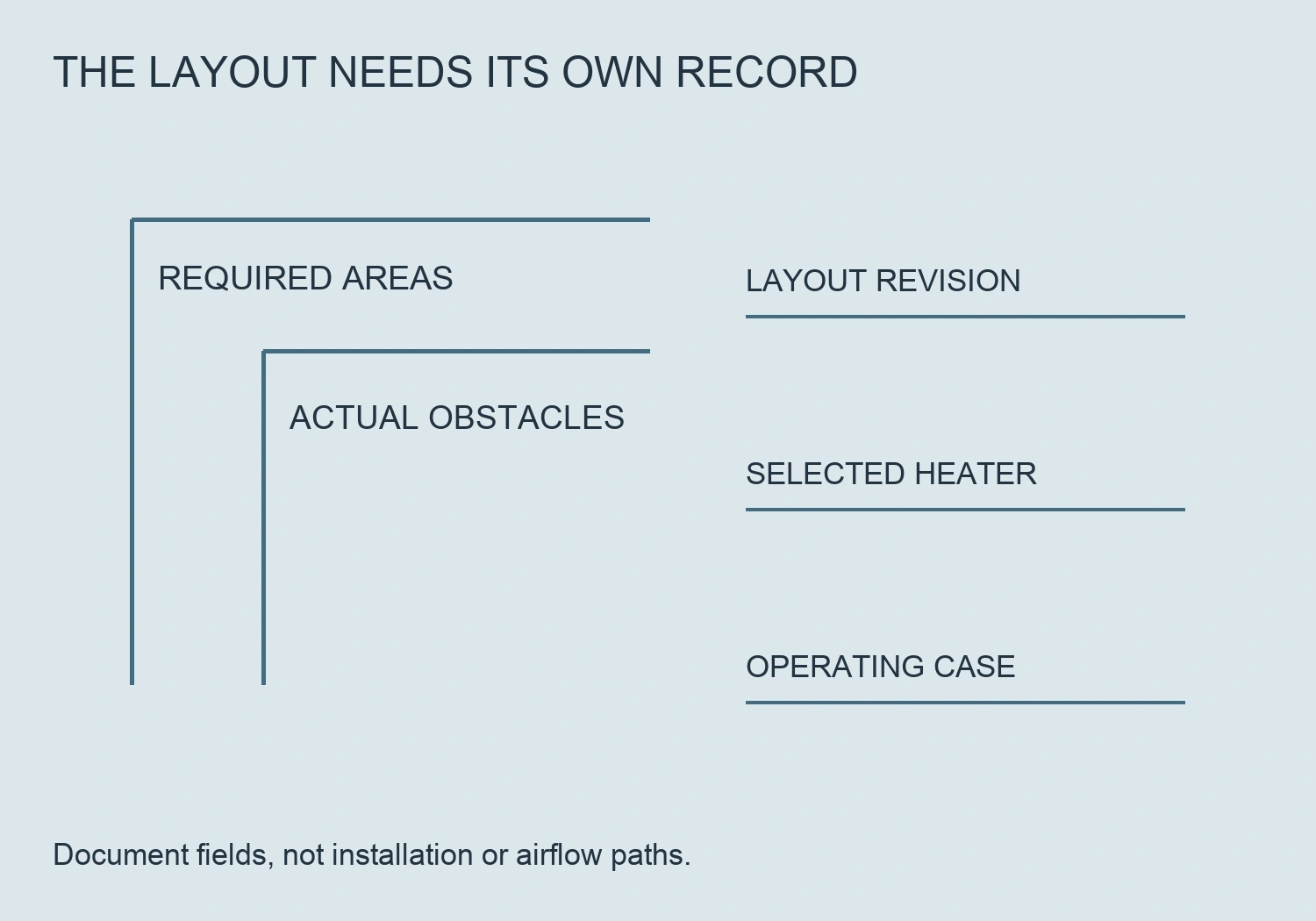
| Required areas | Equipment or cabinet locations covered by the requirement | What needs thermal attention, and on what basis? |
| Internal arrangement | Governing layout, obstacles and separation features | What circulation paths does the actual configuration provide? |
| Selected heater | Exact offered model and applicable instructions | Which architecture and functions are documented for this unit? |
| Operating case | Environmental assumptions and equipment operating states | Does the evidence represent the case being assessed? |
| Evidence boundary | Component description versus cabinet-level assessment | Which conclusions still need installation-specific support? |
| Review ownership | Evidence provider, decision owner and open items | Who resolves each missing relationship before acceptance? |
A supplier may supply a suitable heater document while the cabinet team supplies the layout. The register should connect them rather than crediting either document with the other's conclusions. If a shelf or equipment arrangement changes, identify whether the earlier distribution review still represents the cabinet.
Use the same record structure for both proposals. That makes unresolved evidence visible without awarding one architecture a fictitious result. A comparison sheet that contains a documented model on one side and an assumed installation outcome on the other is not a meaningful assessment.
Define Distribution Acceptance Before Calling It Uniform
“Uniform” needs a defined project meaning if it is to support a decision. Identify the relevant locations, operating cases and requirements in the acceptance record. The qualified team should establish the applicable criteria and method; this guide does not supply universal thresholds or instructions for positioning sensors.
The record should distinguish a requirement, an assessment and a retained observation. A requirement states what the project needs. An assessment may support a proposed arrangement under stated assumptions. An observation represents what was recorded under its documented conditions. None should be silently renamed as another evidence stage.
Do not report a cabinet-wide result from evidence with a narrower scope. If a supplied assessment or retained record covers only identified areas or conditions, retain that boundary. The reviewer can decide whether it is sufficient for the agreed requirement instead of generalizing the result to every possible configuration.
This approach also keeps heater architecture separate from condensation claims. A distribution review may inform the wider project assessment, but it does not alone prove that condensation has been eliminated. Environmental requirements and equipment suitability remain their own relevant questions.
Build a Temperature-Distribution Acceptance Record
The second original table identifies the evidence fields for an approved project review. It is not a measurement procedure, a completed test report or a record of an installation accepted by RITOKS.
| Acceptance field | Information to retain | Unsupported conclusion to avoid |
|---|---|---|
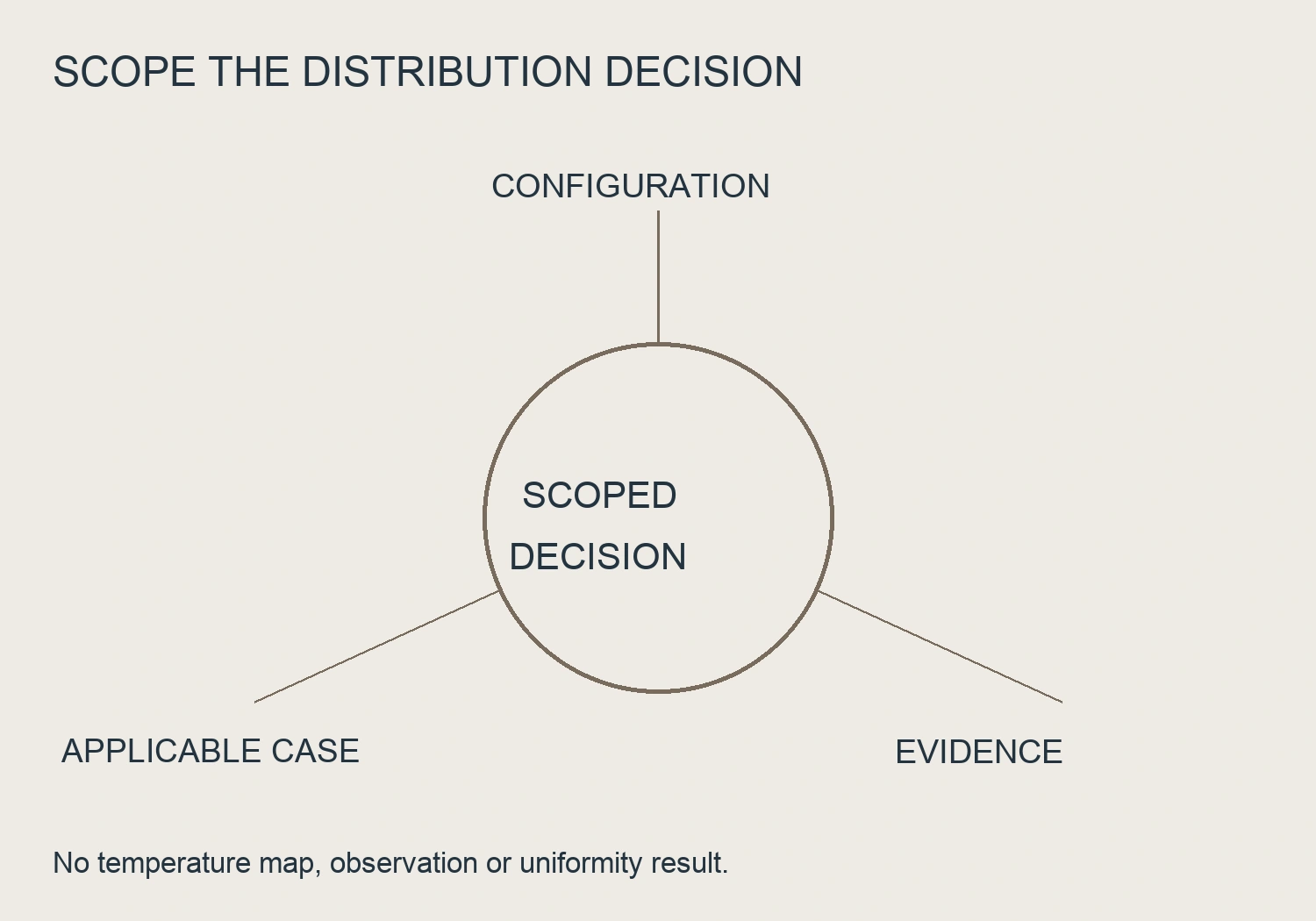
| Configuration identity | Cabinet layout and exact heater reference | Applying a previous result to an altered arrangement |
| Location identities | Areas covered by the agreed requirement | Claiming every cabinet area was assessed without evidence |
| Applicable case | Environmental and equipment-state scope | Generalizing one case to all operating conditions |
| Requirement and criteria | Owner-approved acceptance basis and method reference | Inventing a universal definition of adequate uniformity |
| Supporting evidence | Assessment or approved observation with its limitations | Describing predicted distribution as a measured result |
| Decision and changes | Reviewer, conclusion, unresolved items and revision | Treating architecture or equal output labels as approval |
The project may use an existing controlled record rather than this format. What matters is preserving the connection between the requirement, configuration and evidence. A supplier's general distribution statement can support a question without becoming a completed acceptance entry.
If later evidence does not match the proposed assessment, retain the difference and its context. The responsible team determines the next decision under its approved process. Do not rewrite the requirement or invent a successful result merely to complete the purchasing folder.
A Conditional Comparison Example
Consider a tall control cabinet with a documented internal partition and two proposed PTC heater architectures. No thermal analysis or measurement is implied. Both proposals carry comparable output descriptions, but the available material does not show how either arrangement serves the project-defined areas.
The useful initial result is an unresolved distribution comparison. The team can request the exact heater documents and reconcile each proposal with the actual layout and operating cases. Equal output descriptions do not fill the missing air-path or cabinet-level evidence.
Suppose the fan-assisted proposal later identifies its applicable control functions while the natural-convection proposal supplies its relevant installation document. Each response improves a different part of the record. Neither automatically establishes the required spatial result; the project assessment still needs the governing configuration and acceptance scope.
Il RTX-FHT fan-assisted PTC enclosure heater family e JRQ PTC enclosure heater family provide relevant commercial routes for this discussion. Their architecture descriptions identify the inquiry, not a measured comparison in the illustrative cabinet. Request the exact offered configurations and their supporting documents before accepting either proposal.
Domande frequenti
Does equal heating output mean equal distribution in a tall cabinet?
No. Review the actual layout, circulation paths, selected equipment and relevant operating cases. An output label does not establish which areas receive the required thermal conditions.
Does a fan guarantee that every cabinet area is adequately served?
No. Fan assistance supports air movement, but the configuration and obstacles remain relevant. Obtain project-specific evidence for the required areas rather than assuming a cabinet-wide result.
Is natural convection unsuitable simply because the enclosure is tall?
No universal rejection follows from height. Assess the selected heater and actual circulation arrangement against the project requirements. Keep unsupported outcomes unresolved rather than choosing an architecture by label alone.
Can a manufacturer example establish JRQ or RTX-FHT installation performance?
No. The cited examples identify architecture and documentation questions for their own equipment. The offered RITOKS configuration and actual cabinet require their own applicable evidence.
Conclusion
Choose between fan-assisted and natural-convection PTC heating through a documented spatial requirement, not an assumed result from height or output alone. Reconcile each offered heater with the actual cabinet layout, circulation paths and operating cases. Then retain a distribution acceptance record that distinguishes requirements, assessments, observations and decisions. This gives cabinet designers a defensible comparison while keeping unverified uniformity, condensation and installation claims out of the purchasing conclusion.
Riferimenti
- STEGO. (n.d.-a). Heating. Official heating-family overview.
- STEGO. (n.d.-b). CSK 060. Official PTC convection heater information.
- STEGO. (n.d.-c). CS 130. Official fan-assisted PTC heater information.