
Enclosure Heaters for Control Cabinets · Technical Explainer
Cabinet Heater Sizing: Separate Steady Heat Loss from Warm-Up Duty

Quick answer
A cabinet heater is often sized with two different questions. Steady heat loss asks how much power is needed to hold the cabinet above a minimum temperature after temperatures settle. Warm-up asks how much extra power is needed to raise the enclosure and its contents from a cold state within a required time.
Use the cabinet heat-transfer relationship, equipment heat generation, target internal temperature, coldest external ambient and an energy balance for warm-up. Then check the exact JRQ or RTX-FHT heater output, supply, mounting, airflow and thermostat arrangement. A heater's nominal watts are not a complete cabinet result.
Define the two duties before selecting watts
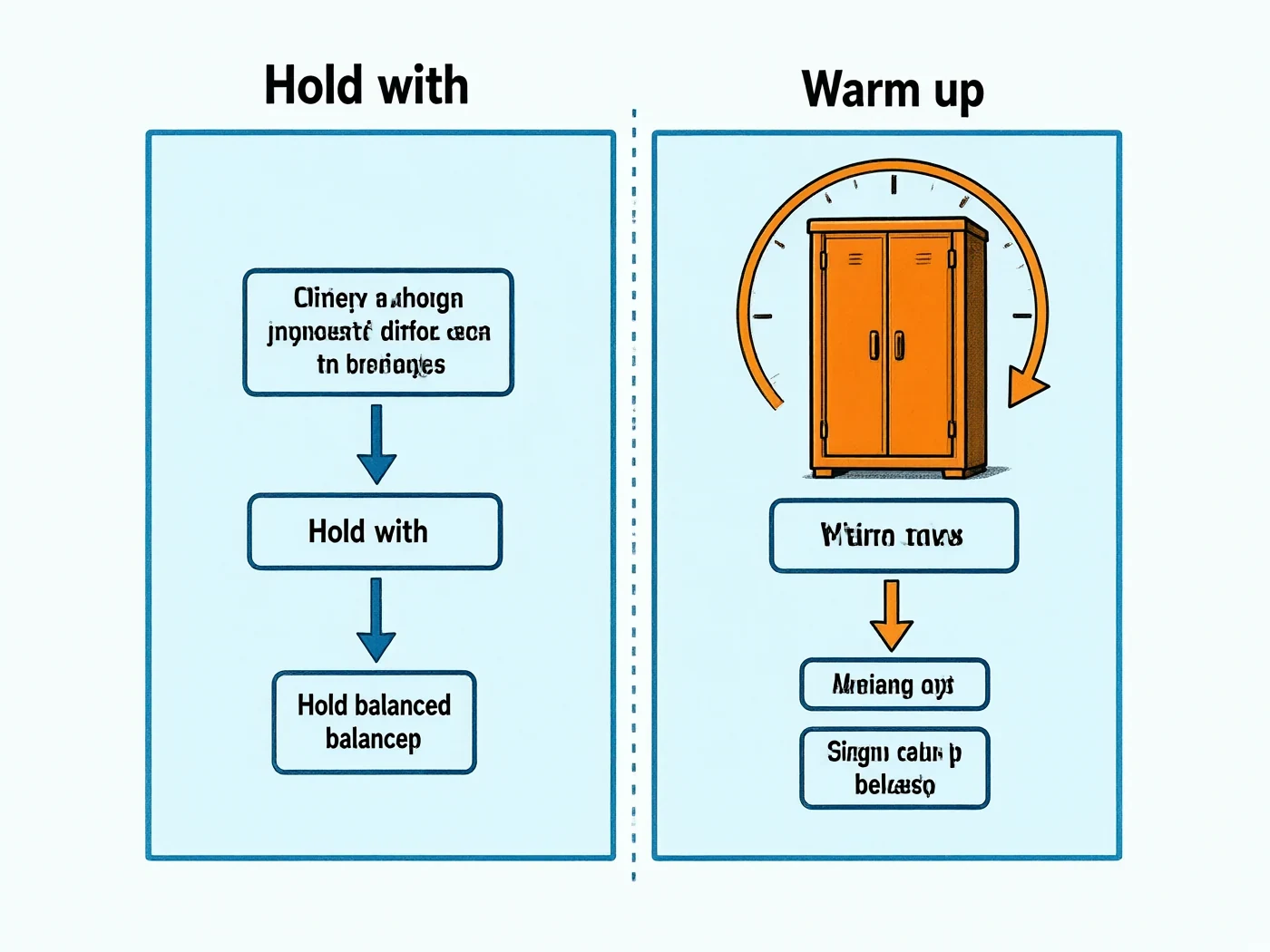
Steady heating maintains a temperature difference between the inside and outside of an enclosure. If the heat loss equals the heater output plus any internal equipment heat, the internal temperature can remain stable. The calculation usually needs an enclosure heat-transfer coefficient, surface area and the design temperature difference.
Warm-up starts with the cabinet and contents below the target. The heater must supply the ongoing loss while also adding energy to the thermal mass of the enclosure and equipment. This can require a higher short-term power, or an accepted longer start-up period.
These are different acceptance criteria. A heater that maintains a warm cabinet may take a long time to bring it up from cold. A larger heater may warm faster but can overshoot or create local hot spots if the heat is not distributed. Size and installation need to be reviewed together.
Write the two states as separate rows: hold and warm-up. Record the boundary conditions under each. A single "heater capacity" number without that split invites two different interpretations of the same installation.
Collect the enclosure heat-loss inputs
Use the actual cabinet dimensions, surface area and installation context. A cabinet against an insulated wall loses heat differently from one in moving outdoor air. Conduction through doors, top panels and cable entries may not match a simple area estimate. The project engineer should use the approved enclosure or site method.
The temperature difference is the intended minimum internal temperature minus the external design temperature. If the internal target is above 0 degrees C and the external design is below, the difference is not a ratio or a generic setpoint. It is a project condition that should include credible cold nights and operational downtime.
Include internal equipment heat when it remains on. A drive or power supply may keep the cabinet partly warm, reducing the heater needed in steady operation. If that equipment is off during a cold start, warm-up cannot rely on its heat. Keep the two equipment states explicit.
Look for thermal bridges and openings. A well-insulated cabinet can retain heat, while an unsealed panel defeats the heater. The goal is not to invent a coefficient; it is to use documented enclosure data or a qualified calculation and record the assumption.
Use a transparent warm-up energy balance
A warm-up estimate can be written as a conceptual balance: heater energy, heat loss during the rise and energy stored in the cabinet and contents must be accounted for. The thermal capacity of steel, copper and other heavy components may dominate a small cabinet. This article does not assign one universal cabinet heat capacity.
If a hypothetical cabinet needs 200 W to hold its target and the engineer wants a warm-up time from a lower temperature, the 200 W heater alone would use all its power against the loss and leave little to raise the load. A larger short-term capacity could shorten the rise, but its duty, control and local heat distribution still need checking.
The arithmetic must use consistent units and a clearly stated time. An estimated rise of a few degrees in an hour is not a promise that every internal mass reaches the same temperature. Record the assumed mass and surface heat transfer. If the equipment mass is unknown, state that gap rather than manufacturing a result.
Treat the result as a design estimate, then verify the real cabinet behavior with the approved temperature record. A heater can be mechanically correct and still fail warm-up because the sensor measures air near the heater while a large component remains cold.
Read PTC output at the working temperature
The JRQ family page lists seven 230 VAC models from 15–20 W to 150–160 W at 20 degrees C ambient. The two-number output reflects the PTC behavior and the tested condition. The usable output at another temperature and supply may differ, so the buyer must ask for the applicable curve or model data.
PTC heaters often change resistance as they heat. That can be useful for self-limiting behavior, but it also means a headline output at one ambient cannot be treated as constant across every enclosure temperature. Use the manufacturer's output curve and the intended control state.
The RTX-FHT fan-assisted family moves warmed air through a fan. That can change local temperature distribution, but the exact power, supply and mounting are model-specific. Fan operation and failure behavior belong in the installation review, not only the wattage comparison.
Do not select the highest heater and rely on the thermostat to make it safe. Fit, airflow, capacitive or other upstream supply requirements and the cabinet's material must be checked with the exact product instructions.
Set the control and sensor position
An enclosure thermostat or external controller decides when heating begins and ends. Its differential and sensor location affect how much the cabinet actually warms and how often it cycles. A sensor next to the heater may see local air changes before the heavier components reach the target.
Place the temperature reference according to the product and panel design, then record the intended minimum temperature at the component of interest. If the cabinet contains a critical device with a different local cold region, the control point should be chosen with the project engineer rather than by a convenience cable route.
Heating and cooling controls should not fight one another. A thermostat setting that calls for heat while another system cools can waste energy and produce unstable cycling. Record the operating modes and any interlock expectation. This is a control-coordination question, not a universal heating setpoint.
Use the manufacturer's terminal and protection instructions. The heater supply must match the exact selected model. Do not infer a universal 230 V suitability from a family description or a local mains label.

Use a sizing and installation checklist
| 入力 | 記録 | 決定 |
|---|---|---|
| 添付資料 | Dimensions, material, surface area and openings | Heat-loss basis |
| 環境 | Minimum external and target internal temperature | Temperature difference |
| Equipment | Internal heat when on or off | Hold and cold-start rows |
| Warm-up | Thermal mass, required time and allowed estimate | Extra duty requirement |
| Heater | Exact model, PTC curve, fan and supply | Output at working condition |
| 制御 | Thermostat, sensor and heating-cooling coordination | Repeatable operation |
Leave assumptions visible. A large cold-start requirement may be impossible for the selected heater, or may require a different enclosure design. Recording that finding is more useful than raising a wattage number until it looks sufficient.
The checklist should include mounting position and guards required by the heater instruction. A heater near wiring or a plastic component may need a separation that dominates the mechanical layout. The selected thermal output does not define the permitted material clearance.
Perform a real temperature record after installation with representative doors closed, actual equipment state and a defined cold-start condition. Compare the result with both rows of the sizing record.
Choose the commercial family after the duty
その JRQ PTC enclosure heater family is the starting point for a low-power condensation-control or minimum-temperature-maintenance requirement. Submit the exact supply, desired hold duty, warm-up time and mounting constraints. Ask for the selected model's output curve and terminal instructions.
その RTX-FHT fan-assisted PTC heater family can be considered when air movement within the cabinet is part of the thermal plan. The exact output, supply and physical arrangement still require model-level confirmation. The fan can improve distribution while adding another service item to review.
Both families should be checked against the cabinet layout. State whether the heater will operate continuously in condensation-control mode, be switched by a thermostat or start only in cold standby. The operating time changes the annual energy estimate and the control duty even when the heater model is unchanged.
If the required hold or warm-up duty exceeds the family scope, ask for another product route rather than extrapolating a catalogue wattage. Keep the measured enclosure inputs so a larger solution can be compared on the same basis.
Energy cost follows the operating hours
Calculate the heater's operating time separately for the hold and warm-up cases. A large heater on a short control cycle may consume less energy than expected, while a modest heater running continuously at the cold extreme uses its rated power for every hour of the heating period. Use actual supply voltage and the PTC output curve to estimate input power accurately.
If the cabinet uses a thermostat, estimate the duty cycle at the coldest credible condition rather than assuming full power all winter. If the controller has an alarm or remote-monitoring output, include its configuration and not only the heater energy. Energy cost belongs to the owner, so the assumptions should be transparent.
Heating and cooling should not be evaluated from the same enclosure area formula without validating the installation. A heater mounted near an uninsulated wall may waste energy; a fan-assisted heater can improve distribution but uses fan power. Record the actual arrangement as part of the operating cost.
Verify warm-up at heavy components
Put a temperature sensor on or near the largest thermal mass, such as a metal enclosure section or heavy electrical equipment, where the site procedure permits. A sensor in the air beside the heater can satisfy a setpoint while the critical component remains colder. The acceptance criterion should identify which temperature governs.
If a cabinet reaches temperature in the required time but one component remains below its permitted minimum, the heater placement or warm-up power is not sufficient. If all components warm faster than required and the heater overshoots, adjust the control strategy only within the product instruction. The sizing worksheet should link each sensor location to a specific decision.
Acceptance rule
Approve the cabinet heater when the steady heat-loss calculation and the cold-start warm-up estimate both fit the exact selected heater's documented output and installation limits, and the completed cabinet temperature record reaches the target. A nominal wattage alone is not enough.
This keeps condensation control, minimum temperature, warm-up time and electrical selection tied to the same enclosure record. It also gives the buyer a way to explain why a larger heater may be necessary even when a smaller one could maintain a warm cabinet.