
Enclosure Heaters for Control Cabinets · Technical Explainer
How to Estimate Enclosure Heater Capacity for a Cold Cabinet
An enclosure heater is selected for a temperature and moisture-control problem, not simply because a cabinet is installed outdoors or feels cold to the touch. The first question is what minimum internal condition the equipment must maintain under the coldest credible operating state. The second is how much heat the enclosure loses to that environment, after accounting for any useful heat produced by energized components. A heater-capacity estimate connects those questions. It is a starting point for model selection and engineering review, not a promise that a particular wattage will keep every point in the cabinet warm.
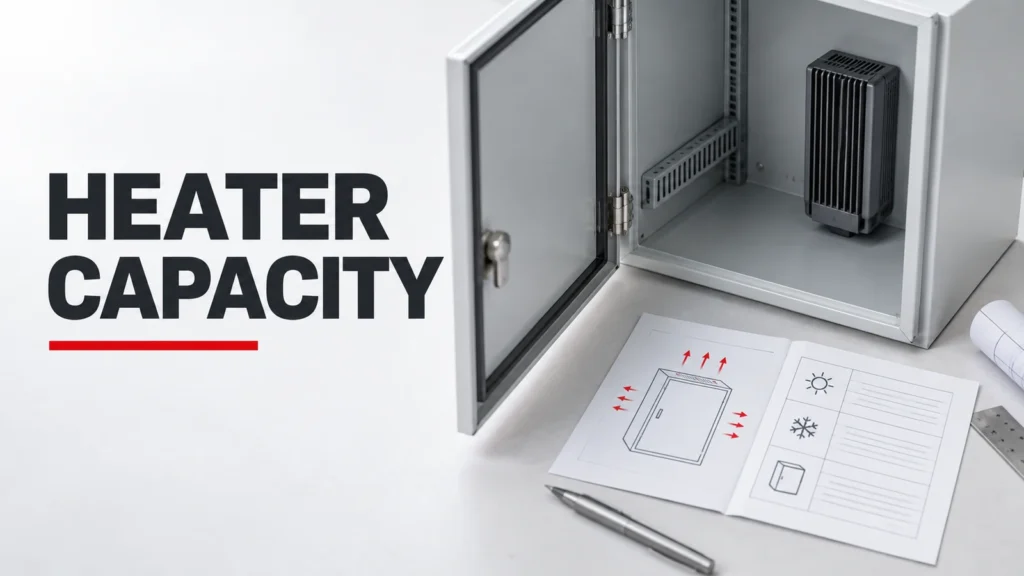
This guide is for electrical-panel buyers preparing a heater inquiry. It explains the inputs behind a heat-loss estimate, why a catalog wattage cannot be chosen from enclosure size alone, and what evidence to request before ordering. Heating and cooling are different calculations. If the concern is overheating during high ambient temperature or high electrical load, use a cabinet-cooling assessment rather than adding heater capacity to that problem.
Define the cold-case design condition
Begin with the minimum outdoor or room ambient temperature the cabinet may experience while its protected equipment must operate. Pair that with a justified minimum internal temperature at the location of concern. The difference between those temperatures is the design temperature rise the heating arrangement is expected to support. The target should come from the equipment's documented operating limits, the cabinet's moisture-control objective and the project's duty cycle. It should not be copied from a neighboring panel or a generic heater advertisement.
Ask whether the coldest condition occurs with the electrical load energized, at reduced load, or completely off. A cabinet whose drives and supplies dissipate heat during normal operation may have little internal heat when it is parked overnight. The worst heating case may therefore be the least active electrical state. Record that state explicitly. Also establish whether doors or service openings remain closed during the condition being calculated and whether ventilation openings can admit outdoor air. An estimate based on a sealed cabinet will not describe a deliberately ventilated one.
その RITOKS enclosure-heater category asks buyers to confirm enclosure conditions, documented capacity, supply, mounting and control method. That is an appropriate commercial starting point, but it cannot replace the project's ambient and internal-temperature requirements.
Collect enclosure geometry and exposed surfaces
Heat escapes through the cabinet's walls, roof, base, door and any thermally connected mounting structure. A simple calculation needs an effective heat-loss surface area, not just the nominal height, width and depth. A free-standing cabinet with air around most sides exposes a different surface arrangement from one mounted against a wall or joined to adjacent cabinets. A base on a plinth, a back against a wall and a banked enclosure may also change how heat transfers. The manufacturer's calculation method determines how these surfaces are counted.
Record the enclosure dimensions, material, mounting arrangement and which faces are exposed. Note insulation, double walls, sun shields, internal partitions or large cable entries if they matter to the thermal path. Do not assume that a surface-area formula from one manufacturer's steel-cabinet example applies unchanged to a plastic or insulated housing. It is better to supply the real construction and let the selected calculation method declare its assumptions.
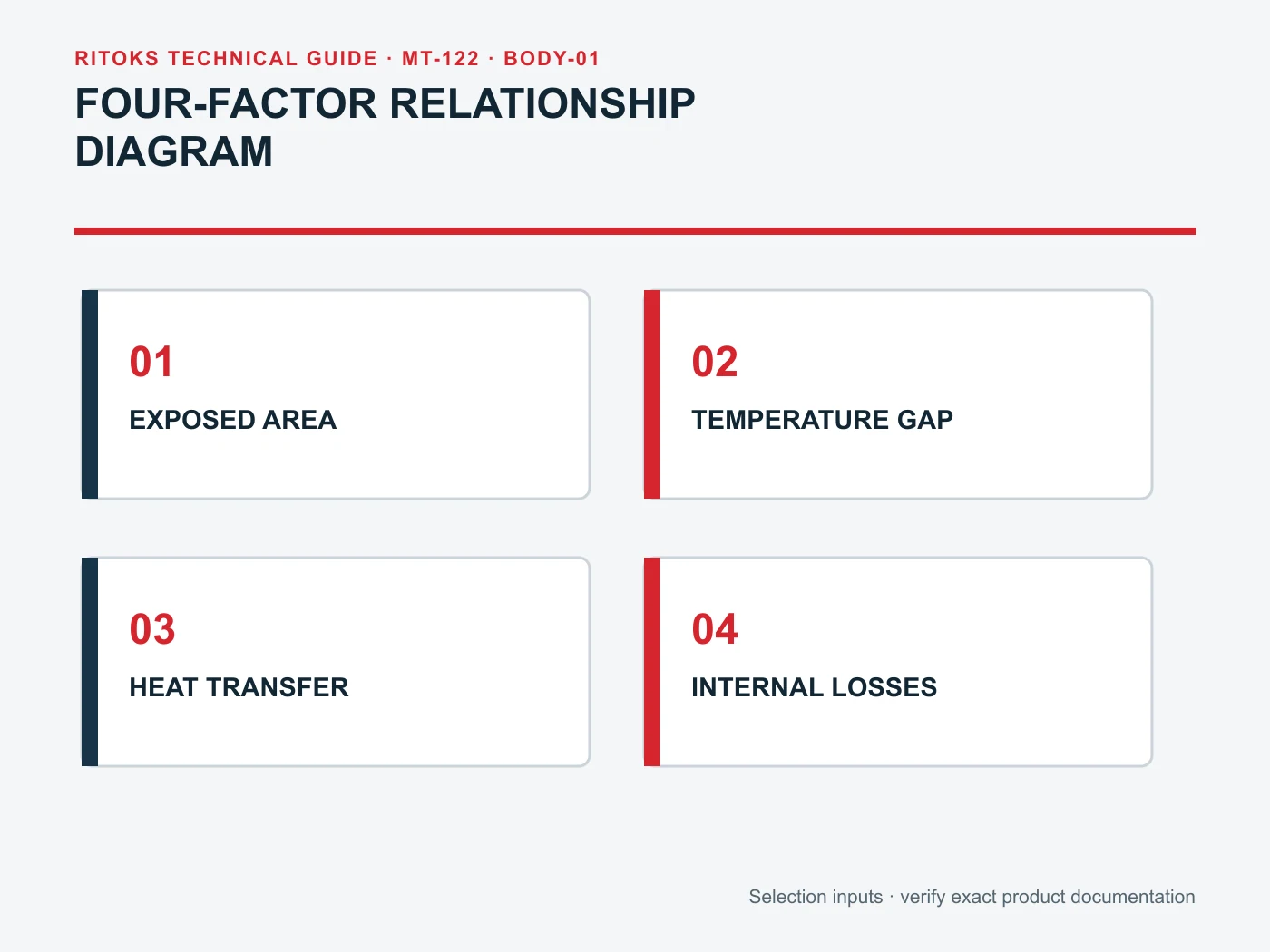
Rittal's enclosure-heater technical catalogue presents a preliminary relationship between required thermal output, effective surface area, temperature difference and a heat-transfer coefficient. Its published worked basis is an indoor, static-air case for its stated coefficient and enclosure assumptions. That relationship explains why a larger exposed area or a larger requested temperature rise generally increases heater duty. It does not make one coefficient universal for every material, installation or airflow condition.
Use heat balance as an estimate, not a product guarantee
For a simplified steady-state case, the heat leaving the enclosure is related to effective area, the inside-to-ambient temperature difference and an appropriate overall heat-transfer coefficient. Rittal expresses the basic enclosure-heater output relationship as area multiplied by temperature difference multiplied by coefficient. A more complete system balance also considers internally generated heat. If the internal electrical equipment is dissipating useful heat during the cold case, that contribution may reduce the heater output needed to hold the target temperature. If it is switched off, it cannot be credited.
This is a heat-balance concept, not an instruction to subtract every nameplate watt from the heater estimate. Electrical input is not always equal to heat released in the cabinet, and operating duty varies. Use documented losses at the relevant operating point. If those losses are unknown, show the uncertainty rather than entering a convenient number. Leakage, air exchange, wind exposure, insulation and thermal bridges can also shift the result beyond a simple wall-loss model. Ask the enclosure or thermal-management supplier which effects its calculation includes.
その STEGO calculation-tool explanation lists enclosure dimensions, desired temperature and humidity, ambient temperature and other application factors as inputs. The existence of such a tool is useful evidence that heater sizing is an application exercise. A tool output still needs an engineer to review whether the entered geometry, conditions and product assumptions match the actual cabinet.
Separate steady-state duty from warm-up duty
Maintaining a cabinet at a chosen minimum after it has stabilized is different from warming a cold cabinet quickly after a shutdown. A steady-state heat-loss estimate asks what output offsets continuous loss. Warm-up asks how much energy is needed to heat the enclosure structure, equipment and air over a specified time while heat continues to escape. A buyer who needs fast restart should state the allowable warm-up interval and the initial temperature. A preliminary wall-loss estimate alone cannot confirm that interval.
Heater placement matters during warm-up. Warm air circulation may leave a cold region below, behind or isolated from the heater. Rittal's published enclosure-heater guidance discusses placement in the base region of an enclosure for temperature distribution in its own test context. That is not a universal mounting instruction for RITOKS equipment. Follow the installation and clearance instructions for the heater actually selected, and inspect the cabinet layout for blocked circulation or heat-sensitive neighboring parts.
If the cabinet contains temperature-sensitive batteries, displays, instruments or process devices, a single central air sensor may not represent the most vulnerable component. State the protected location and the relevant temperature requirement. The heater may require a thermostat sensor position or an additional control strategy to address that location. Component-level temperature confirmation belongs in system validation, not in an unsupported catalog claim.
Consider condensation separately from temperature
Heating can be part of a condensation-management approach because warming internal surfaces can change the moisture condition near them. It does not remove water from an enclosure, guarantee a dry cabinet or repair a leaking seal. Humidity, water ingress, temperature cycling and surface temperatures must be considered together. A buyer may need a hygrostat, thermostat, ventilation strategy, sealing review or drainage decision depending on the cabinet. Do not convert a humidity concern automatically into a particular heater wattage.
Describe the environment: indoor conditioned room, unheated plant, sheltered outdoor location or exposed outdoor position; typical and low ambient conditions; washdown or rain exposure; and whether moisture appears after a shutdown or at morning restart. If condensation has already been observed, record when and where it appears. This information can change both the target condition and the control method. A heat-loss calculation will not diagnose the water path by itself.
RITOKS identifies condensation management and low internal temperature as possible reasons to consider enclosure heaters. The category does not claim that every heater prevents condensation in every installation. In an inquiry, describe the moisture problem and ask for a documented control recommendation rather than requesting a heater solely by power label.
Check the candidate heater and its control as a system
Once a thermal estimate is available, compare it with the actual heater family's documented output, supply requirements, mounting method, allowable installation orientation and control options. The published JRQ Series enclosure-heater family is the relevant RITOKS product route. The family title indicates a range of models, but the selected part number, electrical data and installation instructions must be checked before anyone commits to a size. This guide deliberately does not nominate a particular JRQ model from an unverified cabinet example.
Ask whether the heater has an integrated control device or needs a separate thermostat or hygrostat. Ask how the control contact behaves, where the sensor should be mounted and what electrical load it can switch. A thermostat may keep a heater from operating outside the selected control condition, but it does not increase the heater's available output. A heater with sufficient nominal output can still underperform in the cabinet if the sensor is badly placed, the supply is wrong or circulation is obstructed.
If several smaller heaters are proposed instead of one larger unit, evaluate their distribution and installation constraints using the actual manufacturer instructions. The aim is not to maximize the number of heaters; it is to reach the required protected conditions with a maintainable, electrically compatible arrangement. Confirm cable routing, guards, hot-surface clearances and access for service. Those details are model-specific and must come from the chosen product documentation.
Record assumptions before comparing quotations
Two suppliers can quote different outputs because they assumed different enclosure surfaces, ambient extremes, internal dissipation or thermal coefficients. A useful comparison therefore begins with a shared design sheet. Record the enclosure construction and exposed faces; minimum ambient; desired minimum internal condition; operating state; known internal heat losses; sealing or ventilation status; moisture objective; supply; mounting space; and any warm-up requirement. Keep unknown values visible. A precise-looking output derived from guesses is weaker than a range accompanied by explicit assumptions.
Do not treat the result of one online calculator as a certification for the whole assembly. Request the calculation basis and product datasheet. Ask whether the proposed capacity is continuous output at the relevant ambient condition or a rating defined at another condition. Confirm how a PTC heater's output varies with operating state if such a heater is offered. The distinction between self-regulating element behavior and cabinet-level control matters, but neither substitutes for model-specific thermal data.
What to send with an enclosure-heater RFQ
- Provide enclosure dimensions, material, installation arrangement and the surfaces exposed to the surrounding air.
- State the lowest relevant ambient condition and the justified minimum internal condition, identifying the equipment or location protected.
- Describe the electrical operating state at the cold condition and provide documented internal heat-loss information where available.
- Identify ventilation openings, sealing, insulation, wind exposure and observed condensation or water-ingress symptoms.
- State whether the priority is steady-state temperature holding, condensation control, a defined warm-up time or a combination.
- Give the available power supply, mounting constraints and any control-device requirements.
- Request the exact heater model data, calculation assumptions, control arrangement and installation instructions with the quotation.
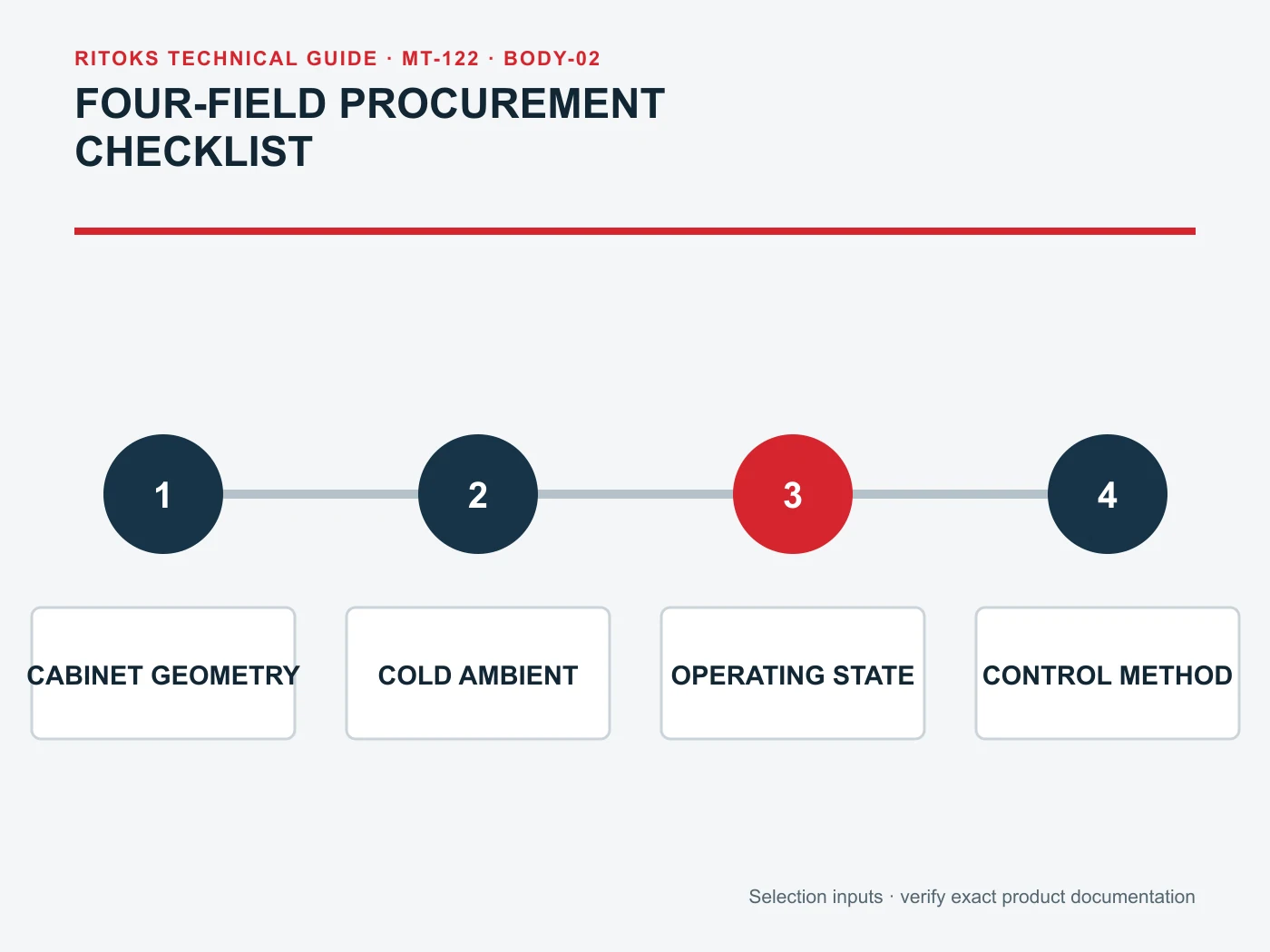
These fields let a supplier check the heat balance and identify the missing information before offering a specific heater. They also make the resulting quotation easier to review against the cabinet's real service condition. If a destination-market standard, environmental rating or special approval is required, include it as a project requirement and request exact-model evidence; this guide does not assert that any RITOKS heater carries a particular approval.
Final selection check
The shortest defensible answer to “what heater capacity do I need?” is: calculate the cold-case heat loss using the real exposed enclosure geometry and temperature requirement, adjust only for verified internal heat, then validate a candidate heater and controller against the exact installation. Do not choose a wattage by cabinet size alone, and do not confuse winter heating with summer cooling. Start with the RITOKS Enclosure Heaters category and the published JRQ family, then send the design conditions and open assumptions with the RFQ. The final capacity and control plan belong to the documented cabinet design.