
技術リソース · 比較
kW vs kWh on an Energy Meter: Power and Energy Explained

The short answer: rate versus quantity
An energy meter may show both kW そして kWh, but the two numbers answer different questions. Kilowatts express electrical power: the rate at which energy is being transferred or used. Kilowatt-hours express electrical energy accumulated across a period. The US Energy Information Administration explains the distinction in exactly those terms: watts and kilowatts measure power, while watt-hours and kilowatt-hours measure use over time. One kilowatt sustained for one hour accounts for one kilowatt-hour of energy [1].
For a plant operator, a present reading of 12 kW means “the load is at about this power level according to this meter and its display definition.” It does not mean the equipment used 12 kWh during the shift. A register reading of 12,000 kWh means the meter has accumulated that amount under its configured counting rules; it does not say the load is presently 12 kW. To find energy used during a shift, subtract two readings of the same energy register, taken at the start and end of the defined interval. Check the meter's register map and multiplier first.
This distinction sounds elementary, yet it matters when teams size a control-panel supply, compare production-line energy, investigate a high bill, or decide which meter fields to trend. Each task needs a different measurement and a clear time boundary.
Why “kWh” contains an hour but is not an hourly power reading
The hour in kWh is part of the unit, not a statement that every displayed value covers the most recent hour. Energy is power integrated over elapsed time. If a load were exactly 1 kW for one hour, its use would be 1 kWh; if it were exactly 2 kW for half an hour, it would also use 1 kWh. The arithmetic works because kW multiplied by hours gives kWh [1].
A cumulative energy register usually keeps growing while relevant consumption is measured. A number such as 8,420 kWh might represent the total since commissioning, since a configured reset, or another interval defined by the device. The digits alone do not reveal which. A historian's “daily kWh” may instead be a calculated difference between two cumulative readings. Label the source register, reset behavior, time zone and calculation method before comparing reports. Never relabel a total-energy register as “today's energy” merely because it was read today.
The distinction is equally important for a display or dashboard that uses “kW” for a sampled power value and “maximum demand” for an interval-based result. Both use power units, but they describe different observation windows. Consult the exact meter manual before assigning a time interpretation to either field. The term “instantaneous” may be convenient shorthand; a digital instrument still computes and refreshes its display according to its own measurement and update method.
Work through a changing-load example
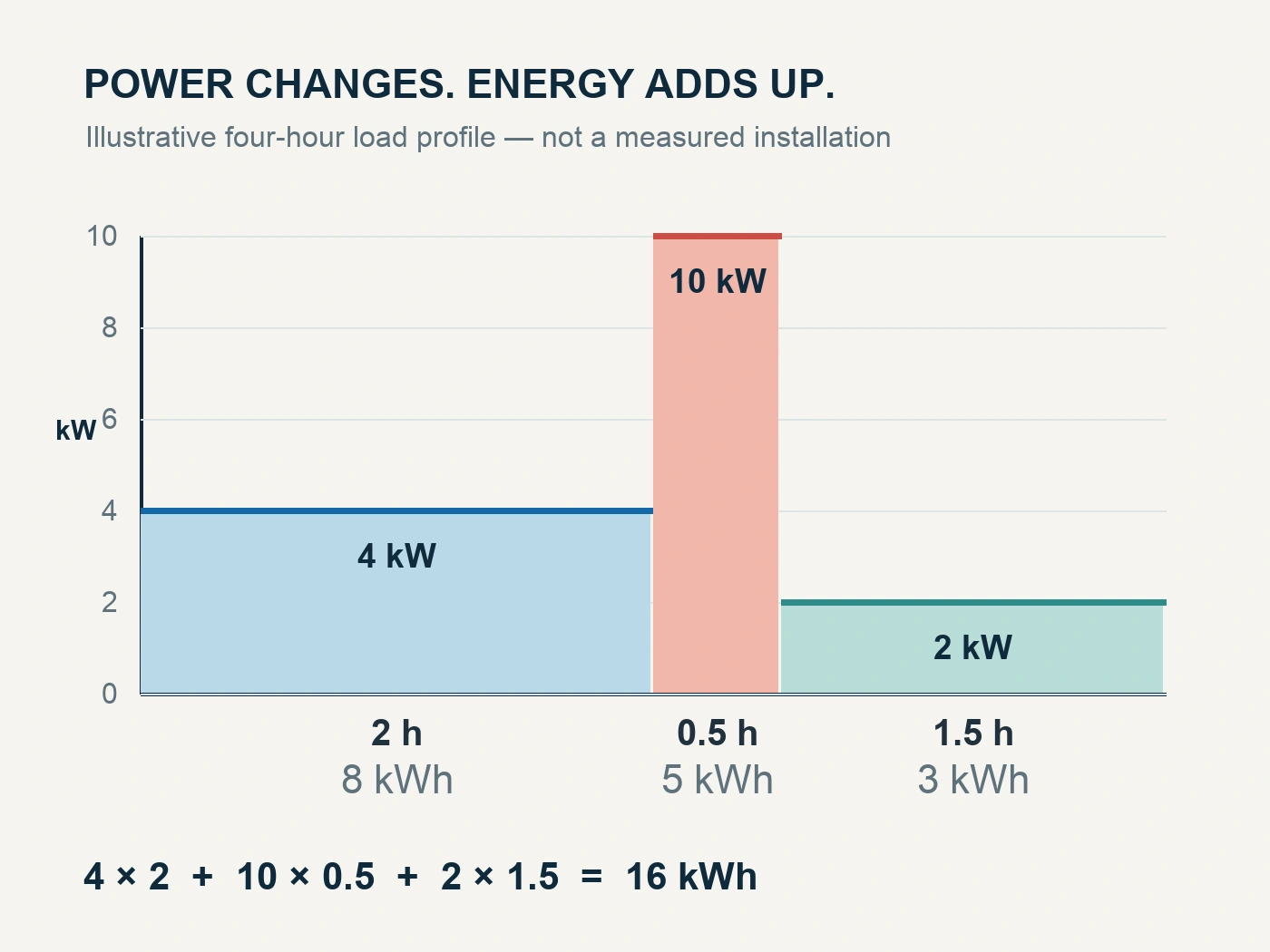
Consider an illustrative, not measured, workshop load. Assume it remains at 4 kW for two hours, rises to 10 kW for 30 minutes, and then falls to 2 kW for 90 minutes. Assuming each level is constant within its stated interval, the calculated energy is:
| Assumed interval | Assumed power | Calculation | Energy |
|---|---|---|---|
| First two hours | 4 kW | 4 × 2 | 8 kWh |
| Next half-hour | 10 kW | 10 × 0.5 | 5 kWh |
| Last 1.5 hours | 2 kW | 2 × 1.5 | 3 kWh |
| Entire four-hour period | Varies | 8 + 5 + 3 | 16 kWh |
The highest power in this simplified story is 10 kW, while the energy over four hours is 16 kWh. Dividing 16 kWh by four hours gives an average power of 4 kW for that interval. None of these three values can replace the others. A snapshot taken during the 10 kW phase could misrepresent the whole four-hour energy total. A snapshot taken during the 2 kW phase could do the same in the opposite direction.
Real loads rarely follow perfectly flat steps. A motor, heater or production cell changes state; a meter records according to its measurement and logging design. For real reporting, use appropriately spaced energy-register readings or trustworthy interval data rather than assuming the load remained at one observed kW value. State any missing interval, communication outage or register reset. Do not fill such gaps with an unlabelled estimate.
Reading the meter: identify the field before using the number
Begin with the exact field name and unit shown by the device or its protocol documentation. A screen may rotate among power, energy, voltage and other values. A software dashboard can also rename a register or apply a multiplier. Capture the screen label or register address alongside the numeric value. A “power” field without a verified unit is not enough to decide whether the value is W, kW, a scaled integer, or another quantity.
For energy, distinguish cumulative import, export, net, tariff-specific and resettable registers only if the exact meter provides them. Do not infer any of these functions from a generic photo or from another model in the same product family. For power, establish whether the figure is total or per phase, active or reactive, and present or interval-based. A configuration worksheet with these fields is often more useful than a screenshot of the number alone.
Also check the measurement boundary. If a meter covers only one feeder, its kWh cannot automatically represent a whole machine or building. If a current-transformer or voltage-transformer ratio is configured, confirm the exact scaling in the device and in the data platform; double application of a ratio makes a plausible-looking but false number. The RITOKS DIN rail energy meter selection guide makes this procurement distinction: phase, current designation, measurement functions and exact-model documentation must be checked separately rather than inferred from the housing [2].
Do not confuse energy use with demand or apparent power
An energy value and a power value can both be important to commercial and engineering decisions. In a tariff context, energy charges and demand charges may use different measurements and contract rules. The US Department of Energy's business electricity-bill guide identifies consumption in kWh and discusses demand separately [3]. However, a particular factory's billing method must come from its utility contract and metering documents, not from a generic article. A panel submeter may be useful for internal monitoring yet not be the revenue meter used for billing.
Likewise, kW is not the same as kVA. kW describes active power, while kVA describes apparent power. Do not substitute one for the other when sizing electrical equipment or interpreting a meter field. If an operator sees a kVA number near a kW number, the difference is not necessarily a meter fault. The exact interpretation depends on the measurement system and operating load; investigate with the correct electrical parameters and qualified personnel. This article's worked example uses only active power and energy, so it does not silently assume a power factor or prove any circuit rating.
Peak observed kW also is not always the same as a utility's billed maximum demand. The latter can be defined over a specified averaging interval and subject to contractual rules. Ask what interval and calculation the meter or billing system uses. When a team says “the line peaked at 10 kW,” its report should say whether that is a single sampled display value, the maximum of logged samples, or an interval demand register.
A practical shift-report method
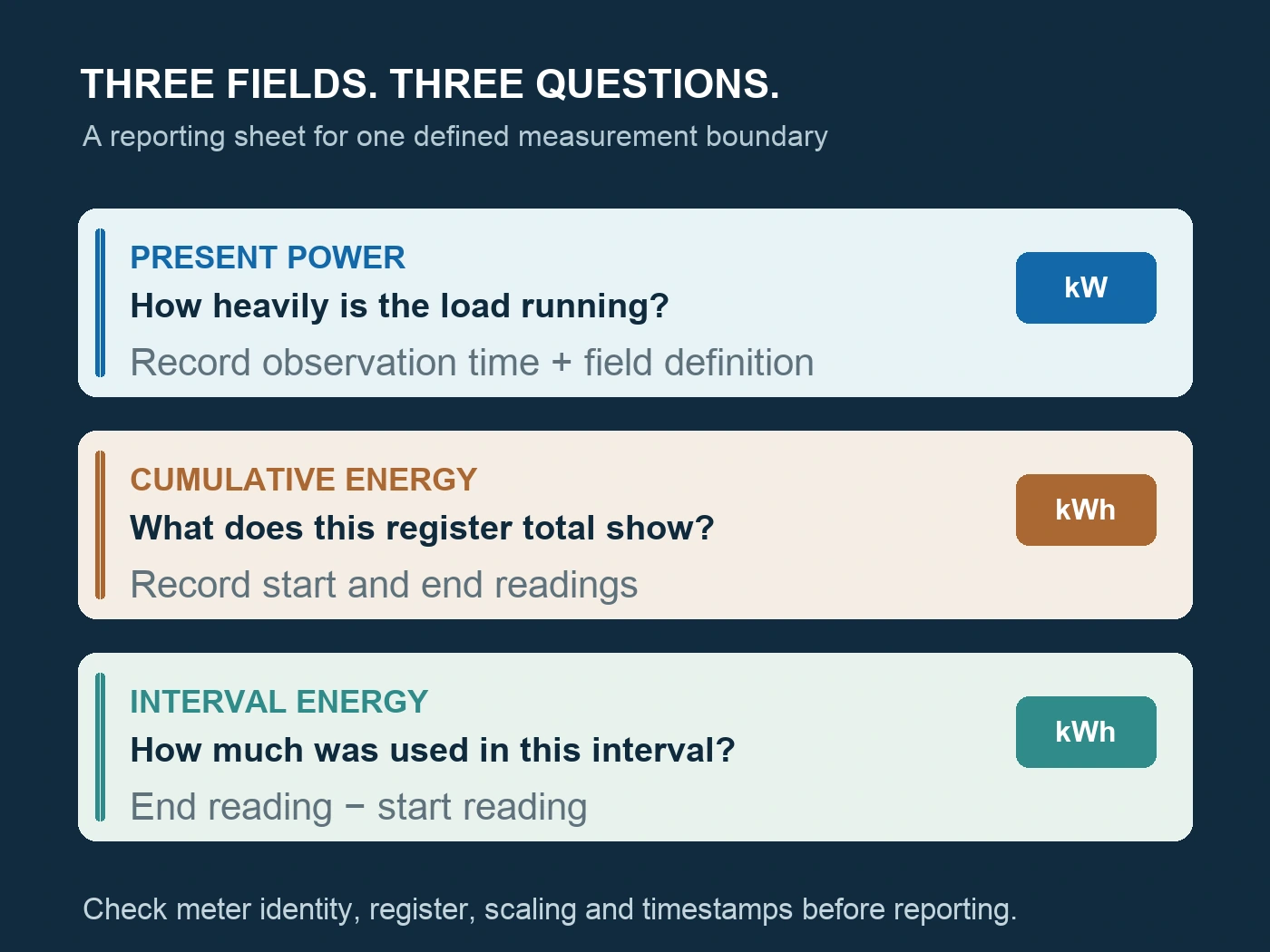
For a basic production shift, document the meter identity, what circuits it covers, the exact cumulative energy register, and the start and end timestamps. Read the register at both boundaries. Subtract the start reading from the end reading only after confirming the same unit and scaling, no reset, and a continuous measurement period. The difference is the reported kWh for that boundary and interval. Record any meter replacement, outage, clock adjustment or missing sample rather than hiding it in a calculation.
If the goal is to understand when energy use occurred, retain interval readings, not just the daily total. If the goal is to understand how heavily the feeder was loaded at a particular event, record an appropriately defined power or demand value at that time. A four-hour total of 16 kWh cannot tell whether the load was steady at 4 kW or varied like the example above. The same total can result from many different power profiles.
A compact field sheet can include: meter and circuit name; energy-register identifier and unit; start and end value/time; computed delta; any ratio or platform scaling; relevant power field and its sampling/averaging definition; and an exception note. This is a reporting aid, not a substitute for the meter manual or the site's metering procedure. It helps the next reviewer reproduce the arithmetic and see where the number came from.
Where product selection enters the picture
The physics of kW and kWh do not tell a buyer which meter to order. Selection still depends on phase and wire arrangement, connection method, voltage and current requirements, measurement functions, installation format and documentation. RITOKS lists the DDS1108 単相 DINレール型電力計 そして、その DTS5158B 三相4線式 DINレール型電力計 as different product families [2,4]. Their published pages do not establish that every configuration exposes the same power fields, registers or protocols. Confirm those features for the exact configuration before specifying a reporting workflow.
For procurement, send a short sample of the fields you need: cumulative energy, any required present or interval power value, the required communication interface if remote logging is needed, and the desired phase/wire and connection method. Ask for the exact model's display list, register list where applicable, wiring diagram and scaling instructions. Avoid assuming that an LCD, a “multifunction” label or a current designation proves a particular logging or billing capability. The category overview is a starting point; the exact datasheet and project electrical design make the final match.
Common mistakes to catch before publishing a dashboard
- Calling a kW snapshot “energy used.” Add the observation time and report kWh separately for the intended interval.
- Treating a cumulative kWh total as one shift's use. Subtract matching start and end register readings, and check for resets.
- Multiplying one observed kW by a whole shift. Do that only when a defensible constant-power assumption exists; otherwise use interval or energy data.
- Ignoring register direction or scope. State which loads and which import/export field are represented, if supported by the exact meter.
- Using an undocumented multiplier. Verify display, protocol and platform scaling against the exact device documentation.
- Comparing mismatched intervals. Align boundaries and time zones before comparing lines, shifts or sites.
- Inferring a product function from its family name. Request the exact model's measurement and communication evidence.
These checks prevent a simple unit mistake from becoming a false efficiency conclusion. They also make a dashboard more actionable: the operator can see both the present loading context and the accumulated energy for a defined production period.
What to ask before the next reading
If the question is “how much electricity did this line use during the last shift?”, request kWh over that shift and a traceable pair of register readings. If the question is “what power level is this circuit carrying now?”, request kW with the meter's update definition and observation time. If the question is “what was the highest interval demand?”, request the meter or billing system's demand field and interval rules. The unit, boundary and time window should travel with every reported number.
For a new submeter installation, write these questions into the equipment request before choosing a display or interface. RITOKS can review the phase, measurement fields, logging needs and documentation required for an exact meter configuration; it cannot infer them from a generic kW-versus-kWh explanation. Clear requirements are the quickest way to turn a useful reading into a reliable specification.
Source notes
- US Energy Information Administration, Measuring electricity: power and energy unit definitions.
- RITOKS, DIN Rail Energy Meter Selection Guide: published families and model-verification limitations.
- US Department of Energy, Understanding Your Electricity Bills: consumption and demand billing concepts.
- RITOKS, DTS5158B product page: three-phase four-wire family and published scope.