
Power Distribution Blocks for Control Panels · Technical Explainer
One or Two Wires per Distribution Port? Check the Clamp Approval
Quick answer
Two conductors should share a distribution-block port only when the exact terminal documentation permits that combination. A port large enough to accept them, a screw that feels tight or a total conductor area within a listed range is not sufficient evidence. Check the conductor count, construction, sizes, preparation and applicable connection instruction together.
If the documentation only gives a conductor cross-section range, do not turn that range into an unverified two-wire allowance. Request the missing connection data or redesign the branch arrangement around documented separate ports. This is a manufacturing-document decision, not a test of whether two wires can physically be pushed into a hole.
For an assembly work instruction, list permitted combinations by port type and exact block model. Make any unresolved combination visible before production rather than leaving operators to decide at the bench.
Distinguish a port from a distribution function
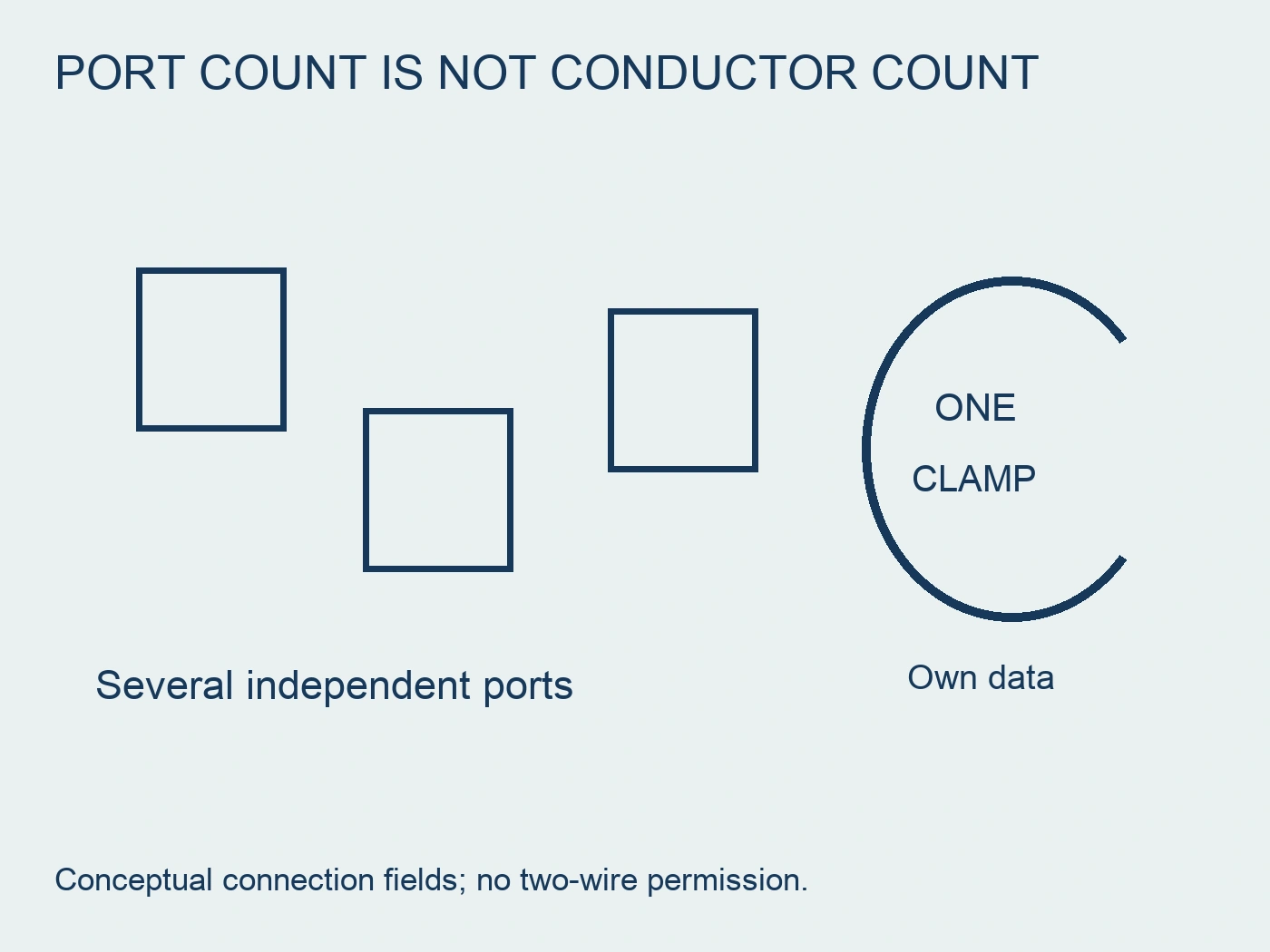
A distribution block connects several branch circuits to a common electrical point, but that does not mean every individual clamping unit accepts multiple conductors. The number of available outputs and the permitted conductors within each output are separate specifications.
| 질문 | Relevant evidence | Inadequate substitute |
|---|---|---|
| How many branch connections exist? | Exact model's port arrangement | Overall current rating |
| How many conductors may share one port? | Explicit terminal connection allowance | The hole looks large enough |
| Which conductors may be combined? | Count, sizes, construction and preparation | Their areas add up to a listed size |
| How is the connection assembled? | Model-specific strip length and tightening instruction | The usual workshop practice |
| Is the completed connection acceptable? | Approved inspection criteria and assembly record | A screw feels tight |
The practical result is a clearer wiring schedule. Identify the incoming port separately from the branch ports, and distinguish different branch-port sizes when the model includes them. Do not copy an allowance for one connection into every other connection on the block.
Also distinguish a multi-port block from a multi-conductor terminal. Several ports connected to one potential can provide separate clamping points. A terminal explicitly documented for a particular shared connection can provide a different arrangement. Select the architecture that matches the required wiring instead of treating the two as interchangeable.
Read the conductor combination, not just the largest size
Conductor construction matters. A rigid conductor, a flexible conductor and a flexible conductor with a ferrule are not automatically interchangeable connection cases. A ferrule without a plastic sleeve and a ferrule with one may also have separately listed ranges. The permitted combination must match what the production instruction actually calls for.
Phoenix Contact's official PTFIX 10/18X4-G BU product data illustrates this level of detail. It lists separate line and load connection data and explicitly identifies a particular two-conductor case using equal cross-sections and a TWIN ferrule. That is a model-specific connection allowance, not a rule for UKK blocks or for every ferrule. Phoenix Contact, PTFIX 10/18X4-G BU, 3274034.
The lesson is how to read a connection table. The phrase permitting two conductors is part of the specification; it should not be inferred from a nearby single-conductor range. Retain the qualifiers along with the size limits when transcribing the information into a work instruction.
Different-size conductors deserve particular attention. An allowance for two equal-size conductors does not establish an allowance for unequal sizes. Likewise, a permitted ferruled combination does not establish that two bare stranded conductors are acceptable. If the proposed combination differs from the documented case, it remains unresolved.
What the UKK family information establishes
그 RITOKS UKK power distribution block family presents model-specific incoming and branch conductor ranges, output counts, a transparent cover and mounting options. Those data are useful for selecting a candidate block and planning the branch arrangement.
The public table does not explicitly approve two independent conductors in one clamping port. Its notation describing multiple outputs is not permission to place multiple wires under one clamp. Keep the output count separate from the shared-port connection question.
For a quotation, send the exact UKK model and a port-by-port conductor schedule. If a shared-port connection is proposed, identify both conductors, their cross-sections, construction and termination method. Ask for the applicable manufacturer connection allowance and assembly instructions before putting that combination into production.
Do not treat supplier voltage wording or the block's rated current as evidence of a particular conductor combination. Electrical ratings and connection allowances answer different questions. A current rating does not independently establish whether one clamp can retain and connect the proposed pair.
Ferrules do not create an automatic exception
A twin ferrule can be part of a documented connection method, but its presence does not automatically authorize any two-wire combination. The block, ferrule and preparation method must support the selected conductors and the intended terminal connection.
Record the ferrule reference and applicable tool or preparation instruction where that is part of the approved process. A production description saying only “use ferrule” can hide a change in barrel size, sleeve shape or conductor combination. The assembly process should identify the relevant details without relying on an operator's interpretation.
Do not assume that a ferrule's nominal size can be substituted into a terminal's conductor range as if every construction were identical. Read the terminal's ferruled-conductor data and any shared-connection qualification. If the evidence does not describe the proposed case, request clarification.
The same principle applies to other conductor-end treatments. A workshop preference or a convenient fitting method is not a connection allowance. Avoid introducing an undocumented treatment merely to make two wires fit the available space.
Convert the allowance into a production limit
Once the supplier has confirmed an exact combination, transfer it into a controlled work instruction. Identify the block order code, the port or port group, the permitted conductor case and the source document revision. Do not summarize a qualified allowance as “two wires allowed” without its conditions.
| Work-instruction field | Entry required | Question for quality review |
|---|---|---|
| Block identity | Order code and document revision | Does it match the purchased component? |
| Port identity | Input or specific output group | Is the allowance assigned to the right clamp? |
| Conductor count | Documented number per clamp | Was it explicitly allowed? |
| Conductor construction | Rigid, flexible or specified termination | Does production use that construction? |
| Combined arrangement | Exact permitted sizes and preparation | Were qualifiers retained? |
| Assembly instruction | Applicable strip and tightening data | Was another model's instruction copied? |
| Inspection record | Approved criteria and responsible check | Does the evidence cover the actual connection? |
| Unresolved item | Missing permission or instruction | Is manufacture held or the design revised? |
The table should be practical enough for purchasing and production to use together. If the design requires a connection that has not been documented, purchasing should know that before substituting a component. If a substitute is proposed, the same connection review applies to its own order code.
An inspection plan should verify conformity to the approved instruction. It should not use an improvised pull or tightening check to declare an undocumented combination suitable. Qualification and production inspection serve different purposes.
The port schedule should also preserve branch identity. If two branches share a documented connection, record both circuit references at that point and consider the maintenance implications within the approved panel design. Removing or replacing one conductor must not be treated as an unrelated operation when another branch shares its clamp. The applicable isolation and reassembly procedure determines how the work is controlled. Clear identification helps the technician see the arrangement before work starts and helps quality staff compare the completed wiring with the approved drawing.

Review a shared-port proposal without guessing
Consider a fictional panel where two branch wires are assigned to one output because the chosen block has no spare ports. The design note says their combined area is below the published maximum. That observation does not establish a permitted two-conductor connection.
The reviewer should ask for the exact clamp allowance and conductor preparation data. If the manufacturer confirms the proposed combination with applicable conditions, those conditions can become part of the controlled work instruction. If the allowance is not documented, consider a suitable block with additional independent outputs or another documented distribution arrangement.
The appropriate outcome is an evidence-based design decision, not an assertion that the pair is safe because another panel used it. This example supplies no approved UKK two-wire combination and describes no actual RITOKS installation.
It also shows why the issue should be resolved before assembly. A late discovery that a shared port is unsupported can require wiring and component changes. A port schedule makes the connection requirement visible while the design is still easy to revise.
Keep substitutions and later additions controlled
A later additional branch should trigger a connection review rather than automatically occupy an existing clamp. Preserve the original conductor schedule and update it when the wiring changes. A spare-looking space inside a terminal is not a documented expansion provision.
Replacement blocks also need their own connection data. Similar appearance, current rating or external dimensions do not establish identical clamp allowances. Ask purchasing to retain the exact technical information behind any substitution approval.
For maintenance, keep the approved port schedule with the panel documentation. It helps distinguish an original qualified arrangement from an undocumented later addition. Electrical inspection and rework must follow the site's qualified procedures; this article supplies the document boundary, not a live retermination method.
자주 묻는 질문
Can two conductor areas simply be added together?
Not as proof of permission. A listed single-conductor size does not establish a two-conductor allowance. The exact terminal data must describe the proposed count and combination.
Does using a twin ferrule make every clamp suitable?
No. A twin ferrule is part of a connection method only when the terminal and preparation instructions support that method and conductor combination.
Does the UKK output count mean multiple wires per port?
No. The public table describes separate branch outputs and their ranges. It does not establish a shared-clamp allowance for two independent conductors.
What if the supplier cannot provide the allowance?
Keep the proposed connection unresolved and consider a documented arrangement with enough independent ports. Do not convert a missing approval into a workshop assumption.
참고 문헌
- Phoenix Contact. (n.d.). PTFIX 10/18X4-G BU distribution block, 3274034. Line and load connection data. Retrieved October 3, 2026. https://www.phoenixcontact.com/en-us/products/distributor-terminal-block-ptfix-1018x4-g-bu-3274034
- RITOKS. (n.d.). UKK series power distribution blocks. Published model and connection-range scope, checked October 3, 2026. https://ritoks.com/products/ukk-series-power-distribution-blocks-80a-400a/