
AC Surge Protective Devices for Low-Voltage Systems · Technical Explainer
AC SPD Connection Topologies for TT and TN-S Distribution Boards

Quick answer
In a phase-neutral plus N-PE arrangement, the phase branches connect to neutral and a separate surge element connects neutral to protective earth. In a direct-to-PE arrangement, the documented conductor branches connect to protective earth instead. These are different circuits even when both occupy four module positions. TT and TN-S are earthing arrangements, not interchangeable labels for those SPD circuits: select the exact variant whose declared application and connection instructions match the board design.
A request for a "four-pole SPD" leaves several decisions unanswered. Four housings might represent direct conductor-to-PE branches or a phase-to-neutral arrangement with a separate neutral-to-earth element. Neither a photograph nor a Type 2 label resolves that ambiguity. The purchasing team needs a topology statement that matches an approved board drawing.
For purchasing, the immediate task is to separate three decisions: what each surge branch connects, which earthing arrangement the product covers, and how the complete branch fits the board's RCD and external protection. This is a design and procurement review, not a terminal-by-terminal installation instruction. A qualified designer remains responsible for the actual installation under applicable national rules and product instructions.
Confirm the earthing arrangement at the proposed SPD location
Schneider Electric describes TT fault protection using earthed exposed conductive parts and residual current devices. Its TN-S discussion identifies separate neutral and protective conductors. Those distinctions provide context for an SPD review, but they do not establish every permitted SPD location or decide a particular board's protection scheme. Schneider Electric, earthing characteristics.
Start the review with the approved single-line diagram. Ask the designer to identify the incoming earthing arrangement, the neutral and PE bars serving the proposed connection, and any upstream point where a PEN conductor becomes separate N and PE conductors. Do not classify the complete installation from one familiar cabinet label.
A site supplied through a combined conductor arrangement may contain a downstream section with separate N and PE. The quotation should therefore name the connection location, rather than simply say "TN system." For an existing board with uncertain records, obtain the responsible engineer's confirmation before treating a supplier's circuit as a match.
Include any alternative supply mode in that confirmation. Where a generator, transformer or transfer arrangement is present, ask whether the approved earthing and neutral arrangements change with the operating mode. That question does not imply that every transfer system changes topology; it prevents an unexamined assumption from entering the purchase order.
Read protection paths before pole descriptions
Schneider's SPD guidance distinguishes phase-to-neutral differential-mode protection from conductor-to-earth common-mode protection. For TT and TN-S reviews, both deserve attention. Its architecture discussion is a useful starting point, but the selected manufacturer's circuit and declared application determine what an ordered device actually provides. Schneider Electric, SPD characteristics.
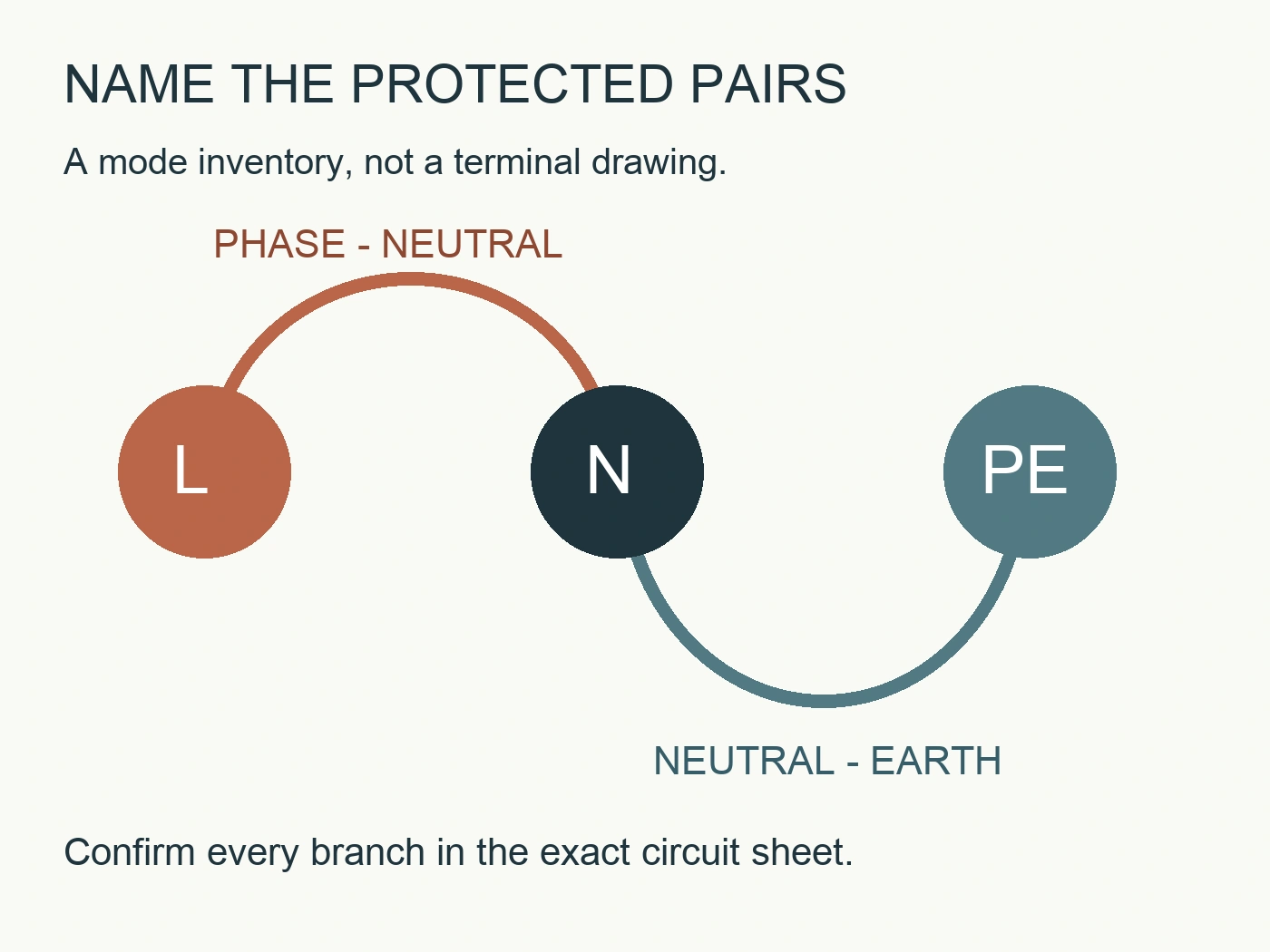
Use a path inventory instead of trying to infer a circuit from the front-panel width. Mark each protected pair on a copy of the manufacturer's circuit drawing. Record which branch contains a voltage-limiting component and which contains a voltage-switching component. Keep the drawing revision with the supplier's response.
| Topology description | Paths to identify in the drawing | Procurement question |
|---|---|---|
| Single-phase phase-neutral plus N-PE | L-N branch and separate N-PE branch | Does the quoted variant document this arrangement and the intended earthing system? |
| Three-phase phase-neutral plus N-PE | L1-N, L2-N and L3-N branches plus N-PE | Is the complete assembly specified, rather than an assumed combination of individual modules? |
| Direct conductor-to-PE arrangement | Individual phase-PE branches and, where provided, N-PE | What modes and system applications does the manufacturer declare for this exact circuit? |
| Unexplained "2P" or "4P" label | Not yet established | Can the supplier provide the actual circuit before the quotation is accepted? |
The table is a document-review aid, not an installation schematic. Labels such as 1+1, 3+1, 1+NPE and 3+NPE should be interpreted against the corresponding product drawing. Do not impose one vendor's naming convention on another vendor's offer.
TN-S does not create a universal ban on 4+0 arrangements. DEHN's current modular family explicitly includes a TN-S 4+0 configuration and a TT/TN-S 3+1 configuration. That manufacturer example disproves the shortcut "every TN-S board must use 3+1," without approving either circuit for an unrelated product or project. DEHN, DEHNguard modular.
Review the N-PE element as a separate function
A neutral-to-earth surge element is not a permanent neutral-to-earth jumper. Schneider's component explanation distinguishes voltage-switching GDT or spark-gap technology from voltage-limiting zinc-oxide varistors. It gives a manufacturer example combining phase-neutral varistors with a neutral-earth gas discharge tube. The exact implementation still requires the selected product's documentation. Schneider Electric, SPD components.
Ask for the N-PE branch's technical sheet separately when the main catalogue collapses all paths into one headline rating. The RFQ should identify the branch technology and require its declared operating and protection characteristics. Where the documentation uses different values for different modes, preserve those distinctions in the comparison sheet.
Avoid a casual instruction to "bond N to PE through the SPD." That phrase can confuse a surge branch with the installation's normal bonding arrangement. State that the supplier must confirm the complete SPD circuit for the designer's approved scheme. Leave bonding design and verification with the qualified professional.
Also distinguish an SPD's internal disconnection function from the board's other protective devices. Schneider describes internal thermal protection, end-of-life indication and external short-circuit protection as separate functions. A status flag therefore cannot substitute for a confirmed backup-protection arrangement. Schneider Electric, SPD components.
For a replacement, request confirmation that the proposed plug-in module belongs to the installed base and topology. A module with a similar outline or voltage marking is not an adequate replacement specification. Record the manufacturer's accepted replacement reference and any restrictions instead of leaving the installer to judge appearance.
Worked comparison: two four-position offers are not equivalent
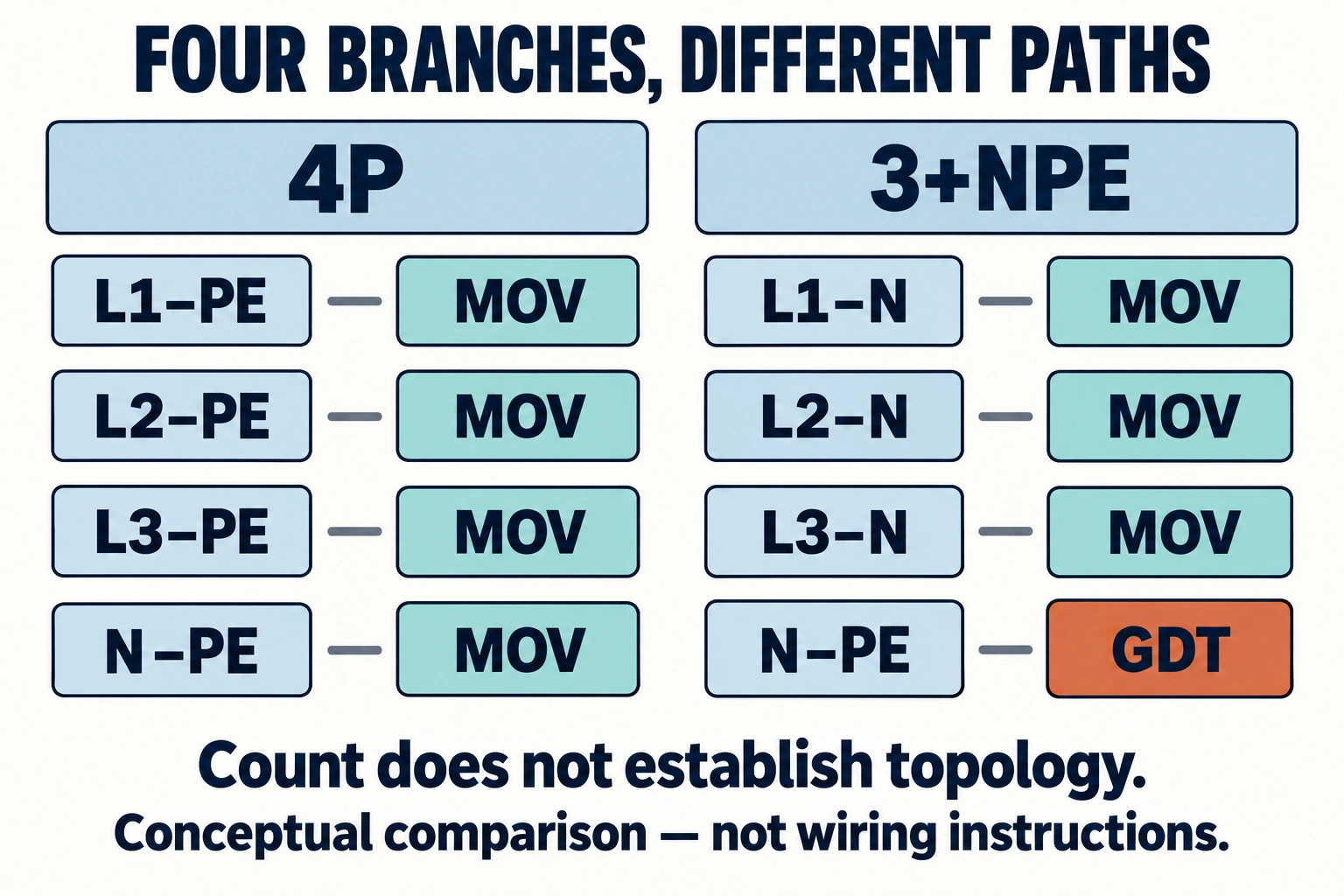
Consider an illustrative purchasing exercise using the published GSP10-C40N family configuration table. It is a reading example, not a recommendation for a particular board. The two candidates are the documented 4P and 3+NPE arrangements; no current, voltage or certification value is assumed. Their similar front-panel scale makes the distinction easy to miss if the quotation contains only a product photograph.
| 비교 필드 | Published 4P arrangement | Published 3+NPE arrangement | Effect on the comparison |
|---|---|---|---|
| Phase branches | L1-PE, L2-PE and L3-PE MOV paths | L1-N, L2-N and L3-N MOV paths | The phase branches have different endpoints; the circuit sheets cannot be substituted. |
| Neutral branch | N-PE MOV path | Separate N-PE GDT path | The technology differs even though both descriptions contain N-PE. |
| Branch inventory | Four listed conductor-to-PE paths | Three listed phase-to-N paths plus one N-PE path | Counting four branches does not distinguish the circuit. |
| Board approval | Requires exact-variant instructions and board review | Requires exact-variant instructions and board review | Neither column establishes blanket TT or TN-S suitability. |
The numerical point is deliberately simple: three phase branches plus one neutral branch give four branches in either inventory, but arithmetic says nothing about their endpoints or component behaviour. The useful information is the ordered pair of conductors and the branch technology. Keep those two fields together rather than comparing an isolated pole count.
Suppose the approved design calls for phase-neutral branches and a separate N-PE switching element. Candidate 4P does not describe that requested circuit, so its lower price would not make the quotations like-for-like. Candidate 3+NPE matches the requested path description at family-table level, but still needs the exact orderable variant, instructions and protection conditions before approval. Conversely, if the design specifies a permitted direct-to-PE arrangement, a sales description saying “3+1 is always safer” does not justify replacing that design without assessment.
This example also explains why Type classification should have its own comparison column. A Type 2 label describes the SPD classification; it does not tell purchasing whether a phase branch terminates at N or PE. Likewise, a documented Type 1+2 single-phase product does not become a three-phase assembly by using its family name in the same spreadsheet. The result of the comparison is an accurately described candidate, not a completed protection design. RITOKS, GSP10-C40N configuration table.
Treat the RCD relationship as an approval question
An AC SPD topology review should record whether the proposed surge branch is upstream or downstream of each relevant RCD. Neither position should be approved through a blanket rule copied from an unrelated product. For TT boards in particular, the designer must review fault protection alongside the exact SPD instructions and applicable installation requirements.
The useful purchasing question is not "which side is always faster or better?" Ask the engineer to mark the proposed branch and the relevant RCDs on the single-line diagram. Then request written confirmation of the accepted arrangement from the selected supplier where its instructions require clarification.
Separate the concerns in that request. Normal-operation leakage, surge-current behaviour and an SPD failure condition are different subjects. An answer about nuisance tripping alone does not establish the installation's fault-protection performance. Likewise, an earthing-system label alone does not identify the RCD model or the conditions covered by its documentation.
If a vendor replies only "suitable for TT," return a focused question: "Does your connection instruction cover this proposed position relative to the shown RCD, with the stated backup protection?" Attach the controlled drawing. Do not ask the supplier to approve an unspecified board, and do not silently substitute a different RCD to make the SPD proposal appear acceptable.
IEC 60364 references in manufacturer educational guides are research signposts, not evidence that a particular assembly complies with every current national adoption. This article does not reproduce the full normative text or claim to have completed a compliance assessment.
Keep topology approval separate from physical layout
Schneider's connection guidance explains that conductor arrangement affects installed protection, so a device's intrinsic protection level is not the whole assembly result. It also identifies conductor duty and short-circuit withstand as design checks. A topology that is acceptable on paper still needs a reviewed physical arrangement. Schneider Electric, SPD connection.
After the circuit has been accepted, ask for a board-layout review that identifies the actual connection route and the relevant earth terminal location. Require the designer to consider the chosen enclosure and assembly construction. Avoid promising the catalogue protection level at equipment terminals without that review.
A useful procurement boundary is to separate supplied equipment from installation materials. Confirm whether the offer includes a prewired SPD assembly, a base with modules, a remote indication contact, or only individual devices. Identify any external protective device and connection accessories as explicit items or exclusions. A photo of a complete cabinet should not imply that every visible part is included.
Do not select a backup MCB or fuse solely by matching physical size. Obtain the manufacturer's coordination requirements and let the designer check them against the available board data. Keep any unresolved item open on the comparison sheet rather than filling it with a familiar stock component.
Build a topology-specific evidence request
A useful AC SPD RFQ joins the proposed circuit to the actual orderable variant. Require the earthing-system confirmation, controlled board drawing and manufacturer connection instruction to identify the same location and configuration. A quotation remains a candidate when any of those documents describes a different circuit or leaves the N-PE path unexplained.
| Evidence requested | What the reviewer should establish | Reason to keep approval open |
|---|---|---|
| Board single-line diagram | Earthing scheme and proposed SPD/RCD positions | Supply arrangement or connection location is uncertain |
| Exact variant and circuit sheet | Protected conductor pairs and component arrangement | Only a family title or pole count is supplied |
| Mode-specific technical data | Characteristics assigned to the documented paths | One headline value is applied to every branch |
| Installation instruction | Conditions covering the proposed arrangement | A generic brochure replaces model-specific instructions |
| Backup-protection information | Required external protection and coordination basis | An assumed fuse or breaker has no supporting document |
| Supply and replacement scope | Included base, modules and approved replacements | Interchangeability is inferred from appearance |
Keep the commercial comparison short enough to use. One row per proposed variant is more helpful than a catalogue containing every SPD family. The review record should name the document revision, the unresolved question and the person responsible for closing it. Price comparison can then use offers with an equivalent documented scope.
For RITOKS sourcing, begin with the existing AC surge protective device family and request the configuration sheet for the proposed item. The GSP10-C40N Type 2 family presents several path arrangements; its family-level options should not be treated as interchangeable board approvals.
발행된 BR-12.5M Type 1+2 page documents a 1P+N configuration. Do not infer a three-phase assembly from that family title. Type classification and topology are separate fields in the RFQ, so carry both through the supplier comparison.
Close the review with a defined configuration
Approve a clearly identified SPD variant against a controlled board drawing and an accepted manufacturer instruction, not a general claim that an SPD "fits TT or TN-S." Record the N-PE path, RCD relationship and external protection scope before ordering. That record gives purchasing, assembly and maintenance the same configuration to work from.
참고 문헌
- Schneider Electric. (2026). Characteristics of TT, TN and IT systems. Electrical Installation Guide.
- Schneider Electric. (2026). Common characteristics of SPDs according to the installation characteristics. Electrical Installation Guide.
- Schneider Electric. (2026). The components of a SPD. Electrical Installation Guide.
- Schneider Electric. (2026). Connection of Surge Protection Device. Electrical Installation Guide.
- DEHN. (n.d.). DEHNguard modular. Retrieved October 2, 2026. Manufacturer product configurations are examples, not RITOKS ratings.