
캐비닛 냉각 팬 · 기술 해설
Fan Bearing Choice: Check Mounting Orientation and Ambient Temperature

Quick answer
Choose a cabinet fan bearing from the exact fan's permitted mounting orientation, temperature conditions and documented life basis. A ball-bearing label is not a guaranteed operating lifetime, and an oil-bearing label does not describe every permitted installation. Compare complete fan versions using the conditions attached to their evidence, not a universal claim that one bearing lasts a fixed multiple of another.
Record the shaft orientation clearly, identify the air temperature experienced by the installed fan and request the manufacturer's applicable life information. Keep operating limits separate from life estimates. A fan may be within its permitted temperature range while still requiring a different maintenance plan from the one suggested by a catalogue life figure measured under other conditions.
Define orientation using the shaft, not a vague panel label
Descriptions such as horizontal fan or vertical mounting can be ambiguous. They may refer to the frame, panel or shaft. Put an orientation sketch in the specification showing the shaft direction and airflow direction relative to gravity. Ask the supplier to confirm the exact version's permitted position using that sketch.
SANYO DENKI AMERICA's bearing comparison identifies mounting orientation as a selection input and discusses the effect of orientation on conventional sleeve-bearing designs. It also describes its ball-bearing arrangement. That guidance makes orientation a necessary question; it is not permission to declare every fan with a similar bearing label suitable for every position (Masessa, 2024).
Use exact manufacturer terminology for the offered construction. A supplier-listed oil bearing should not automatically be relabelled as a particular sleeve, fluid-dynamic or proprietary bearing technology. Obtain its definition and instructions before applying a comparison intended for another design. Likewise, do not infer the internal arrangement from an image of the fan frame.
Orientation review does not replace mounting review. Confirm the fan drawing, permitted fastening and surrounding clearances through the applicable instructions. Do not change the cabinet arrangement solely to satisfy a guessed bearing rule when the resulting airflow or equipment layout has not been reviewed.
Establish the temperature seen by the installed fan
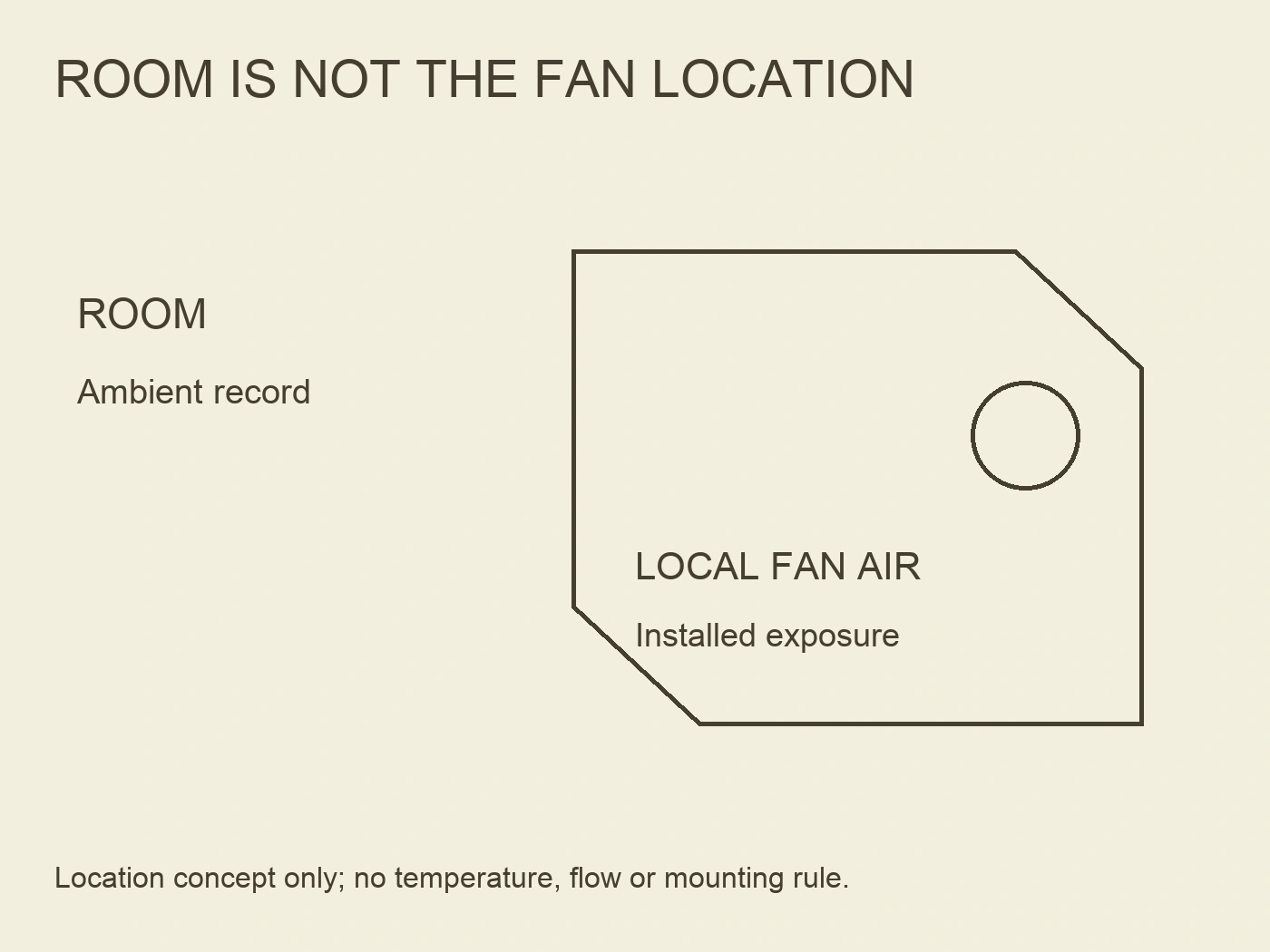
The fan's local environment can differ from room temperature. Identify where it sits in the cooling path and which operating cases determine the air around it. A fan near warm exhaust needs an assessment for that location, not only the room thermometer value used in a purchasing spreadsheet.
Separate the temperature limits from the temperature used for a life claim. The operating range tells the reviewer where the specified fan may operate under its documented conditions. A life curve or estimate describes a different question: expected deterioration over time under stated assumptions. Passing the range check does not make every point in that range equivalent for service planning.
Oriental Motor's cooling-fan service-life discussion explains the importance of bearing grease deterioration and distinguishes estimated life from expected life. Its example derives a life characteristic from measured bearing temperature rise at rated voltage. Those are useful evidence categories, not a formula or thermal correction automatically applicable to another manufacturer's cabinet fan (Oriental Motor, n.d.).
Do not derive a generic doubling or halving rule from an example curve. Use the selected model's data and the manufacturer's permitted interpretation. If relevant local temperature or duty information is unavailable, mark the life comparison as incomplete rather than extending a familiar value to an unmeasured installation.
| Installed-condition field | Record to provide | 그것이 왜 중요한가 |
|---|---|---|
| Exact fan version | Model, supply version and bearing description | Ties the assessment to the ordered construction |
| Shaft orientation | Sketch relative to gravity | Removes ambiguity from horizontal or vertical labels |
| Fan location | Intake, exhaust or other position in the cabinet | Identifies the local environment to assess |
| Temperature case | Applicable local conditions and observation basis | Separates room conditions from installed exposure |
| Duty pattern | Continuous operation or documented cycling requirement | Makes the service requirement explicit |
| Access and replacement | Permitted service arrangement and availability needs | Relates life evidence to the practical maintenance task |
This record does not prescribe a universal temperature margin or replacement interval. It identifies the inputs that the project and supplier need to review. Missing inputs are visible questions, not an invitation to assume that a bearing option provides unlimited reserve.
Read what a published life number actually means
Ask whether the number is an estimate, a statistical expected-life value, a minimum under specified conditions or a different metric. Request the failure criterion as well as the hours. A claim based on rotational-speed deterioration is not necessarily the same as a claim based on acoustic behaviour or a complete equipment failure.
Oriental Motor explicitly distinguishes cooling-fan rotation life and sound life, and states that its service-life information is a reference rather than a guarantee. This illustrates why two attractive hour figures may answer different questions. The manufacturer's definitions must stay attached to the values when comparing candidates (Oriental Motor, n.d.).
If the supplier uses an L10 or survival-rate statement, request its definition and test conditions for the offered model. Do not describe a statistical population value as a promise that every unit will run for that duration. Keep MTBF separate unless the manufacturer explains its relationship to the specific wear-out or life assessment; a different reliability metric cannot silently replace missing bearing-life evidence.
Retain the ambient temperature, supply, speed or control conditions and installation assumptions attached to the claim. Ask whether the result represents free-air operation or an installed cooling path. If the conditions differ from the project, seek an applicable interpretation rather than assuming the catalogue value is conservative.
Compare candidates without inventing a life multiplier
A fair comparison uses versions that satisfy the same project requirements and clearly identifies any differences. Matching size alone is insufficient. Supply, speed, blade construction and cooling performance may differ along with the bearing, so a performance change cannot automatically be attributed only to bearing technology.
| 비교 문제 | Candidate evidence needed | Unsupported shortcut |
|---|---|---|
| Is the construction identified? | Exact bearing description for the offered version | Calling every oil bearing the same technology |
| Is the position permitted? | Applicable mounting instruction or confirmation | Treating a generic comparison as exact-model approval |
| Are temperatures comparable? | Same relevant conditions or an explained model-specific basis | Comparing room-temperature data with exhaust exposure |
| Is life defined consistently? | Metric, criterion and stated test conditions | Ranking hours without the definition |
| Is cooling suitability retained? | Complete fan data for the installed design | Assuming a bearing change preserves airflow or noise |
| Can the unit be maintained? | Service access and replacement requirements | Treating a longer estimate as a guarantee of no service |
Where one candidate lacks evidence, report the gap rather than awarding it a lower invented life value. The comparison may conclude that a version needs further information before selection. That is more useful for procurement than a precise-looking ranking built from unrelated manufacturer examples.
Consider the consequences of replacement in the actual installation. Remote access, spare-part identity and permitted maintenance windows can make service planning important, but they do not prove which bearing is best. Use those requirements to ask for suitable evidence and support rather than adding an unverified lifecycle-cost saving to the quotation.

Use the exact RITOKS fan version in the request
그 RITOKS12038 AC axial fan family lists oil-bearing and dual-ball-bearing versions according to the selected SKU. The broader industrial AC axial fan family also identifies bearing options by supplied version. These pages provide a sourcing starting point; they do not publish a universal bearing-life curve or orientation approval for every listed combination.
Send the required version, shaft-orientation sketch, local temperature cases and operating duty with the inquiry. Request model-specific installation instructions and the available life evidence, including its definition and conditions. Keep electrical ratings and the installed cooling requirement in the same review so the bearing choice does not obscure the rest of the fan selection.
If a proposed substitute changes the bearing, voltage, speed or other construction field, identify those changes explicitly. The existing approval should be reviewed for the substituted version rather than carried over because its outer dimensions match. Retain the accepted model identity and documentation with the equipment record for later replacements.
A conditional procurement comparison
In a hypothetical cabinet project, two fan quotations offer the same frame size but different bearing descriptions. One includes a life statement for a stated temperature; the other provides no mounting or life information. The cabinet drawing shows an orientation that has not yet been confirmed for either exact version.
The buyer does not assume a fixed lifetime advantage for the ball-bearing option. It submits the orientation sketch and local temperature requirements, asks for applicable documentation and compares the complete fan versions against the cooling and supply requirements. If one version's evidence supports the installation and service objective, it can proceed through approval. If both remain undocumented, the bearing labels alone do not complete selection.
This example does not report test results or claim a percentage saving. It shows how a missing-condition question becomes a supplier action rather than an invented numerical comparison. A final selection still requires the project's review of the exact offered assembly.
자주 묻는 질문
Does dual ball bearing guarantee a particular service life?
No. The bearing label does not replace the exact fan's life definition, temperature conditions and supporting evidence. Use documented information for the selected version and retain the distinction between a reference estimate and a guarantee.
Is an oil-bearing fan always restricted to one orientation?
Do not assume a universal restriction. Confirm the manufacturer's definition of the offered bearing construction and its permitted shaft position. General sleeve-bearing comparisons cannot establish exact-model approval.
Can I compare life hours quoted at different temperatures?
Not as equivalent figures without an applicable interpretation. Request the selected models' conditions and any supported life curves. This guide supplies no universal conversion or life multiplier.
Does a bearing upgrade preserve the existing cooling performance?
Not automatically. Review the complete offered version, including supply, speed and relevant cooling data. Matching the frame size or changing a bearing label does not prove identical installed performance.
참고 문헌
Masessa, G. (2024, February12). Which is right for you? Ball bearings vs. sleeve bearings. Cooling Fan Technology by SANYO DENKI AMERICA. https://coolingfans.blog/which-is-right-for-you-ball-bearings-vs-sleeve-bearings/
Oriental Motor. (n.d.). Service life: Cooling fans. https://www.orientalmotor.com/support/service-life.html