
Enclosure Air Conditioners for Control Cabinets · Technical Explainer
Enclosure Air Conditioners in Factory Automation Cabinets
An enclosure air conditioner in factory automation is not selected from cabinet size alone. Drives, power supplies, controllers and switching equipment release heat inside a cabinet while the surrounding production area imposes its own temperature, dust and operating schedule. The cooling decision has to protect the actual components within their permitted conditions without compromising the enclosure boundary.
This guide is an application checklist for panel builders, machine OEMs and maintenance teams. It does not assign a capacity to a RITOKS unit or replace the calculation and installation instructions for the exact machine. Build the application record first; then compare candidate cooling units with manufacturer evidence.
Start with the automation cabinet, not the cooling catalog
List every heat-producing device in the cabinet and its operating condition. A variable-speed drive at one operating point may dissipate differently from the same drive during another duty cycle. Include power supplies, transformers, contactors, protective devices, network equipment and any mounted display whose losses contribute inside the sealed volume. Preserve each source and its assumed load case in the design file.
Record cabinet dimensions, wall material, insulation, exposure to adjacent hot machines and the available free space around any proposed cooling-unit mounting face. Note whether the cabinet is a stand-alone enclosure or part of a row of bayed panels. Nearby equipment can raise local ambient temperature above the general factory reading.
Check the most demanding credible operating case rather than a convenient average. A machine may run continuously at production peak, sit idle with controls energized, or be restarted after a hot shutdown. Each condition can change the heat balance and the risk of condensation. State which case controls the design and which cases still need operational checks.
Define the permissible internal temperature
The cabinet setpoint should be justified by the lowest relevant temperature limit among installed components and by their arrangement. A room-temperature target is not automatically necessary, but neither is a generic high setpoint safe for every drive, controller or power supply. Read the component manufacturers' operating and derating instructions.
Place temperature sensors where they represent vulnerable equipment, not only near the cooling unit's return-air inlet. Vertical stratification and obstructed airflow can leave a hot upper region while a controller senses a cooler pocket. If the final acceptance test identifies hot spots, address layout or circulation as well as nominal cooling capacity.
Document the enclosure's required ingress-protection or environmental classification and check how the installed cooling unit, mounting cutout, gaskets and drain arrangement affect it. A cooling unit cannot preserve a sealed cabinet simply because its catalog entry has a protection rating; the assembled installation and service practices matter.
Measure the local factory environment
Ambient temperature is the air the condenser side of the unit actually sees. Measure it at the intended mounting location during representative production, including adjacent exhausts, ovens, sunlit walls or machine heat rejection. A facility's general HVAC setpoint can be misleading when a cabinet is placed in a cramped equipment aisle.
Describe the contamination: dry dust, fibers, oil mist, aerosol, water spray or corrosive residues are not interchangeable. They create different filter, coil-cleaning and material requirements. Schneider Electric's cooling-unit instructions explicitly distinguish filter-maintenance conditions; a clean office assumption should not be transferred to a production line.
Check that the external air inlet and outlet can remain unobstructed after installation. A cooling unit rejected into a narrow gap or enclosed recess can recirculate warm exhaust and lose usable performance. A supplier capacity figure should be read at its stated ambient and internal conditions, with the specified clearance.
Calculate the heat balance for the application
Separate internal component losses from heat entering through cabinet surfaces and from any process heat source connected to the cabinet. Panel dimensions, material, indoor ambient and target internal temperature affect surface transfer. Use a documented thermal calculation method and the product's capacity curve at the actual design point. Do not equate electrical input power with net cooling output.
Rittal's selection material names component heat losses, ambient pollution, required protection category and installation ventilation as relevant inputs. Those are useful headings for a procurement worksheet, not substitute values. If a drive's losses are unavailable, request them or retain an unresolved input instead of inventing a percentage.
Check both peak and part-load operation. Excessive cycling can be an operational concern, while an undersized unit can run continuously without reaching the target under peak heat. The selected controller and installation should be reviewed against the machine's duty schedule and the manufacturer's permitted operating envelope.
Plan internal airflow and mounting
The cooled air must reach the equipment that needs it, and warm return air must find the unit without short-circuiting directly from outlet to inlet. Cable ducts, shelves and dense device rows can block circulation. Reserve the mounting cutout, internal clearances and service access before the panel is fully populated.
Choose side, door or roof mounting only after checking the unit instructions and the cabinet's structural and service constraints. Door mounting adds cable movement and hinge loading; side mounting may conflict with an adjacent cabinet; roof mounting affects internal airflow and clearance. The exact unit may not support every orientation.
Schneider Electric's ClimaSys installation recommendations discuss intake placement and ambient limits for its own units. They illustrate why orientation and local installation details belong in the technical review. They do not establish corresponding limits for RITOKS equipment; obtain those from the exact RITOKS model documentation.
Treat condensate and maintenance as design inputs
Cooling below the air's dew point can produce condensate. Determine where it drains or evaporates, whether a hose is required and what happens if the drain blocks. Keep water away from live terminals, sensitive controls and walkways. Verify the proposed condensate arrangement using the selected unit's instructions.
Describe filter access and cleaning intervals appropriate to the site contamination. A clogged external circuit can reduce cooling performance, but opening a dirty cabinet during service can also defeat its environmental protection. Leave space to remove filters, clean coils and inspect seals without dismantling the machine.
Define monitoring and alarm response. The machine team should know whether the cooling controller exposes a fault contact, temperature alarm or communication option for the exact model, and what the automation system will do on failure. Do not assume those functions exist across a whole product family.
A practical request-for-quotation record
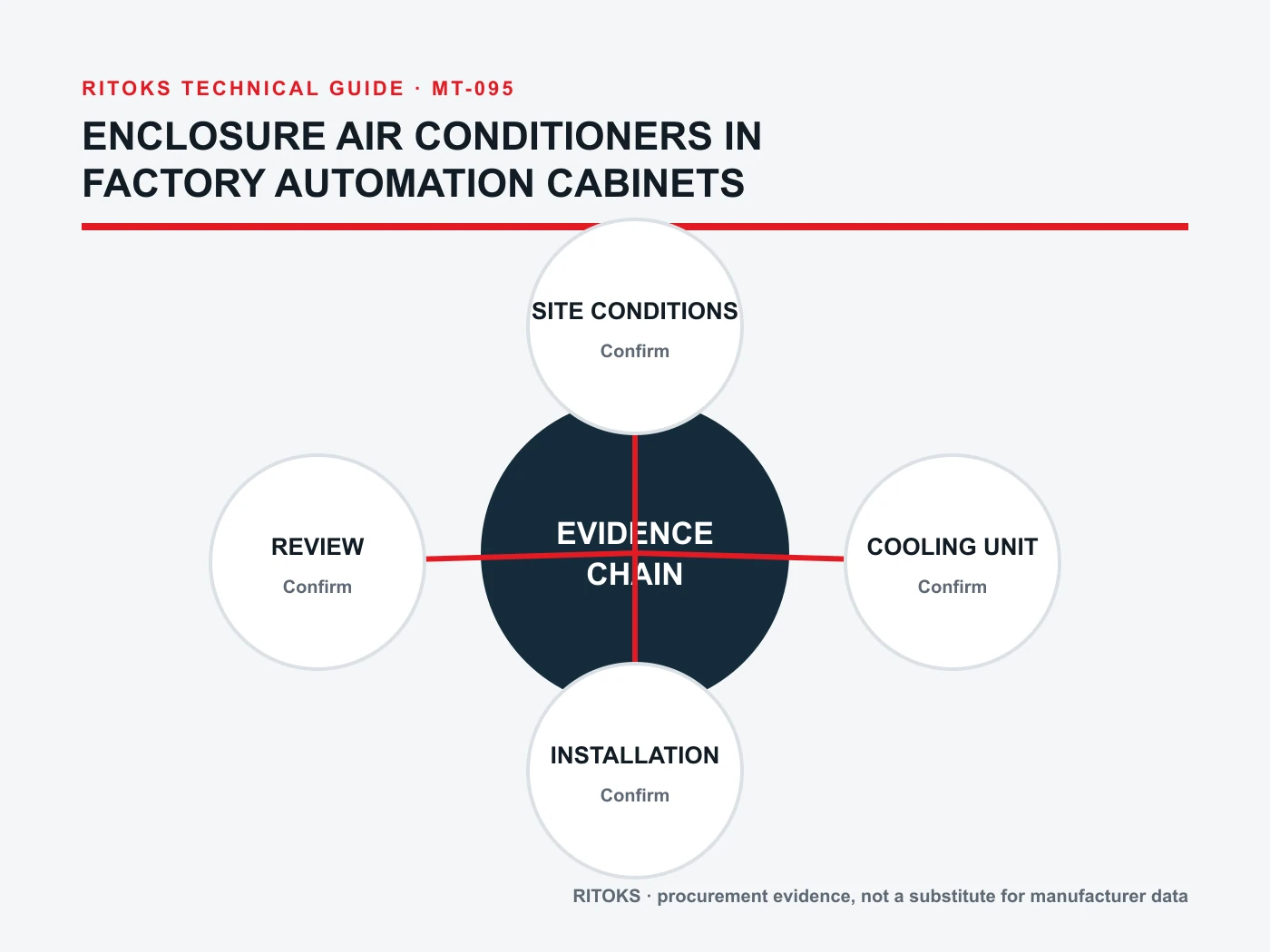
| 입력 | Project record | 요청할 증거 |
|---|---|---|
| Heat | Device loss list and duty case | Capacity at design conditions |
| 환경 | Local ambient and contamination | Permitted ambient and filter guidance |
| 내각 | Dimensions, sealing and mounting face | Cutout, gasket and clearance drawings |
| 작전 | Run hours, alarm response, service access | Controller, wiring and maintenance instructions |
| 수분 | Humidity and drain path | Condensate handling instructions |
그 RITOKS enclosure air-conditioner category 그리고 EP-A indoor family are relevant starting points. The family page is not proof that any model satisfies the heat balance, local contamination or mounting arrangement. Send the completed application record to RITOKS and ask for the exact model's performance and installation data.
For a factory rollout, document one representative cabinet and verify it under a realistic production cycle before copying the selection to every machine. Cabinets may differ in drive loading, adjacent heat, door opening frequency and maintenance access. A common enclosure size does not guarantee a common thermal duty.
Validate the first installed cabinet
Before copying a cooling-unit choice into a machine series, monitor the first installed cabinet through startup, normal production and the hottest expected operating period available during acceptance. Log cabinet air temperature near critical devices, the cooling controller's status and ambient temperature next to the unit. Include door-open events and alarms in the record. A short no-load shop test may confirm wiring but cannot prove summer production performance.
Check that condensate follows the planned route and that the external air path is not blocked by guards, stored material or adjacent machines. Inspect the mounting seal after installation. If the cabinet still runs hot, compare the measured operating point with the original calculation before replacing the unit: an unexpected heat source, recirculating exhaust or short-circuited internal airflow can explain the result.
Hand over filter and coil-maintenance instructions with the machine's routine service schedule. Record the accepted setpoint, alarm thresholds and any remote fault wiring. A cooling system that works on commissioning day but has no maintenance ownership can become a hidden cause of drive trips months later.
자주 묻는 질문
Can a larger air conditioner compensate for blocked airflow?
Not reliably. Restricted condenser airflow can undermine the unit, and poor internal circulation can leave hot spots. Correct the installation geometry before relying on a larger nominal capacity.
Is factory dust only a filter issue?
No. It affects cleaning frequency, external heat exchange, cabinet sealing and the service procedure. Record the contaminant type and concentration instead of labeling every plant environment “dusty.”
Can the same model be used on every identical-size cabinet?
Only after comparing device losses, local ambient, duty and mounting conditions. Physical size is one input, not the application verdict.
결론
A factory automation cabinet cooling specification should connect the machine's heat sources, local environment, operating schedule and service constraints to exact unit evidence. That record makes an RFQ useful and gives the commissioning team measurable conditions to confirm, instead of treating catalog capacity as a complete solution.