
Enclosure Heaters for Control Cabinets · Technical Explainer
Enclosure Heater Power Consumption: Inputs for an Operating-Cost Estimate
“How much electricity will this enclosure heater use?” cannot be answered from the wattage on a product title alone. Nameplate or rated power is one input. Actual energy use depends on how long the heater is energized, its control method and the conditions in the cabinet. A thermostat may cycle it; a self-regulating element may draw power differently as it warms; a continuously energized resistance unit may run for a different duration. The buyer needs an estimate framework with stated assumptions, followed by measured or model-specific evidence where the cost matters.
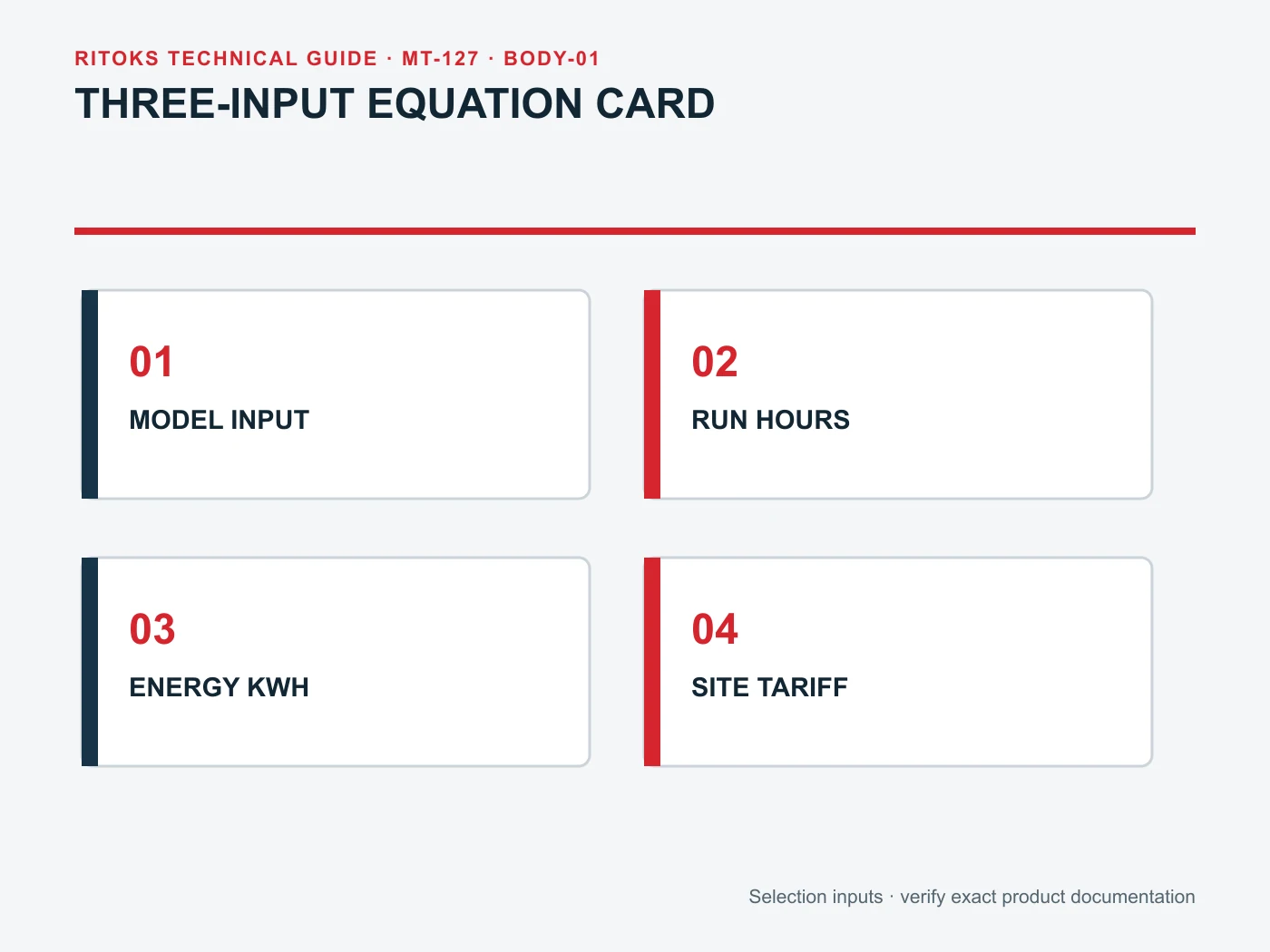
The simple accounting relationship is energy in kilowatt-hours equals average electrical power in kilowatts multiplied by operating hours. Cost then equals kilowatt-hours multiplied by the applicable electricity price. Those formulas are useful, but the hard part is choosing defensible values for power and hours. A catalog range such as “15 W to 150 W” is a list of potential products, not the power of the selected heater and not a forecast of annual consumption. This guide shows how to construct the input sheet without inventing a duty cycle or promising savings.
Start with the exact selected heater
그 RITOKS JRQ enclosure-heater family is listed under 인클로저 히터. The family title spans multiple heater capacities. A buyer should identify the exact model and obtain its supply, rated input, heating technology and installation/control details before calculating anything. Do not average the endpoints of a product-family range or treat the highest capacity as the normal power of every option. If the supplier publishes a heating-output figure and an electrical-input figure separately, use the electrical input for energy calculations and do not assume they are interchangeable.
Power can also vary with operating state. Rittal's product literature describes different enclosure-heater formats, including heaters with fans, and STEGO documents PTC heaters and thermostatic control. These manufacturer sources establish that technology and control architecture differ among products; they do not provide RITOKS JRQ consumption data. Ask for the exact JRQ model's electrical data rather than borrowing a third-party curve. If startup current, temperature-dependent input or fan consumption matters to the estimate, request the supplier's datasheet and test conditions.
Separate installed power from average power
Installed power is useful for supply and circuit planning. Energy billing, however, depends on average electrical input over time. A nominally 100 W heater that runs only part of an interval does not consume 100 W continuously during that interval. Conversely, it would be misleading to assume a 20 percent duty cycle without observations or a thermal model. Temperature, ambient weather, cabinet construction, openings, operating heat load and controller setpoint all affect runtime. The average-power value should either come from a documented model and validated duty scenario or from metered operation in a comparable or actual cabinet.
For a simple switched resistance heater, a first estimate can use rated input multiplied by an estimated energized fraction, then by hours. State clearly that the fraction is an assumption. For a self-regulating element or a fan heater, a single nominal power times runtime may not capture the full electrical profile; request its operating-power curve or measure it under the expected conditions. A separate thermostat, relay or fan can add small but real consumption if those devices have their own powered electronics. Include only verified components in the calculation.
Create three scenarios instead of one false-precision number
An early procurement estimate benefits from a low, central and high scenario, each with explicit inputs. The scenarios should reflect plausible control hours and ambient conditions for the specific site, not arbitrary percentages borrowed from another project. A cold outdoor installation and a warm indoor control cabinet may behave very differently. The point is to reveal which assumption drives the total and which unknown needs better evidence.
| 입력 | Low-use scenario | Central scenario | High-use scenario |
|---|---|---|---|
| Exact heater model and supply | Same documented model | Same documented model | Same documented model |
| Electrical input when energized | Supplier-confirmed value or range | Supplier-confirmed value or range | Supplier-confirmed value or range |
| Energized hours or duty fraction | Stated, justified assumption | Stated, justified assumption | Stated, justified assumption |
| Annual operating period | Site-defined | Site-defined | Site-defined |
| Electricity tariff | Contract or utility value | Contract or utility value | Contract or utility value |
| Result | Calculated estimate, not guarantee | Calculated estimate, not guarantee | Calculated estimate, not guarantee |
Avoid presenting a scenario as “the heater's annual cost” unless its conditions are stated beside it. If the energy use will affect a design decision, revise the scenarios once cabinet temperatures or meter data are available. A measured seasonal profile is stronger evidence than an unverified universal duty cycle.
Illustrate the arithmetic without claiming a product result
Suppose a project worksheet contains a hypothetical 0.08 kW electrical input and a measured or deliberately assumed 1,000 energized hours in a year. Multiplying gives 80 kWh. At a hypothetical electricity price of 0.20 currency units per kWh, the arithmetic produces 16 currency units. These values are a worked calculation only; they are not RITOKS heater specifications, a recommended control schedule or a site forecast. Replace every example input with the project's documented values before sharing an operating-cost number with procurement.
For a thermostat-controlled heater, energized hours can be estimated from a controller log, a meter, or a carefully qualified engineering model. A building electricity bill usually cannot isolate one enclosure heater from other loads. If several cabinets share a supply, note whether the estimate is per cabinet or for the fleet. If tariffs vary by time of use, the simple single-price multiplication is insufficient; use the applicable tariff periods. If the business asks for lifetime cost, record the service period and maintenance assumptions separately rather than hiding them in the kWh number.
Control choices change the estimate
A thermostat may prevent unnecessary heating by switching according to cabinet temperature, but the exact benefit cannot be declared without the installation and operating conditions. Its mounting position also affects that result; see where to mount an enclosure heater and thermostat. A hygrostat responds to humidity instead of temperature; its runtime pattern can differ. A PTC element's resistance behavior can differ from a fixed-resistance heater's behavior. Those concepts help frame an RFQ, not rank products by guaranteed annual cost. The chosen setpoint and sensor placement matter as much as the controller type: a sensor near a heater plume may switch earlier than one representing the coldest zone.
Use the control objective to avoid false economy. Reducing operating hours is not beneficial if the cabinet fails its required temperature or condensation-control condition. Conversely, a continuously energized heater is not automatically necessary where a suitable control strategy can meet the design requirement. Ask the panel designer to define the acceptable cabinet condition, then compare energy estimates only among arrangements that meet it. The supplier can provide device data; the engineering team owns the cabinet-level outcome.
Fan heaters and combined systems
A fan heater may include a fan motor or electronic control in addition to the heating element. The electrical input used for cost should account for the complete device in the relevant operating state. If a cabinet also has a filter fan, distinguish its energy from the heater's energy. The fan might operate in a different season or under a different thermostat. Do not net heating and cooling into one unexplained duty factor.
그 cabinet cooling fan selection guide emphasizes that fan performance requires exact-model evidence; a fan's electrical power is not the same as its delivered cooling performance. The same distinction applies to heaters: electrical input is a cost input, while the heating arrangement must be evaluated against the cabinet's thermal objective. The cheapest kWh total is not useful if the selected hardware cannot do the required job.
Data to request before a serious estimate
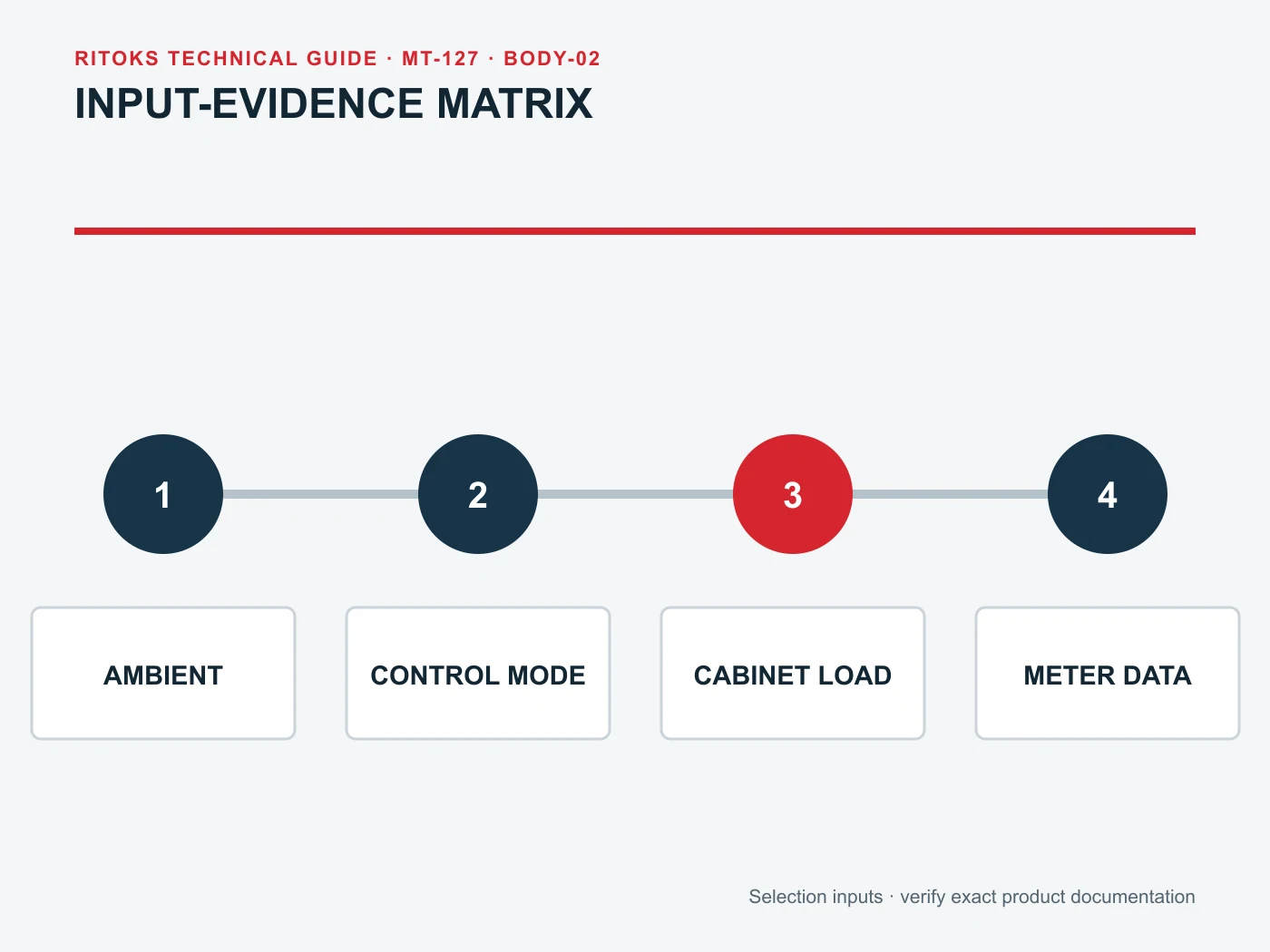
- Exact heater model and its electrical-input data at the relevant voltage and operating conditions.
- Whether the heater uses a fixed resistance, self-regulating PTC element, fan, integrated control or separate external controller.
- Installation orientation and airflow/clearance instructions, because an invalid layout can change behavior or be unsafe.
- Cabinet size, construction, ambient range, installed equipment heat dissipation and idle periods.
- Desired internal temperature or condensation-control objective, controller type, setpoint, differential and sensor position.
- Expected annual operating hours or a way to measure them, plus the actual electricity tariff.
- Any accessory loads, including powered controllers or fans, that must be counted separately.
If the answer to a critical field is “unknown,” mark it unknown. The estimate may still be useful as a sensitivity analysis, but it should not be dressed up as a verified annual cost. A supplier's sales page often has enough information to identify a candidate heater, not enough to model an enclosure in service.
Put the result in an RFQ and later measurement plan
When requesting a quote, send the cabinet and duty information with the required heater capacity and available supply. Ask the supplier to confirm the exact electrical input, control arrangement and any variable-power characteristics for the proposed model. Record the power source for each line of the worksheet. If the project is significant, plan to log heater circuit energy or energized time during commissioning and a representative cold period. That measurement can refine future cabinet designs and procurement assumptions.
An operating-cost estimate is credible when its arithmetic and uncertainty are visible. Use exact-model power, a justified or measured duty profile, a defined time period and a real tariff. The RITOKS enclosure-heater range is a starting point for selecting a device, while the site and controller determine the consumption scenario. No single product-title wattage can answer the whole question.