
Miniature Circuit Breakers (MCB) · Technical Explainer
MCB Derating in Crowded Panels: Ambient Temperature and Grouping
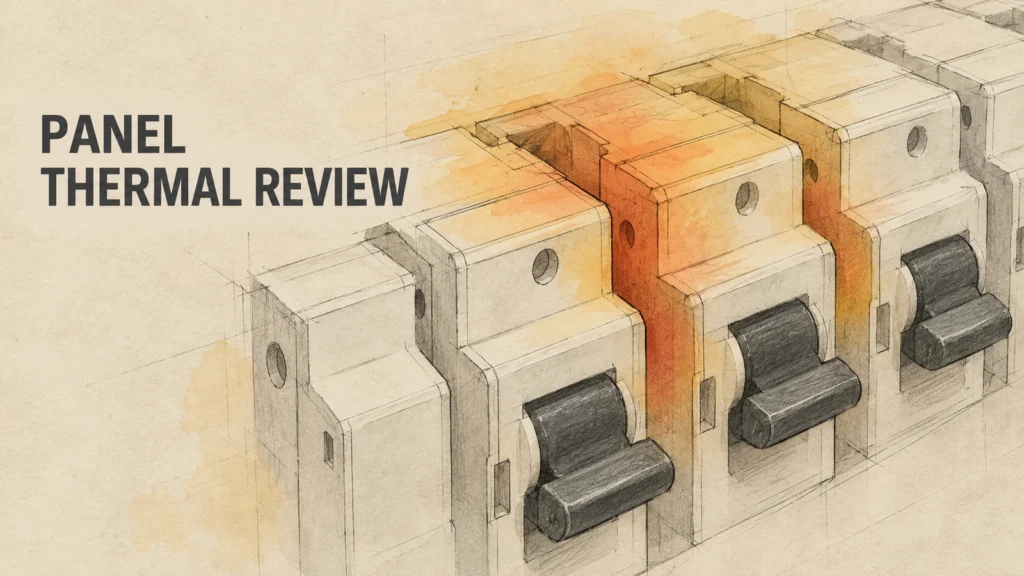
Quick answer
Higher local temperature and heat from loaded neighbors can reduce an MCB's permitted continuous loading under its manufacturer's instructions. Review those conditions inside the completed panel, rather than using room temperature or the breaker label alone. Use exact-series ambient and grouping data, then compare the permitted loading with the circuit duty. If it is insufficient, evaluate a documented device or layout change and repeat the affected protection checks.
A breaker chosen from its front label can be appropriate in one arrangement and need further review in a crowded enclosure. The missing information is often the installation condition rather than the nominal current. A room-temperature reading, an empty panel drawing and a generic correction factor are not substitutes for the selected series' documented thermal conditions.
Schneider Electric's circuit-breaker selection guide explains that surrounding temperature influences uncompensated thermal tripping and that mutual heating can require derating. Its published examples are tied to described devices and conditions. Use them to understand the review method, not to assign their factors to a RITOKS breaker.
Separate ambient temperature from adjacent-device heating
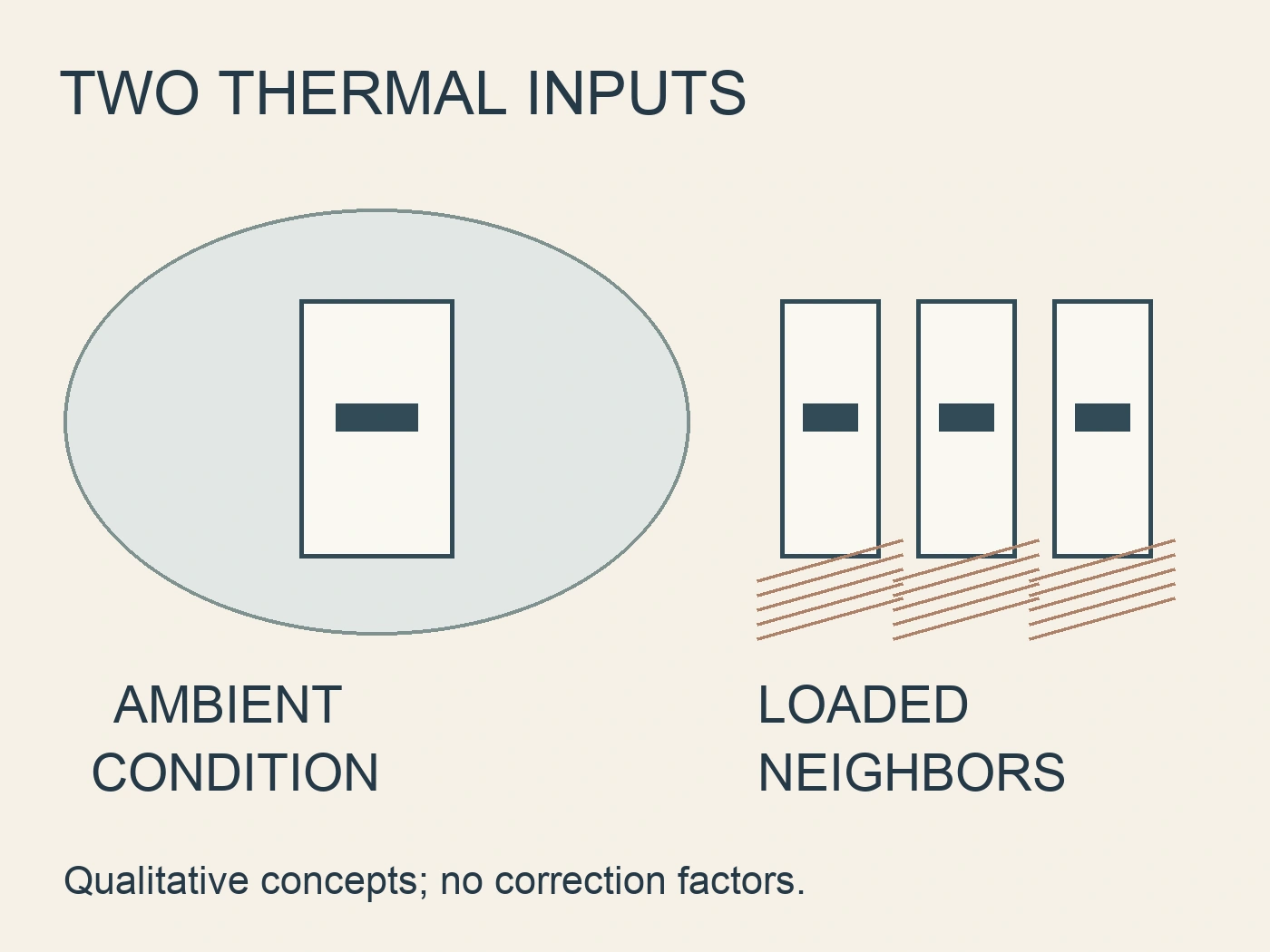
Ambient temperature and grouping describe related but different parts of an installation. The first concerns the conditions around the device; the second concerns its installation beside other devices under the manufacturer's stated loading assumptions. Read the definitions before combining corrections, because a table may already describe a particular arrangement.
Begin with the exact breaker family, pole configuration and selected current rating. Ask for the document that specifies its reference conditions and its loading capability away from those conditions. A stated operating-temperature range is not automatically a table of permissible continuous current throughout that range. Put those two fields on separate lines in the review sheet.
Grouping needs its own description. Count the relevant adjacent devices according to the manufacturer's definition and identify which circuits are loaded together. The total number of ways in a panel is not necessarily the same thing as the number of loaded adjacent breakers. Empty ways, spacing pieces and devices of different widths require the installation instructions to be read, rather than guessed from a front elevation.
Use the following questions to collect the inputs. The table is an original review aid, not a correction-factor schedule:
| Installation input | 요청할 증거 | Mistake the record should prevent |
|---|---|---|
| Exact breaker variant | Series, poles, current rating and applicable document revision | Using the table for a visually similar device |
| Local ambient condition | Defined measurement location and justified operating condition | Substituting the air-conditioned room temperature |
| Adjacent loading | Layout and the documented simultaneous circuit duty | Counting empty ways as fully loaded devices |
| Spacing arrangement | Approved spacing or installation instruction | Treating any improvised gap as a validated correction |
| Duty profile | Continuous, intermittent and overlapping load periods | Using an average that hides the reviewed condition |
| Conductor arrangement | Cable selection and terminal requirements | Assuming breaker derating also verifies the cable |
Resolve the source of each input before doing arithmetic. A neat spreadsheet built from unsupported temperatures and guessed loading can hide the very uncertainty that the thermal review is meant to expose.
Read a manufacturer's table without borrowing its factors
A manufacturer's derating table belongs to the stated series and installation assumptions. Match its title, rating row, temperature column and grouping definition to the proposed assembly. Keep the document revision in the calculation record. A factor becomes usable only after that matching exercise, not because it looks familiar.
ABB's S 200 S data sheet provides separate ambient-temperature load values and adjacent-device factors. Its example uses an S201S-C16 at 40°C: the listed temperature value is 15.1 A, then eight adjacent devices use a factor of 0.75, producing 11.33 A. These are ABB's published example conditions, not ratings or instructions for RITOKS products.
The example demonstrates why recording both conditions is useful. The temperature-adjusted value alone is not the completed review for that illustrated arrangement. Equally, its final factor should not be copied onto another model. Ask whether the offered manufacturer's documentation prescribes separate corrections, a combined table or another approved method.
Avoid filling gaps between table entries by assuming linear interpolation. If the proposed temperature or arrangement lies outside the documented cases, request guidance for that condition. An unsupported extrapolation should remain an unresolved input, even if the resulting number appears conservative. The supplier needs to confirm the method as well as the value.
Make the panel thermal assumptions visible
A useful panel record identifies where temperature is assessed, what loads are operating and which enclosure condition is represented. Keep those assumptions connected to the actual drawing and duty schedule. Otherwise a later circuit addition can invalidate the review while leaving the old calculation looking complete.
Prepare a layout showing the reviewed breaker and its neighbors. Mark the circuits expected to operate simultaneously and the heat-producing equipment included in the enclosure assessment. Record the enclosure arrangement and any specified ventilation condition. Do not label a cooling provision as sufficient merely because it is present; its effect belongs in the approved thermal assessment.
Where measurements are used, distinguish observed conditions from design assumptions. Include the operating state, measurement location, instrument record and whether the enclosure was in its normal service arrangement. A reading taken with a door open should not silently become evidence for the closed-door case. A single convenient measurement should also not be presented as a complete operating envelope.
Qualified personnel should plan any energized observation under the site procedure. This article does not specify sensor insertion, energized access or an acceptance temperature. The purpose of the record is to make the engineering review traceable, so the person responsible for the design can decide whether the evidence represents the intended service conditions.
The time profile matters when deciding which condition to assess. If heating circuits and auxiliaries overlap during a production stage, write that stage into the duty schedule. If their operation is controlled to avoid overlap, identify the control assumption and how it is verified. Do not count on an informal operating habit as a permanent design restriction.
Link the loading result back to circuit protection
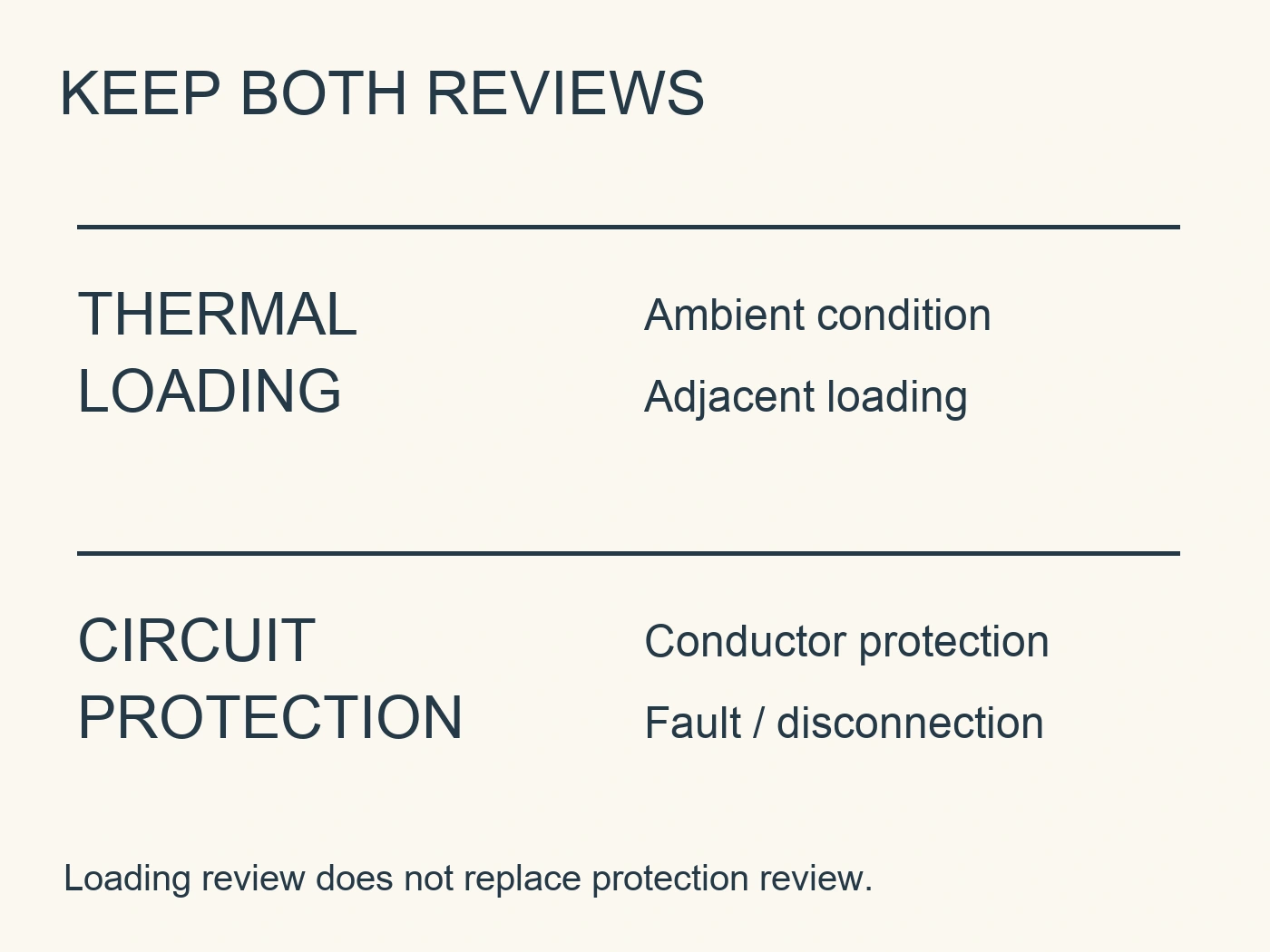
The derating review answers whether the chosen breaker can support the documented load under the assessed conditions. It does not complete cable protection, fault interruption or automatic-disconnection verification. If the result changes the proposed breaker or layout, return to those checks rather than treating a higher current rating as a simple thermal remedy.
For wider selection context, the existing AC MCB 선정 가이드 covers current, poles, trip curve and breaking-capacity questions. The thermal review here is a separate installation task. Keep its conclusion attached to the selected device so a procurement substitution does not inherit an approval that belonged to another configuration.
The table below is a proposed sign-off record. Complete it using the responsible designer's criteria and the selected manufacturer's instructions:
| Review line | Result to record | Action if unresolved |
|---|---|---|
| 부하 및 운전 조건 | Required operating condition and its basis | Confirm the actual circuit duty |
| Temperature allowance | Applicable table entry or approved method | Request exact-series documentation |
| Grouping allowance | Applicable arrangement and correction method | Resolve the loaded-neighbor definition |
| Adjusted loading review | Comparison with the documented load requirement | Reassess the device or approved arrangement |
| 회로 보호 | Cable, fault and disconnection review references | Return the change to the design owner |
| Assembly record | Final layout, product reference and calculation revision | Hold technical approval until records agree |
Possible design responses include a different documented device selection, an approved layout change or a revised thermal arrangement. Each response has its own consequences. Do not assume that spacing, cooling or changing the breaker rating can be accepted without revisiting the associated assembly and protection requirements.
A conditional crowded-panel review
Use the published ABB S201S-C16 example above as a document-reading exercise, and assume an illustrative circuit demand of 12 A continuous. The demand is hypothetical; the 40°C temperature row, 15.1 A loading value, eight-adjacent-device factor of 0.75 and their applicability belong to the cited ABB example. The calculation is 15.1 A × 0.75 = 11.325 A, rounded to 11.33 A. A nominal 16 A label therefore does not answer whether this particular illustrated condition supports the assumed demand.
The filled review entry is “ABB example conditions; adjusted loading 11.33 A; hypothetical demand 12 A; demand exceeds the illustrated allowance by about 0.67 A.” This does not diagnose a real panel trip or predict an exact opening time. It shows that looking only at the temperature row would miss the grouping effect: 12 A is below 15.1 A but above the combined example result. Both inputs change the decision.
Now consider an offered RITOKS series for that hypothetical project. The ABB arithmetic remains a learning example, while the RITOKS selection remains unresolved until its own temperature and grouping instructions are supplied. Copying 0.75 into the offered product's spreadsheet would create a number without an applicable source. The correct entry is “exact-series method missing,” with the offered reference and panel arrangement attached to the enquiry.
The design response depends on what the missing document eventually supports. Approved spacing or a different layout might address mutual heating while preserving the selected circuit rating, but costs enclosure space and can alter conductor routing. A different device may have other documented loading capability but needs its own circuit and assembly review. Increasing nominal current is not a neutral adjustment: the original conductor and disconnection assumptions must still hold. These options should be compared on the same duty and closed-enclosure condition.
A useful final disposition is therefore specific: accept the original selection under its documented conditions, approve an assessed arrangement change, or keep the thermal question open. If a proposed layout relies on nonoverlapping loads, identify the control basis rather than assuming operators always avoid simultaneous use. Retain the final drawing and load scenario beside the calculation so later additions can be assessed against the actual accepted arrangement.
Request exact-series evidence from RITOKS
RITOKS lists several AC miniature circuit breaker families. They should not share a thermal correction schedule by assumption. The Pro-series product page 그리고 compact 1P+N product page provide relevant commercial starting points, but the reviewed pages do not establish a complete exact-series ambient/grouping approval for the proposed crowded panel.
Send the chosen configuration, load duty and panel arrangement with the enquiry. Request temperature-dependent loading information, adjacent-device instructions and any defined spacing conditions for that exact offer. If a document names a different series, ask the supplier to resolve the mismatch before approval. General catalogue similarity does not establish applicability.
Keep the confirmed information with the final order and drawing. If an alternative series is later offered, review its own conditions rather than transferring the previous calculation. The same approach applies when the panel gains an extra circuit: a small bill-of-materials change can require a new check of the relevant operating assumptions.
A completed thermal review identifies the offered device, the assessed installation and the documents supporting the decision. Keep those three aligned when the panel layout or order changes.
참고 문헌
- Schneider Electric. (n.d.). Selection of a circuit-breaker, Electrical Installation Guide.
- ABB. (n.d.). Miniature circuit breaker S 200 S, data sheet 2CDC002137D0201.
- RITOKS. (n.d.). AC miniature circuit breaker selection guide.