
Miniature Circuit Breakers (MCB) · Comparison
MCB Auxiliary vs Trip Alarm Contacts: Choosing the Right Feedback

Quick answer
An MCB auxiliary contact answers whether the associated breaker is open or closed. A trip alarm contact answers whether a defined tripping event occurred. Choose feedback from the required control-system meaning, then verify the exact accessory combination and state diagram. An open breaker signal alone does not explain why the circuit opened.
For an OEM control panel, the buying question is therefore not simply whether the breaker accepts an accessory. The panel designer needs to know which event the accessory reports, how that event reaches the controller, and what happens when an operator resets the breaker. A device called an auxiliary contact is not automatically a fault alarm.
Schneider Electric's OF+SD24 documentation separates breaker position from trip status for its listed compatible devices. That is a useful example of the distinction, not evidence that its accessory fits another manufacturer's MCB. Start the purchase review with the required information, rather than with a familiar accessory abbreviation.
Define the message before choosing the contact
A feedback requirement should describe an observable condition and its intended use. Write the signal label, the event that changes it, and the action expected from the operator or controller. Keep position indication, trip indication and electrical supply confirmation separate unless the approved design explicitly relates them.
Consider a panel that displays "branch unavailable" whenever its breaker is open. A position contact can support that display, subject to the confirmed contact operation. A panel that displays "protective device operated" needs different evidence: its signal must respond to the relevant trip event, rather than every deliberate shutdown. Calling both points "MCB fault" leaves the controls engineer to guess.
These are proposed information requirements, not a universal accessory truth table:
| Required message | Question for the accessory documentation | Information still needed elsewhere |
|---|---|---|
| Breaker open or closed | Does the selected contact follow the main-device position? | Reason for opening and actual downstream voltage |
| Trip occurred | Which actions activate the alarm contact? | Detailed fault cause and protection diagnosis |
| Operator switched off | Can the chosen feedback distinguish this from a trip? | Operator intent, maintenance permit or command record |
| Branch energized | Is a separate voltage measurement needed? | Supply availability and the approved sensing arrangement |
| Circuit ready for restart | Which conditions must be true before restart? | Process state, interlocks and reset authorization |
Use those distinctions to decide whether one feedback point is sufficient. A monitoring-only dashboard can have a different information requirement from a machine controller. More signals are useful only when their meanings and handling are defined. Two unexplained binary points can create more confusion than one accurately named indication.
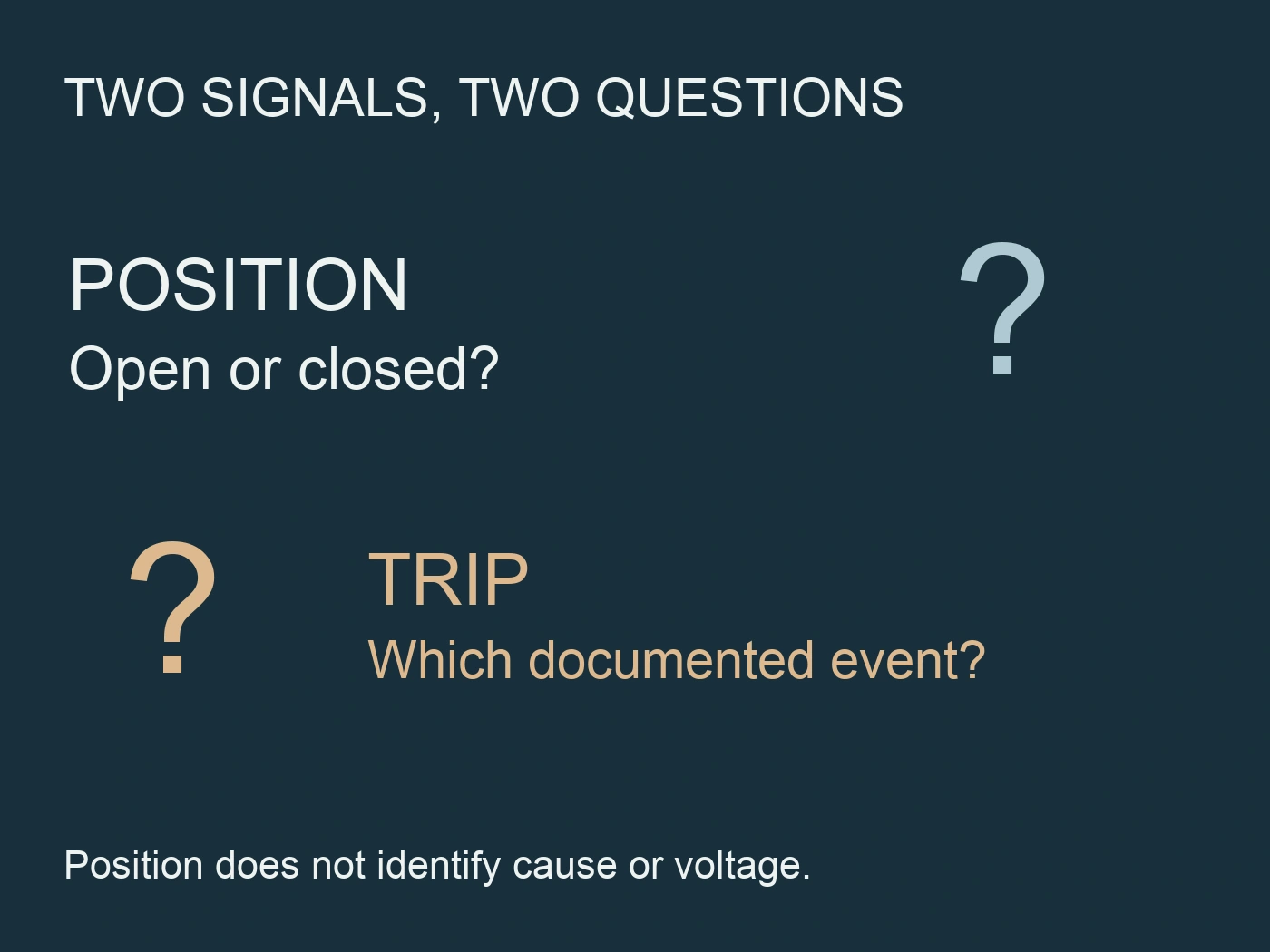
Compare position feedback with trip feedback
Position feedback and trip feedback can change during the same event, but they answer different questions. The review should examine the manufacturer's contact state table for normal closing, manual opening, each documented trip action and reset. Do not infer a contact's function from its housing shape or terminal count.
De ComPact NSXm indication-contact guide provides a helpful caution from a different breaker architecture. Its trip indication includes operation of specified releases and the push-to-trip button, as well as a protection-detected electrical fault. A trip signal therefore need not identify overcurrent as the cause. The document is an example of explicitly defined semantics, not an MCB accessory compatibility approval.
For the selected MCB, request the equivalent event description. If the supplier uses a term such as "fault contact," ask which actions actually operate it. Determine whether the alarm is retained after the main contacts open and when it returns to its normal state. Those answers belong in the control drawing, not in an informal purchasing note.
Also separate an alarm contact from a shunt release. A release is used to initiate a documented opening action; feedback reports a condition. Buying a remotely operated breaker does not establish which feedback is available. If a command and indication are both required, include them as separate functions in the bill of materials and interface review.
Write a contact-to-controller point list
The point list should translate the manufacturer's contact states into named controller inputs. Record the actual terminals, the meaning of each electrical state and the conditions that make the reading unavailable. The operator's display should describe the equipment state, rather than exposing an unexplained normally-open or normally-closed label.
Normally open and normally closed describe contacts relative to a stated reference condition. Before assigning either label to a PLC input, find that reference in the selected accessory drawing. An accessory drawing and a controller's logical normal state are not interchangeable. The controller may intentionally invert an input, but the inversion needs to be visible in the approved documentation.
Create a short record for every point. Include the device reference, accessory reference, drawing revision, terminal pair, input channel and displayed message. Add the control supply and electrical-interface requirements to the same record. Verify the accessory's suitability for the actual switching duty and the input's requirements from their respective manufacturer documents; do not substitute the MCB's main-circuit rating.
Define what the controller does when the indication circuit loses power. A simple open contact path can be ambiguous if the installation has no separate supervision. The correct response depends on the approved control design. Avoid labelling a missing input as a proven breaker fault when the interface cannot distinguish equipment status from an indication-circuit failure.
Use an event review instead of an assumed truth table
An event review is a proposed acceptance document that must be completed against the exact product instructions. It should include manual actions and documented trip actions, plus the reset sequence. Record observed indications during authorized commissioning, but never use a destructive fault as a convenient way to test a feedback point.
The table below is a blank review structure. Its entries describe questions to resolve, not predicted terminal states:
| Review event | Position-point question | Trip-point question | Record before acceptance |
|---|---|---|---|
| Approved closing operation | Does the indication match the documented closed position? | Is the non-tripped indication as documented? | Device state, terminals and controller display |
| Deliberate manual opening | Does the open indication appear? | Does this action leave trip indication unchanged? | Manufacturer event description and observed result |
| Manufacturer-approved trip test | Does the position indication report the documented result? | Does this test operate the chosen alarm function? | Test method, expected states and responsible person |
| Remote opening, if fitted | Does the position point change as specified? | Is the release action included in the trip indication? | Exact release and accessory combination |
| Reset after a trip | What is reported before closing again? | At which reset step does the alarm clear? | Reset sequence and alarm handling |
| Loss of indication supply | Is the input distinguishable from a valid state? | Does the display report uncertainty honestly? | Interface supervision and agreed response |
Agree the expected result before the test, including the difference between an HMI alarm acknowledgement and a mechanical reset. Acknowledging a message should not silently redefine the device state. The controls engineer should document whether an event remains in the history after the current trip indication clears.
Where there is no approved test method for a particular event, leave that portion unresolved and request instructions. A supplier's contact diagram can support a design review without justifying an improvised energized test. Installation and commissioning belong to qualified personnel following the applicable site procedures.
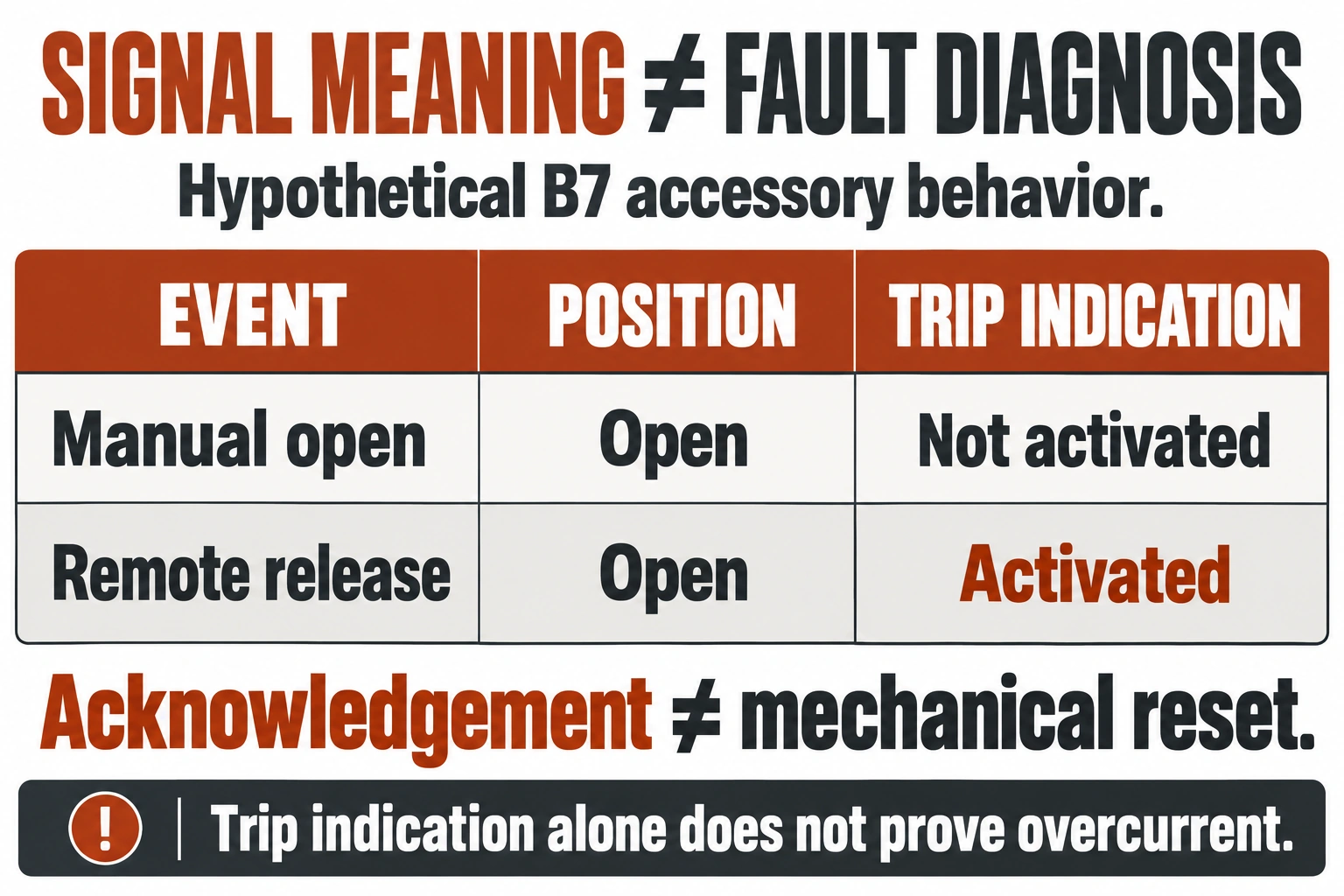
A conditional document-review example
Suppose an OEM requires one point for branch position and another for a breaker trip. The machine has a planned shutdown mode, so manual opening must not produce a misleading fault message. This hypothetical requirement does not specify an accessory part number or claim that a particular MCB supports both points.
The buyer first sends the exact MCB reference and the two signal descriptions to the supplier. If the offered accessory provides position feedback only, the position requirement can be reviewed, but the trip requirement remains unresolved. The buyer should not rename the position point "trip" to make the purchase appear complete. Instead, request a documented compatible trip indication or reconsider the approved monitoring requirement.
If both functions are offered, the next step is to compare the event definitions with the machine's point list. A trip alarm that also responds to a remote release can be appropriate, but its HMI message should not claim that an overcurrent fault has been diagnosed. The commissioning plan then separates manual opening, approved trip testing, remote opening and reset. Acceptance requires the actual accessory documentation and test record, not the assumptions in this example.
This approach exposes a useful distinction: an accessory can satisfy a mechanical compatibility check while failing the required information meaning. Check both before placing the order.
Confirm the exact RITOKS accessory scope
The RITOKS Pro-series AC miniature circuit breaker page lists support for an auxiliary contact and shunt release. Its FAQ names F3 and S3 accessories. Those statements provide a relevant starting point for an enquiry; they do not supply a complete trip-alarm state diagram or prove that every offered combination provides independent trip feedback.
For a quotation, identify the selected breaker configuration and request the exact accessory schedule, permitted combination, mounting instructions and terminal diagram. Ask whether the offered feedback is position indication, trip indication or both. Obtain the supported trip events and reset behavior in writing. If the required trip alarm is not documented, mark that function unconfirmed rather than copying another brand's accessory behavior.
Keep the order description aligned with the drawing. An item such as "MCB with auxiliary" leaves too much room for interpretation when the machine requires two different messages. State each function separately and attach the agreed interface record. Related AC miniature circuit breaker options should likewise be reviewed by exact series and accessory pairing, not assumed interchangeable.
Fill two points without inventing the terminal states
Consider a hypothetical OEM schedule for branch B7. The first point is B7-POS, displayed as “breaker open/closed”; the second is B7-TRIP, displayed as “documented breaker trip.” The manufacturer information assumed for this example says that manual opening changes position only, while a specified remote-release event also activates the trip indication. These assumptions are not an F3 or S3 state table or a RITOKS product capability.
During a planned shutdown, the filled semantic record therefore reads “B7-POS: open; B7-TRIP: not activated by this manual action; display: planned branch unavailable.” The actual electrical contact values remain in the exact accessory and controller drawing. A useful point list can be filled with meanings without fabricating normally-open terminal assignments, supply voltage or logical input polarity.
During the assumed remote-release event, both information points change according to that example's documented behavior. The display should report the breaker trip and retain the recorded command context. Calling it “B7 overcurrent fault” would add a diagnosis the assumed event does not support. If operations need to distinguish remote command from protective overcurrent, the design requires the documented information that can make that distinction; two generic accessory signals do not automatically provide it.
Acknowledgement introduces another independent state. An operator can acknowledge the displayed event while the breaker remains open and the documented trip indication remains active. Later mechanical reset may clear the present indication under the exact instructions while the controller retains history. The point schedule should describe the intended active and historical treatment rather than clearing every record when the operator presses an HMI button.
If the offered accessory instead supports position alone, keep B7-POS as a candidate and mark B7-TRIP “unsupported by supplied documentation.” That is a concrete purchasing difference. One correctly named point may satisfy a simple branch-availability display; a process requiring separate trip reporting needs further documented capability or a revised approved information requirement. More feedback is worthwhile only when it removes a defined ambiguity. The example supplies that decision logic while leaving compatibility, wiring and actual event behavior with the selected product documentation.
The purchase is ready for technical approval when the required messages, accessory compatibility and documented event behavior agree. A clear point list is more useful than a familiar abbreviation printed on the accessory box.
Bronvermeldingen
- Schneider Electric. (n.d.). OF+SD24 indication auxiliary, I/O Smart Link user guide.
- Schneider Electric. (n.d.). Indication contacts, ComPact NSXm legacy user guide.
- RITOKS. (n.d.). 10kA Pro-series miniature circuit breaker.