
Power Semiconductor Modules · Technical Explainer
MOSFET Module Current Ratings: Why Case Temperature Changes the Answer

Quick answer
A MOSFET module's current declaration must be read with its temperature, gate-drive, duty and package conditions. Case temperature, junction temperature and ambient temperature are different quantities. A rating that assumes a defined case or mounting-base temperature does not promise the same current in equipment whose cooling arrangement has not established that condition.
Check the exact on-resistance definition and temperature dependence, then review semiconductor, package and application limits separately. A large ampere number or a low nominal resistance does not establish complete equipment capacity. For MOS420N10P, the public 420A designation is not a verified continuous-current guarantee at a defined temperature; request the selected data sheet and supporting conditions.
Identify the temperature that the rating actually uses
Junction temperature describes the semiconductor junction. Case or mounting-base temperature describes a manufacturer-defined reference on the device. Ambient temperature describes the surrounding environment. None should be substituted for another merely because one is easier to record.
Ask where the reference point is defined for the exact package. Do not assume that every module's case reference is its plastic surface, mounting plate or a particular terminal. A temperature recorded elsewhere may be useful to the equipment review, but it is not automatically the reference required by the current declaration.
Nexperia's AN90016 identifies the mounting-base reference for its LFPAK examples and distinguishes it from junction temperature. Its explanation is explicitly tied to that package technology, not a universal reference-point definition for all MOSFET modules. Nexperia AN90016
For procurement, request the reference-point definition before accepting a statement such as “rated at room temperature.” Does that statement concern ambient air, an actively maintained case point or the junction condition used for an electrical parameter? The answers lead to different evidence requests.

A case-temperature assumption needs an actual thermal path
A case-referenced current value assumes the applicable reference temperature. The equipment still needs a documented way to maintain the relevant conditions. A cool room does not prove a cool device case, and a cool case does not mean the junction is at the same temperature while dissipating power.
Infineon's automotive MOSFET data-sheet explanation distinguishes junction-to-case thermal resistance from the application-dependent junction-to-ambient path. The external arrangement and environment are part of the latter. A device thermal parameter alone therefore does not describe a complete cooling system. Infineon data-sheet explanation
Record the actual proposed interface and cooling arrangement without inventing its thermal result. The supplier's component data, the equipment's cooling proposal and any actual validation evidence should remain distinguishable. A related heatsink listing is not proof that the selected mounting and thermal path have been assessed.
This also improves quotation comparison. Two suppliers may provide similar current classes while assuming different temperature references or external conditions. Put those assumptions beside the quoted number instead of ranking the offers by amperes alone.
| Temperature or thermal item | Meaning to preserve | Procurement question |
|---|---|---|
| Junction temperature | Semiconductor temperature relevant to the stated limit or characteristic | Which maximum and operating conditions apply to the exact part? |
| Case or mounting-base temperature | Manufacturer-defined device reference point | Where is it defined, and which current declaration uses it? |
| Omgevingstemperatuur | Surrounding environment of the actual application | What environment was assumed, and what is the equipment proposal? |
| Junction-to-case path | Device-specific thermal path to its defined reference | Which exact parameter and conditions are documented? |
| External cooling path | Interface, mounting, cooler and environmental arrangement | What evidence supports the proposed configuration? |
| Transient thermal information | Relevant time-dependent thermal response | Which duty and duration does the selected documentation cover? |
The table provides questions, not a thermal network verified for MOS420N10P. Leave undocumented values pending rather than filling them from another package.
Read RDS(on) with its electrical and temperature conditions
On-resistance is stated at defined gate voltage, drain current and junction temperature. Keep those conditions with the value and distinguish typical from maximum. A typical characteristic is not automatically a guaranteed maximum suitable for every acceptance calculation.
The selected device's temperature dependence belongs in the loss review. Do not multiply a room-temperature value by a generic silicon coefficient or copy another family's normalized curve. Request the applicable selected-part data and the intended use of typical or limiting information.
Infineon's explanation discusses these on-resistance conditions and temperature effects alongside current-rating definitions. Its coefficients and production-test statements describe its documented context; they are not parameters or guarantees for the RITOKS candidate.
For a quotation, “low resistance” is an incomplete answer. Ask for the value's definition, its supporting curve or table and the relevant gate-drive condition. If the supplier provides only a model-class description, the loss input remains unresolved even when the package is otherwise attractive.
Do not present an estimated conduction loss as measured equipment performance. It is one part of a review that may also require switching and other assembly losses. Keep the calculation's scope explicit instead of attaching an unsupported continuous-current approval to a nominal resistance.
Silicon capability is not the only current boundary
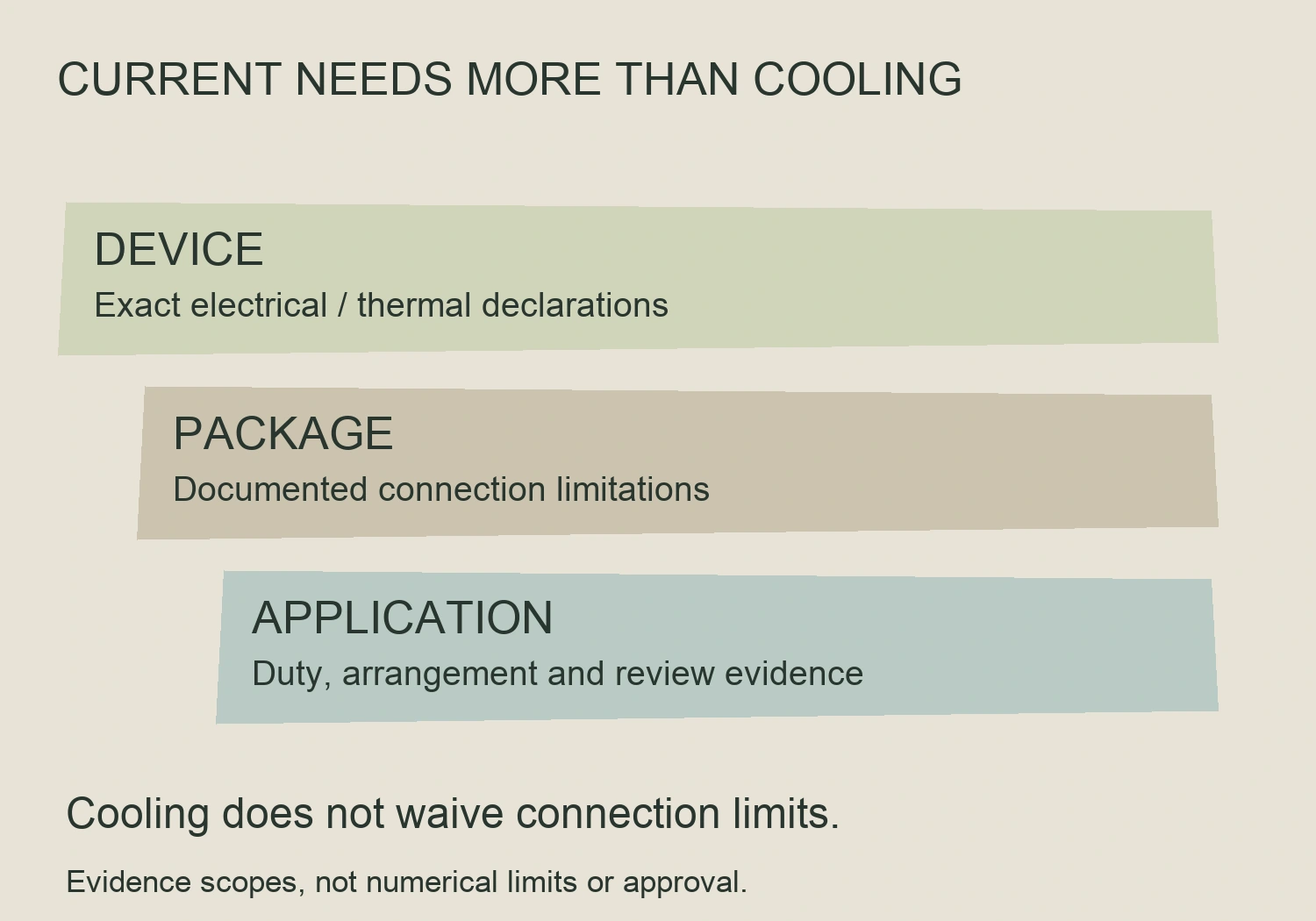
A theoretical semiconductor capability and a final declared current may differ because other constraints apply. Package interconnects, terminals and the actual application arrangement need their own evidence. Improved cooling does not automatically remove a documented electrical or mechanical current limit.
AN90016 illustrates that distinction for Nexperia LFPAK devices: it separates theoretical capability from the final rating and discusses practical application and connection constraints. The lesson is to read the limiting context, not to transfer its package construction, demonstrations or test durations to a different module.
Infineon's explanation also distinguishes chip, DC/package or test-related, and reference-application current declarations in its data-sheet format. Exact footnotes identify the applicable meaning. Do not impose those labels on another supplier without confirmation or treat an explanatory calculation as permission to exceed a selected product's documented limit.
Ask the supplier to identify which current definition the selected module uses and whether additional terminal or interconnect constraints are specified. Record a missing limit as unknown. Do not assume that all constraints have been addressed because the model name contains a large number.
Continuous, pulsed and linear operation need different evidence
A pulse declaration does not establish continuous equipment capacity. Preserve pulse duration, repetition and temperature conditions where they are part of the selected documentation. Do not compare a pulsed number with another supplier's continuous declaration as though both describe the same duty.
Fully enhanced low-resistance operation also differs from intentional linear operation, where substantial voltage and current can coexist. Nexperia's IAN50006 explains why the selected safe operating area and duty conditions matter for that review. A low RDS(on) or a current class alone does not establish linear-mode suitability. Nexperia linear-mode guidance
Keep the application requirement clear. If the equipment uses the device as a low-loss switch, specify that duty. If another operating case requires a different region, request the evidence for that case separately. Do not fabricate a safe operating envelope from a thermal calculation or another manufacturer's example.
This article supplies no MOS420N10P curve, calculated junction temperature or qualified operating point. The relevant selected-product limits and the actual application evidence must establish those conclusions.
Build a continuous-current conditions register
The register below is useful when procurement receives an impressive current number but incomplete conditions. It links the request to the documents needed for engineering review without manufacturing a test result.
| Register field | Required information | Unresolved status to preserve |
|---|---|---|
| Product identity | Exact order code, package/version and data-sheet revision | Family name does not identify the assessed configuration |
| Current definition | Continuous, pulsed or model designation; actual device/path scope | Do not relabel a class number as continuous current |
| Reference temperature | Stated condition and exact case/base reference-point definition | Ambient cannot stand in for an undocumented case assumption |
| On-resistance | Conditions, typical/maximum status and temperature-dependent data | Do not supply a borrowed multiplier or curve |
| Device thermal data | Applicable junction limit and thermal parameters | Missing values are not inferred from package appearance |
| Connection constraints | Documented package, terminal and interconnect limitations | Cooling alone does not clear unknown connection limits |
| Application arrangement | Gate condition, duty, interface/cooler and environment | A proposed arrangement is not verified performance |
| Review evidence | Relevant analysis or actual test record with conditions and limitations | Separate estimate, measured result and approval disposition |
Give each missing field an owner and required source. A supplier can respond with a document, clarification or a revised selection. The reviewer then assesses the actual proposal. “Document received” and “application approved” should be separate statuses.
For comparison across offers, use the same application requirement while preserving each supplier's rating conditions. If one offer lacks a reference temperature or terminal limit, record that difference rather than inventing equivalent assumptions for a tidy spreadsheet.
The register can also expose a mismatch between the requested duty and the quotation. A supplier may have answered with a pulse value, a theoretical capability or a model class. Resolve the definition before treating the offer as an alternative for a continuous-current requirement.
Keep MOS420N10P at its documented candidate scope
De MOS420N10P low-voltage MOSFET module page identifies a silicon N-channel module candidate with a 100V series listing and 420A model designation. That public description does not establish continuous 420A operation at a defined case temperature or equipment capacity.
Its public information requests exact data-sheet, resistance, derating and thermal-interface review. It does not supply the verified on-resistance curve, junction limit, case measurement location or package/terminal current conditions required to complete this register.
Send the intended continuous or pulsed duty, relevant gate condition and actual cooling proposal with the inquiry. Request the exact rating definition and reference-point documentation. Ask for the selected package and connection constraints rather than expecting them to follow from the designation.
The correct status is a candidate awaiting the relevant evidence, not a proven 420A assembly and not an automatically rejected part. Keep related cooler sourcing separate from a demonstrated thermal fit.
Preserve the configuration behind the final decision
A useful release record identifies the selected part, conditions and application arrangement that were reviewed. It does not authorize every future configuration with the same current class. Changes to the module version, gate drive, connection path, mounting interface, cooler or duty may affect the relevant evidence.
Retain the source revisions and the review disposition. If a claim cannot be tied to its temperature reference or supporting document, return it for clarification instead of replacing it with workshop experience. A transparent pending item is more useful than a precise-looking but unsupported current value.
The result should be a conditions-based selection: what the manufacturer declares, what the application requires and which evidence supports the comparison. That approach makes case temperature meaningful without treating it as the only constraint on the equipment.
Veelgestelde vragen
Does a case-temperature rating apply at the same ambient temperature?
Not automatically. Case and ambient are different quantities. Confirm the exact reference-point definition and the actual thermal arrangement needed to maintain the stated condition. Surrounding air temperature alone does not establish device case or junction temperature.
Can a typical RDS(on) value replace a maximum value?
Not without an applicable basis for that use. Preserve the stated conditions and whether the value is typical or maximum. Obtain the selected-part temperature data rather than assuming a typical curve establishes a guaranteed limit.
Can a larger heatsink remove a package current limit?
Do not assume so. Thermal and connection constraints need separate review. A cooler proposal does not waive documented terminal or interconnect limits, and missing limits remain unresolved rather than automatically cleared by cooling.
Does the MOS420N10P name establish continuous 420A operation?
The public designation does not establish that guarantee at a defined temperature and duty. Request exact current definitions, reference conditions and supporting package/thermal evidence before approving a continuous application.
Bronvermeldingen
- Nexperia. AN90016: Maximum continuous currents in NEXPERIA LFPAK power MOSFETs. Rev.1.1, September3,2020. Introduction, section3 and sections5.1–5.2; LFPAK-specific examples. Accessed October2,2026.
- Infineon Technologies. Datasheet Explanation Update for Infineon's Automotive MOSFETs. Z8F80216033, November29,2021. Relevant current, thermal and on-resistance sections. Accessed October2,2026.
- Nexperia. IAN50006: Power MOSFETs in linear mode. n.d. Linear-mode definition and SOA discussion; page updated May9,2022. Accessed October2,2026.