
Thermische overbelastingsrelais voor motorbeveiliging · Technische uitleg
After an Overload Relay Trips: Record the Motor Conditions Before Reset
Quick answer
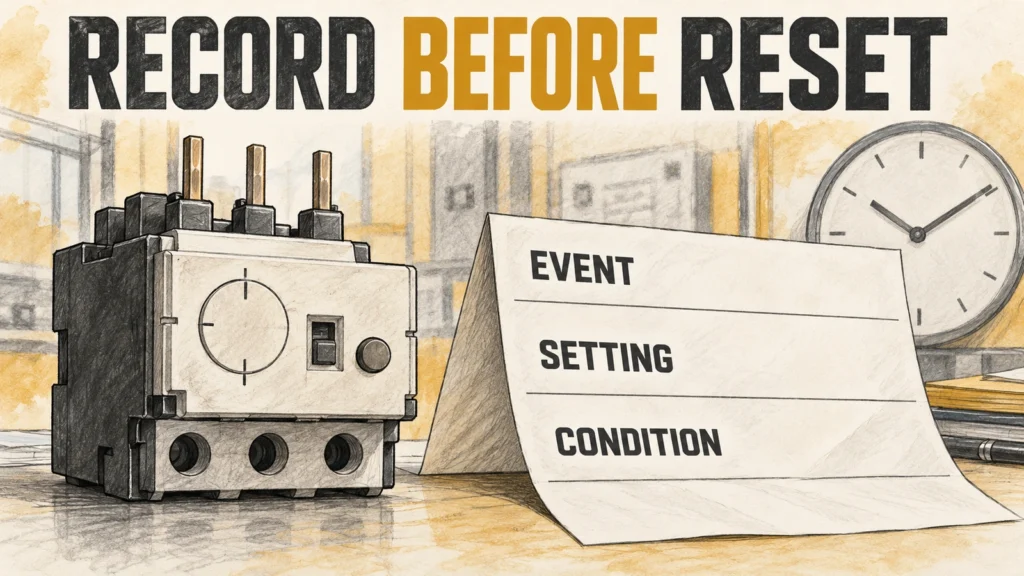
Before resetting an overload relay, preserve the trip indication, relay identity, setting, motor nameplate details, operating sequence and available current records. Distinguish observations already recorded by the control system from information that would require an approved inspection. A stopped motor and a trip flag establish an event, not its root cause.
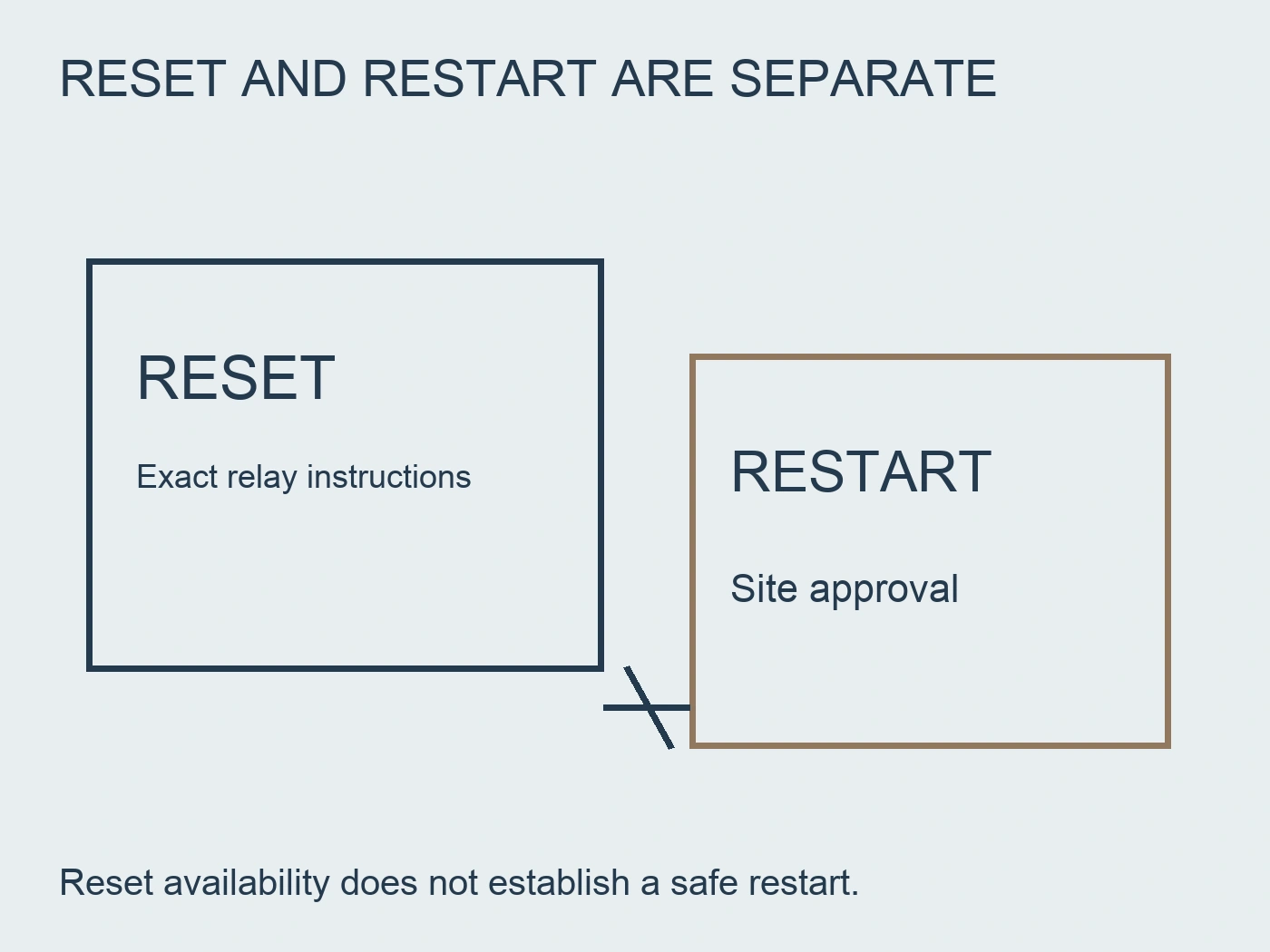
Do not raise the current setting merely to make the event disappear. Review the motor's actual operating conditions and the exact relay instructions, then make any authorized correction with a documented reason. Reset availability does not itself establish that restarting is appropriate.
This guide helps maintenance teams prepare an overload relay trip diagnostic record. It is not a live measurement procedure or permission to repeatedly restart a motor. Qualified personnel must use the site's isolation, inspection and restart procedures, with the manufacturer's instructions for the installed equipment.
Preserve the event before changing the equipment
A useful record separates what happened from what someone thinks happened. “Overload relay indication present after the motor stopped” is an observation. “Motor overloaded because of the pump” is a proposed explanation that needs supporting evidence. Keeping those two statements apart helps the next person investigate instead of inheriting an untested diagnosis.
| Record field | Useful entry | Avoid substituting |
|---|---|---|
| Event identity | Time, equipment tag and operating command | “It trips sometimes” |
| Bewijsstukken met betrekking tot apparatuur | Exact relay reference and observed indication | An assumed trip cause from a generic label |
| Configuratie | Existing setting and reset-mode position | A new setting recorded after alteration |
| Operating sequence | Start, running period, load change and stop order | One unqualified elapsed-time estimate |
| Electrical record | Available phase-current values with source and time | A lone current number with no phase or condition |
| Mechanical context | Process state and relevant load observations | “The motor looked normal” |
| Recent changes | Motor, starter, supply, process or setting changes | An assertion that nothing changed without checking |
Photographs of accessible labels and indicators can support the record where site rules allow them. Do not open an enclosure or approach electrical equipment just to complete a table. If a field requires an inspection that has not been authorized or carried out, mark it as unavailable and assign the appropriate follow-up.
Keep the original indication and operator report distinct from later findings. A relay may have been reset before the investigator arrives, or several devices may have operated in the same event. Record that limitation rather than reconstructing a precise sequence from memory.

Identify the exact relay and what its indication means
An overload relay is part of a motor-control assembly. The relay reference, contactor, upstream protection and motor all matter to interpreting the event. A generic family name is not enough to establish a trip class, reset behavior, terminal function or diagnostic capability.
De RITOKS ZS3RU thermal overload relay family identifies overload and phase-loss protection, temperature compensation and trip indication. Its public page requires the exact adjustment band and mounting compatibility to be confirmed. It does not supply a universal post-trip waiting interval or a complete diagnostic procedure for every variant.
Record the actual installed reference and the applicable manufacturer instructions. Verify what the visible indicator identifies: a relay trip, a particular fault type, a test operation or a more limited mechanical state. Do not assume that every thermal relay distinguishes all causes on its front face.
Schneider Electric's TeSys Giga guide illustrates why device scope matters. Its specified electronic overload relays latch the trip state, and resetting changes the auxiliary-contact state. That describes the Giga devices, not the operating details of ZS3RU. The general recordkeeping lesson is to preserve the indication before reset changes the visible or control-system evidence. Schneider Electric, Trip reset, DOCA0189EN–05.
Connect current information to the operating sequence
Current records are more useful when they describe the same event and operating state. Identify which phase each value belongs to, when it was captured, its measurement source and whether the motor was starting, accelerating or running under a particular load. Separate pre-trip history from readings obtained later under different conditions.
If the control system has a trend or event record, retain the original export where possible. A handwritten summary can omit short events, missing samples or a change in process state. Note those limitations rather than treating a sparse display value as a complete history.
Three phase values can support a more meaningful review than an unspecified single reading, but they are not a diagnosis by themselves. The investigator must interpret them against the motor connection, supply conditions, measurement method and exact protection arrangement. This article assigns no acceptable imbalance threshold and gives no instructions for energized measurements.
Timing also needs a reference point. “After starting” may mean during acceleration, shortly after the motor reached speed or after a later load change. Record the command time, available running indication and trip time separately. If only an operator's estimate is available, label it as an estimate rather than implying event-logger precision.
For repeated incidents, keep separate records instead of combining them into an average. Events following a cold start may differ from those following repeated operation. An investigator can compare the records without losing those distinctions.
Record the motor and installation context
The motor nameplate and connection arrangement provide essential context for reviewing the existing setting. Include the motor reference, rated data applicable to its actual connection and any approved commissioning setting record. A nameplate photograph without a connection record can leave uncertainty about which listed rating was used.
Document the process condition around the event. Examples include a changed product load, a blocked driven process, a different duty pattern or a recent mechanical maintenance activity. These are investigation prompts, not a list of confirmed causes. State what is known and how it was observed.
The relay's local environment also belongs in the record. Cabinet ventilation, nearby heat sources and a recent enclosure change may be relevant to review. The fact that a relay includes temperature compensation does not justify omitting environment information or assuming unrestricted performance in every enclosure.
Ask whether anything changed since the last approved operating record. A replacement motor, a changed supply connection, a different contactor or an altered process can invalidate an earlier setting rationale. Matching one current value on an old checklist does not establish that the complete application remained unchanged.
Keep investigation proportionate to the evidence. An event report should first preserve the known facts and define the missing information. It does not need to list every conceivable motor fault or authorize unrelated component replacement.
Separate reset permission from restart approval
A relay returning to a resettable state is not evidence that the original cause has disappeared. The restart decision must also consider the motor, driven equipment, personnel exposure and site operating procedure. Record who authorizes the return to service and what unresolved conditions remain.
Schneider Electric's LRD reset-time FAQ states that its electromechanical LRD devices have variable reset timing affected by trip type, prior thermal state and ambient temperature. It does not provide one fixed reset time. This is an LRD-specific explanation, not a ZS3RU timing specification. It supports avoiding a borrowed countdown as a substitute for exact instructions. Schneider Electric, What is the reset time for LRD thermal overload relay?, updated August 11, 2026.
Also identify manual or automatic reset configuration and the wider command logic. Resetting a protective device and issuing a motor start command are different actions, but the assembly may permit restart when an existing command remains present. The exact circuit and site procedure must establish that behavior; a general guide cannot promise that reset is motion-free.
The review should never turn repeated reset attempts into an informal test. When the cause is unresolved, preserve the evidence and use the authorized escalation path. A current setting change requires a valid selection rationale, not only a desire to restore production.
Use a conditional investigation example
Consider a fictional motor that stops after a process load change. The operator reports an overload indication, but the first maintenance note contains only “reset successful.” That note does not preserve the prior relay setting, running interval, phase-current history or condition of the driven equipment.
A better record would identify the equipment and exact relay, retain the indication if still available, capture the original configuration and state which observations were made before reset. The investigator could then compare the event with the approved motor and starter documentation and review the process change.
If that review establishes a genuine setting mismatch, an authorized correction may be appropriate. If it instead indicates a load or supply problem, raising the setting would not answer the finding. If essential data are missing, the report should remain open rather than claim a root cause because the motor restarted once.
This example is a documentation exercise, not an account of a RITOKS installation or a recommended troubleshooting sequence. No numerical setting, trip interval or restart limit is implied.
Make the handoff actionable
An investigation record should conclude with a disposition that another shift can understand. Separate the original event, confirmed findings, unresolved questions and authorized action.
| Handoff item | What to document | Waarom dit belangrijk is |
|---|---|---|
| Confirmed observations | Indication, timestamps and source records | Preserves facts independently of the diagnosis |
| Configuration comparison | Exact motor data and approved relay setting basis | Explains whether the existing selection was reviewed |
| Missing information | Specific unavailable measurement or instruction | Defines a follow-up instead of guessing |
| Findings | Evidence supporting each accepted explanation | Avoids presenting possibilities as causes |
| Authorized action | Scope, responsible person and approval | Distinguishes investigation from repair permission |
| Return-to-service decision | Site procedure and unresolved restrictions | Keeps reset separate from restart approval |
| Follow-up record | Relevant observation after approved work | Does not erase the original event |
For replacement procurement, send the exact relay reference, required adjustment band, compatible contactor or independent mounting arrangement and reset-mode requirement. The thermal overload relay category is the commercial family for this requirement; confirm the actual configuration rather than substituting a similarly named device.
Veelgestelde vragen
Should the current setting be increased after a trip?
Not merely to prevent another interruption. Review the exact motor data, relay instructions and operating evidence. Any correction needs an authorized selection rationale; a trip alone does not establish that the existing setting is too low.
Does a successful reset show the motor is healthy?
No. It shows a reset action was possible under the observed conditions. It does not identify the original cause or approve restarting the motor and driven equipment.
What if no current trend was recorded?
Mark it as unavailable. Preserve the remaining event details and let qualified personnel determine the appropriate approved investigation. Do not manufacture a phase-current history from a later isolated reading.
Can an LRD reset-time explanation be applied to ZS3RU?
Not as a product specification. The cited FAQ concerns LRD devices. Obtain the exact ZS3RU instructions and reset requirements for the installed model.
Bronvermeldingen
- Schneider Electric. (2026). What is the reset time for LRD thermal overload relay? Updated August 11, 2026; retrieved October 3, 2026. https://www.se.com/us/en/faqs/FAQ000133310/
- Schneider Electric. (n.d.). Trip reset. TeSys Giga installation guide, DOCA0189EN–05. Retrieved October 3, 2026. https://productinfo.se.com/tesysgigainstallationguide/tesys-giga-series-giga-contactors-and-giga-thermal-overload-relays-installation-guide/English/TeSys%E2%84%A2%20Giga%20Series%20Giga%20Contactors%20and%20Giga%20Thermal%20Overload%20Relays%20Installation%20Guide_0000447511.xml/$/PanGu_TripResetCPT_0000524825
- RITOKS. (n.d.). ZS3RU thermische overbelastingsrelais. Live published product-family scope, checked October 3, 2026. https://ritoks.com/products/zs3ru-thermal-overload-relays-0-11a-100a/