
DIN Rail Energy Meters · Technical Explainer
Planning an RS485 Meter Network: Polling Time and Data Freshness

Quick answer
A meter network's polling interval is not the same as its measurement update interval. A recent successful read can return a value that was calculated earlier. To plan useful monitoring, define how old the measurement may be when the platform uses it, then budget the serial transactions and the rest of the delivery path.
Baud rate is only one part of that budget. Request size, response size, device processing, framing intervals, gateway behavior and failed-node handling all influence when a usable value arrives. A network can communicate successfully yet fail the application's freshness objective.
The intended deliverable is a measured polling plan with explicit uncertainties. It is not a register map, a universal node-count recommendation or a promise that faster polling produces new measurements.
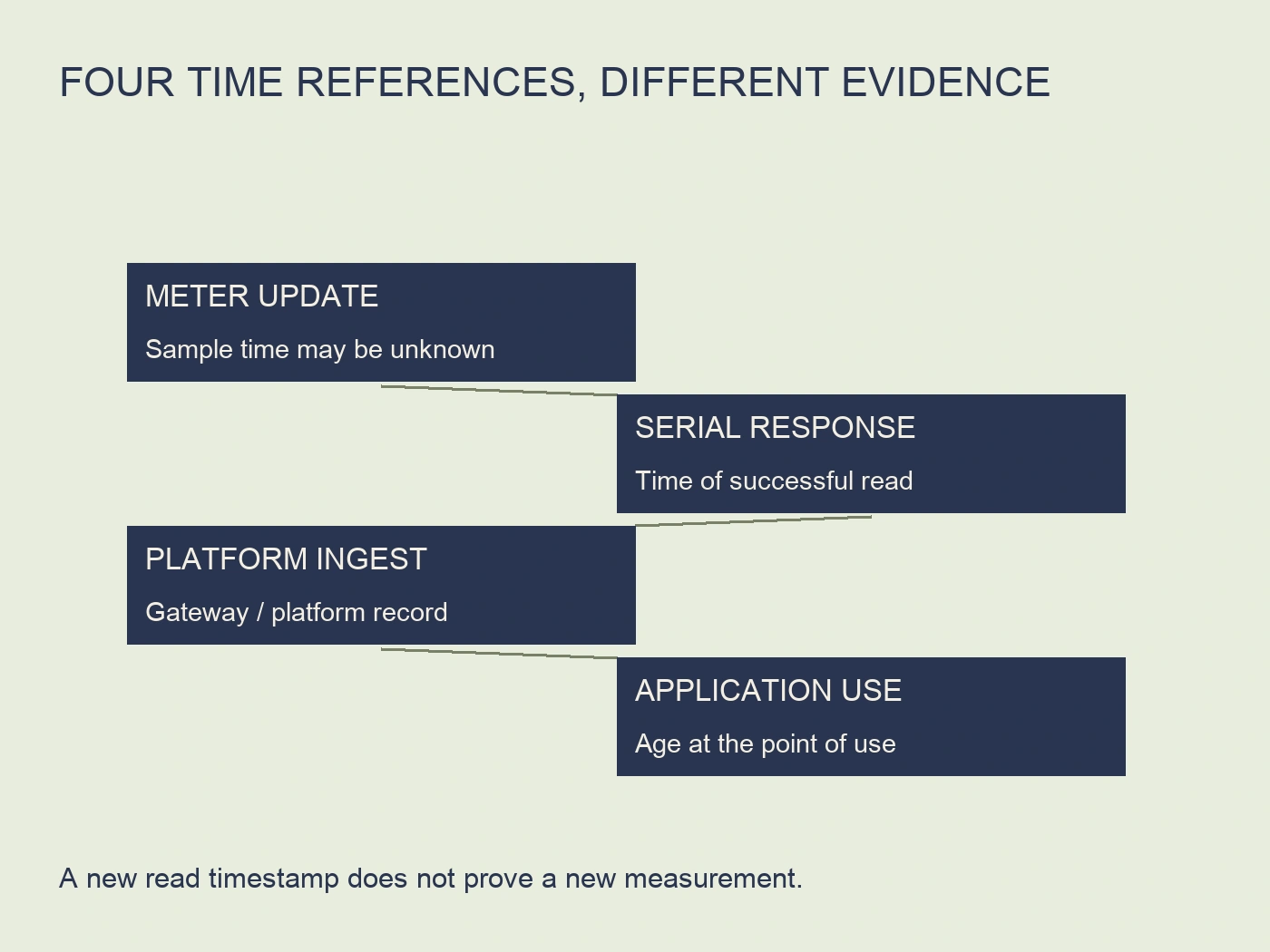
Separate four different time references
First identify when the meter forms or updates the quantity. Different quantities may have different calculation behavior; an instantaneous electrical value and an accumulated energy counter should not automatically share one freshness assumption.
Next identify when the polling client requests the value and receives a valid response. That establishes communication timing, not necessarily the underlying sample time. A meter register without a timestamp may leave the exact measurement age unresolved. What the operator sees on the display is a separate timing question; see panel meter refresh rate vs response time.
Then identify when a gateway or platform publishes the value and when the consuming application uses it. Queueing, caching and application schedules can add delay beyond the serial bus. A display refresh may simply repaint the last stored value.
| Time reference | What it establishes | What it does not establish alone |
|---|---|---|
| Meter measurement update | When the device forms the relevant value, if documented | When the platform receives it |
| Successful serial response | A valid response reached the polling client | A newly sampled measurement |
| Platform ingestion/publication | The value entered the application data path | No preceding caching or queueing delay |
| Application use/display | When a user or calculation consumes the value | The underlying measurement's age |
If the measurement update time is unavailable, state that limit. Do not label the last successful communication timestamp “measurement timestamp” unless the exact device or application establishes that meaning.
Treat the serial bus as a shared transaction resource
The official Modbus serial-line guide specifies that the initiator starts only one transaction at a time. Its timing discussion includes response timeout, and its RTU framing discussion includes required silent intervals. These protocol facts explain why a polling budget needs more than the payload's byte count. Modbus serial-line specification and implementation guide.
For a multi-meter plan, list each scheduled transaction. A device read may require several documented register blocks. Those blocks consume separate transaction time unless the exact device supports a combined request.
Other clients using a gateway may share the serial scheduling resource even when their network connections appear independent. Establish whether the gateway serializes requests, caches values or imposes its own schedule. Do not assume each TCP connection creates an additional simultaneous serial channel.
Broadcast is not a shortcut for reading all meters at once. The serial guide's broadcast mechanism does not return individual read responses. This article does not propose broadcast polling or any live command sequence.
Plan request blocks using the real register map
The Modbus application specification defines read functions and their data structures. It does not define the manufacturer's energy-meter register map, measurement scaling or supported grouping. Modbus application protocol specification.
Build request blocks from the selected meter's actual communications document. Identify the requested quantities, function, supported addresses and encoding. Contiguous numbering does not guarantee that every intervening register can be read or that all quantities update together.
A larger valid block may reduce repeated request overhead, but it also creates a longer response. Compare the actual alternatives without inventing unsupported addresses or assuming one universal optimum.
Separate data priorities where the application genuinely needs them. A slowly changing counter may not need the same schedule as a faster monitoring value. The selected device's behavior and the monitoring objective decide that allocation; this guide supplies no recommended universal interval.
Calculate an illustrative transport budget
The following is a hypothetical arithmetic example, not a RITOKS device characteristic. Assume a successful transaction has an 8-byte request and a 25-byte response. Assume the selected serial framing uses 11 bits per character and the bit rate is 9,600 bits per second.
The 33 total transmitted characters require 363 bits. Dividing 363 by 9,600 gives approximately 0.0378 seconds, or 37.8 milliseconds, of transmission time.
For this example only, assume an additional combined 12 milliseconds covers the relevant silent intervals, processing, turnaround and scheduling costs without overlapping or double-counting them. The successful transaction budget becomes approximately 49.8 milliseconds.
Ten identical successful transactions would then occupy about 498 milliseconds. That result is not a guaranteed half-second update interval: it excludes any costs not represented in the assumptions and says nothing about the meter's measurement update rate.
| Hypothetical contribution | Assumed value | Budget meaning |
|---|---|---|
| Request plus response | 33 characters | Actual frames would come from the selected function and block |
| Character framing | 11 bits per character | Must match the configured serial format |
| Bit rate | 9,600 bits/s | Transmission rate, not measurement update frequency |
| Pure transmission | 37.8 ms | Rounded result of 33 × 11 ÷ 9,600 |
| Additional non-overlapping costs | 12 ms | Illustrative allowance only; requires actual evidence |
| Successful transaction total | 49.8 ms | Conditional sum, not a manufacturer response guarantee |
The arithmetic is useful because its assumptions are visible. For the actual plan, replace every assumed term with documented or measured data and specify where timers overlap. For example, a measured request-to-response interval may already include device processing and transmission; adding both again would inflate the budget incorrectly.

Include failed nodes and retries
A healthy-cycle estimate does not describe a network containing a silent meter. The client may wait for its configured timeout before moving on, and retry policy may repeat that wait. One missing response can consume more time than several successful transactions.
Extend the hypothetical example with nine successful 49.8-millisecond transactions and one failed transaction. If the entire failed attempt is assumed to consume 500 milliseconds and there is no retry, the cycle becomes 948.2 milliseconds. That is 9 × 49.8 + 500, not the healthy-cycle figure.
If one additional failed attempt is allowed, and that attempt also consumes the assumed 500 milliseconds, the same cycle becomes 1,448.2 milliseconds. These are planning examples only, not recommended timeout settings or a description of either RITOKS meter.
Define precisely what the timeout covers. A timer measured from the request start differs from one measured after request transmission. Preserve any additional retry scheduling or gateway delays outside that definition.
Decide how the platform reports data during failures. Retaining the last value can be useful, but its age and quality state must remain visible. A cached value should not receive a new measurement timestamp simply because the dashboard refreshed.
Do not equate address capacity with network capacity
Protocol addressing and an installation's practical capacity are separate questions. The available addresses do not establish a recommended number of meters, wiring distance or sustainable refresh objective.
The physical design must follow the equipment's applicable RS485 installation requirements. The timing plan must then account for the actual transaction workload and measured behavior. Neither review replaces the other.
A network with fewer meters can still be slow if requests are fragmented or timeout handling dominates. A larger network might meet a modest monitoring target when its actual workload and physical implementation support it. These conditional statements do not qualify any particular installation.
Avoid choosing the meter count by dividing a target interval by pure transmission time alone. Use the complete measured cycle, including the failure cases that the monitoring task must tolerate.
Request the missing meter timing information
The RITOKS 2P single-phase RS485 Modbus DIN-rail energy meter oraz multifunction digital power meter with RS485 are relevant commercial families for this integration task.
Their public pages do not establish a measurement update interval or worst-case response time for the selected variants. Consequently, this article cannot guarantee a polling cycle or measurement freshness for them.
Request the exact communication document and firmware applicability, supported serial settings and register grouping. Ask for the relevant measurement update behavior and any stated response-time limits. Where a gateway is included, request its polling, caching and timestamp behavior separately.
If some behavior is undocumented, use an authorized commissioning record to establish observed performance under the intended workload. Observed performance remains tied to that configuration and is not a substitute for an unavailable manufacturer guarantee.
Validate the plan against the application's age limit
A practical acceptance record should include the healthy scan duration, missing-node duration, retry behavior and end-to-end publication delay. It should also retain the measurement-update evidence or explicitly state that the underlying update time is unknown.
Compare those records with the monitoring task's allowed age and failure behavior. Some applications can tolerate delayed energy counters but require clear stale-data marking. Others need a tighter measurement-age bound. Define that requirement before calling the network acceptable.
Measure the chosen workload rather than only one isolated meter response. Preserve relevant configuration, device and gateway versions, request blocks and observed timing variation. Do not turn the best observed cycle into the worst-case bound.
If freshness remains uncertain because the device supplies no measurement timestamp or update declaration, state which part is unknown. The network may still deliver valid communications, but the evidence does not establish the stronger freshness claim.
Make the assumed age budget change the decision
Consider a further hypothetical planning case, using the rounded transaction budgets above. The application owner sets an illustrative age limit of twelve hundred milliseconds at application use. Assume the selected quantity has a documented maximum update-age contribution of four hundred milliseconds. Assume another one hundred and twenty milliseconds covers the remaining gateway, publication and application delay. These are invented planning inputs, not RITOKS specifications, measurements or recommended monitoring limits. For this example, treat the three contributions as additive, conservative and non-overlapping; a real age model must justify that treatment for its actual schedule.
Using the healthy ten-transaction scan of four hundred and ninety eight milliseconds, the assumed combined bound is four hundred plus four hundred and ninety eight plus one hundred and twenty: one thousand and eighteen milliseconds. It is one hundred and eighty two milliseconds below the fictional application limit. That comparison supports only the stated healthy scenario. It says nothing about unknown costs or whether a real meter provides the assumed measurement-update declaration. A communications acceptance without that declaration would have a different evidence status.
For the missing-node case without a retry, substitute the earlier nine hundred and forty eight point two millisecond cycle. The assumed age total becomes one thousand four hundred and sixty eight point two milliseconds, exceeding the fictional limit by two hundred and sixty eight point two milliseconds. With one additional failed attempt, the total becomes one thousand nine hundred and sixty eight point two milliseconds. The healthy scenario could meet the assumed target while the failure scenario does not; reporting only the fastest scan would hide the decision-changing case.
The owner now has a defined choice rather than a universal polling recommendation. If the requirement must be maintained during the stated failure condition, this proposed workload and failure behavior are not demonstrated adequate under the assumptions. The designer could assess a revised documented scheduling strategy or another architecture. If the accepted application requirement instead permits the affected data to become explicitly stale, that is a different service outcome and must be agreed by its owner. It cannot be silently substituted for the original age requirement merely to make the proposal pass.
Finally remove the assumed update-age evidence while leaving serial performance unchanged. The healthy scan remains a useful transport result, but the combined age bound is no longer established. Increasing baud rate alone cannot fill the missing measurement-age field. This reversal separates a quantified transport improvement from a supported freshness conclusion. The record should preserve each scenario's assumptions and disposition, with no implication that these hypothetical timers should be applied to an operating network.
Hand over a maintainable polling schedule
The schedule should identify each data group, its exact documented request, its priority and the applicable timing evidence. Keep timeout and retry settings alongside the measured failure behavior so future changes can be reviewed.
Retain separate fields for last successful communication, data-quality state and measurement timestamp where the latter exists. A platform should not erase those distinctions to create a reassuring “live” label.
For a RITOKS inquiry, provide the selected meter variants, desired monitoring quantities, network workload and freshness requirement. Request the missing update and response documents rather than assuming the advertised communications interface answers those questions.
The useful result is a network plan whose time costs and data-age limits are traceable. Faster transmission can help one part of the path, but reliable freshness comes from the complete measurement, polling and application chain.
Bibliografia
- Modbus Organization. (n.d.). Modbus over Serial Line Specification and Implementation Guide, sections 2.1, 2.4 and 2.5. https://www.modbus.org/file/secure/modbusoverserial.pdf
- Modbus Organization. (n.d.). Modbus Application Protocol Specification V1.1b3. https://www.modbus.org/file/secure/modbusprotocolspecification.pdf