
Proteção contra oscilações na alimentação CA · Comparação
RCD Test Buttons vs Instrument Testing at Panel Handover
Quick answer
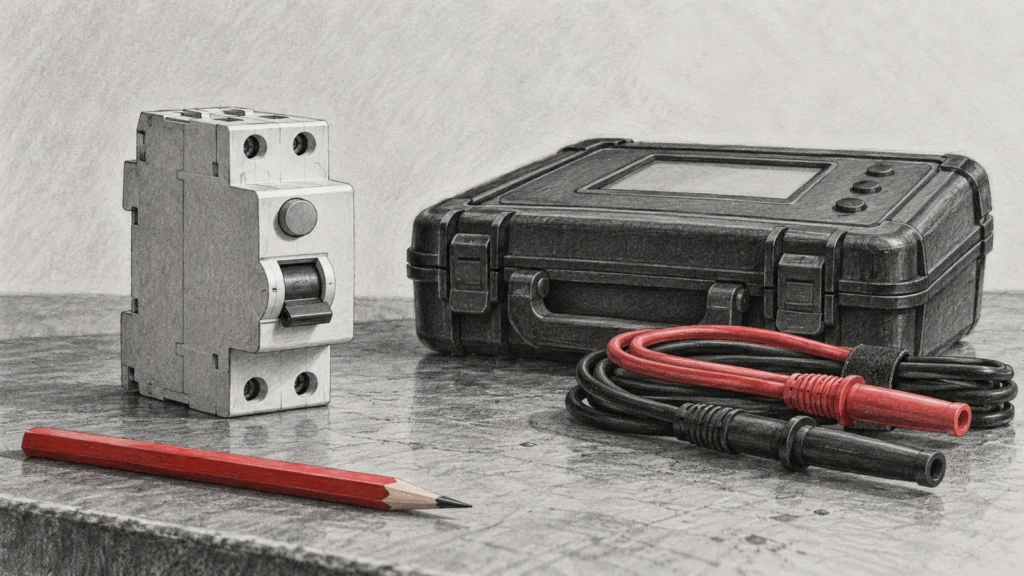
An RCD test button provides a built-in functional check. An appropriate test instrument can apply a defined test condition and record a response, such as disconnection time. Neither result should be presented as proof that every part of the panel and downstream installation has been verified.
At handover, record the button observation separately from any required instrument results. State the exact device, applicable inspection requirements, test method, instrument configuration and acceptance basis. Do not copy a generic test frequency or numerical pass limit into every project. The responsible electrical professional must establish the required checks for the installation, jurisdiction and device configuration.
For the buyer, the useful question is not which method is “better.” It is which verification task each method addresses, what evidence was recorded and which checks remain outside its scope.
Separate functional observation from measured response
The integral test facility allows a user to initiate the device's built-in check under its specified conditions. Record whether the intended device operated, rather than describing the observation as a complete electrical safety test. A button press does not provide a measured disconnection-time value or a documented instrument test current.
Instrument testing adds a defined test stimulus and a measured response where that is required by the applicable verification method. The IET's 2022 explanation of RCD testing changes distinguishes installation testing from the extensive product type testing performed by manufacturers. It also explains that instrument capabilities and settings affect how results should be interpreted.
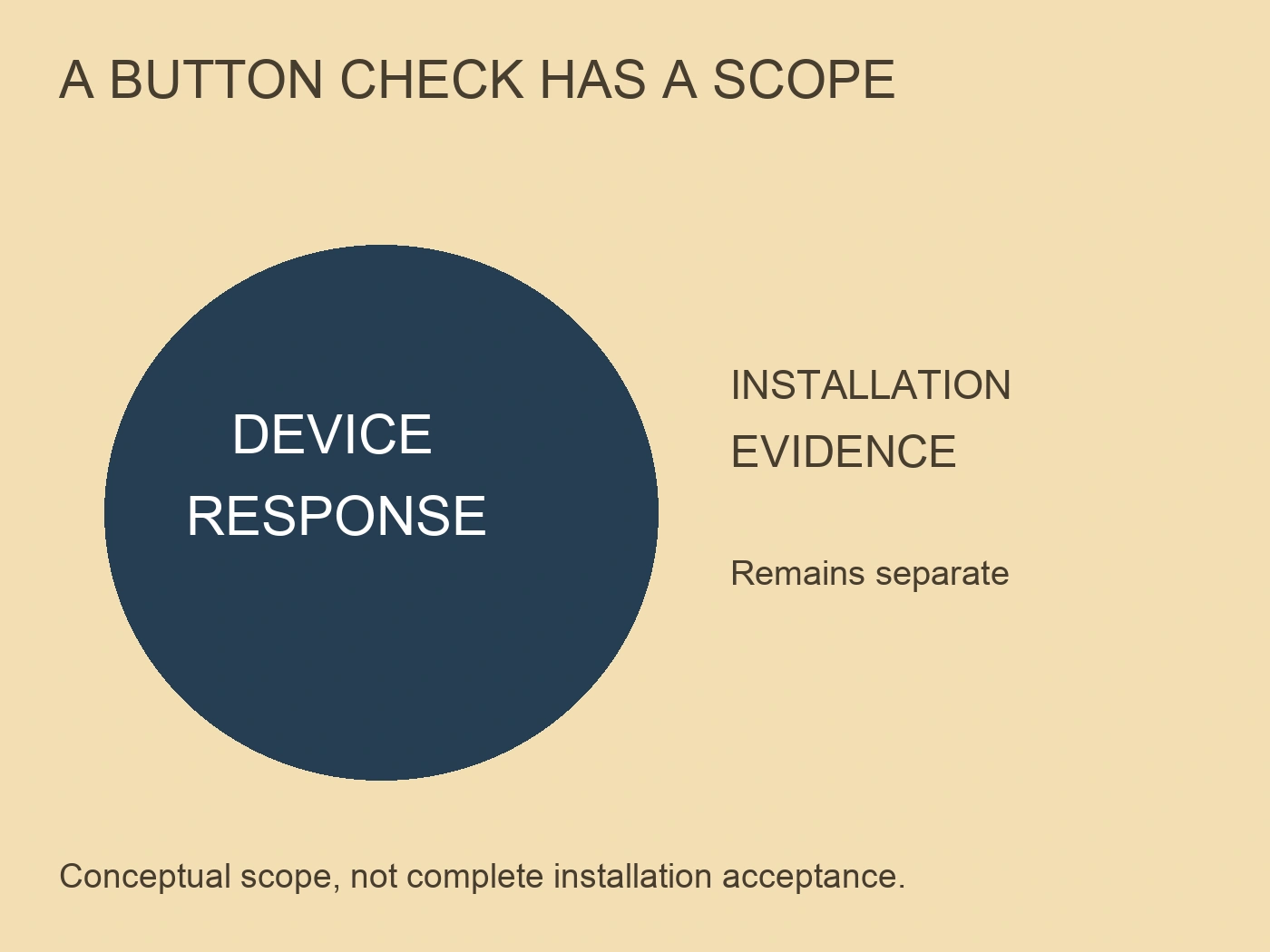
Do not extend either observation beyond its evidence. A satisfactory button check is not a record of protective-conductor continuity, circuit identification or the complete earthing arrangement. An instrument result obtained under one test condition is not a demonstration of every possible fault waveform or a new certification of the device.
This distinction matters commercially. A panel supplier may provide factory documentation while the installation contractor supplies on-site verification. The purchaser needs both scopes identified, not one unqualified “RCD tested” entry covering work by different parties.
Compare what the two records can establish
The following comparison is an original handover aid. Required checks and permitted alternatives remain governed by the project's applicable documents; it does not declare that instrument testing is mandatory everywhere or that button operation can always replace it.
| Handover question | Built-in test-button record | Appropriate instrument-test record |
|---|---|---|
| Did the integral check initiate operation? | Records the functional observation under specified conditions | Does not replace recording a separate button check where required |
| What test condition was applied? | Identifies use of the device's integral facility | Records selected method, settings and relevant applied condition |
| What response was measured? | Usually an observed operation, not a measured time | Can record the measured quantity supported by the instrument and method |
| Is the complete circuit verified? | No complete-installation conclusion from this observation alone | Limited to the declared test scope; other inspection and tests remain relevant |
| Is product type certification established? | Não | No; field verification is not manufacturer type testing |
| Can the record be reviewed later? | Requires device identity, date, observer and outcome | Also requires instrument identity, conditions, results and acceptance basis |
The table deliberately separates observations from conclusions. If a report only contains a tick beside “pass,” ask what the tick means and where the supporting record is held. A concise record can be adequate, but its meaning must be traceable.
Establish the acceptance basis before the visit
Identify the installation location, applicable rules, current project specification and manufacturer's instructions. Record the edition or revision used. Initial verification, periodic inspection, a fault investigation and routine user checks may have different purposes and reporting requirements.
Historical guidance is useful for understanding why test practices differ, but it is not automatically the current acceptance rule. The cited IET article concerns a particular 2022 amendment to UK BS 7671. Its discussion shows why an old worksheet or tester sequence should not be copied without checking the adopted requirements. This article intentionally supplies no universal trip-time limit or current multiplier.
Agree which organization is responsible for resolving conflicting documents. If the contract requests a test outside the normal installation-verification scope, identify its purpose and obtain an appropriate method rather than treating an arbitrary extra test as harmless evidence.
Where an instrument offers automatic sequences, do not assume its factory preset represents the project's required procedure. The professional carrying out verification must understand the selected sequence and its acceptance criteria. A screen label or device-type icon is not, by itself, a statement of compliance with the applicable project requirements.
Identify the exact RCD before interpreting a result
Record the manufacturer, full reference, residual-current type, rated residual operating current and any intentional delay classification relevant to the task. Include configuration or production information when the manufacturer's guidance distinguishes versions. Keep rated load current separate from the residual-current rating.
A Type A device description, for example, does not establish every instrument setting that a particular installation-verification method requires. The test waveform selected on an instrument and the device's classification are related technical matters, but they should not be treated as interchangeable labels.
Also identify the circuit or circuit group served. In an assembly containing both grouped RCCBs and individual RCBOs, avoid copying one device's result across several records. If operation interrupts more than the expected equipment, retain that observation for review rather than changing the circuit schedule to match an assumption.
For component inquiries, RITOKS lists the RTX-RCA63 Type A RCCB e o PXB2Ln-63 1P+N RCBO. Request configuration-specific instructions and supporting documents for the proposed item. These product pages do not establish the installed assembly's test procedure, its compatibility or a completed handover result.
Check instrument suitability and evidence of accuracy
Obtain the instrument reference and the method's required measurement capabilities. A general electrical meter is not automatically an RCD test instrument, and different installation testers may provide different options. Confirm the relevant functions from the instrument documentation rather than assuming an automatic mode covers every device and purpose.
The evidence of instrument suitability should address range, relevant test output or function, measurement capability and the accuracy-control arrangements used by the contractor. This is a documentation review, not an instruction to make connections at live terminals.
Electrical Safety First's Best Practice Guide descriptions emphasize maintaining and recording test-instrument accuracy and consistency. They also caution that plug-in socket testers cannot provide complete assurance of socket safety. A simple socket indication should therefore not be substituted for the declared instrument verification and wider installation checks.
Ask for the instrument's serial number and the applicable calibration or verification evidence under the contractor's system. Do not invent a universal annual calibration requirement. What matters is that the accepted system can support confidence in the results and identify when an instrument needs attention.
Record conditions that may influence the result
Record where the test was performed and the relevant state of the installation. Connected electronic loads, cable capacitance and existing leakage can influence instrument results, as discussed in the IET article. An unexpected reading requires interpretation of the test arrangement, not immediate assignment of device failure.
The responsible professional selects the safe arrangement and any necessary load management according to the method and instructions. Facilities staff should arrange operational access and outage permissions. They should not disconnect outgoing conductors, fabricate test leads or repeatedly experiment with instrument settings to obtain a favourable number.
Where several RCDs are installed in series, note which device operated and whether the intended result could be recorded. An upstream operation can affect interpretation and service continuity. It is not permission to bypass protection during testing.
O Health and Safety Executive's electrical FAQ stresses competence and secure isolation for electrical work. A successful RCD check does not make exposed conductors safe to touch. The testing plan and access controls must address the actual risks, independently of the desired handover result.
Use a handover record with explicit boundaries
Consider a hypothetical handover file for device RCD-Q1 serving group Q1. The factory sheet records “integral button operated device,” with the component reference and assembly identity. The site sheet records “RCD pass,” but has no method reference, instrument settings or measured result. The filled buyer-review entry should be “factory functional observation traceable; site installation-test scope unresolved.” The button record is useful evidence, while the unexplained site tick cannot be evaluated as a measured response.
The focused follow-up is to request the missing site record, not to order every possible test again. If the contractor supplies a result linked to RCD-Q1, its method, relevant conditions, instrument and acceptance basis, the professional reviewer can assess whether it closes the required scope. If the result belongs to a different device or the factory visit, it does not answer the original site question. Identity and purpose matter as much as the word “pass.”
Suppose RCD-Q1 was replaced after that site result was recorded. Keep the removed-device record as historical evidence and identify the replacement's reference in a new entry. The responsible verifier determines which affected checks must be repeated. Reusing the old result solely because the replacement has the same family name would obscure the change; automatically rejecting all unaffected records would waste useful evidence. The record should connect each retained result to the scope that remains applicable.
Finally, a routine operator button check can be assigned to a different maintenance activity from periodic professional verification. The handover file should name both owners and their instruction or requirement references, with agreed service-disruption arrangements. This avoids two common administrative failures: an operator believing that a button observation completes the contractor's testing obligation, and a contractor's historical result being mistaken for an ongoing check program. All records in this example are hypothetical; none represents an actual RITOKS installation test or an acceptance limit.
This original record structure helps a purchaser review the submitted evidence without dictating a universal test sequence.
| Record item | Provas a serem mantidas | Missing-information consequence |
|---|---|---|
| Device and circuit identity | Exact reference, relevant classification and circuit/group designation | Result cannot be confidently assigned to the installed item |
| Acceptance basis | Applicable document, edition and specified test purpose | A “pass” cannot be interpreted against a known requirement |
| Button check | Date, observer, operating conditions and observed outcome | Integral functional observation remains unrecorded |
| Instrument verification | Method, settings, measured result and units where applicable | Required quantitative or method-specific evidence remains incomplete |
| Instrument control | Reference, serial number and relevant accuracy-control evidence | Confidence in the submitted reading cannot be assessed |
| Installation conditions | Test location, relevant load state and other devices that operated | Unexpected results may be misinterpreted |
| Review and closure | Responsible professional, disposition and remaining limitations | Unresolved work may be mistaken for accepted service readiness |
Keep factory documentation separate from on-site results, while linking both to the same assembly identity. If a device is replaced after testing, review what evidence must be repeated for the changed installation. A record for the removed item should not silently become the result for its replacement.
Handle unexpected outcomes without hiding them
If a test button does not produce the expected operation, follow the applicable instructions and escalate the finding. Do not return the installation to accepted service on the assumption that the button is unimportant. Equally, a failure observation is not a complete root-cause diagnosis without review of the device and test conditions.
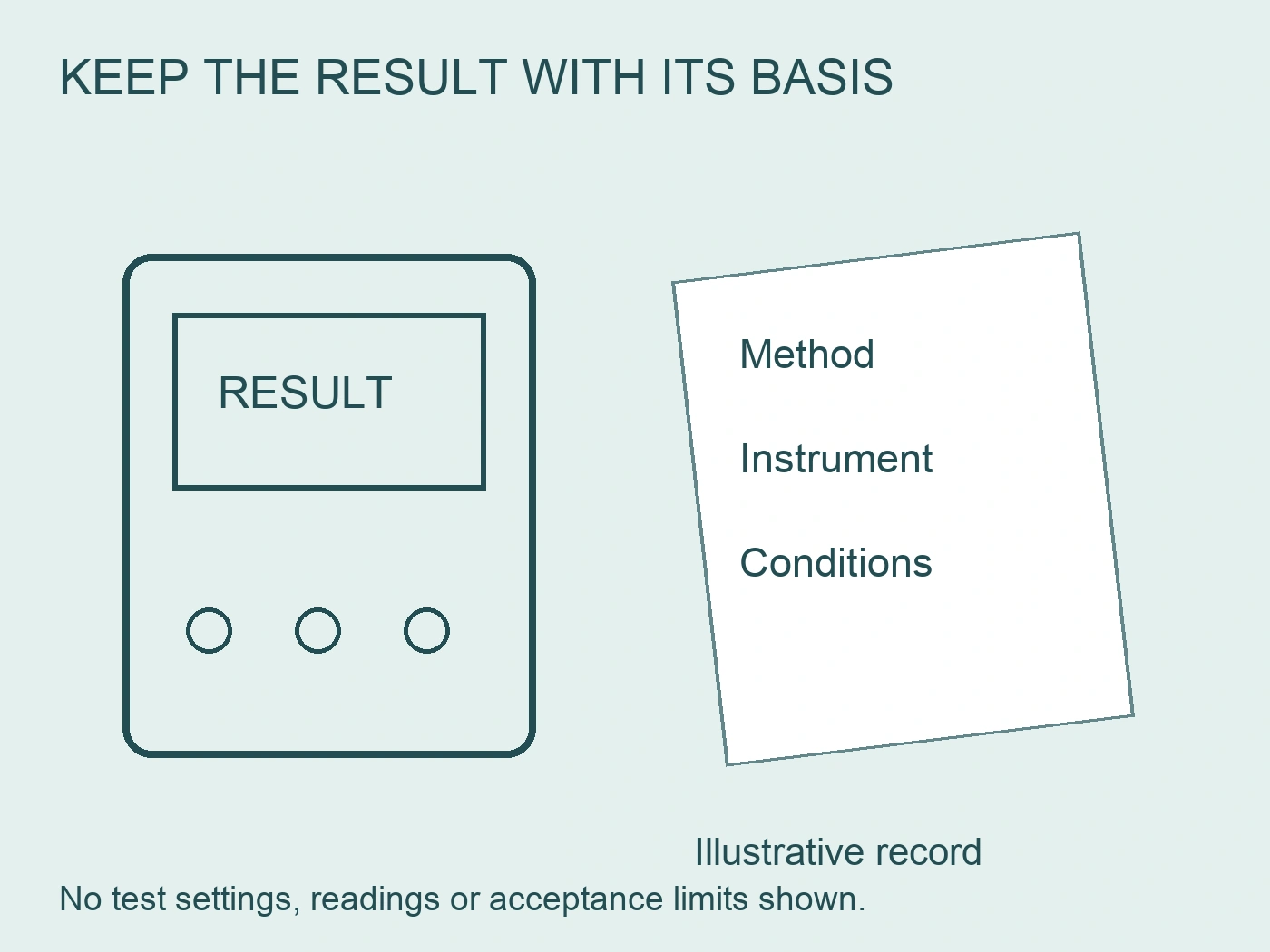
If an instrument result is unexpected, retain the reading and settings. Check the method, device identity, instrument capabilities and relevant installation conditions before drawing the conclusion. Repeatedly changing settings until a passing number appears destroys the value of the record.
The closing entry should state whether the issue was resolved, what was changed, what evidence supports the resolution and whether anything remains unverified. Where the inspection scope excludes part of the installation, identify that limitation explicitly.
Set the routine-check plan at handover
Routine test-button checks and periodic professional verification are separate maintenance activities. Specify the responsible person, approved instructions, service-disruption arrangements and the recorded basis for each interval.
Schneider's RCBO test-interval FAQ distinguishes local guidance, environmental conditions and particular voltage-dependent technologies. That is useful evidence that a single interval should not be assigned to all RITOKS devices by analogy. Obtain the instructions for the installed configuration and apply the relevant local requirements.
Give operators a clear escalation route for an unsuccessful check or an unexplained trip. Keep the plan accessible with the circuit schedule and maintenance documentation. The objective is a usable ongoing check system, not an interval printed on a label without ownership.
Referências
- Peace, M. (2022). Changes to RCD testing in BS 7671:2018+A2:2022. IET Wiring Matters, July 2022. Amendment-specific historical explanation, not a universal current test sequence.
- Electrical Safety First. (n.d.). Best Practice Guides. Actual HTML descriptions of instrument accuracy control and socket-tester limitations. Retrieved October 2, 2026.
- Health and Safety Executive. (n.d.). Electrical safety: frequently asked questions. Competence, RCD checks and safe working. Retrieved October 2, 2026.
- Schneider Electric. (2017). What is the recommended interval between tests for an RCBO?. Manufacturer-specific interval guidance. Retrieved October 2, 2026.