
AC Contactors for Industrial Motor Control · Technical Explainer
Reversing a Motor: Define Stop, Coast and Reverse as Separate States
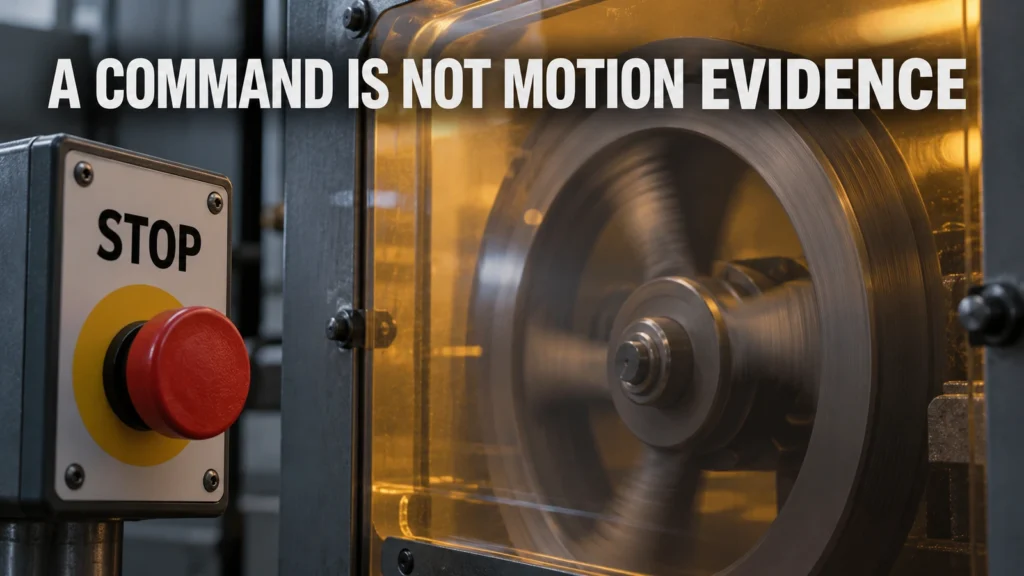
Use three descriptions rather than one stop label
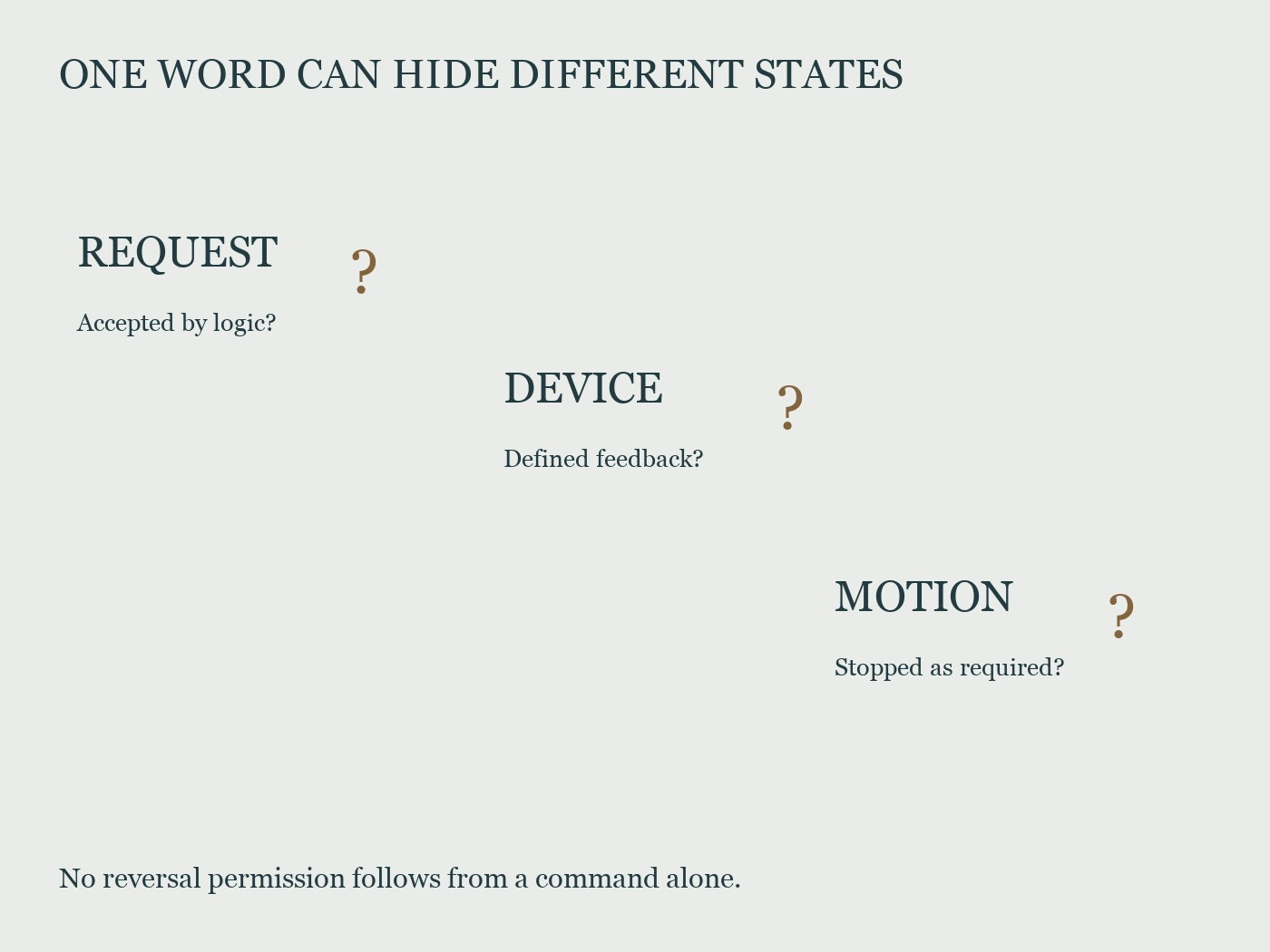
Start with the command: what has the operator or controller requested? Then identify the electrical switching state supported by the available feedback. Finally, identify the physical motion state using the evidence required by the application. Keeping these descriptions separate prevents a control indication from silently becoming a claim about shaft motion.
For example, a stop request may initiate the approved stopping sequence. Its acknowledgement does not by itself establish the final contactor condition. A confirmed change in contactor state does not by itself establish that every moving part has reached the condition required for reversal. The responsible designer must specify what each signal means and what remains unconfirmed.
| Description | Question it answers | Question it does not automatically answer |
|---|---|---|
| Stop command received | Was the stop request accepted by the control logic? | Has the power circuit completed its response? |
| Forward contactor state | What switching condition does the defined feedback indicate? | Is the motor or driven mechanism stationary? |
| Coasting or stopping state | Is the machine still completing its stopping process? | Is opposite-direction energisation permitted? |
| Reverse permission | Have the required application conditions been established? | Is the contactor rated for an unspecified operating duty? |
| Reverse running state | Is the commanded sequence established as defined? | Have all machine hazards been resolved? |
These are review labels, not universal control inputs. A particular machine may need other states or evidence. Document those requirements instead of adding a generic elapsed-time permission to every reversing circuit.
Distinguish stopped reversal from plugging duty
Describe what happens when the opposite direction is requested while the motor is still turning. Does the approved design reject the request, retain it until specified conditions are satisfied, or implement a specifically engineered braking or reversal function? Procurement cannot infer that behaviour from the word “reversing.”
Schneider Electric's TeSys Giga utilization-category guide distinguishes motor switching duties, including plugging and inching under AC-4. Its table also includes reversing in the AC-3 description. Therefore, “reversing always means AC-4” is too crude, just as an AC-3 family listing does not prove suitability for repeated plugging.
Use the actual operating sequence to ask the supplier for the appropriate model-specific rating. State the motor information, supply, reversal frequency and intended switching condition. The required duty is an engineering selection input, not a marketing label that a general guide can allocate without the application details.
| Operating requirement | Information to obtain | Procurement consequence |
|---|---|---|
| Reverse only after a defined stopped condition | How that condition is established and maintained | Confirm the ordinary reversing assembly against the defined duty |
| Opposite command during run is refused | Request handling and operator indication | Specify the control behaviour as well as the hardware |
| Request is retained during stopping | Permission criteria, cancellation and restart conditions | Include sequence responsibility in the supplier scope |
| Plugging or rapid direction changes are intended | Motor/load approval and switching-duty evidence | Do not rely on a generic AC-3 statement |
| Braking equipment is present | Its role, sequence and interaction with direction control | Review the complete coordinated arrangement |
Avoid inventing a safe reversal delay from motor power or contactor size. A time interval, if the actual application uses one, needs its own documented basis and limits.
Identify what the interlocks actually provide
Mechanical and electrical interlocks belong in the assembly review, but their purpose must be described correctly. Ask for the exact manufacturer's arrangement that prevents conflicting forward and reverse switching commands or contactor operation. Do not present an interlock as proof of stopped motion or as automatic evidence of a complete machine safety function.
Schneider's FAQ FA114642 gives a specific example for its Class 8736 reversing starters: normally closed auxiliary contacts are factory wired for electrical interlocking. That documents a switching-control function for the named equipment. It neither identifies the auxiliary arrangement supplied with UKC1-R nor establishes a motion-detection function.
For the proposed assembly, obtain the contactor order codes, interlock accessory details and control diagram. Ask how the available feedback is used in the sequence and which states it can legitimately establish. The panel builder should resolve any mismatch between the hardware supplied, drawing symbols and controller signal descriptions before acceptance.
If the quotation mentions an interlocked pair but omits auxiliaries or control wiring scope, make those omissions visible in the comparison. A mechanical assembly, a wired reversing starter and a machine controller are not necessarily the same commercial deliverable. Two quotations can appear equivalent while leaving different sequence responsibilities with the buyer.
Write a state table before selecting a waiting time
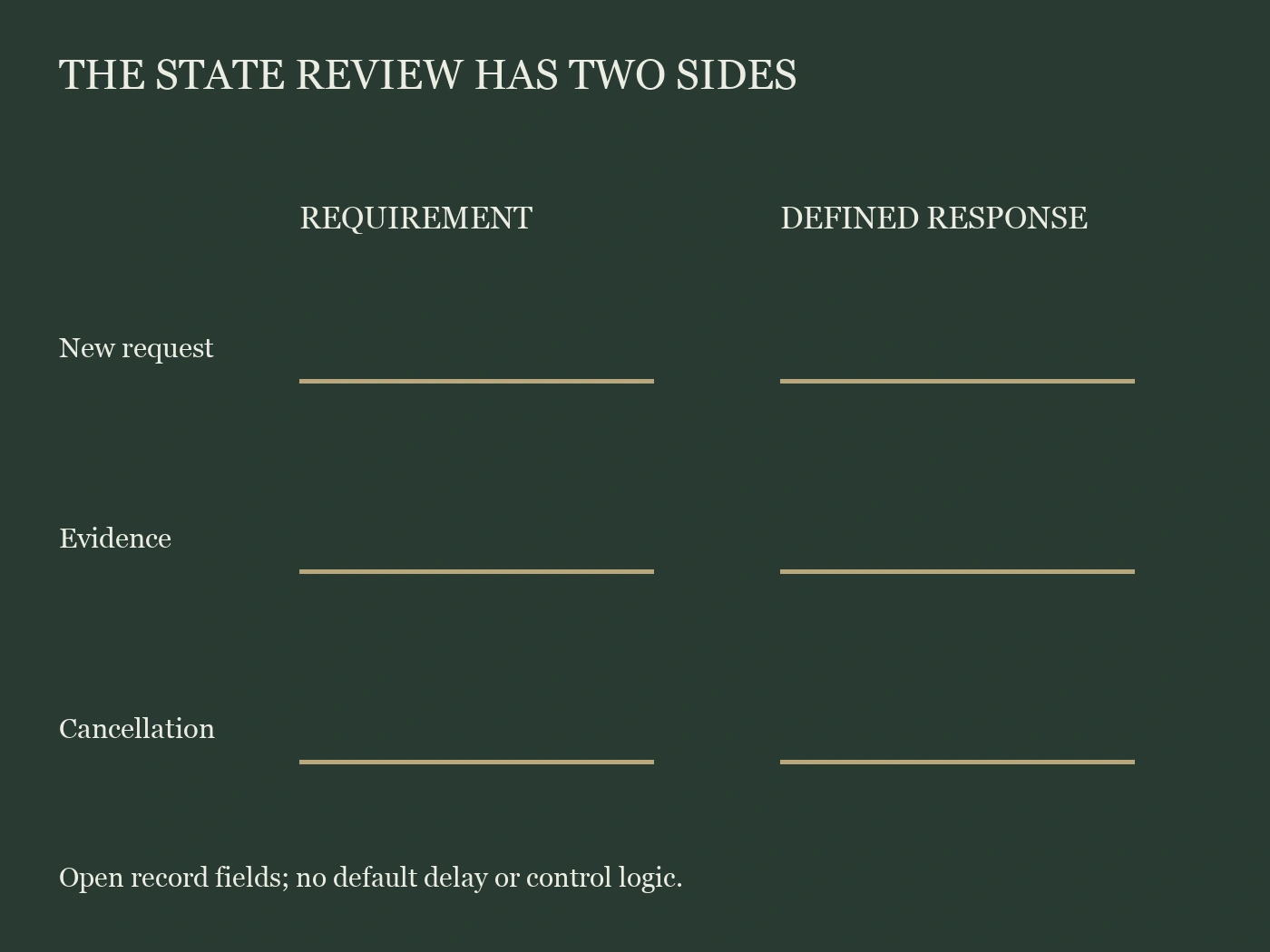
A useful state table contains the current state, new request, required conditions and specified response. Include requests that occur during stopping rather than reviewing only a normal forward-to-stop-to-reverse cycle. Mark unresolved conditions as questions for the machine designer; do not hide them behind “delay complete.”
For a stopped-reversal requirement, the designer should define the evidence that permits reverse and what happens if it is absent or inconsistent. If the machine uses a time-based element, document which operating conditions its engineering basis covers. The chosen method must come from the actual motor, load and control requirements.
Also state how a direction request is cancelled. Does a new stop request remove a pending reverse request? What happens after an overload operation or control-power interruption? Is operator acknowledgement required before restarting? Those are practical specification questions because retained commands can otherwise be interpreted differently by the controller programmer and the panel supplier.
Distinguish normal operational stopping from any required emergency or safety-related stopping function. This article does not select a stop category, performance level or safety architecture. The project's risk assessment and qualified design process must establish those requirements separately from the purchasing state table.
Review motion evidence at the machine, not just the coil
The driven machine may have relevant motion that a contactor status does not describe. Ask the machine builder what must be checked before the next directional operation and whether motor-shaft information alone represents the driven mechanism. Record the actual evidence method instead of assuming the last electrical command defines every moving component.
Identify what the selected feedback represents, including its location and limitations. If a sensor, controller estimate or timing method is used, the responsible engineer should define its valid conditions and failure response. “Zero speed” on a signal list is a label; its meaning and suitability still require documentation.
Keep the braking scheme explicit where one exists. Which component performs the braking function, when is it applied, and which condition permits the direction sequence to proceed? Do not attach an unspecified brake to the drawing and then assume it provides an immediate stopped state.
For commissioning, ask for an approved test plan covering the relevant sequence and operating conditions. Observations should connect command timing, defined contactor feedback and required motion evidence. They should not be reported as proof of an untested load case or as a universal stopping time for another machine.
A quotation disagreement that the state method resolves
Consider a hypothetical machine RFQ describing “forward/reverse motor control” without any sequence detail. One supplier offers an interlocked contactor pair for ordinary operation. Another interprets the request as repeated rapid reversal. Both respond to the same short phrase, but they have priced different duties and responsibilities.
The buyer should issue a common state requirement before choosing between those offers. Explain how requests during operation are handled, identify whether reversal occurs only after the required stopping condition, and provide the motor and load information. Ask both suppliers to confirm the exact switching-duty evidence and the control functions included in their proposals.
If the design has not yet decided whether plugging is permitted, leave that question with the machine engineer. Do not resolve it by selecting the lower-cost assembly or by adding an arbitrary pause in software. The revised RFQ should distinguish confirmed requirements from pending design decisions.
This is an original procurement example, not a RITOKS field case, measured stopping result or claim that a particular controller implementation has been validated.
Specify the UKC1-R assembly without expanding its claims
Cele publicate RITOKS UKC1-R reversing contactor assembly describes an interlocked contactor pair for three-phase forward/reverse control. It calls for confirmation of AC-3 duty, coil requirements and reversal frequency for the application. That is a commercial starting point, not approval for frequent plugging or a complete machine stopping function.
Send the motor data, supply and control requirements, defined direction sequence, operation frequency and protection scope with the quotation request. Include the approved state table and ask which interlocks, auxiliaries and wiring are part of the ordered configuration. Request documentation for the exact contactors and assembly rather than relying on an unqualified family designation.
For acceptance, keep separate records of component identity, switching coordination and machine sequence evaluation. A successful hardware inspection does not replace a sequence test, and a sequence observation does not establish an undocumented contactor duty rating. Assign the remaining application decisions to their responsible reviewers before treating the order as complete.
The practical aim is clarity: stop is a request, coast or stopping is a machine condition to establish, and reverse is an operation that requires its own permission and rated duty. Defining those separately gives the panel supplier and machine builder a common specification without pretending that an interlocked pair answers every question.
Referințe
- Schneider Electric. Categorii de utilizare, TeSys Giga contactors and thermal overload relays installation guide, DOCA0189EN-05, n.d.; AC category table. Official guide.
- Schneider Electric. FAQ FA114642, published December 22, 2005; modified August 15, 2026; electrical-interlocking auxiliaries on the specified Class 8736 starters. Official FAQ.