
Enclosure Climate Controls · Technical Explainer
Hygrostat Readings Change with Temperature: Use the Local Conditions
Quick answer
Relative humidity is a temperature-dependent condition at the sensing location, not a direct measure of how much water the whole cabinet contains. A reading can change when local temperature changes even without a corresponding moisture-removal process. Record local temperature, relative humidity and control state together before interpreting a hygrostat response. Choosing between the two controls is covered in thermostat vs hygrostat for electrical enclosures.
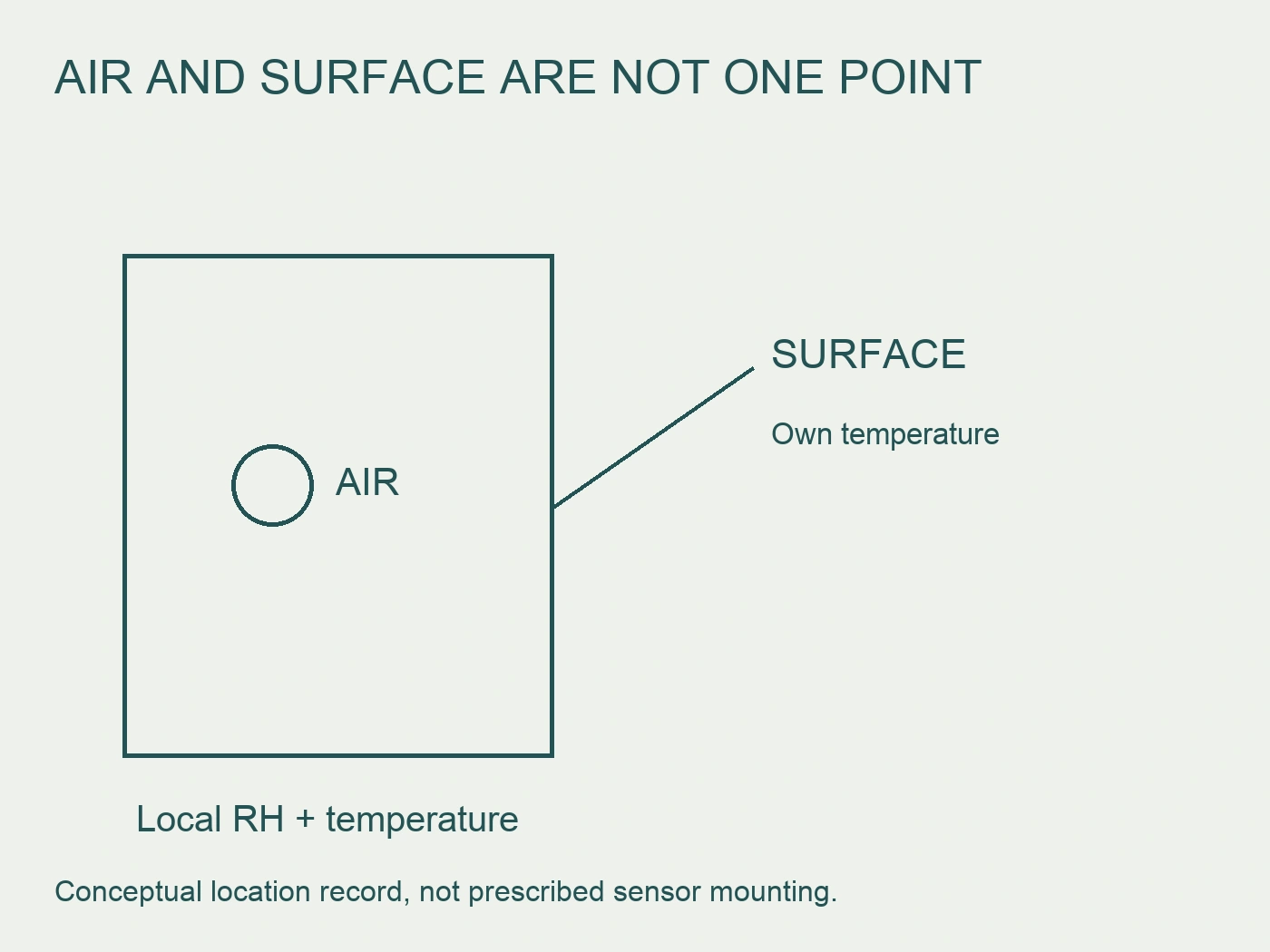
Also distinguish local air conditions from the temperature of a cold enclosure surface. A lower RH near a heater does not prove that condensation is impossible elsewhere. Use the exact controller's sensing and switching documentation, then assess the required locations and operating cases. This guide concerns interpretation and sensor placement; it does not choose a universal humidity setting or repeat a general dew-point calculation guide.
Separate a real local change from a measurement error
There are two different temperature effects to review. First, the local air can change temperature, changing its relative humidity. Second, a sensor at a different temperature from the surrounding air can produce an unrepresentative RH measurement. Treating both effects as a failed hygrostat can lead to an unnecessary replacement without resolving the actual condition.
Vaisala's humidity measurement guidance defines RH using water-vapour pressure relative to temperature-dependent saturation pressure. Its installation guidance also explains that the probe should be in thermal equilibrium with the environment being measured. Those principles support recording temperature alongside RH; the guidance's special test-chamber installation details are not universal mounting instructions for cabinet switches (Vaisala, n.d.-a).
Do not label a warmer reading as better merely because its RH is lower. The relevant question is whether it represents the region the controller is supposed to manage. A hygrostat near a local heat source and a comparison instrument near a cold wall may both report their own local conditions. Their disagreement does not automatically establish which instrument is wrong.
For a reference comparison, use instruments and a procedure appropriate to the task. Vaisala's HM70 guide specifically warns about errors when probe and environment temperatures differ. A newly positioned probe should not be treated as an immediate calibration verdict before the required equilibration and instrument conditions are met (Vaisala, n.d.-b).
Map the control location and the surfaces of concern
Identify the hygrostat's actual sensing element or documented sensing region. Mark its installed position on a cabinet drawing and note its relationship to the heater, ventilation openings, cable entries and relevant equipment. Use actual instructions to determine permitted mounting; do not relocate the device solely to make its reading match a target.
Then identify which locations the project needs to assess for moisture and condensation concerns. These may include a colder wall or region away from the heater, but the required points depend on the enclosure and environment. An unlabelled cabinet RH value cannot describe every surface or air zone.
Keep air and surface measurements separate in the record. A surface-temperature reading should identify the actual surface and method. An RH reading should identify its air location and instrument. Do not combine measurements from unrelated places and times into a dew-point conclusion without checking whether they represent the same relevant conditions.
| Location record | Information to capture | Misinterpretation it prevents |
|---|---|---|
| Controller sensing region | Documented element and installed position | Calling a local control response a cabinet-wide reading |
| Heater relationship | Position and operating state | Assuming lower local RH proves water removal |
| Reference air point | Instrument, location and local temperature | Comparing unlike measurement environments |
| Cold surface | Surface identity, temperature method and time | Replacing surface condition with warm-zone air temperature |
| Air exchange path | Openings and relevant operating configuration | Treating different ventilation cases as identical |
| Unresolved location | Missing drawing or inaccessible measurement point | Hiding a gap behind one convenient cabinet value |
This map helps frame the review; it is not a requirement to add more sensors to every cabinet. Use only the locations needed for the actual control and environmental questions. If a required point cannot be observed safely, record the limitation rather than improvising an energized measurement method.
Log temperature and control state with RH
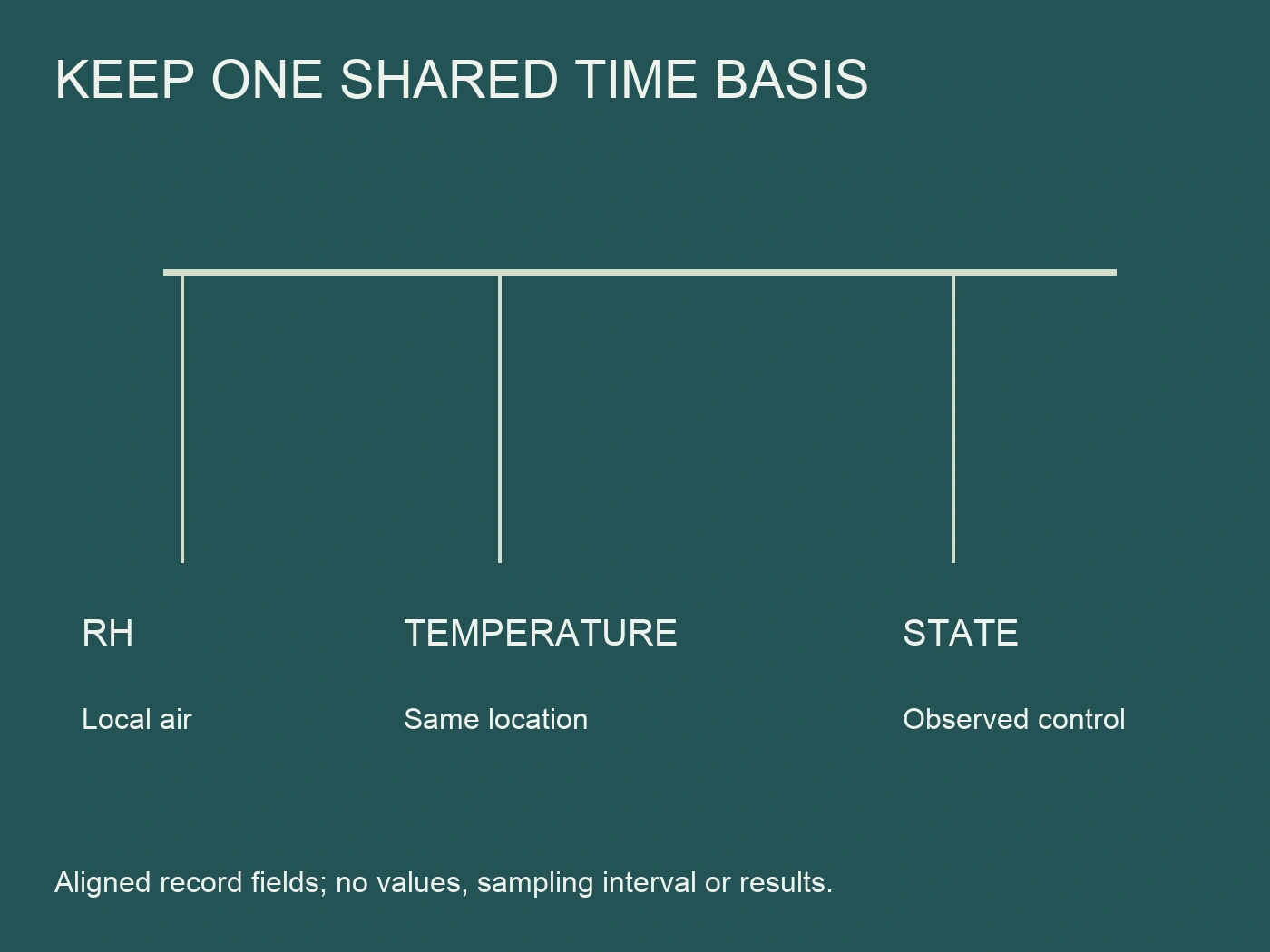
Use a common time basis for local temperature, RH, heater or fan state and relevant environmental events. A sequence containing only RH can conceal the reason the value changed. Recording a heater start, a door opening or a change in the surrounding environment helps the reviewer identify which conditions accompanied the response.
Separate direct measurements from inferred states. A controller contact state is not necessarily evidence that the driven heater is producing heat, and a commanded fan state is not necessarily evidence of airflow. If the review needs actual load operation, document the permitted observation method rather than filling the field from an assumed wiring relationship.
Check whether the device provides a reading, an adjustable scale, a switch response or a combination. A setting mark is not a continuous measurement display. For a switch-only device, the log can record reference RH and temperature around a switching event, subject to the documented sensor relationship and tolerance. Do not invent data that the device never outputs.
| Log field | What to retain | What it supports |
|---|---|---|
| Timestamp | Shared time reference for observations | Relates environmental changes to control operation |
| Local temperature | Instrument and exact air location | Explains a temperature-associated RH change |
| Local RH | Instrument, location and data validity | Identifies the condition actually measured |
| Control response | Observed contact or reported state | Distinguishes sensing response from load performance |
| Driven-load observation | Permitted evidence of heater or fan operation | Confirms the action required by the review |
| Surface/environment case | Relevant surface temperature and external conditions | Limits conclusions to the conditions represented |
Do not select a universal sample interval or observation duration from this table. The commissioning task, controller response and instrument documentation determine what is needed. Preserve the original log and note gaps, because a polished summary chart cannot reconstruct a transition that was never recorded.
Do not equate lower RH with a dry cold surface
A heater can change local temperature and therefore the RH reported in that region. That observation alone does not show that moisture has left the enclosure or that a separate cold surface is above the condensation condition. Evaluate the environmental record rather than treating one lower percentage as a completed condensation assessment.
Vaisala's discussion of condensing environments links condensation to the relationship between surface temperature and dew point, and explains that heated humidity probes need additional temperature information when reporting RH. Its specialised warmed-probe technology is not a feature inferred for a cabinet hygrostat; the relevant lesson here is that temperature and measurement location remain part of interpretation (Partanen, 2019).
Use a valid combination of measurements and an appropriate method when the project requires a dew-point assessment. This article supplies no universal RH threshold that guarantees freedom from condensation. Nor does it recommend heating the sensor as a remedy for an inconvenient reading. A controller selected for local RH switching must be reviewed as that architecture, not relabelled as a cold-surface detector.
If two instruments disagree, first compare locations, temperatures, validity and documented uncertainty. If a difference remains under a suitable same-condition comparison, follow the manufacturer's calibration or service procedure. Changing a setting merely to conceal the disagreement would remove the symptom from the display without establishing trustworthy control evidence.
Request exact controller information before setting acceptance criteria
Этот RITOKS MFR012-2 enclosure hygrostat family is described as relative-humidity switching. The ETF012 temperature and humidity controller family combines environmental inputs, with outputs and detailed operation requiring version confirmation. These are relevant sourcing paths, not published guarantees for an arbitrary cabinet's condensation performance.
Request the exact order code, sensing arrangement, range, tolerance, switching differential and output duty documentation. For a combined controller, establish how the two inputs affect the output rather than assuming independent relays or a specific logical rule. Provide the intended load and installation conditions for the electrical and environmental review.
Keep device acceptance separate from enclosure performance acceptance. A controller can satisfy its documented switching behaviour while the larger arrangement still needs review. Conversely, an environmental record that looks acceptable during one operating case cannot establish every seasonal or shutdown condition that the project may require.
A conditional interpretation example
Consider a hypothetical cabinet whose reference RH falls after its heater operates. The initial record contains a measurement near the heater but no local temperature or cold-wall observation. The team describes the cabinet as dry based only on the lower percentage.
The reviewer asks for a location-labelled record containing the temperature associated with the RH reading, the heater state and the surface conditions relevant to the project. If the review shows that the required cases are supported by valid measurements and the selected control arrangement, acceptance can proceed. If the lower percentage represents only a warmer local region, the missing enclosure condition remains unresolved.
The example does not report a measured failure or prescribe a threshold. It shows why a temperature-associated RH change is insufficient evidence for a cabinet-wide moisture conclusion. Any revised control or heating arrangement requires its own review, not an automatic setting change.
Часто задаваемые вопросы
Why does RH fall when the local air becomes warmer?
RH relates water-vapour pressure to a temperature-dependent saturation value. A lower percentage can therefore accompany a temperature change without proving that water has been removed. Retain the local temperature and conditions with the reading.
Does disagreement with a reference meter mean the hygrostat is faulty?
Not automatically. Compare sensing locations, thermal equilibrium, valid measurement conditions and the device documentation first. A proper same-condition comparison can support a service decision; unrelated local readings cannot.
Can a humidity setting guarantee no condensation anywhere?
No universal setting is established here. Cold-surface temperature and the relevant moisture conditions matter, while a hygrostat responds to its sensing region. Assess the project's actual locations and cases rather than assigning a cabinet-wide guarantee to one percentage.
Does a combined temperature and humidity controller remove the need for location review?
No. Confirm its sensing arrangement and output logic, then review whether the measured region represents the intended control task. Two inputs do not automatically establish the conditions of every cabinet surface.
Список литературы
Partanen, J. (2019, January21). Measuring humidity in condensing environments. Vaisala. https://www.vaisala.com/en/blog/2020-10/measuring-humidity-condensing-environments
Vaisala. (n.d.-a). Humidity measurement in test chambers: Questions and answers. https://www.vaisala.com/en/application-note/humidity-measurement-test-chambers-questions-and-answers
Vaisala. (n.d.-b). Errors caused by temperature differences. HM70 User Guide (M210297EN-G). https://docs.vaisala.com/r/M210297EN-G/en-US/GUID-9D273B5F-99DE-4C66-B8C9-644EED6833B6