
DC Molded Case Circuit Breakers (MCCB) · Technical Explainer
DC MCCB and Fuse Coordination: What a Selectivity Claim Needs
Quick answer
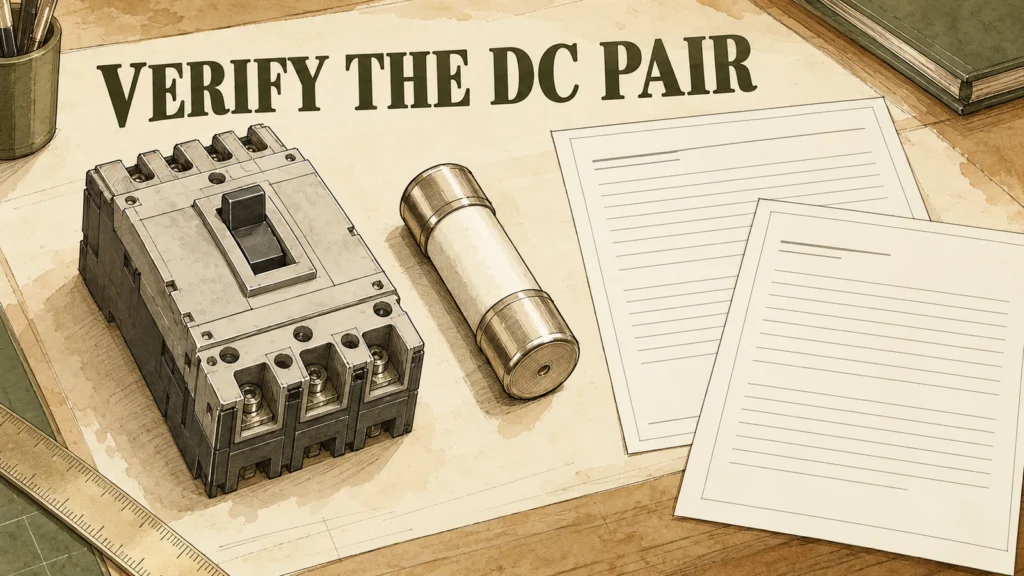
A DC molded case circuit breaker and a fuse may each have suitable individual ratings without forming a selective protection pair. A defensible selectivity claim identifies the upstream and downstream devices, their settings, the DC circuit conditions and the fault range covered by the supporting evidence. Buying two capable components is not the same as verifying how they interact.
This guide is for protection procurement and engineering review, not a settings recipe. It addresses installations where both technologies are present. It does not declare any RITOKS breaker and fuse combination selective, supply a universal rating ratio or authorize a protection delay. Those decisions need exact-device information and the system protection study.
Define the service outcome before selecting the pair
Selectivity concerns which protection operates for a fault and what remains supplied. ABB distinguishes total selectivity from selectivity limited to a particular current range. Its general explanation is not a test report for a DC MCCB and fuse pair, but it establishes why a selectivity claim needs a stated boundary. ABB selectivity overview.
Start the review with the service requirement. Which healthy branches should remain available after a branch fault? Is interruption of an entire feeder acceptable for a bus fault? Which fault locations fall outside the promised service outcome? Put those answers on the single-line drawing or in its accompanying protection schedule.
A purchase specification that says only “selective protection required” leaves suppliers guessing about the required result. An identifiable upstream MCCB and downstream fuse arrangement is different from an upstream fuse and downstream MCCB arrangement. List the actual sequence and location, rather than treating the two components as an unordered set.
Describe whether the requested conclusion concerns overload behavior, short-circuit behavior or both. A statement covering one part of the operating range should not be presented as evidence for every fault. The project engineer should define the applicable scope before procurement asks a supplier to demonstrate it.
Establish the DC conditions that the evidence must cover
A selectivity submission should match the system it is meant to protect. Request the DC voltage, source arrangement, relevant fault-current range, current direction and applicable fault-current rise conditions. If those conditions are unavailable, record the gap rather than treating nominal load current as a substitute for fault information.
ABB's marine DC protection discussion identifies batteries, capacitors and converters as relevant fault contributions in its studied architecture. That example shows why source identity matters; it does not establish the fault current or converter behavior of a different installation. Use the actual equipment documentation and system study for the project. ABB, “Breaking ground”.
The following is a review worksheet, not a completed coordination calculation. Its purpose is to make the supplier's evidence comparable with the project's conditions.
| Обзор товара | Record required | Question for the submission |
|---|---|---|
| Device order | Upstream and downstream references | Does the evidence cover this order? |
| DC operating conditions | Voltage and source configuration | Do document assumptions match the system? |
| Fault range | Relevant minimum and maximum conditions | What part of that range is supported? |
| Fault development | Applicable waveform or time-constant assumptions | Is the DC evidence conditional on these values? |
| Breaker configuration | Frame, release, settings and pole arrangement | Is the tested or assessed configuration identical? |
| Fuse identity | Exact type, rating and revision | Is substitution permitted in writing? |
Keep the operating states visible. A charging state, a discharging state or a changed source connection may require separate evaluation. Do not assume that reversing normal power flow automatically preserves an existing protection conclusion. Ask the responsible engineer which states have to appear in the study.
Read curves according to what they actually describe
Two curves drawn on one chart can be useful without proving a complete selective combination. First identify the meaning of each trace or band: its device identity, current basis, operating-time definition and stated conditions. A visual gap is meaningful only after these descriptions have been reconciled.
Eaton's high-speed fuse application guide explains that DC circuit inductance affects current rise and that this influences fuse melting characteristics and peak let-through behavior. It also identifies fault-condition time constant as relevant. These are Eaton fuse-application principles, not permission to copy an AC graph into a RITOKS DC combination assessment. Eaton high-speed fuse application guide.
For a fuse, ask whether the supplied information describes pre-arcing behavior or complete clearing. For a breaker, ask what the operating band includes and whether the release configuration is the one being purchased. Where a graph does not establish the short-circuit interaction, request the applicable combination assessment instead of extending the plotted lines by eye.
The reviewed material does not establish a universal fuse-to-MCCB rating ratio for DC selectivity. Procurement should therefore avoid turning an unsupported rule of thumb into a contractual acceptance criterion. A supplier should identify the evidence used for the specific pair and its limits.
Keep graph annotations separate from conclusions. A reviewer may note “curves supplied, operating definitions unresolved.” That is more useful than “selective” because it identifies the next technical question without pretending that it has been answered.
Separate selectivity from other protection claims
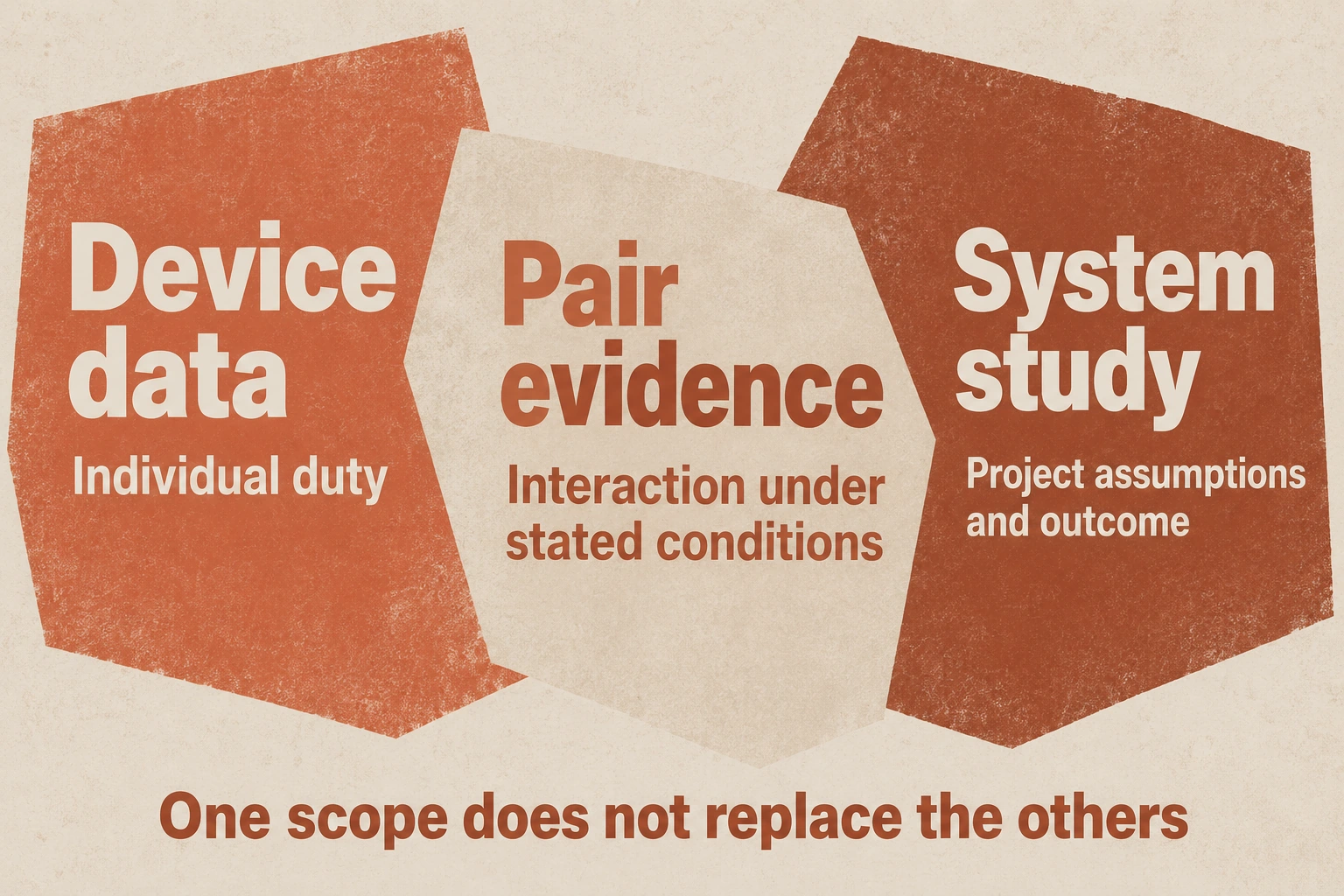
Individual interrupting capability, selective operation and protection of connected equipment answer different questions. A document proving one should not silently close the others. The review should name the claimed outcome and point to the evidence that supports precisely that outcome.
For example, a statement that a breaker has a specified DC breaking capacity is not itself a statement about a fuse remaining intact during a downstream event. Equally, fuse clearing data do not demonstrate the availability of healthy circuits after every fault. Treat the protection pair as a separate review object.
A useful evidence register can distinguish the following submissions. None of these rows is a declaration that a proposed RITOKS combination meets the requirement.
| Submission | What to identify | What it should not be mistaken for |
|---|---|---|
| Individual device data | Exact product and DC conditions | Complete pair selectivity evidence |
| Combination table or report | Both devices, order and conditions | Approval for unspecified replacements |
| Coordination study | System assumptions and setting schedule | An installation inspection record |
| Equipment protection assessment | Protected equipment and acceptance basis | Automatic continuity of every healthy branch |
| Assembly acceptance record | Actual fitted components and settings | Permission to alter the approved design |
When a supplier uses terms such as backup protection, cascading or selectivity, ask for a definition within the supplied documentation. Do not accept an interchangeable use of these labels. If the claim is limited, its limit belongs in the procurement record rather than in an informal email that may be lost.
Turn the assessment into an identifiable procurement item
The RITOKS DC molded case circuit breaker category и DC fuse link category are separate commercial families. Use the selected models from those families as inputs to an evidence request, not as proof that any two products are already coordinated.
Attach the exact order codes, release variants, settings, relevant pole configuration and fuse revision to the request. A family name alone may leave several materially different options open. Ask the supplier to identify whether its conclusion is based on a test, a published combination table or an engineering assessment, and to name the document revision.
There should be a clear route for unanswered questions. If the relevant DC combination evidence is missing, procurement can request it, ask the engineer to assess another documented pair or retain the item as unresolved. It should not replace the missing evidence with a confident paragraph in the article or a sales note.
For quotations, distinguish a component offer from a coordinated-system offer. If the supplier is only offering components, say so. This avoids assigning protection-study responsibility to a party that has not accepted it and prevents an exact-model substitution from being approved solely on price and nominal current.
Preserve the result through settings and replacements
A coordination conclusion should remain traceable to what is actually fitted. Record the approved setting schedule and the source assessment together. The purchase order, panel drawing and commissioning record should refer to consistent identifiers, so the reviewer does not have to reconstruct which revision was intended.
Consider a hypothetical handover in which the study names one fuse revision but the spare-parts list names only a broad size and current rating. No fault test is assumed in this example. The discrepancy is a documentation problem: the maintenance team cannot tell whether a proposed spare retains the assessed pair. Resolve the replacement rule before accepting the handover.
The same applies to a changed trip unit or setting. This guide does not recommend delaying an upstream device to obtain a better-looking graph. Any proposed adjustment has to return to the responsible engineer for review against the relevant protection and equipment constraints.
Close the register with a specific outcome: supported within named conditions, limited to a named range or still unresolved. That wording preserves the difference between an engineering conclusion and a procurement aspiration. An approval that cannot identify its devices and conditions is difficult to maintain.
Compare a limited submission with two filled fault records
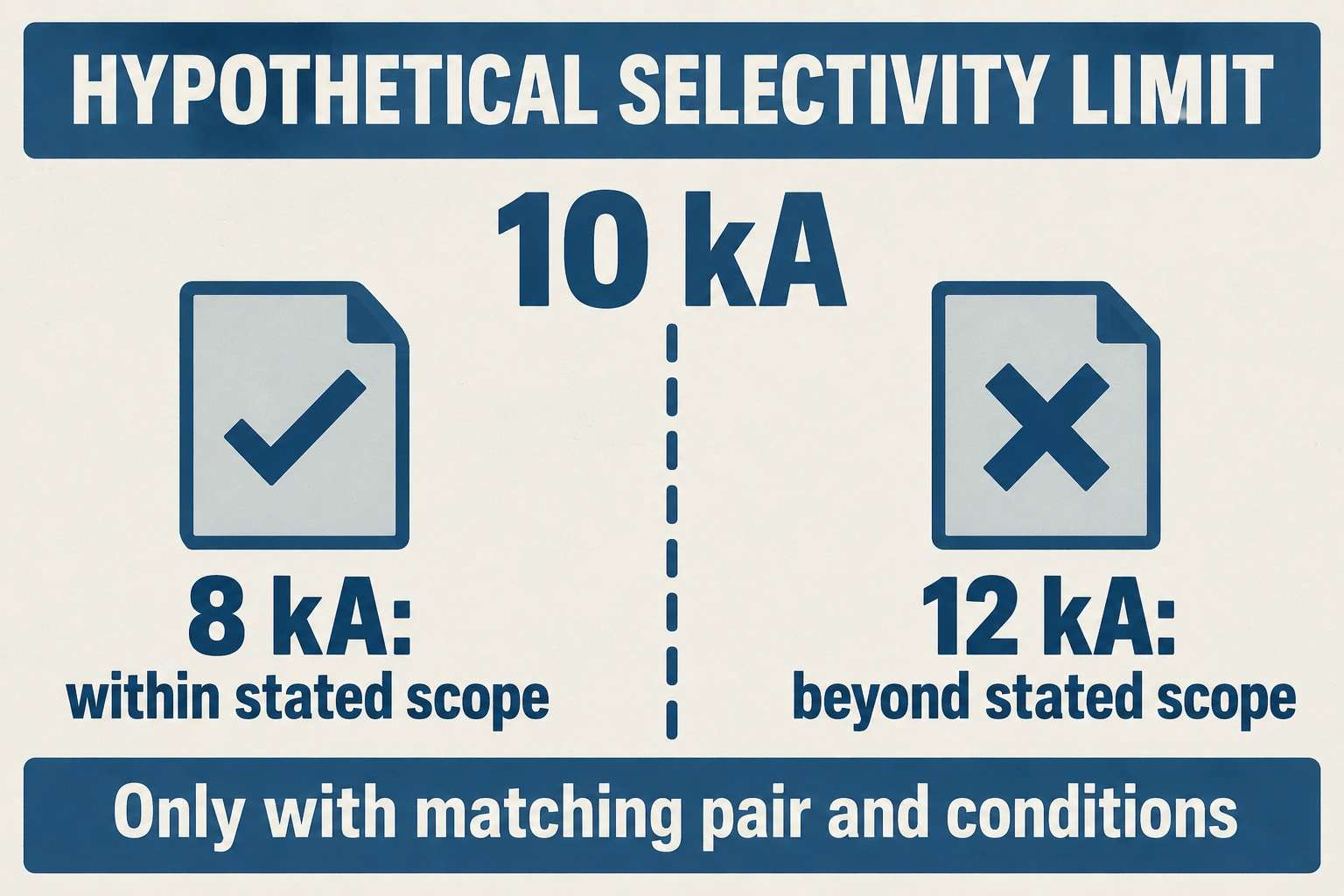
Consider a hypothetical coordination proposal P1 with a named upstream MCCB and downstream fuse. Fictional combination document C1 describes selectivity up to 10 kA under stated DC conditions for that exact order, device identities and release configuration. These are invented teaching inputs, not a RITOKS combination table, manufacturer test result or acceptable protection setting. Assume the responsible engineer has checked that those stated conditions match the two fault records used below; without that assumption, comparing the current numbers would be premature.
Project record F1 has an assumed assessed fault current of 8 kA, while F2 has 12 kA. F1 lies 2 kA below C1's fictional limit; F2 lies 2 kA above it. The filled review credits C1's selectivity scope to F1 and leaves the required service outcome at F2 unsupported by C1. Neither difference is a breaking-capacity margin, a fuse rating or an operating delay. The example also does not establish the devices' individual interruption capabilities; those remain separate records even where the selectivity submission is applicable.
The purchase decision depends on the promised outage boundary. If the specification requires the documented selective outcome at both F1 and F2, C1 cannot close the requirement for P1. If the responsible engineer's accepted specification requires that outcome only within F1's defined scope, C1 may be sufficient for that limited question while the rest of the protection assessment remains necessary. This is not permission to weaken the specification after receiving an inconvenient quotation. The service requirement must identify the accepted boundary and be agreed by its owner, not invented by procurement to match the available report.
Now suppose response C2 documents a backup-protection relationship for the same listed components but does not state which device operates for F2 or what healthy branches remain supplied. C2 may be relevant to another protection question; it does not fill C1's missing selectivity scope merely because it names both parts. Record it under the outcome it actually addresses. The next request should name F2's service requirement and ask for applicable selectivity evidence, rather than asking the supplier to repeat that the components are coordinated in some unspecified sense.
Device order changes the review object independently of those numbers. Imagine quotation Q3 reverses the original sequence, placing the fuse upstream of the breaker. Even if nominal current markings are unchanged, C1's exact-order basis no longer matches Q3. The record should identify order as the changed input and seek evidence for that proposed order. It should not apply the same 10 kA boundary by symmetry. This fictional example gives no circuit arrangement to install and recommends no change in the actual protective devices; it demonstrates how a documentary condition can invalidate a comparison before any numerical assessment begins.
Curve material needs an equally narrow disposition. Suppose graph G2 labels the fuse trace as pre-arcing while the proposed comparison assumes complete clearing, and the breaker band does not identify its release configuration. The filled status is unresolved operating definitions, not a failed or passed combination test. Ask for the correct definitions and applicable assessment. Extending G2's lines, inserting a delay or substituting a familiar AC chart would create a different claim without the missing DC evidence. C1's accepted limited result can remain in the file while G2's separate interpretation question is resolved.
Finally, the proposed spare fuse S2 has the same broad size and current description as P1's fuse, but C1 does not identify S2 as a permitted alternative. Keep the original pair's accepted scope and hold the replacement question. The spare's own device data can answer its individual duty, but cannot silently establish the original pair interaction. A written alternative-coverage document, or a revised assessment for S2 under the project conditions, could close the changed boundary. The buyer need not discard unrelated accepted panel information while waiting for that specific answer.
The usable output is a filled conclusion: P1's selectivity evidence applies to F1 under named conditions; F2 remains outside C1's scope; C2 addresses a different outcome; Q3, G2 and S2 each raise identified separate questions. All current values and document identifiers are hypothetical. No total selectivity, real fault level or actual tested pair is claimed. Keeping those findings distinct makes the contract, settings record and replacement schedule reflect what is supported instead of turning a collection of documents into an unqualified approval.
Список литературы
- ABB. (n.d.). Selectivity. https://new.abb.com/low-voltage/solutions/selectivity
- Carminati, M. (2023, January 23). Breaking ground. ABB Review. https://new.abb.com/news/detail/99155/breaking-ground
- Eaton. (n.d.). Bussmann series high-speed fuses application guide (BR132015EN, DC conditions section). https://www.eaton.com/content/dam/eaton/products/electrical-circuit-protection/bussmann-iec-high-speed-semi-conductors-fuses/eaton-bussmann-series-high-speed-fuses-application-guide-br132015en-en-us.pdf