
Industrial Motor Starters for Motor Control · Technical Explainer
Star-Delta Transition Timing: What the Motor and Load Must Tell You
Separate acceleration time from the changeover interval
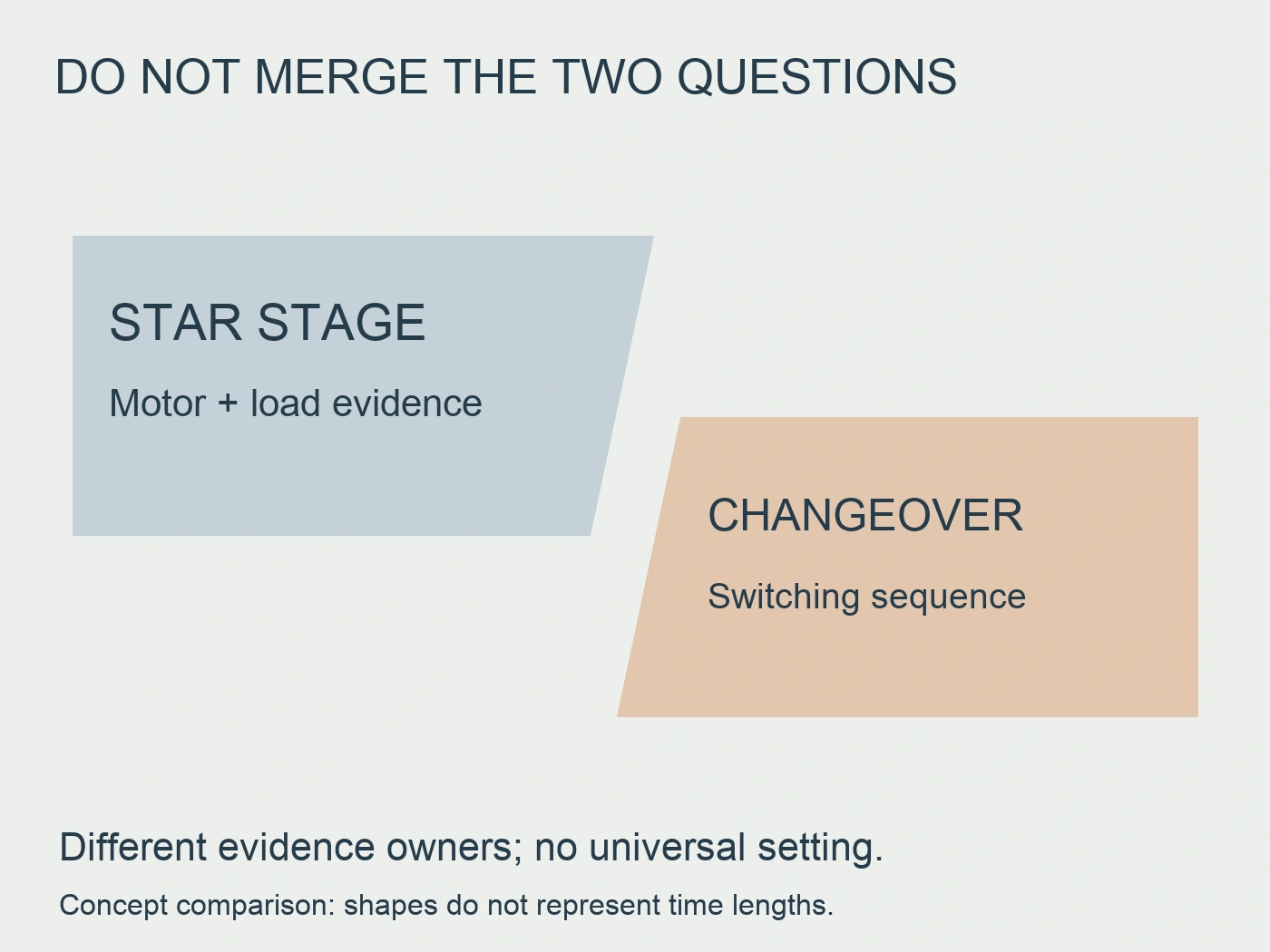
The star stage concerns the motor and load reaching a suitable condition for transition. The changeover interval concerns the switching sequence between the star and delta arrangements. They appear next to each other on a timeline but answer different questions.
Schneider Electric's TeSys Tera Star Delta instructions illustrate the distinction. For that system, the time-in-star timer precedes a separate changeover timer, after which the delta output is activated. The published defaults describe TeSys Tera; they are not recommended LK1 settings and are deliberately not reproduced here.
| Timing question | Evidence needed | What a timer label cannot prove |
|---|---|---|
| How long should the star stage last? | Motor capability, load condition and acceleration assessment | That the machine reaches an acceptable transition condition |
| What interval belongs between star and delta? | Exact contactors, approved timing components and control sequence | That an arbitrary delay matches switching behaviour |
| What happens after a failed start? | Protection, stop and restart requirements | That repeating the previous start is permitted |
| What changes between operating conditions? | Defined loaded/unloaded starts and relevant supply conditions | That one successful test represents every permitted start |
Put separate descriptions on the drawing and parameter schedule even if one timing module provides both functions. That makes supplier questions more precise and prevents a longer star duration from being proposed as a remedy for an unrelated changeover-component issue.
Confirm the motor and load are suitable first
Read the motor nameplate and terminal documentation before discussing elapsed seconds. Ask the motor supplier to confirm the intended supply and winding configuration. Do not infer suitability from “three-phase motor” alone or treat a photograph of a terminal box as complete connection approval.
Schneider's TeSys Giga star-delta application guidance identifies accessible stator terminals and an appropriate delta connection voltage as application requirements. It also discusses load torque and run-up before transition. These are reasons to request motor and machine evidence, not a claim that every motor of a given power accepts the same starter.
| Information owner | Required project information | Decision it supports |
|---|---|---|
| Motor supplier | Nameplate, terminal identification and permitted starting connection | Whether the motor can use the proposed arrangement |
| Machine builder | Driven-load description, inertia information and starting condition | Whether the start can accelerate the actual machine |
| Electrical designer | Supply conditions, protection and approved starter schematic | How the complete circuit is selected and coordinated |
| Starter supplier | Exact contactors, timer, interlocks and overload arrangement | What sequence and component evidence accompany the quotation |
| Commissioning engineer | Approved observations, limits and acceptance criteria | How the timing decision will be evaluated on the machine |
A fan, conveyor or compressor description is not a substitute for the actual load information. Ask whether the machine starts unloaded, whether process conditions change the starting demand, and whether an attached mechanism changes between operating modes. Record the answer for the specific machine rather than assigning a presumed torque curve from its industry label.
Build an acceleration record with an identifiable time origin
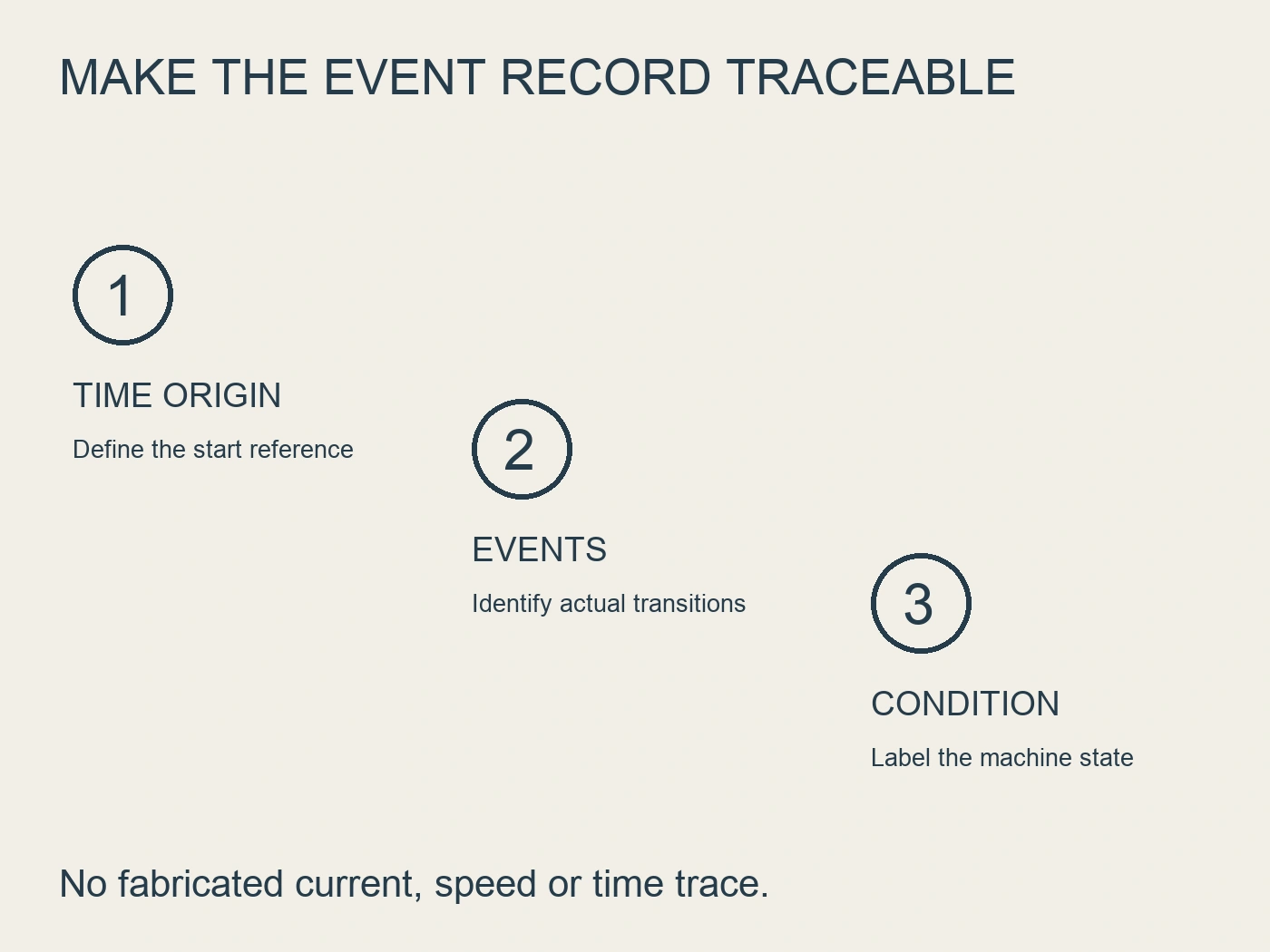
An acceleration record is useful only when its events can be connected to the control sequence. Define the time origin, identify the start request and show how the actual star and delta events will be established. Record the measurement method and the operating condition alongside any current or speed information.
Ask the responsible engineer what measurements are needed to distinguish acceleration behaviour from a switching event. Motor current can be part of the evidence, but a declining current trace alone should not be presented as direct proof of every mechanical state. Where speed matters to the acceptance decision, identify the approved way to establish it.
The record should state whether it represents a loaded start, an unloaded start or another defined condition. Include machine configuration and relevant supply observations. If the plot comes from a supplier's similar machine, label it as a reference rather than an acceptance result for this one.
Use event annotations instead of an unexplained total “start time.” A trace should help the reviewer locate the star period, changeover and subsequent operation. This is a documentation request; it does not prescribe instrumentation connection, energised measurements or trial settings without the project's commissioning procedure.
Review the changeover with the actual switching components
The changeover interval must be assessed with the installed contactor and timer arrangement. An electronic output changing state is not the same evidence as the power circuit completing its required switching transition. Review the manufacturer's control diagram, timing function and interlock provisions together.
Schneider's FAQ FA24956, modified in June 2026, explains why its specified timing arrangement changes for certain larger TeSys contactors: the star power circuit must open before delta closes. The FAQ is a product-specific example of component-dependent changeover, not an instruction to add its named accessories to another starter family.
Ask the supplier which order codes the supplied timing documentation covers. If a contactor frame changes during procurement, check whether the same approved timing arrangement still applies. A change to the coil supply or control accessories should also be reviewed against the exact manufacturer's documentation instead of being treated as a harmless substitution.
The engineering response should identify the allowed sequence and supporting documents. It should not simply state that the timer has a wide adjustment range. Adjustment range describes what can be entered; it does not establish which entry is appropriate for the machine or prove the switching assembly's suitability.
Interpret a difficult start without changing both decisions at once
Suppose, in an original hypothetical review, an unloaded machine produces an acceptable acceleration record, but a later loaded start has a different run-up pattern. The purchasing team asks for “more delay” without stating which delay or supplying the second start record.
First compare the documented operating conditions. The motor and load review asks whether the proposed starting method remains suitable for the loaded condition and what transition evidence is required. The switching review separately checks whether the same contactor and changeover arrangement was actually used. Combining those questions into one timer adjustment would leave both explanations ambiguous.
If the motor does not reach the required condition in star, waiting longer is not automatically a valid engineering solution. Ask for the motor–load assessment and permitted starting limits. If an abnormal event occurs specifically at changeover, preserve the event record and obtain the component sequence review rather than declaring that the motor merely needed more star time.
This scenario reports no measured performance, successful fix or RITOKS field installation. Its purpose is to define what evidence separates two plausible purchasing and commissioning questions.
Keep protection and restart limits in the same review
Timing does not stand alone from the starter's protection arrangement. Identify the overload device, its location in the approved circuit and the model-specific selection basis. Do not use a general article to derive an overload setting from motor current; different documented arrangements require their own engineering review.
Record the permitted response to an interrupted start or protection operation. Who authorises another attempt? Which conditions require investigation? How is a restart command handled? The machine requirements and motor documentation should answer those questions before an operator is left to repeat starts because a timer appears adjustable.
Keep automatic restart behaviour explicit rather than inferring it from the availability of a timing module. The TeSys Tera instructions, for example, distinguish start sources and stop causes within their system. That does not establish the features of an LK1 assembly or justify importing that controller's behaviour into another design.
When the starter is supplied as an assembly, ask which protection and timing components are included and which remain part of the panel builder's scope. A complete commercial description helps prevent a quotation comparison between an assembled starter and a component set that silently excludes necessary controls.
Turn the evidence into an LK1 quotation request
Опубликованные RITOKS LK1 star-delta motor starter assembly describes a supplier-listed contactor and overload arrangement and calls for confirmation of motor winding terminals, timer and overload selection. Use that page to identify the commercial family, not to assume a universal starting time or exact suitability for your motor.
Send the motor documents, supply conditions, load description, required operating modes and approved schematic with the RFQ. Ask for the exact assembly configuration, timing-component documentation, interlock arrangement and protection scope. State which acceleration records are available and which application decisions remain with the machine designer.
For acceptance, retain the approved star duration decision and changeover decision as separate entries, each with its evidence and responsible reviewer. This gives future replacements a clear basis: a timer or contactor substitution can be checked against the original function, while a changed load can be reviewed without losing the switching documentation.
The goal is not the shortest timer setting. It is a documented starting sequence that suits the actual motor and load, with switching components selected for that sequence and no unanswered procurement assumptions hidden behind “star-delta starter.”
Список литературы
- Schneider Electric. Star Delta, TeSys Tera Motor Management System User Guide, DOCA0257EN-01, n.d.; operating principle and delay settings. Official instructions.
- Schneider Electric. Пускатели «звезда-треугольник», TeSys Giga installation guide, DOCA0189EN-05, n.d.; application requirements, contactors and overload context. Official guide.
- Schneider Electric. FAQ FA24956, published December 22, 2010; modified June 8, 2026. Product-specific changeover timing explanation.