
Bridge Rectifier Modules · RFQ Checklist
Bridge Rectifier Module RFQ Checklist
A bridge rectifier module RFQ should describe the electrical circuit and thermal installation, not just request “one rectifier of a given ampere rating.” The supplier must know the phase arrangement, AC input, desired DC output context, continuous and surge duties, cooling method and physical package constraints before comparing exact models.
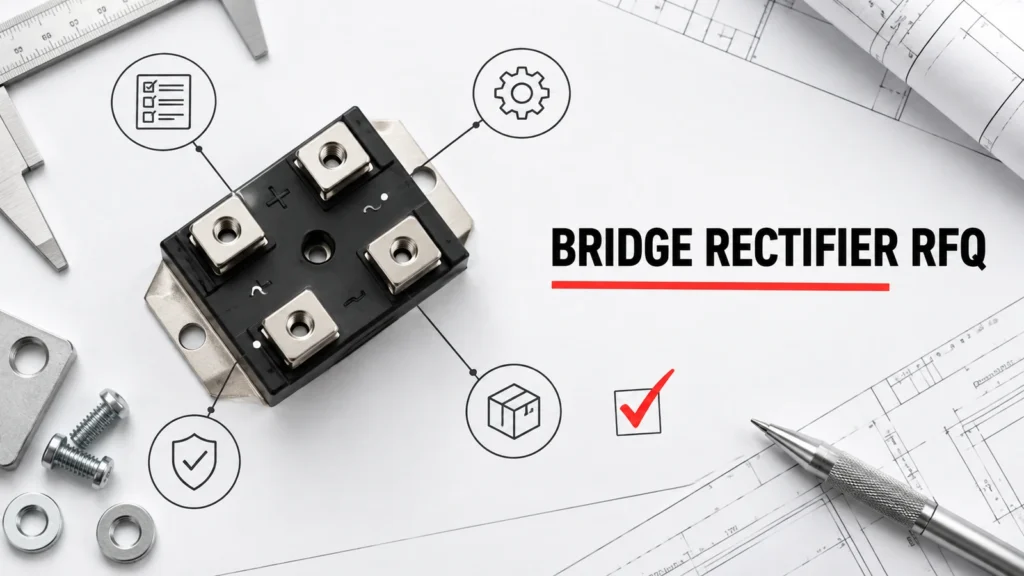
This checklist is designed for engineers and buyers who need a comparable quotation. It separates information the project team must provide from evidence a candidate supplier must return. It does not assume that two modules with similar catalogue current labels are electrically or mechanically interchangeable.
State the rectifier topology first
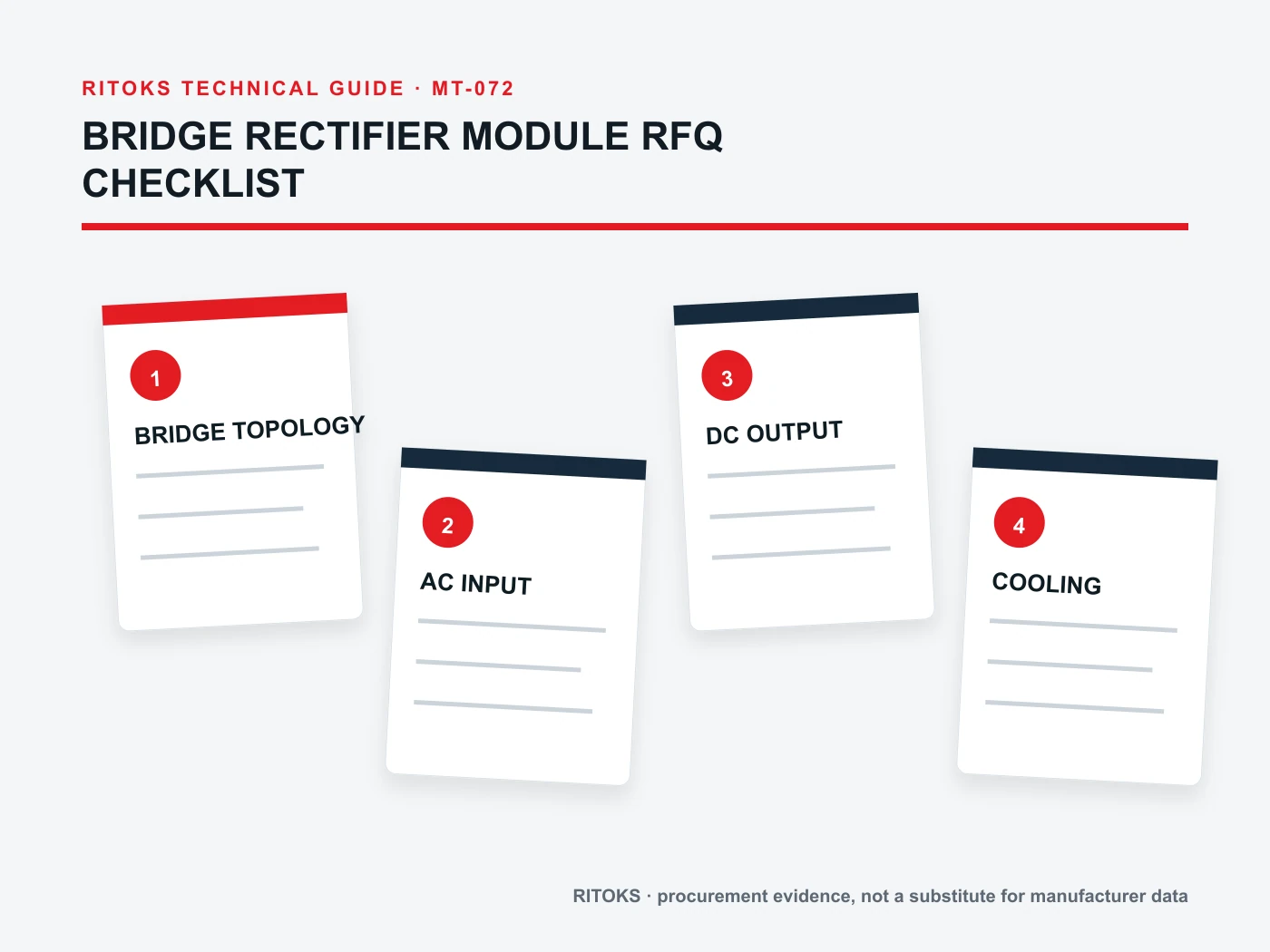
Identify whether the application needs a single-phase or three-phase bridge, and include a simple circuit diagram. Record the intended AC source arrangement, downstream DC link or load and any additional components such as input impedance, smoothing capacitance or protective devices. A “bridge module” name is not enough to identify the internal terminal map or the number of diode paths.
If an existing design is being replaced, provide the original schematic and explain which features may change. A replacement request should not rely only on a package photograph or a legacy part number. Pin assignment, polarity, mounting and heat flow can differ between visually similar packages.
Ask the supplier to return the exact internal circuit diagram for the proposed order code. That drawing is the starting point for confirming that the AC terminals, positive and negative DC outputs and mounting base match the design. A generic family diagram should be marked provisional until the selected variant is identified.
Define AC input and blocking-voltage duty
Provide the nominal AC input voltage, allowed range, frequency and expected supply deviations. Identify line-to-line or line-to-neutral values clearly for multi-phase systems. The reverse-voltage requirement should be established from the circuit, including relevant transients and protection, rather than copied from an unrelated supply label.
Request the exact model's reverse-voltage rating and the test conditions associated with it. Explain whether any external surge suppression is present. A higher headline voltage may look attractive, but it cannot replace a system surge and insulation review. If transient requirements are still under study, state that plainly in the inquiry.
Describe any asymmetry, phase loss or abnormal operating mode that affects diode stress. The supplier can answer a specific duty question more reliably when the relevant waveform and circuit are supplied, not inferred from a single input-voltage figure.
Give current as a profile, not one number
Provide the expected continuous DC output current and the loading cycle. Include ripple, peaks, startup inrush, capacitor charging, overload duration and repetition where applicable. The current waveform and cooling conditions may be more important than a nominal DC output value when comparing thermal capability.
Ask for the candidate's average rectified-current rating under its stated case-temperature and waveform conditions, as well as non-repetitive surge-current evidence where surge duty is relevant. A published surge rating is not automatically a permission for frequent repetitive inrush. Clarify the pulse conditions and thermal starting state before using it in the design.
Record who owns upstream overcurrent protection and coordination. A rectifier module does not replace the need to verify the fault-clearing scheme and the effect of a downstream short. If the project cannot yet provide prospective fault current, the supplier should be told that final selection is pending.
Include loss, heatsink and ambient information
State whether the module will mount to an existing sink, new sink or cooled baseplate. Provide available contact area, mounting-hole pattern, interface material, airflow direction and the hottest expected local ambient. If an existing heatsink must be reused, include its drawing and measured or validated thermal performance under installed conditions.
Request forward-voltage or loss data and thermal-resistance information for the exact module. The thermal design must account for heat produced by the conducting diode paths, transfer through the module and interface, and rejection to ambient. A rectifier's electrical current rating is tied to thermal test assumptions; quoting it without case-temperature and cooling context can mislead.
Ask for mounting instructions, permitted interface materials and fastening procedure. Mechanical contact quality affects heat transfer. Infineon's power-module installation documentation illustrates why interface material and geometry must be treated as part of the thermal path; the final assembly rules must come from the proposed rectifier's own manufacturer documents.
Specify package and terminal constraints
Share cabinet-space limits, module footprint, mounting surface, terminal type, conductor size and busbar geometry. Identify the required creepage and clearance review as part of the project design. The package drawing should show dimensions, hole spacing, terminal labels and torque instructions for the exact order code.
For an existing assembly, document whether terminal orientation is fixed by the busbar or wiring harness. A quotation that requires a new busbar may still be technically possible, but it is not a drop-in substitute. Ask suppliers to note deviations explicitly so cost, lead time and validation can be compared honestly.
Clarify whether the heatsink or mounting base must be electrically isolated from the rectifier circuit. Do not infer isolation from a plastic enclosure around the module. Request the exact product's insulation and mounting information where it affects the mechanical design.
Request comparable documentation from every bidder
| Fältet ”RFQ” | Project provides | Leverantörsreturer |
|---|---|---|
| Topologi | Phase count and circuit diagram | Exact internal schematic and pinout |
| Spänning | Input range and transients | Reverse-voltage evidence and conditions |
| Aktuell | Waveform, continuous duty and inrush | Current and surge data at stated conditions |
| Termisk | Ambient, sink, airflow and TIM plan | Loss, thermal data and mounting guide |
| Mekanik | Footprint and terminal constraints | Dimension drawing and order code |
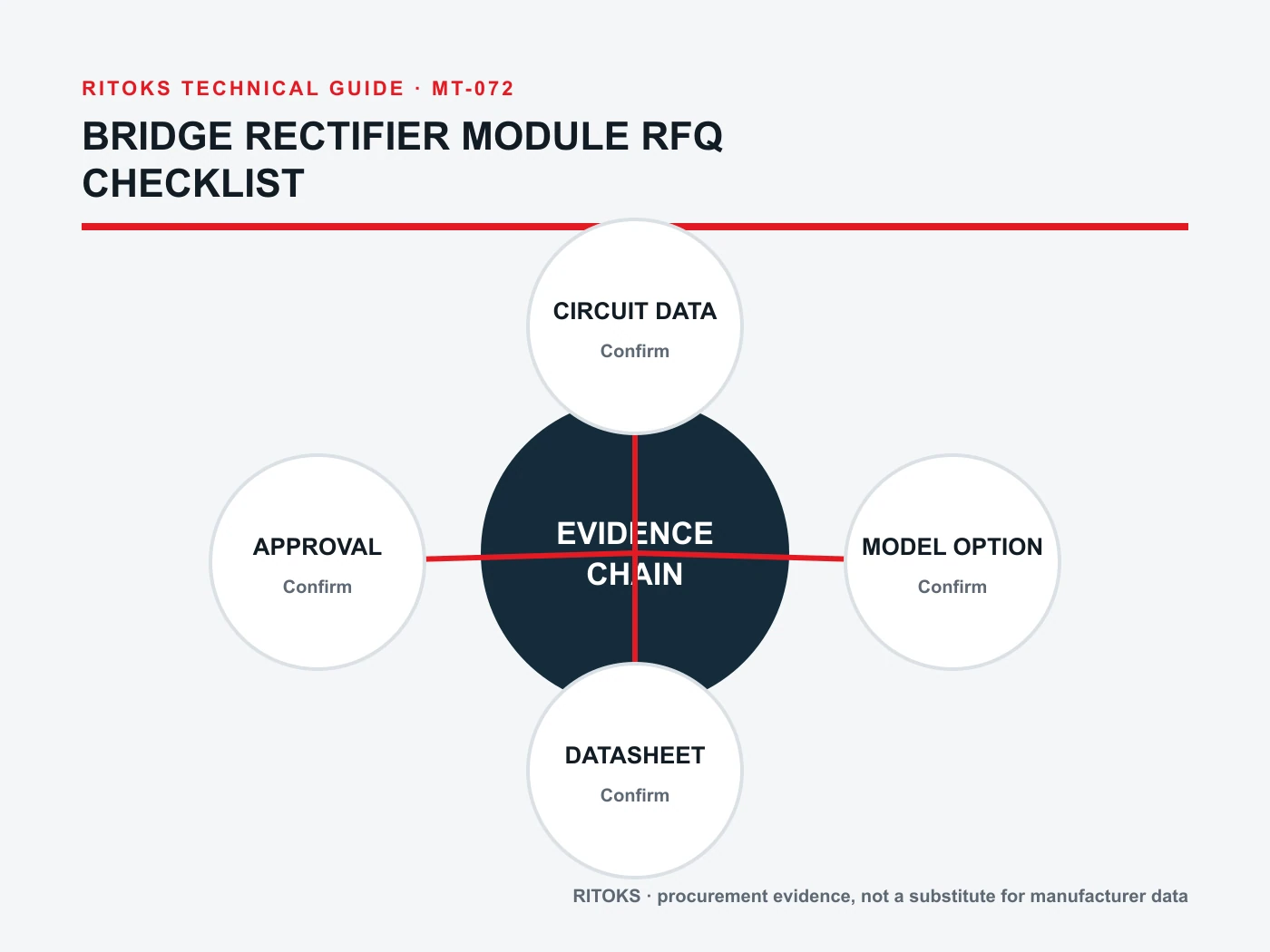
Ask for the latest exact-model datasheet, dimensional drawing, installation manual and any application note needed to interpret ratings. Record revision dates and the supplier's answers to unresolved questions. Do not mark a family catalogue “compliant” if it lacks the variant-specific values needed for the design.
Compare alternatives without hiding qualification work
For every candidate, record whether it meets each requirement, needs a design change or lacks evidence. Treat “needs confirmation” as a distinct state, not an implicit pass. A candidate may have a higher rating but a different terminal arrangement, interface requirement or case-temperature basis. The comparison must show those consequences.
If a supplier offers an alternate bridge topology or package, ask which downstream changes are required. The design team should revisit diode losses, surge duty, protection, mechanical fit and thermal verification. Do not approve a substitute merely because its maximum current and voltage labels exceed those of the former device.
Keep a validation plan for first articles or redesigns: electrical waveform checks, temperature measurements at representative duty, terminal inspection and review of abnormal conditions. State which tests belong to engineering and which documentation the supplier must provide. This avoids treating the purchase order as the end of technical review.
Record what is known and what remains provisional
Some inquiries begin before the final heat sink, fuse or DC-link capacitor is fixed. That is acceptable if the unresolved conditions are visible. Mark each input as measured, calculated, estimated or pending, and explain the design state that produced it. A supplier can then offer a conditional candidate and identify the missing evidence needed for final confirmation.
Do not let an estimated operating current turn into a guaranteed maximum, or a proposed cabinet ambient turn into a validated test condition as the quote moves through procurement. Carry assumptions forward in the comparison sheet and close them before release. This is particularly important if the purchase specification is copied into a second project with a different load cycle.
How RITOKS product families fit the inquiry
Den bridge rectifier module category is the appropriate commercial starting point. The MDS three-phase family och MDS high-current family can be referenced in an inquiry, but a family title is not a model-specific compatibility statement.
Send the completed circuit and duty checklist through Kontakt med RITOKS. Request a proposed order code with the corresponding datasheet, circuit drawing and mounting documentation. If the supplier cannot verify a particular point, leave that point open for engineering rather than allowing a generic quotation to become an approval.
RFQ questions worth asking
Is the headline ampere rating sufficient?
No. Ask which waveform, case temperature and cooling assumptions support that rating, then compare those assumptions with the installed duty.
Can a surge-current rating be applied to repeated startup?
Not without matching the pulse duration, repetition and starting temperature to the manufacturer's evidence. Non-repetitive and repetitive conditions are different questions.
Can a similar case be treated as drop-in?
Only after pinout, mounting, insulation, thermal interface and electrical duty are checked for the exact order code. Visual similarity is not documentation.
Sammanfattning
A strong bridge rectifier module RFQ contains topology, input conditions, current waveform, transient duty, thermal plan and mechanical constraints. Require exact-model documents in response and compare deviations openly. This yields a useful technical quotation without inventing missing project conditions. Keep the approved circuit diagram and supplier datasheet revision attached to the order record.
Källor
- Semikron Danfoss, Användarhandbok för effekt halvledare.
- Semikron Danfoss, example bridge-module product record (illustrates that topology, surge and interface data are product-specific; not a RITOKS rating).
- Infineon, 34 mm and 50 mm Solder Bond Modules — Use and Installation Manual (AN2018-07) (general interface principles).