
Industrial Power Switching · Technical Explainer
Pushbutton Contact Ratings: Why Thermal Current Is Not Switching Duty

Quick answer
A pushbutton contact's conventional thermal current describes a thermal reference under specified conditions. It does not alone approve making and breaking an arbitrary control load. Rated insulation voltage is also not the same as a permissible switching-duty rating.
For selection, request the exact contact block's operational current at the relevant operating voltage and utilisation category, then compare that evidence with the actual load and duty. AC and DC circuits, making demand, breaking demand, operation frequency and installation conditions require their own review.
Do not select a coil, relay or electronic input solely because its steady current is below a catalogue Ith value. A complete procurement record identifies the load and the manufacturer evidence needed to approve that particular use.
Read the rating symbols as different evidence fields
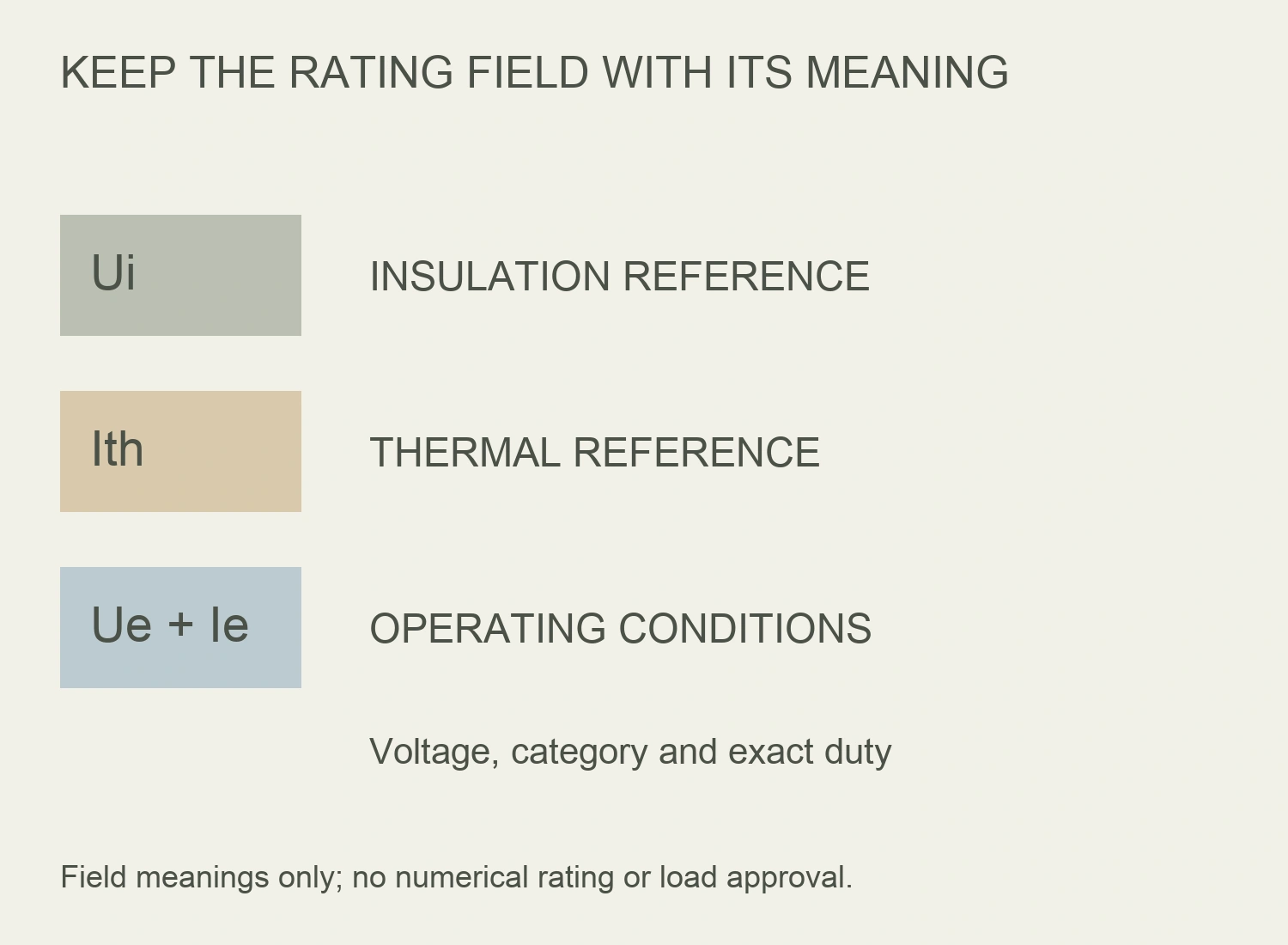
Ui is an insulation reference. Ith is a thermal reference. Ue identifies rated operational voltage, while Ie must be interpreted with the corresponding operating conditions and category. These fields answer different questions rather than offering interchangeable limits.
Schneider defines conventional free-air thermal current in the context of temperature-rise testing of unenclosed equipment in free air. That definition is not a thermal test of a RITOKS assembly, an enclosure allowance or a switching approval. Schneider Electric, conventional thermal current.
When comparing quotations, retain the full label attached to each number. A list headed voltage/current can obscure whether the supplier has supplied insulation and thermal data or an actual switching table.
The missing field should remain missing until verified. Do not turn a thermal-current entry into an operational-current value simply to complete the purchasing spreadsheet.
Require a voltage-and-category-specific switching table
Ask for the selected contact block's operational ratings and applicable conditions. The table should let the reviewer identify the intended AC or DC duty and the relevant voltage, not just the largest current printed on a family page.
ABB's pilot-device guide separates Ui, Ith and category/voltage-specific Ie entries for its own families. Its load discussion explains that switching duty depends on load characteristics and operating conditions, including making and breaking stresses. These are documentation principles, not ratings transferred to another manufacturer. ABB, Pilot Devices Guide.
Do not substitute an AC value for a DC circuit without applicable manufacturer evidence. Nor should a different voltage or category be accepted merely because the resulting numerical current looks conservative.
For an undocumented load type, ask the responsible designer and supplier which evidence is applicable. A procurement team should not invent the category or infer it from the name of the equipment alone.
Register the load before comparing the contacts
The following original register structures the information needed for an enquiry. It contains no measured values, approved combination or universal acceptance threshold.
| Load/input field | Evidence to collect | Why it matters to the review |
|---|---|---|
| Exact controlled device | Model, coil/input option and documentation revision | A family name can hide different interfaces |
| Circuit type | Actual AC/DC arrangement | Ratings are not automatically interchangeable |
| Supply conditions | Relevant operating range and documented conditions | One nominal value may not describe the application |
| Making demand | Applicable pickup/input profile | Steady demand alone may be incomplete |
| Breaking demand | Load characteristics and manufacturer guidance | Opening duty needs separate evidence |
| Tjänstgöring | Expected operations and applicable duty description | Switching life depends on the actual duty |
| Contact identity | Exact block and contact arrangement | Head appearance does not determine ratings |
| Installation conditions | Applicable ambient/enclosure and assembly information | Thermal reference conditions may differ |
| Remaining uncertainties | Missing data and responsible owner | Unknown values must not become assumed approval |
Keep the load documentation beside the contact table. This makes the comparison reviewable and prevents an unsupported summary such as ten-amp switch suitable for all controls.
If different coil or input variants are under consideration, complete the record for each actual option. One variant's demand must not be assigned to every item sharing the same product name.
Compare making and breaking demand separately
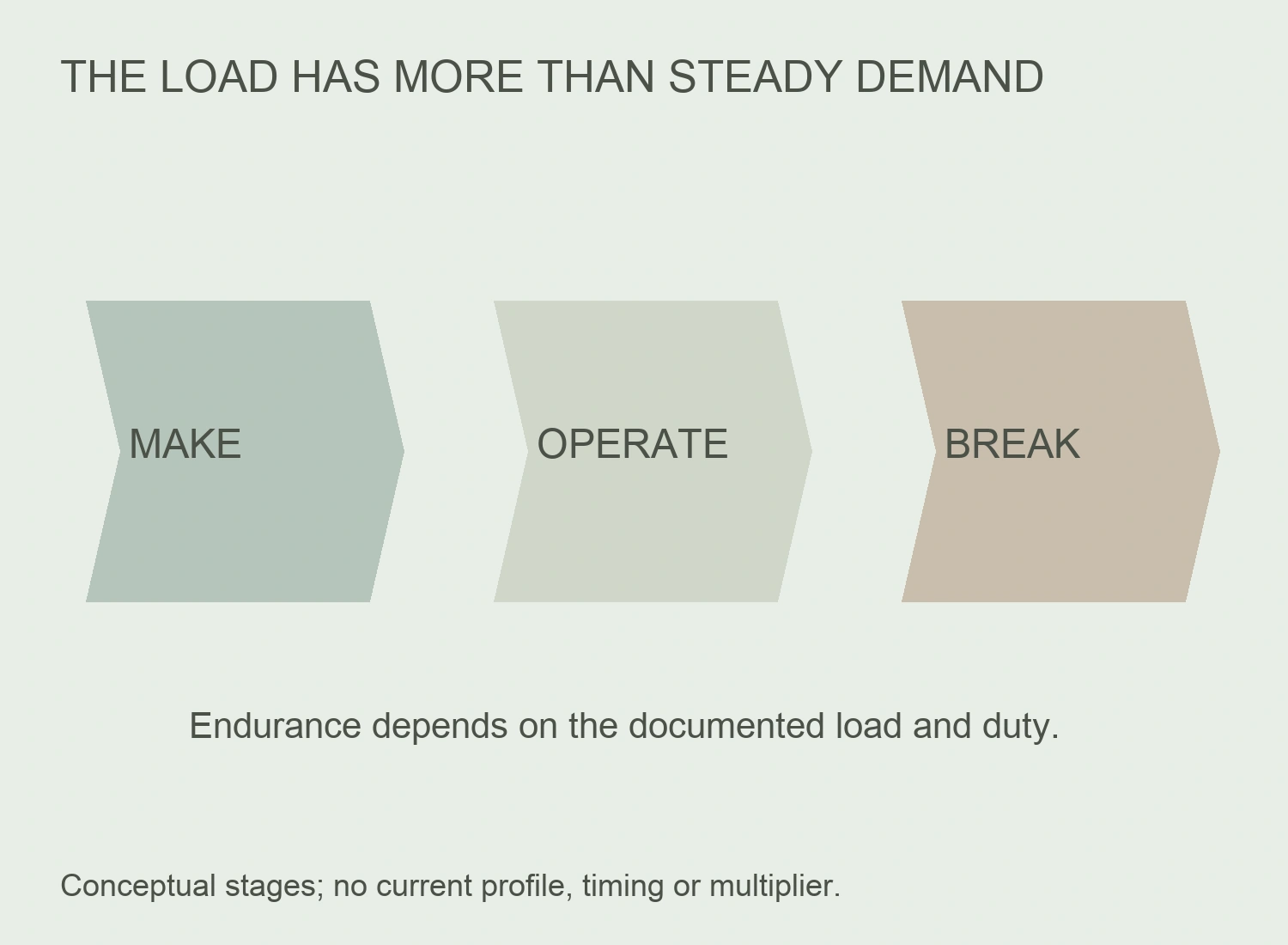
The current associated with an established operating state need not describe what happens when the contact first closes or opens. Obtain the exact load's relevant demand and conditions rather than estimating them from a thermal rating.
For electromagnetic and electronic arrangements, the selected coil or input documentation matters. Different technologies can have different behaviour. The buyer should not apply one generic pickup multiplier or assume every DC coil has the same pull-in and holding relationship.
Ask whether the offered contact ratings cover the actual making and breaking duty. A supplier response limited to steady current leaves that question unanswered.
This article provides no inrush multiplier, DC time constant, contact-series arrangement or load-switching calculation. Those are not safe substitutions for the selected manufacturer's evidence and the qualified designer's review.
Use manufacturer examples without borrowing their ratings
An actual datasheet can show what a complete rating presentation looks like. Schneider's historical 2016 datasheet for the specific 9001KR1RH13 operator lists Ith separately from voltage/category-specific Ie entries. It is an example of distinct fields, not a current RITOKS purchase approval. Schneider Electric, 9001KR1RH13 datasheet.
Do not copy that product's values, protection device, dimensions or certifications into another operator specification. Even apparently familiar contact-rating terminology requires the actual selected block's documents.
Likewise, a comparison table from another brand can help identify a missing field but cannot fill it. If the intended supplier has not supplied the required table, the enquiry remains open.
The useful evidence trail goes from exact ordered part to its rating and conditions, then to the actual load review. It does not go from a similar-looking operator to a borrowed approval.
Request more than mechanical life
Mechanical and electrical endurance are separate questions. A mechanism's operation count does not establish switching life under every load, voltage and duty.
For the intended circuit, request the applicable electrical-endurance information and conditions. If endurance data do not cover the chosen duty, record the gap rather than assigning a generic service lifetime.
Low-level signal switching also requires appropriate evidence. Do not assume that every contact suitable for a higher-current control load is automatically documented for a particular electronic input. Ask for any relevant minimum switching requirements and contact conditions.
The resulting record should distinguish a catalogue life statement from the designer's maintenance or replacement requirements. This guide gives no universal inspection interval, minimum current or numerical life guarantee.
Keep environment and protection as separate review items
The installed environment must be compared with the selected equipment's conditions. A free-air thermal reference is not automatically an enclosed-panel rating at the actual ambient temperature.
Ask for manufacturer conditions applicable to the assembly and duty. Do not invent a percentage derating or choose an arbitrary current margin to compensate for missing information.
Protection and short-circuit conditions also require exact documentation. A thermal-current number does not choose a fuse or approve a protected combination. Keep any manufacturer's stated conditions attached to the precise contact block and circuit being reviewed.
Qualified personnel should assess these items within the actual equipment design. The purchasing record helps them locate unresolved evidence; it is not a substitute for that assessment.
Do not assume an intermediary or suppressor solves every mismatch
If direct switching is not supported, a designer may evaluate a different interface or circuit architecture. The proposed change must still match the actual operator contacts, controlled device and required behaviour.
An intermediary relay or driver is not automatically approved simply because it reduces one apparent load. Request its own input/output requirements and the evidence for the resulting combination.
Likewise, a suppression accessory needs exact compatibility and application guidance. Confirm any effect on the controlled equipment's release behaviour through the relevant manufacturer documentation. Do not promise a universal improvement or supply an unverified wiring recipe.
Record the approved design option and revision rather than silently adding a device to make an incomplete quotation appear compliant.
Read the RTX-PB22 page as a starting point
Den RITOKS RTX-PB22 industrial operator family supplies public insulation and thermal-current entries. Those entries do not alone establish a voltage/category-specific switching table for an arbitrary control load.
Request the exact family, operator action, contact-code interpretation and selected block documentation. Keep A/B/C options separate; the C table does not inherit every A/B selector or emergency-stop configuration.
For an illuminated variant, lamp voltage remains separate from contact-circuit duty. For a maintained or momentary head, mechanical action does not supply the missing Ie evidence.
Use the product page as an enquiry route. Approval should depend on the exact returned contact data and the application's requirements, not on a broad family description or a larger-looking catalogue number.
Review the quotation against the missing evidence
Use this original comparison table to keep each supplier response within its actual scope. It does not prescribe numerical ratings or endorse a circuit.
| Supplier response | What remains unproven | Targeted follow-up |
|---|---|---|
| Ith value only | Intended making/breaking duty | Exact Ie/voltage/category table |
| Ui value only | Permissible operating switching duty | Relevant Ue and operational rating |
| AC operational entry | Requested DC application | Applicable selected-block DC evidence |
| Steady load current | Complete transient and opening demand | Exact load documentation |
| Mechanical life figure | Electrical endurance for the actual duty | Applicable endurance conditions |
| Lamp supply entry | Contact circuit rating | Separate contact documentation |
| Family-wide compatibility claim | Exact head/block/interface assembly | Model-specific configuration evidence |
| Suggested driver or suppressor | Approved combined behaviour | Designer review and exact compatibility documents |
Assign an owner to each outstanding request. A technically honest quotation may identify unavailable data; that is more useful than an unsupported blanket approval.
Maintain the exact load option and contact revision when accepting substitutions. A changed coil, contact block or suppression arrangement can require renewed review even if the pushbutton face stays unchanged.
Vanliga frågor
Can I use Ith as the permitted switching current?
Not alone. Obtain the relevant operational rating and its voltage, category and conditions, then compare it with the actual load and duty.
Does Ui approve switching at that voltage?
No. Insulation reference and operational switching duty are different fields. Request the applicable operational evidence for the selected block.
Is a coil's holding current enough to select the contact?
Not necessarily. The actual making and breaking demands and coil/input technology must be documented. Do not apply a universal multiplier.
Will a suppressor or intermediary relay make any button suitable?
No automatic approval follows. The exact interface, compatibility and resulting behaviour need the responsible designer's documented assessment.
Källor
- Schneider Electric. (2014). Conventional thermal current, FA230658. Complete definition answer; modified September 2026. Accessed October 2, 2026.
- ABB. (n.d.). Pilot Devices Guide, 1SFC151011C0201 rev A. Printed pages 25 and 42–43 actually read; no numeric ratings transferred. Accessed October 2, 2026.
- Schneider Electric. (2016). 9001KR1RH13 product datasheet. Historical exact-product example of separate fields; complete four pages read. Accessed October 2, 2026.