
Electrical Measurement & Monitoring · Comparison
THD vs TDD in Power Quality Reports: Why the Denominator Matters

Key takeaways
- Name the quantity. Current THD, voltage THD and current TDD are not interchangeable report fields.
- Preserve the denominator. A percentage without its reference quantity cannot be independently checked.
- Separate calculation from compliance. A correctly calculated number is not automatically an applicable acceptance result.
- Verify the implementation. A meter's label does not establish its exact phase aggregation or demand-reference method.
- Record the context. Location, configuration and operating state belong with the exported data.
Start with a metric identity sheet
A useful THD vs TDD power quality report identifies the numerator, denominator and measurement scope before interpreting a percentage. Do not merge values merely because their dashboard labels look similar. Retain the original meter field names and add explanatory labels in the report rather than silently renaming the source data.
Schneider Electric's PM5300 manual describes THD using harmonic content relative to the fundamental component. Its separate lowercase thd calculation uses total RMS content as the denominator. These are different conventions, not simply different capitalization for an identical ratio (Schneider Electric, n.d.). Record which definition applies to the actual exported field.
The first table is an original report-design worksheet. It lists questions to resolve, not guaranteed functions of every power-quality instrument.
| Report field | Identity to establish | หลักฐานที่ควรเก็บไว้ |
|---|---|---|
| Current THD | Current channel, included components and fundamental reference | Exact manual definition and source register |
| Voltage THD | Voltage relationship and channel definition | Line-to-line or line-to-neutral measurement description |
| Current TDD | Harmonic-current treatment and demand reference | Exact calculation and documented reference-current setup |
| Total-RMS-based distortion | Whether the denominator differs from fundamental-based THD | Manufacturer's field definition, not a renamed dashboard label |
Write these identities into the project data dictionary. Assign a person to resolve missing definitions before the first report is issued. A technician should not have to reconstruct the intended meaning from a spreadsheet column labeled only “distortion.” That label is too broad to support a comparison or a procurement decision.
Treat the demand reference as documented input
For TDD, ask where the reference current comes from, how it is represented in the installed meter or analysis software, and who approved its use. A configured input, a calculated demand value and an engineering-study reference must not be treated as equivalent without evidence. Keep their origins visible in the report.
Schneider Electric's PM5500 FAQ relates TDD to harmonic-current distortion against the system's full-load demand and identifies maximum demand load in its calculation discussion. The FAQ also places the discussion at a point of common coupling. This is a manufacturer explanation for that meter family, not documentation of another instrument's algorithm (Schneider Electric, 2024).
For a selected Accura 3700 panel power-quality meter, request the exact ordered configuration's metric definitions and register documentation. The RITOKS family page lists THD/TDD and event functions, while requiring confirmation of measurement and recording options. It does not establish the demand-reference algorithm, export representation or compliance process for every configuration.
Keep the reference-current record separate from the meter's input rating. Do not use a CT nameplate value as a demand reference just because both are expressed in amperes. If the engineering team deliberately selects a value, record the applicable method and its supporting source. If the source is unresolved, report that limitation instead of filling the cell with a convenient number.
Use a hypothetical calculation without creating a limit
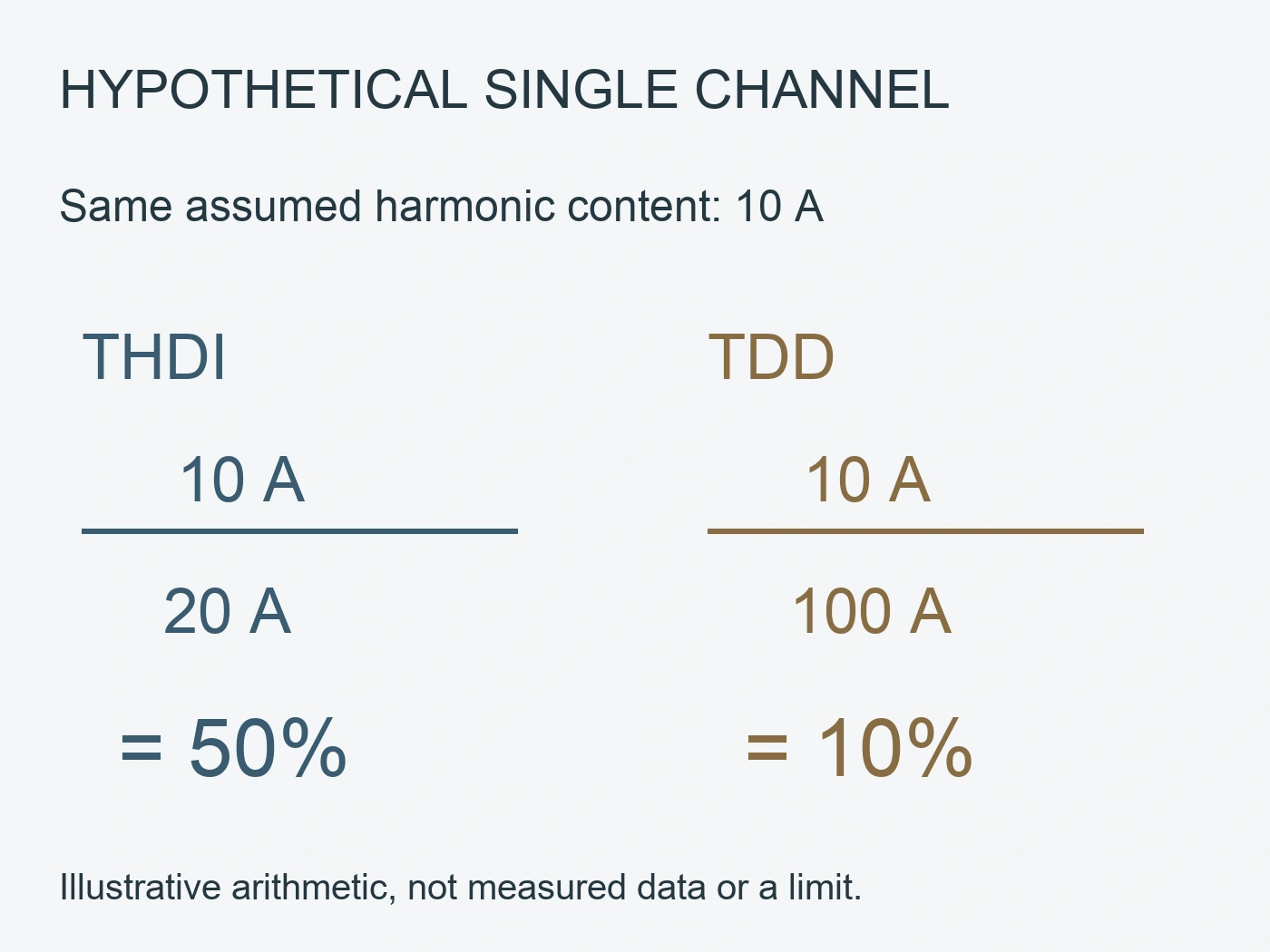
Consider a simplified single-channel illustration, not a reproduction of any meter's combined-phase algorithm. Assume harmonic-current content Hc is 10 A, the measured fundamental current I1 is 20 A, and the independently specified demand reference IL is 100 A. For this illustration, define current THD as 100 × Hc/I1 and TDD as 100 × Hc/IL.
The arithmetic gives 50% and 10% respectively. Both use the same assumed harmonic-current content. Their difference comes entirely from the specified denominators. Neither result says that a site passes a requirement, that equipment is safe, or that a filter is needed. Those decisions require a separate, applicable assessment.
| Hypothetical condition | Hc | I1 | IL | Calculated current THD | Calculated TDD |
|---|---|---|---|---|---|
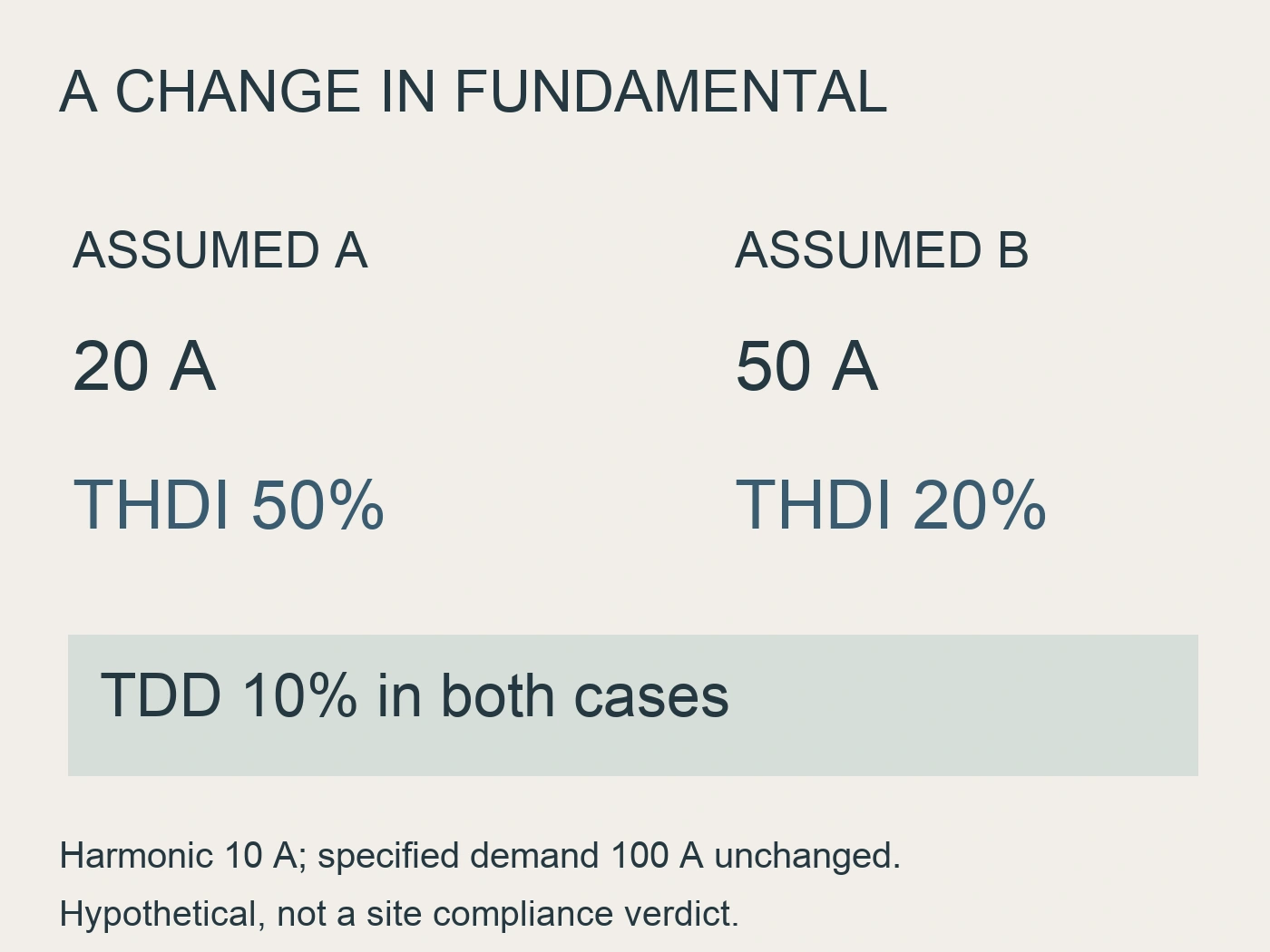
| Assumed condition A | 10 A | 20 A | 100 A | 50% | 10% |
| Assumed condition B | 10 A | 50 A | 100 A | 20% | 10% |
Condition B changes only the assumed fundamental current. It illustrates how the ratio can change even when the example's harmonic-current content does not. The table is original explanatory arithmetic, not recorded site performance or an acceptance threshold. It should never be reused as a product specification or a claim about normal factory operation.
When presenting a real comparison, put the relevant source quantities beside the percentages. If the required quantities were not captured, label the explanation as provisional. Do not reverse-engineer a denominator from a rounded display value and then present the reconstructed number as a measured result. Preserve the distinction between a recorded quantity and an analyst's calculation.
Separate the measurement location from the assessment boundary
Describe the monitored circuit using the approved single-line drawing and an unambiguous point identifier. Keep this description with the report even if the chart title already names a building. A facility name does not identify which interface, feeder or machine circuit was actually measured, nor does it establish the boundary used by an assessment.
The public IEEE 519-2022 description identifies the point of common coupling as the interface between sources and loads and describes steady-state waveform-distortion goals. It does not provide the detailed tables and procedures needed for a site-specific compliance calculation on its public overview page (IEEE Standards Association, 2022).
Consequently, a feeder dashboard should not be labeled “IEEE 519 compliant” merely because it displays TDD. Ask the responsible engineer to identify the applicable standard edition, the assessment boundary, the required measurement and statistical treatment, and the supporting system information. This article does not reproduce numerical limits or claim to apply inaccessible clauses.
The report should distinguish an operational observation from a contractual acceptance statement. “Recorded at feeder F under the attached configuration” is a traceable description. “Facility compliant” is a different conclusion with a different evidence burden. If only the operational task was commissioned, keep the deliverable within that scope and list what a separate assessment would need.
Make comparisons survive configuration changes
Before joining datasets, compare their field definitions, channel identities and configuration records. Treat a change as an explicit boundary in the report rather than hiding it inside one continuous chart. Reviewers should be able to see whether the compared values were produced under the same documented interpretation and reporting method.
Keep a dated configuration record with the instrument identity, firmware information where relevant, transformer scaling, selected measurement system, source fields and reference-current basis. This is a proposed record structure, not an assertion that all meters expose those items in one export. Mark unavailable fields and request the appropriate supplier document.
If a new gateway changes the output column names, preserve the mapping between old and new fields. If the engineering team changes a demand reference, identify the effective date and keep the previous value with earlier results. Do not silently recalculate historic reports unless that revision is authorized and the revised calculation can be distinguished from the original.
The same approach helps commercial selection. Among electrical measurement and monitoring products, a general energy meter, a harmonic-monitoring instrument and an event recorder may serve different data requirements. Build the requirement around the intended deliverable, then confirm the exact model's functions. A product family name alone is not proof of reporting equivalence.
Deliver a report that another engineer can reproduce
Package the raw export, data dictionary and configuration record with the readable report. Use stable filenames and point identifiers so another engineer can locate the supporting information without searching through unrelated project folders. A screenshot is useful for orientation, but it should not replace source data when a reproducible calculation is required.
For each finding, state what was observed, what was calculated and what remains unconfirmed. Keep a separate assessment section for any formally commissioned compliance work. Include the author, review date and limitations. These are proposed editorial controls for clarity; they do not constitute a certification procedure or guarantee that an instrument meets a standard.
A practical review can ask three questions. Can the reader identify the exact metric? Can the reader locate its reference quantities and measurement point? Can the reader distinguish the evidence from the conclusion? If one answer is no, request the missing item before strengthening the finding. This keeps an incomplete dataset from becoming an overstated purchasing recommendation.
คำถามที่มักถูกถาม
Can current THD and TDD show different percentages?
Yes, where their documented calculations use different reference currents. The hypothetical example here demonstrates that arithmetic only. Verify the installed meter's actual calculation, phase treatment and demand reference before using its values in an engineering report.
Does a lower TDD number prove that the installation is acceptable?
No. A numerical result needs an applicable assessment method, a defined boundary and the required supporting information. Do not select a universal acceptance limit from this guide or treat a dashboard label as a compliance verdict.
Is voltage THD the same reporting field as current TDD?
No. Keep the measured quantity and reference basis visible in the data dictionary. Combining them under one unlabeled distortion column removes information needed to understand the report.
What should a buyer ask a meter supplier?
Request the ordered model's exact metric definitions, measurement options, source registers, demand-reference method and export capabilities. Ask which functions require an option or a particular configuration. Preserve unresolved answers in the RFQ rather than assuming them from another manufacturer's manual.
Conclusion
The value of a THD/TDD report comes from a traceable interpretation, not a large percentage printed on a chart. Identify the numerator, denominator, channel and measurement point; retain the source data and configuration; and keep operational observations separate from formal acceptance claims. With those records in place, an engineer can evaluate the evidence and a buyer can specify the reporting capability without inventing product functions or borrowing an inapplicable limit.
แหล่งอ้างอิง
- Schneider Electric. (n.d.). PowerLogic PM5300 series user manual: Power quality (EAV15107-EN11). Official manual chapter.
- Schneider Electric. (2024, October 31). How does PM5500 series meter calculates TDD (Total Demand Distortion) (FA346857; page last modified). Official technical FAQ.
- IEEE Standards Association. (2022). IEEE 519-2022: IEEE standard for harmonic control in electric power systems. Public standard scope.