
Power Distribution Blocks for Control Panels · Technical Explainer
Covered Distribution Blocks: What Touch Protection Requires
Quick answer
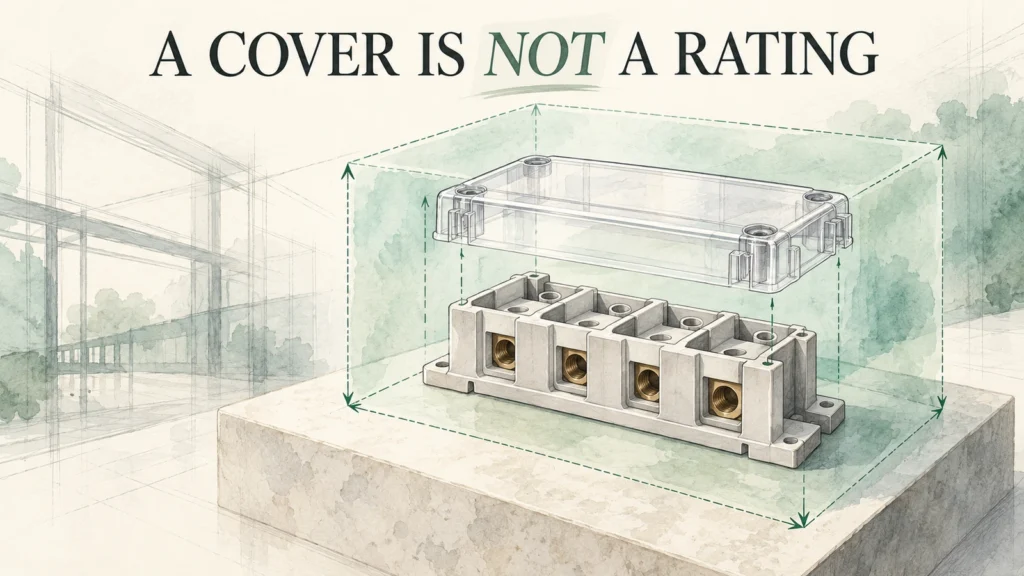
A cover on a distribution block is not, by appearance alone, evidence of a particular touch-protection rating. Check the exact block, its cover and accessories, the documented protection claim and the installed state to which that claim applies. Conductor entries, exposed ends and the way several blocks are assembled belong in that review.
For covered distribution block finger-safe protection verification, ask for the model-specific declaration or test evidence and the relevant installation conditions. Do not turn a transparent lid into an assumed IP rating, short-circuit rating or permission to work on energized equipment.
The decision should be recorded at two levels: what protection the manufacturer documents for the component, and whether the actual assembly preserves the conditions behind that documentation. A product photograph cannot close either question on its own.
Define the claim before reviewing the cover
Terms such as covered, enclosed, finger-safe and touch-protected should not be treated as synonyms. A purchasing description may identify a physical cover without stating a tested protection characteristic. A manufacturer may make a protection claim limited to a particular direction or assembled configuration.
| Description or evidence | What it establishes | What still needs review |
|---|---|---|
| Transparent cover shown | A visible construction feature | Any claimed protection level |
| Model-specific protection statement | The manufacturer's stated scope | Its installation and accessory conditions |
| Applicable test evidence | A result for the identified configuration | Whether the installed assembly matches it |
| Wiring and assembly drawing | Intended arrangement | Actual conformity after installation |
| Completed assembly inspection | Recorded conformity to approved criteria | Functions outside that inspection's scope |
Begin by writing the required protection objective. Identify who may access the enclosure, under which authorized condition, and what component or assembly boundary the requirement concerns. This is a design-review question; the site's electrical safety rules determine access and work permissions.
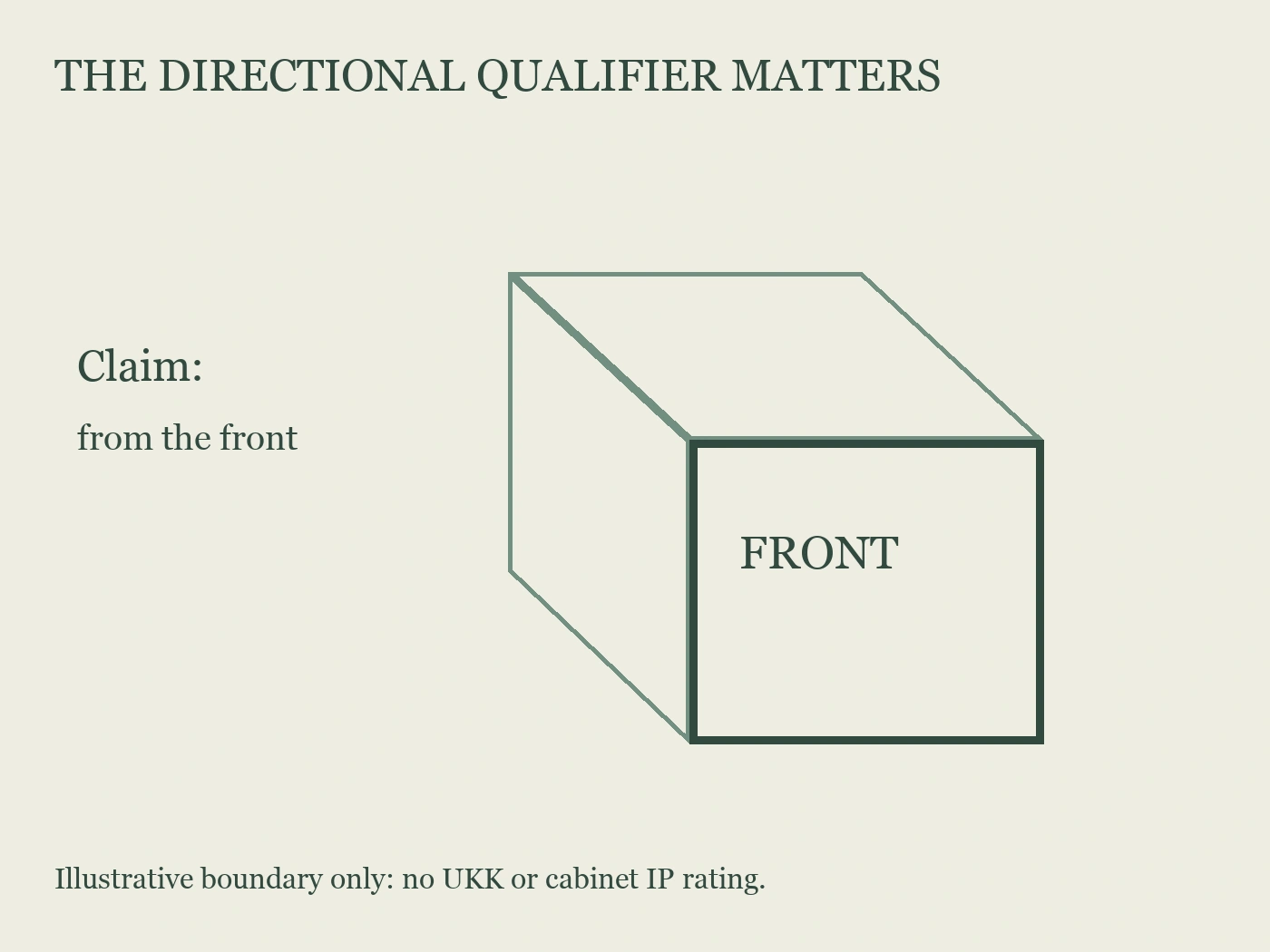
A clear objective prevents a narrow component claim from being used as a broad cabinet claim. Protection at the block's front face, for example, does not automatically describe every direction, adjacent component or enclosure opening.
Read the qualifier attached to the protection statement
Schneider Electric's official enclosed distribution-block page describes its identified product family as finger-safe from the front according to IP20. The directional qualifier is part of the statement. It does not establish the rating of a UKK block, nor does it approve an entire panel assembled around another manufacturer's component. Schneider Electric, IEC enclosed power distribution blocks.
The useful reading method is to preserve such qualifiers when preparing a requirement or work instruction. Record the model, configuration, relevant direction and applicable accessory conditions. Do not shorten the source to “all covered blocks are finger-safe.”
If a test report is provided, identify what was evaluated and which standard or method it references. The qualified designer or compliance reviewer should determine its applicability to the project. This guide does not assign a test probe, test force or compliance result to an undocumented product.
Also keep the report's identity distinct from a sales statement. A catalogue can guide selection, but a requested compliance record may require more precise model identification and conditions. Ask for clarification rather than silently filling gaps from the shape of the component.
Inspect the installed state in the documentation
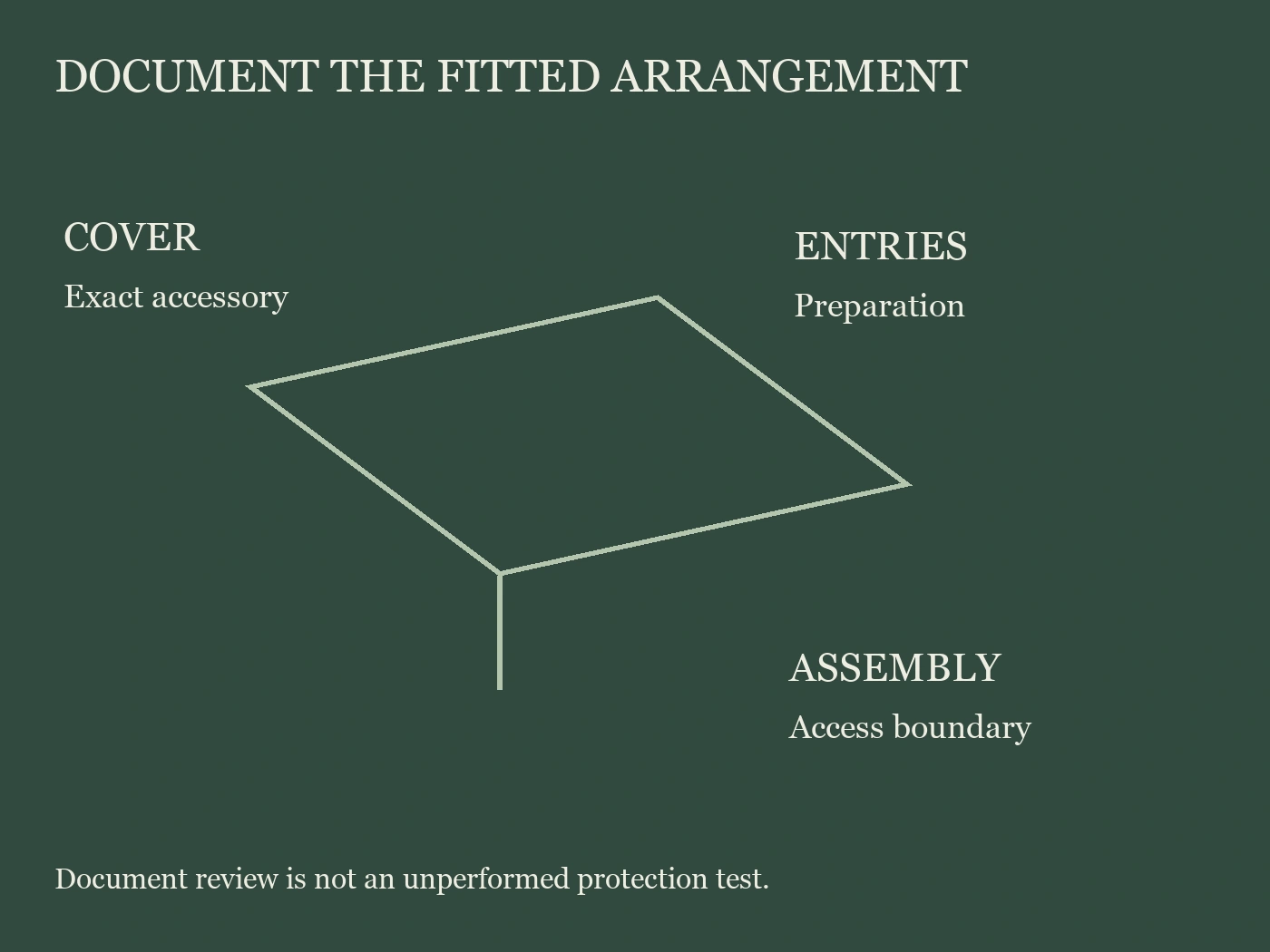
The installed arrangement should be described before its conformity is checked. Identify the exact cover, block, conductor-entry arrangement and any end pieces or joining accessories. A drawing should make clear which conductive parts are enclosed and which access routes remain relevant to the required protection boundary.
Conductor preparation is part of that arrangement. Ask for the applicable stripping and insertion instructions, and define inspection criteria that follow them. Do not assume a closed cover corrects an incorrectly prepared conductor or a partially inserted connection.
The number and position of fitted conductors can also change the physical arrangement under review. Record unused entries, the proposed branch schedule and any required accessories. If the manufacturer's protection claim depends on conditions that are not stated, request the missing instruction before accepting the assembly.
Joining several single-pole blocks deserves its own drawing. The same product may be arranged differently depending on the panel design. A claim for one component should not be expanded to an assembled bank without reviewing the applicable requirements and documented configuration.
Keep this as a qualified document and conformity review. Do not improvise a touch test on an energized assembly or insert an object into a terminal to imitate a laboratory test. Any required inspection or verification must use the approved procedure and equipment state.
What the UKK product page does and does not say
Şu RITOKS UKK series power distribution block page documents a transparent cover, model-specific incoming and branch conductor ranges, output counts and mounting arrangements. It gives a useful starting point for a panel wiring and component enquiry.
The public page does not establish a model-specific touch-protection test result or an IP rating for the completed wired installation. A transparent cover allows connection inspection as a construction feature, but its appearance should not be promoted into an unverified finger-safe claim.
Send the required UKK model, branch schedule, installation drawing and touch-protection objective with the enquiry. Request the applicable cover instructions and protection evidence for the exact configuration. If the information is unavailable, record the requirement as unresolved rather than copying another family's rating.
The supplier-listed voltage wording on the UKK page is also a separate matter. It should not be treated as proof that an unspecified touch-protection standard has been met. Product ratings, insulation construction and access protection need their own appropriate evidence.
Keep fault ratings separate from access protection
Touch protection addresses a different question from short-circuit capability. A block may need both kinds of review, but evidence for one does not close the other. A cover's appearance is not proof of a short-circuit current rating, and a fault-rating document does not itself establish safe access around the wired block.
The short-circuit review requires the exact component, assembly conditions and applicable protective-device coordination evidence. The touch-protection review requires the documented access boundary and installed configuration. Place both requirements in the project checklist when relevant, with separate dispositions.
This distinction helps procurement avoid a vague request for “a safe covered block.” State the required electrical ratings and protection objectives separately so the supplier can identify which documentation is available. Keep unsupported items visible instead of treating a broad marketing word as a complete answer.
It also prevents an inspection overclaim. An inspector confirming that the lid is fitted has recorded a physical condition. That observation should be compared with the approved installation criteria, not reported as a laboratory protection test or comprehensive compliance approval.
Use a conditional cover-review example
Consider a fictional panel purchase specifying a covered distribution block. The submitted photograph shows a clear lid, and the quotation calls the part “protected.” The review file contains no precise protection claim, applicable test evidence or drawing of the fitted conductors.
The reviewer should first clarify the project's actual requirement. If the manufacturer then supplies evidence for the exact model and arrangement, the design team can compare that configuration with the intended installation. The assembly inspection can subsequently check conformity to the approved instructions.
If the only available evidence remains a photograph, the protection requirement is not closed. The team may need additional documented accessories, an appropriately specified alternative or a revised assembly design. It should not issue a rating merely because the lid looks similar to a product with a known rating.
This example is a document-review exercise. It assigns no test result or protection rating to UKK and describes no actual RITOKS installation. The conclusion depends on evidence obtained for the selected component and project.
Build the verification record around the actual arrangement
The following record supports both the design review and production handoff. It should be completed using applicable documents rather than informal assumptions.
| Record item | Required detail | Acceptance boundary |
|---|---|---|
| Component identity | Block order code and manufacturer | Only that identified component |
| Cover and accessories | Exact references and fitted arrangement | No assumed equivalent accessory |
| Protection claim | Stated level, direction and conditions | Qualifiers remain attached |
| Evidence reference | Applicable report or declaration | Model and configuration match |
| Conductor schedule | Entry position and preparation requirement | Actual wiring follows approved instruction |
| Assembly drawing | Grouping, surrounding access and enclosure context | Component claim not enlarged without review |
| Inspection result | Conformity to defined criteria | Not described as an unperformed laboratory test |
| Open requirement | Missing evidence and responsible decision | No blanket approval while unresolved |
A good record makes changes easier to evaluate. If the cover, block, conductor preparation or grouping changes, the reviewer can identify which evidence needs reconsideration. Without that structure, a previous approval may be incorrectly treated as applying to any later arrangement.
Retain the approved documents with the panel's manufacturing file. A substitute cover or block should not enter production solely on appearance or nominal current. The replacement must support the actual protection requirement and connection arrangement.
Record an absent or damaged cover as the actual observed condition, not as an intact component with a paperwork exception. If the approved arrangement requires that cover, the deviation needs an authorized disposition before conformity can be reported. Similarly, an inspection photograph should show the relevant installed state rather than a loose demonstration sample. This distinction lets the reviewer separate component documentation from assembly evidence and prevents a catalogue image from standing in for an inspection that was never performed.
Sık Sorulan Sorular
Does a transparent cover prove finger-safe construction?
No. It establishes a visible cover feature. Obtain the exact manufacturer's protection statement and applicable conditions before assigning a protection claim.
Can another enclosed block's IP rating be applied to UKK?
No. The Schneider source concerns its identified family and limits its statement to the front. It is not evidence of a UKK rating or an entire panel's protection.
Is touch protection the same as short-circuit capability?
No. Keep their requirements and evidence separate. Neither a cover nor a fault-rating document automatically establishes the other characteristic.
What should quality inspectors record?
Record conformity to the approved model, cover, wiring and installation criteria. Do not call a visual cover check a protection test or claim functions outside the inspection scope.
Kaynakça
- Schneider Electric. (n.d.). IEC enclosed power distribution blocks. Official family statement and directional protection qualifier. Retrieved October 3, 2026. https://www.se.com/ca/en/product-range/63503-iec-enclosed-power-distribution-blocks/
- RITOKS. (n.d.). UKK series power distribution blocks. Published cover and connection arrangement scope, checked October 3, 2026. https://ritoks.com/products/ukk-series-power-distribution-blocks-80a-400a/