
Miniature Circuit Breakers (MCB) · Technical Explainer
MCBs for LED Lighting: Check Inrush Before Increasing the Trip Curve
Quick answer
Before replacing an LED lighting MCB with a different trip curve, identify the operated device and review the exact driver's startup data, simultaneous driver count and manufacturer's breaker coordination guidance. Any proposed change also needs the circuit's cable and fault-protection checks. Normal running wattage alone does not establish startup compatibility.
A lighting circuit that opens when switched on presents a diagnostic question, not an automatic instruction to install a larger breaker. Purchasing needs to distinguish a documented startup limitation from an overloaded circuit, another protection function or an installation fault. The selected remedy should address the supported cause while retaining the required protection.
Schneider Electric's LED circuit-breaker guidance identifies transient driver startup current as a possible cause of tripping. The task here is narrower than a general B/C/D comparison: assemble the driver-to-breaker evidence for the actual lighting branch, then decide whether the offered combination is acceptable.
Record what actually opened the circuit
Start the investigation with the operated device, event timing and circuit arrangement. A reported lighting failure is not proof that the MCB's instantaneous mechanism operated. Record whether opening occurred during energization or after sustained operation and identify any other protective device that acted. Let qualified personnel determine the cause from the available evidence.
Ask the site team for the device reference and the observable indication, rather than a message such as "the lights trip." A branch can contain separate overcurrent and residual-current protection, upstream devices and a lighting control device. A description that combines their functions can send the procurement review toward the wrong component.
Record which group was being switched, how many drivers were connected to that group and whether other groups were energized at the same time. Include the supply and switching arrangement as shown on the approved drawing. Note whether the event follows ordinary operation, restoration after a supply interruption or a particular control sequence. These distinctions define the condition that the proposed solution must cover.
Do not repeatedly energize a suspected faulty circuit to collect convenient observations. The investigation and any measurements belong to qualified personnel following the site procedure. The buyer's job is to obtain a clear record of the reviewed event and route missing technical information to the designer and component suppliers.
Read peak current, pulse width and driver count together
LED-driver startup information should be tied to an exact order code and its stated test conditions. Review peak current and pulse duration together with the manufacturer's supported breaker count or coordination guidance. Keep input running current separate from output power. Different fields answer different parts of the branch-circuit review.
For example, Signify's Xitanium 42W/a 0.15-1.05A 42V MC 3CB product data lists input current, inrush peak, a pulse-width definition and a maximum count for a stated MCB condition. It is evidence that those fields can be specified together, not a compatibility statement for a RITOKS breaker or another driver.
Build the information request around the actual luminaire or driver being purchased:
| Alan | What the buyer should request | What it does not establish alone |
|---|---|---|
| Exact driver identity | Order code, revision and intended input supply | Compatibility of a different driver from the same brand |
| Running input current | Applicable operating condition and tolerance | Startup pulse behavior |
| Inrush peak | Value and measurement conditions | Pulse duration or allowed driver count |
| Pulse width | Definition used and corresponding startup waveform | A universal breaker trip threshold |
| Supported MCB combination | Breaker details, count limit and assumptions | Permission to transfer the count to another series |
| Switching group | Number energized together and switching method | All possible restoration or emergency sequences |
Keep wattage in the record, but use the input information needed by the circuit designer. The driver output rating is not a substitute for the manufacturer's input-current data. A lighting schedule that lists only luminaire watts can leave the startup review incomplete even when its total appears comfortably below the branch's ordinary running demand.
Use coordination evidence instead of a curve-letter shortcut
The trip curve is one part of the review, not a complete startup coordination statement. Ask for manufacturer guidance that applies to the actual breaker, driver and simultaneous count. If the offered count is qualified by a particular breaker condition, preserve that qualification in the purchasing record rather than reducing it to "LED compatible."
Schneider Electric's LED constraints guidance distinguishes short startup pulses from the durations represented by standardized tripping curves. Its advice is to follow manufacturer selection guidance. That supports a document-led review; it does not justify estimating acceptable driver count by comparing only a stated peak with a familiar curve multiplier.
Ask whether the coordination document covers the installation's normal switching group and its restoration behavior. A design that switches several groups separately during ordinary operation may energize them together after a supply interruption. If the acceptance assumption depends on sequencing, the controls documentation should show how that sequence is maintained in the reviewed operating cases.
Avoid multiplying one driver's peak current by a count and presenting the result as a verified branch waveform. Such a calculation can be a screening assumption, but it does not replace the manufacturer's stated method or an authorized assessment of the actual supply and switching condition. Label assumptions as assumptions so they do not become unsupported approval evidence.
Mevcut B/C/D MCB comparison is useful background for curve terminology. This lighting task needs the additional driver data and installation review. Do not treat the general comparison as a maximum-luminaire schedule for a specific branch.
Recheck protection before accepting a different breaker
A proposed breaker change should return to the circuit designer for review of the protected conductors, available fault conditions and required disconnection performance. Startup tolerance does not remove those obligations. The final record should distinguish an accepted driver count from an approved protective-device selection and identify the supporting documents for both.
A higher current rating changes more than the startup question. A different curve likewise needs an assessment of how the circuit meets its protection requirements. The person responsible for the installation must determine the relevant criteria and verify them for the actual branch; a purchasing checklist cannot replace that design work.
Use the following decision record to prevent an inrush remedy from becoming an unreviewed protection change. The rows are proposed review actions, not technical acceptance limits:
| Proposed response | Startup evidence to obtain | Other review that remains necessary |
|---|---|---|
| Retain the offered combination | Exact supported driver count and operating assumptions | Ordinary load and branch protection verification |
| Change the MCB curve | Applicable driver/breaker coordination evidence | Fault and disconnection assessment for the revised device |
| Increase the MCB current rating | Reason the revised combination is required | Conductor protection and complete circuit reassessment |
| Split the switching group | Documented group count and restoration sequence | Revised circuit/control drawings and protection review |
| Use an inrush-control arrangement | Compatibility instructions for the actual control and drivers | Switching duty, failure behavior and installation requirements |
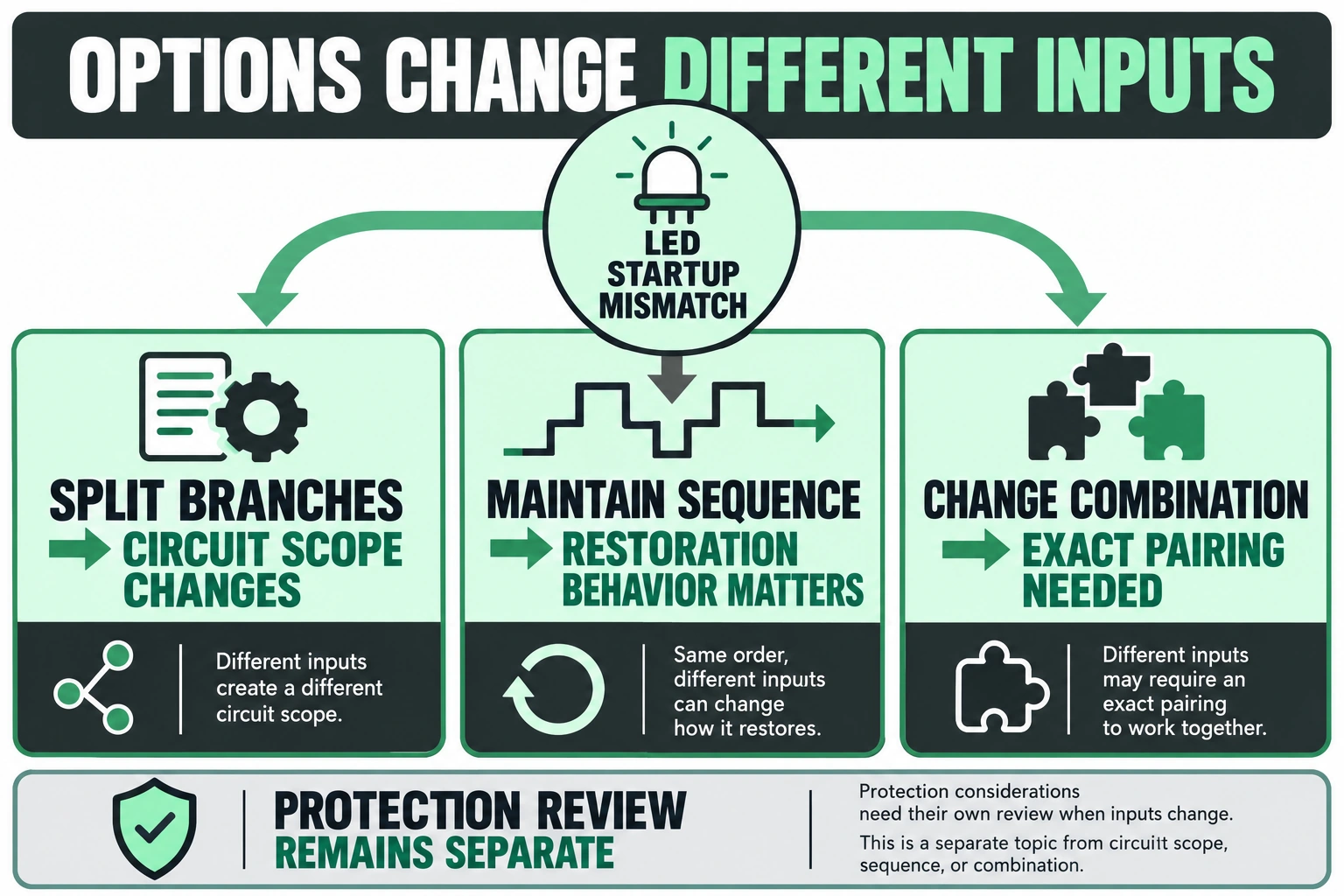
A supplier may propose more than one response. Compare them against the same reviewed condition. A solution that works only when an operator switches groups in a particular order is different from one designed for the recorded restoration sequence. Put that distinction into the decision, rather than hiding it in commissioning notes.
A conditional LED retrofit document review
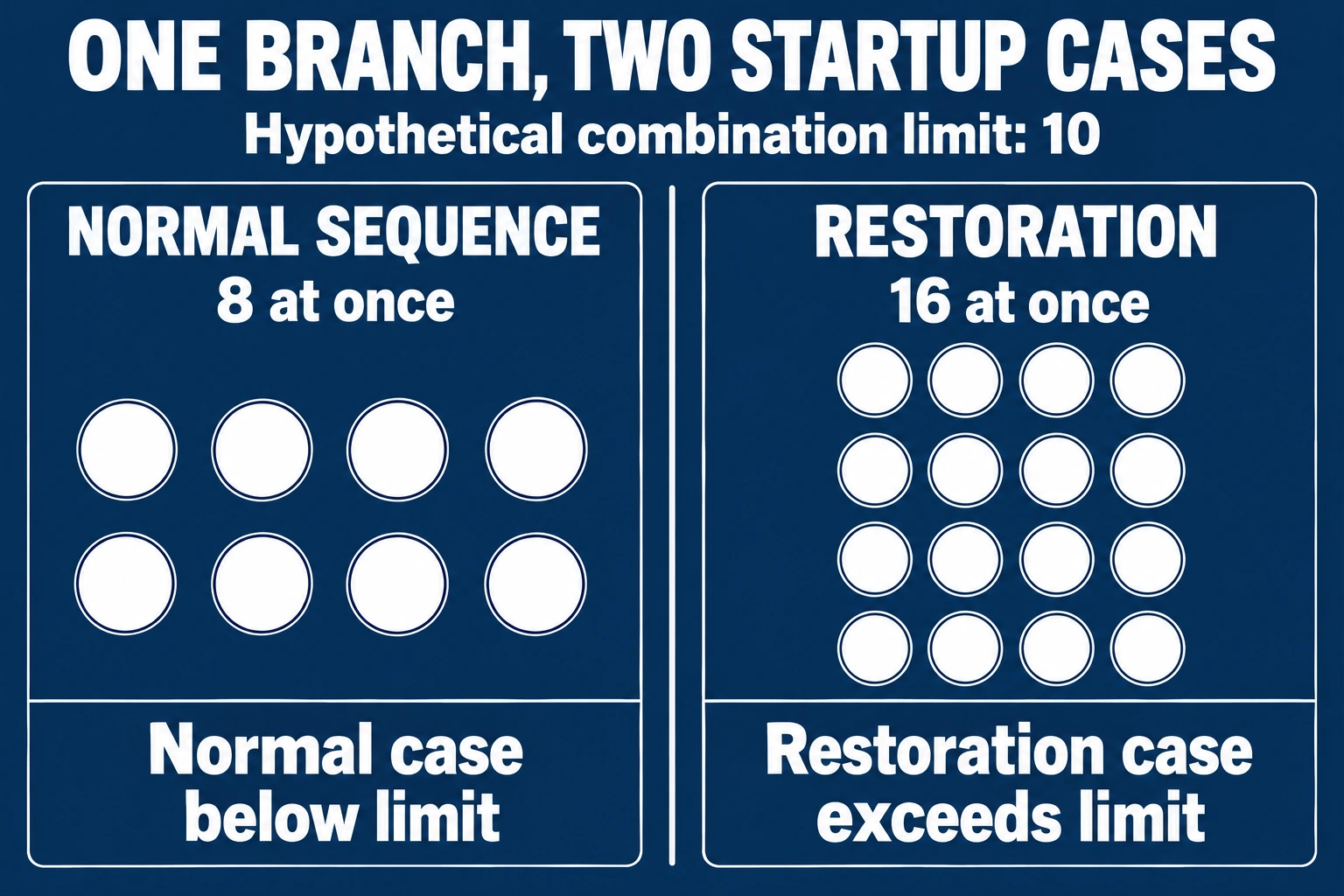
Assume a hypothetical retrofit proposes sixteen identical drivers, labelled D1 in its schedule, on a branch protected by exact breaker B1. Also assume a manufacturer document for that precise combination permits ten drivers energized together under its stated conditions. These invented counts are a teaching exercise, not Signify limits, RITOKS compatibility data or an approved circuit. They illustrate how to read a scoped count without calculating a guessed startup waveform.
During ordinary operation, the controls energize two groups of eight. The first filled record reads “normal sequence: eight drivers per switching event, below the assumed ten-driver limit; sequence conditions still to be matched to the document.” After a supply interruption, however, the proposed controls restore both groups together. The second reads “restoration: sixteen drivers simultaneously, above the assumed limit; startup coverage unresolved.” A favourable normal-switching comparison therefore does not close the restoration case.
Three responses have different costs. Dividing the equipment into two reviewed branches changes board space, cabling and circuit documentation but can reduce the count seen by each branch at restoration. A maintained control sequence could address simultaneity within one branch, provided its startup and failure behavior are supported for the actual drivers. Another breaker combination may support the required count, but its conductor, fault and disconnection checks must be reviewed. None is selected solely because a curve letter appears more tolerant.
The buyer's filled enquiry should identify D1, B1, normal group eight, restoration group sixteen and the manufacturer's condition reference. The question is “which documented arrangement covers both operating cases?” rather than “please supply a C curve.” If the offered breaker is actually B2, a different series, the ten-driver statement is not evidence for that offer even if B2 has the same nominal current and curve. The mismatch must be resolved before the count comparison becomes an acceptance basis.
This exercise assumes startup compatibility is the demonstrated issue. An actual switching-time trip still needs the operated-device and qualified diagnostic record; the numbers alone do not establish its cause. Once the design is accepted, keep the exact driver reference and restoration assumptions with the order. A later driver substitution or a control-program change can reopen the review without altering luminaire wattage or external appearance.
Prepare a useful RITOKS enquiry
RITOKS lists compact 1P+N AC MCBs ve economy 1P+N AC MCBs with B/C curve options on their public product pages. The pages provide relevant product-family information, but they do not establish a verified maximum count for the specific LED driver in a proposed lighting branch.
Send the selected MCB configuration with the driver order code and its startup documentation. Describe the simultaneous group and ask for the manufacturer's applicable coordination evidence. Include the designer's required protection criteria and identify any proposed curve or rating change as a change requiring review. A quotation should not imply compatibility merely because lighting appears among the product's applications.
If several AC miniature circuit breaker families are offered, request evidence for the exact alternative. Keep the driver pairing and installation assumptions attached to the technical offer. Commercial availability and technical approval are separate decisions; the enquiry should make that boundary visible.
Approve a lighting branch when its startup combination and its protection design are both supported. Keep the exact driver identity in that approval so a later substitution does not silently change the reviewed condition.
Kaynakça
- Schneider Electric. (n.d.). LED lamps: choice of circuit breaker.
- Schneider Electric. (n.d.). LED lighting: constraints and recommendations.
- Signify. (n.d.). Xitanium 42W/a 0.15-1.05A 42V MC 3CB product data.